



To cut a dragon fruit properly, follow these simple steps:
- Slice: Place the fruit on a cutting board and cut it in half lengthwise using a sharp knife.
- Scoop: Run a tablespoon between the pink skin and the flesh to scoop the meat out in one piece. Alternatively, peel the skin back with your fingers.
- Cube: Discard the inedible skin and chop the flesh into cubes or wedges. Serve chilled.
Dragon fruit, also known as pitaya, is arguably the most photogenic fruit in the produce aisle. With its vibrant, bright pink skin, green scales, and speckled flesh, it looks like something straight out of a fantasy novel.
However, that exotic, spiky appearance can be intimidating. Many shoppers walk right past it simply because they are unsure how to cut a dragon fruit properly or what to do with it once they get it home.
The good news? Despite its fierce name and complex look, dragon fruit is one of the easiest fruits to prepare. It is softer than an apple, less messy than a mango, and requires no specialized tools—just a knife and a cutting board.
In this ultimate guide, we will walk you through how to cut a dragon fruit step by step, explore the differences between the white, red, and yellow varieties, and answer the burning question: what does a dragon fruit taste like?
Whether you are making a smoothie bowl, a tropical fruit platter, or just want a healthy snack, this guide has you covered.
What Is Dragon Fruit? (Quick Overview)

Before we start slicing, it helps to understand what we are dealing with. Dragon fruit is the fruit of several cactus species indigenous to the Americas. Today, it is widely cultivated in Southeast Asia, Florida, the Caribbean, and Australia.
The fruit is technically a berry growing on the Hylocereus cactus, also known as the “Honolulu Queen,” which blooms only at night. The name “dragon fruit” comes from its leather-like skin and prominent scaly spikes, resembling the exterior of a dragon.
Is Dragon Fruit Good for You?
Absolutely. Dragon fruit is a nutrient-dense superfood. It is hydrating, low in calories, and packed with essential vitamins and minerals. It fits perfectly into vegan, paleo, and gluten-free diets.
The Main Varieties
While they may look similar on the shelf, there are distinct types you should know:
- White-Fleshed: Pink skin with white flesh and black seeds. This is the most common and widely available type.
- Red/Pink-Fleshed: Pink skin with deep red or purple flesh. It is generally sweeter and richer in antioxidants (betalains).
- Yellow Dragon Fruit: Yellow skin with white flesh. This variety is the sweetest of them all and has slightly larger seeds.
What Does Dragon Fruit Taste Like?
If you have never tried it, you might expect a flavor explosion matching its loud appearance. However, the taste is surprisingly subtle and delicate.
What does a dragon fruit taste like?
Most people describe the flavor as a cross between a kiwi and a pear, with earthy undertones of watermelon.
- Texture: The flesh is firm yet creamy, similar to a ripe kiwi or watermelon. It is crunchy due to the thousands of tiny edible black seeds, which provide a pleasant pop similar to chia seeds.
- Sweetness: It is mildly sweet, not sugary.
Flavor Differences by Color
- White Dragon Fruit: Mild, slightly bland, and refreshing. It acts as a palate cleanser.
- Red Dragon Fruit: Sweeter and more berry-like. It has a stronger flavor profile than the white variety.
- Yellow Dragon Fruit: The sugar bomb of the family. It has floral notes and a significantly higher sugar content, making it taste almost like honey or lychee.
Why Does My Mouth Hurt After Eating Dragon Fruit?
This is a surprisingly common query: why does my mouth hurt after eating dragon fruit?
If you experience a slight stinging, itching, or burning sensation on your tongue or lips, there are usually two culprits:
- Mild Oral Allergy Syndrome (OAS):
Some people have a sensitivity to dragon fruit proteins. If you are allergic to pollen or latex, your body might mistake the proteins in the fruit for an allergen. This usually results in a tingle or itch. If your throat feels tight or you have trouble breathing, stop eating immediately and seek medical help. - Calcium Oxalates:
Like pineapples and kiwis, dragon fruits contain natural organic acids and microscopic crystals called oxalates. In high amounts, these can cause a “cutting” sensation on the tongue. - Phytochemical Sensitivity:
The seeds contain oils and proteins that might irritate sensitive gums if chewed thoroughly.
Pro Tip: If the sensation is mild, drinking water or eating a piece of bread usually clears it up quickly.
Tools & Preparation Before Cutting a Dragon Fruit
You don’t need a machete to tackle this dragon. The skin is surprisingly soft—softer than an orange peel.
Essential Tools
- Chef’s Knife or Paring Knife: A sharp chef’s knife is best for halving the fruit, while a paring knife is great for peeling if you choose that method.
- Cutting Board: Since red dragon fruit can stain, use a plastic or glass board rather than a porous wooden one if you are cutting the red variety.
- Spoon: For the “scoop” method (the easiest way to eat it).
How to Prepare Dragon Fruit to Eat
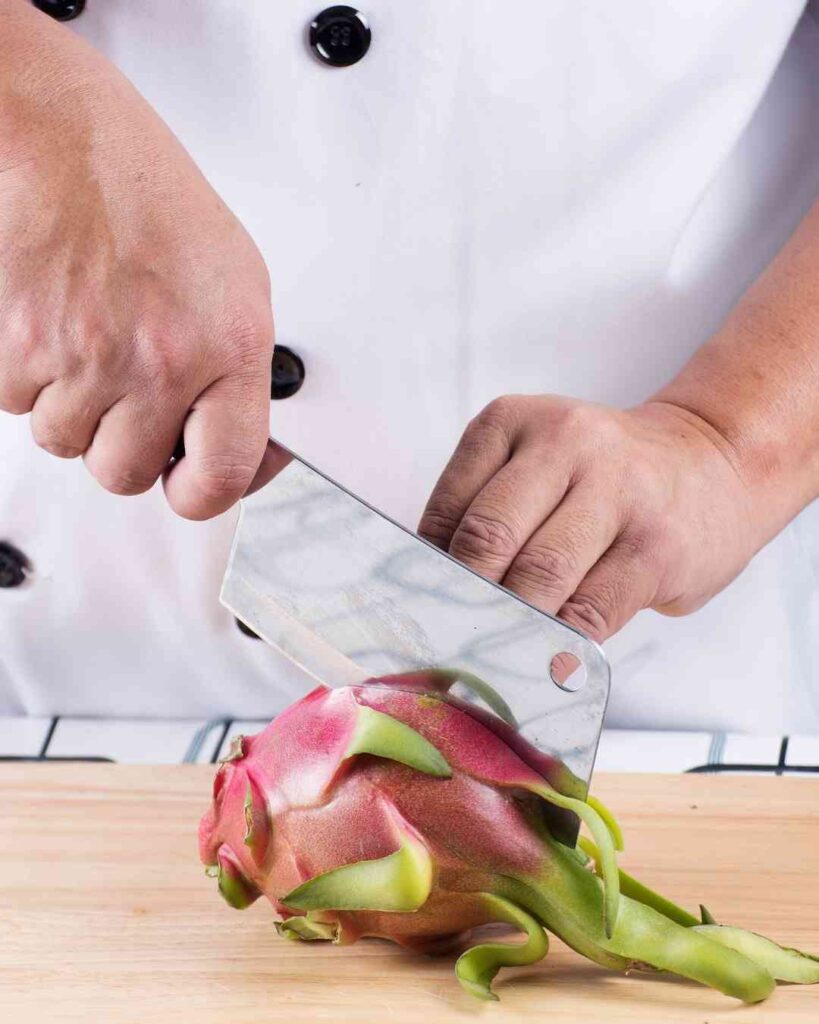
- Check for Ripeness: A ripe dragon fruit should have bright, even-colored skin. Press the skin gently with your thumb; it should give slightly, like a ripe avocado or mango. If it’s rock hard, let it sit on the counter for a few days. If it’s mushy or has many dark splotches, it’s overripe.
- Wash the Fruit: Even though you don’t eat the peel, you should wash the exterior. When your knife slices through the skin, it can drag bacteria from the outside into the flesh. Rinse it under cold water and pat dry.
How to Cut a Dragon Fruit (Step-by-Step Method)
This is the core method that works for 90% of recipes and snacking needs. Whether you are searching for how to cut a dragon fruit easy or how to cut a dragon fruit step by step, this is the fail-safe technique.
Step 1 – Cut Dragon Fruit in Half
Place the dragon fruit on your cutting board. Locate the woody stem at the top. You don’t need to cut this off first.
- Hold the fruit steady with your non-dominant hand.
- Take your sharp knife and slice straight down through the center, from the stem to the bottom.
- The fruit should yield easily. You will now have two identical halves exposing the white or red flesh.
Step 2 – Separate the Flesh from the Skin
There are two main ways to do this: the Peel Method and the Scoop Method.
- The Scoop Method (Easiest): Take a tablespoon and slide it between the pink skin and the edible flesh. Curve the spoon around the edges to detach the meat. The entire chunk of fruit should pop out in one piece, leaving a clean “bowl” of skin behind.
- The Peel Method: If you want perfect cubes, place the fruit, half cut-side down on the board. Use your fingers to peel back the pink skin. It usually tears away easily, similar to peeling a banana, but in larger sheets.
Step 3 – Slice, Cube, or Scoop
Now that you have the naked fruit flesh on your board:
- Cubes: Cut the flesh into 1-inch strips lengthwise, then rotate and cut crosswise to create cubes. This is perfect for fruit salads (see keywords: how to cut a dragon fruit up).
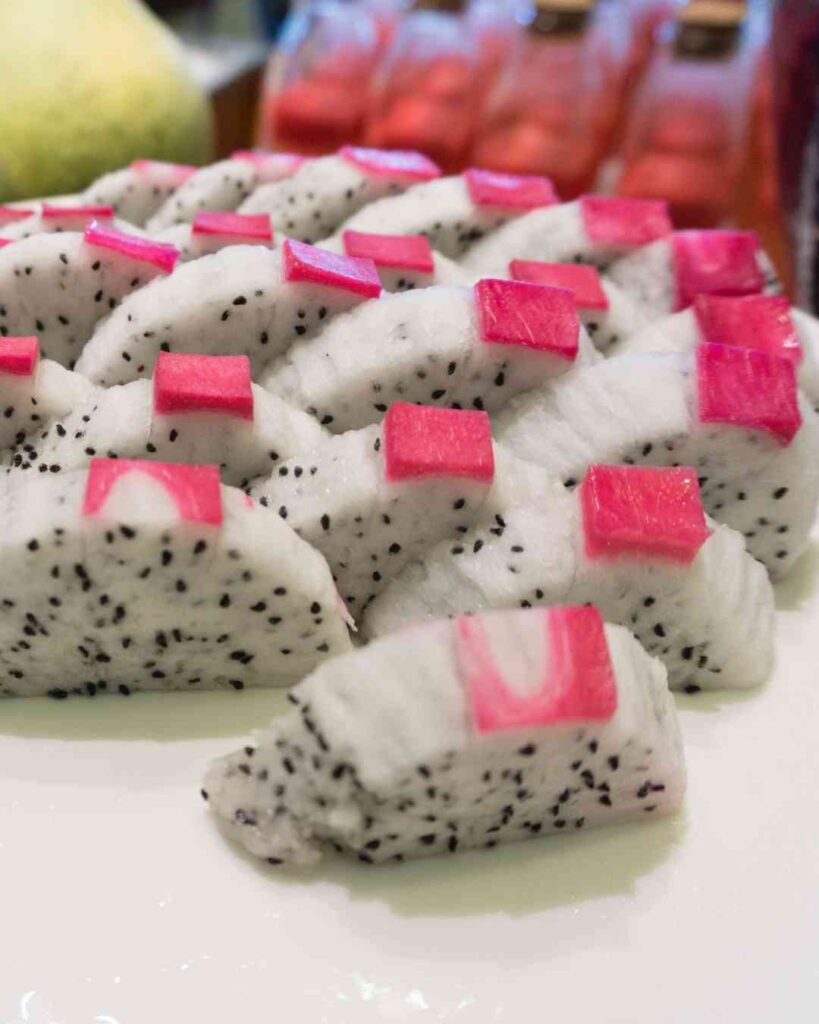
- Slices: Cut the flesh into thick half-moon slices.
- Spheres: Before removing the flesh from the skin, use a melon baller to scoop out perfect little spheres.
How to Cut and Eat Dragon Fruit
There is a difference between preparing fruit for a recipe and just wanting a snack right now. If you are wondering how to eat a dragon fruit instantly, you don’t even need to remove the skin.
The “Kiwi” Method (Spoon Method)
This is the best way to eat dragon fruit for a quick breakfast or snack.
- Slice: Cut the fruit in half lengthwise.
- Scoop: Hold one half in your hand like a bowl. Use a spoon to dig out the flesh and eat it directly from the skin.
- Discard: Throw away the empty skin shell.
The “Wedges” Method (Like an Orange)
- Cut the fruit in half.
- Cut each half again to make quarters.
- You can now bite the flesh right off the skin, or peel the skin back halfway to keep your fingers clean. This is great for kids’ lunchboxes.
Note: The skin is not edible. It is tough, bitter, and indigestible. While not toxic, it is certainly not pleasant. Always discard the pink/yellow rind.
How to Cut Dragon Fruit by Color (Type-Specific Guides)
While the general method applies to all, each color has slight nuances in texture and skin thickness.
How to Cut a Dragon Fruit White
The white-fleshed variety is the standard. Its skin is usually moderately thick. The flesh is firm, so it holds up well to cubing.
- Best Cut: Cubes or melon balls. The high contrast between the white flesh and black seeds looks stunning in salads.
How to Cut a Dragon Fruit Red
Red dragon fruit (often labeled as Pitaya Roja) has a softer, juicier texture and intensely pigmented juice.
- Warning: The red juice acts like a dye. It will stain wooden cutting boards, clothes, and porous countertops pink.
- Best Cut: Slice it directly into a blender for smoothies, or cut into large wedges. If cutting cubes, rinse your hands immediately after to avoid pink fingertips.
- Pro Tip: If serving red dragon fruit, do not mix it with light-colored fruits (like bananas or apples) until the last minute, or everything in your fruit salad will turn pink.
How to Cut a Dragon Fruit Pink
Pink-fleshed dragon fruit is a hybrid, often sweeter than the white but firmer than the red.
- Best Cut: Slices or wedges. The color is beautiful and appetizing without being as messy as the deep red variety.
How to Cut a Dragon Fruit Yellow
How to cut a dragon fruit yellow requires a slightly different approach.
- The Thorns: Yellow dragon fruit sometimes still has small thorns or prickly knobs on the skin. Handle with care.
- The Skin: The skin is thicker and tougher than the red/pink varieties.
- The Method: It is best to slice the ends off first to create a stable base. Stand the fruit up and slice the skin off downwards with a knife (like peeling a pineapple), rather than trying to peel it with your fingers. The flesh is very soft and sweet, so handle it gently to avoid squishing it.
How to Cut a Dragon Fruit for Serving & Presentation
If you are hosting a party, you want the fruit to look as good as it tastes. Here is how to cut a dragon fruit for a fruit platter to impress your guests.
1. The Dragon Fruit Boat
This is a classic resort-style presentation.
- Cut the fruit in half lengthwise.
- Run a spoon around the edge to loosen the flesh, but do not remove it yet.
- Slice the flesh into cubes while it is still inside the skin (be careful not to pierce through the bottom skin).
- Gently push on the bottom of the skin to invert the cubes slightly, or use a fork to stagger them.
- Serve the cubes inside their own pink “boat.”
2. Half-Moon Slices
Leave the skin on. Slice the fruit into rounds (discs), then cut those in half. The bright pink rim of the skin contrasts beautifully with the white or red flesh. (Remind guests not to eat the skin.)
3. Cookie Cutter Shapes
Peel the fruit and slice the flesh into thick slabs (about 1/2 inch). Use small star or heart-shaped cookie cutters to punch out shapes. This is a hit for children or romantic breakfasts.
How to Open Dragon Fruit Without a Knife
Caught on a picnic without tools? You can still open it. This answers the query how to open dragon fruit in a pinch.
The “Banana Peel” Method:
This only works if the dragon fruit is very ripe.
- Locate the opening at the top of the fruit (the stem end).
- Dig your thumb into the soft spot near the stem to break the skin.
- Pull the skin downwards in strips, just like peeling a banana.
- Once peeled, you can bite into the fruit like an apple. It’s messy, but effective!
Dragon Fruit Benefits (Health & Nutrition)
Beyond its looks, is dragon fruit good for you? The nutritional profile suggests it is one of the best fruits you can eat.
Dragon Fruit Nutrition Facts
Here is the breakdown for a typical 6-ounce serving (approx. 170g):
| Nutrient | Amount |
| Calories | 102 |
| Protein | 2 grams |
| Carbohydrates | 22 grams |
| Fiber | 5 grams (High!) |
| Sugar | 13 grams |
| Vitamin C | 9% of RDI |
| Magnesium | 18% of RDI |
| Iron | 8% of RDI |
Top Dragon Fruit Benefits
- Promotes Gut Health: The high fiber content acts as a prebiotic, feeding the healthy bacteria (probiotics) in your gut. This aids digestion and can prevent constipation.
- Boosts Immunity: High levels of Vitamin C and carotenoids help strengthen your immune system and prevent infection.
- Rich in Antioxidants:
- Betalains: Found in red dragon fruit, these combat oxidative stress and may suppress cancer cells.
- Hydroxycinnamates: Known for anti-cancer properties.
- Flavonoids: Linked to better brain health and reduced heart disease risk.
- Boosts Iron Levels: It is one of the few fresh fruits that contain iron. The Vitamin C in the fruit also helps your body absorb that iron efficiently.
- Weight Management: Low-calorie density + high fiber = feeling full longer. This makes it an excellent snack for weight loss.
Best Way to Eat Dragon Fruit
Once you have mastered how to cut a dragon fruit, the culinary possibilities are endless.
- Raw & Chilled: The texture is best when cold. Keep your dragon fruit in the fridge before cutting.
- Dragon Fruit Smoothie Bowl: Blend frozen red dragon fruit packets or fresh cubes with banana and almond milk. The result is a vibrant, neon-pink base. Top with granola and coconut.
- Salads: Toss cubes into a salad with spinach, walnuts, and a vinaigrette. The mild sweetness balances salty nuts and cheese.
- Agua Fresca: Blend the flesh with water, lime juice, and a touch of agave. Strain out the seeds if you prefer (though they are healthy!).
- Salsa: Dice it finely and mix with onions, cilantro, jalapeño, and lime juice. Serve over grilled fish or tacos.
Common Mistakes When Cutting Dragon Fruit
Even experienced cooks make these errors. Avoid them to get the best experience.
- Cutting Unripe Fruit: If the fruit is hard as a rock, it will be flavorless and difficult to peel. Wait until it gives to the touch.
- Eating the Skin: Never eat the skin. It can contain pesticide residue and is tough to digest.
- Ignoring the Stem: Always check the stem end for mold. Since moisture gathers there, it’s the first spot to rot. If the stem is shriveled and dry, that’s fine. If it’s mushy or fuzzy, cut that part away generously.
- Leaving it Out After Cutting: Once cut, dragon fruit flesh oxidizes and gets mushy quickly. Store it in an airtight container in the fridge for up to 2 days, but no longer.
Video Guide – How to Cut a Dragon Fruit
Video 1:
- Title: How to Cut Dragon Fruit
- Creator: White On Rice Couple (Reputable food bloggers)
- URL: Video Link
- Why this video: It is short, professionally shot, and demonstrates the “halve and peel” method clearly, which matches the steps in your article.
Video 2:
- Title: How to Cut Dragon Fruit (Pitaya)
- Creator: F.N. Sharp
- URL: Video Link
Why this video: A very recent, high-definition guide that focuses specifically on safe knife handling and multiple cutting styles (wedges, cubes).
Frequently Asked Questions (FAQ)
Here are quick answers to the most searched questions about dragon fruit preparation.
How do you cut a dragon fruit?
Simply cut it in half lengthwise, scoop out the white or red flesh with a spoon, and discard the pink skin. Slice the flesh into cubes or wedges.
How do you properly cut a dragon fruit?
For a proper clean cut, slice off both ends (stem and bottom), cut a slit down the side of the skin, and peel the skin off the whole fruit. Then, slice the naked cylinder of fruit into discs or cubes.
What’s the correct way to eat dragon fruit?
There is no single “correct” way, but the most common method is eating it raw. You can scoop it, slice it, blend it, or freeze it. The seeds are edible and should be eaten with the flesh.
What does a dragon fruit taste like?
It tastes like a mild cross between a kiwi and a pear. The texture is crunchy (seeds) and creamy (flesh). Red varieties are sweet/berry-like; white varieties are mild; yellow varieties are very sweet.
Is dragon fruit good for you?
Yes. It is rich in magnesium, iron, Vitamin C, and fiber. It is excellent for digestion, immune support, and lowering inflammation.
Can you eat dragon fruit skin?
No. Dragon fruit skin is tough, bitter, and not meant to be eaten. It may also hold pesticide residues. Always discard the skin.
How do you store cut dragon fruit?
Store cut cubes in an airtight container in the refrigerator. They are best eaten within 24–48 hours. If you wait longer, the texture becomes mushy and the flavor ferments.
Final Thoughts
Now that you know how to cut a dragon fruit properly, there is no reason to walk past this exotic beauty in the grocery store. Whether you choose the mild white variety or the sweet yellow one, dragon fruit is a simple, healthy, and delicious addition to your diet. Grab a knife, slice it open, and enjoy the tropical taste of one of nature’s coolest fruits.
Authoritative References
1. On Nutrition Facts (Calories, Fiber, Vitamins)
- Dragon fruit is low in calories, high in fiber, and contains magnesium and iron. U.S. Department of Agriculture (USDA) FoodData Central, “Dragon Fruit, Raw.”
2. On Gut Health & Prebiotics
- Dragon fruit contains oligosaccharides that act as prebiotics, feeding healthy gut bacteria and potentially aiding digestion. Wichienchot, S., et al. (2010). Oligosaccharides of pitaya (dragon fruit) flesh and their prebiotic properties.” Food Chemistry.
3. On Antioxidants (Betalains)
- Claim: Red dragon fruit contains betalains, a pigment with strong antioxidant properties that combat oxidative stress. National Institutes of Health (NIH) / PubMed, “Betalains: A Narrative Review on Pharmacological Mechanisms Supporting the Nutraceutical Potential Towards Health Benefits.”
4. On Mouth Irritation (Calcium Oxalates)
- The “cutting” or stinging sensation some people feel is often due to calcium oxalate crystals (raphides), which are also found in kiwi and pineapple. Children’s Hospital of Philadelphia, “Plants That Irritate.”
5. On Oral Allergy Syndrome (OAS)
- An itchy mouth can be a sign of Oral Allergy Syndrome, where the body mistakes fruit proteins for pollen. American Academy of Allergy, Asthma & Immunology (AAAAI), “Oral Allergy Syndrome (OAS).”