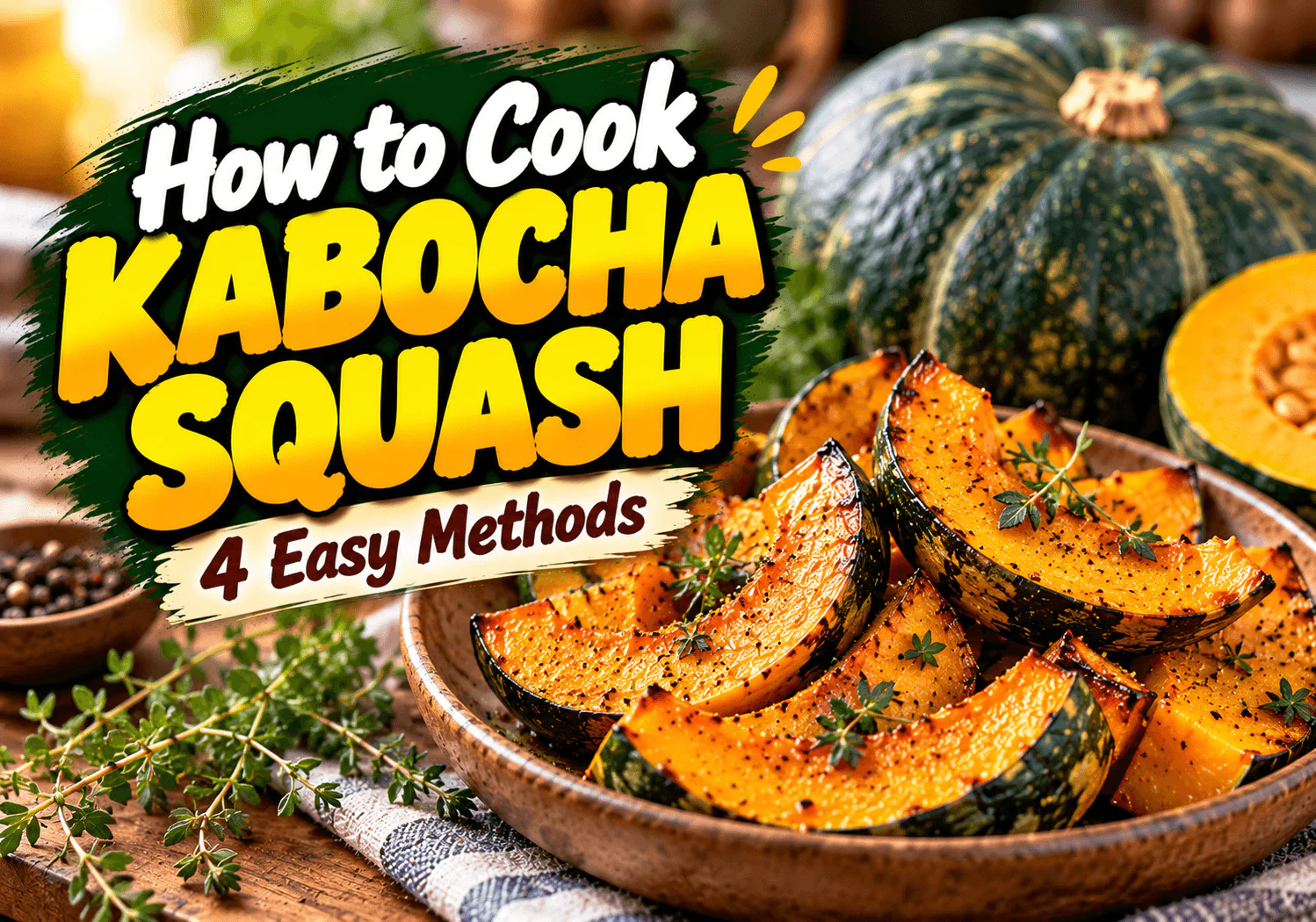
Kabocha looks intimidating: a squat, dark green squash with a rock-hard rind. But inside is some of the sweetest, creamiest flesh of any winter squash, and you don’t even have to peel it. In this guide, you’ll learn how to cook kabocha squash four easy ways: roasted, steamed, simmered Japanese-style, and microwaved. You’ll also learn how to cut it safely, how to pick a ripe one, what it offers nutritionally, and a few safety points to know before you start.
Key Takeaways
- Peeling is optional. Kabocha’s green skin softens when cooked, so most people leave it on.
- Best all-round method: roast wedges at 425°F for 25–30 minutes.
- Fastest method: microwave or steam chunks for 6–15 minutes.
- Cut it safely: microwave the whole squash for 2–3 minutes first to soften the rind.
- Nutrition: kabocha is rich in carotenoids, and research found its levels can be higher than butternut squash.
- Cook it with a little fat to help your body absorb those carotenoids, and throw away any squash that tastes bitter.
What Is Kabocha Squash?
Kabocha is a Japanese variety of winter squash, often called Japanese pumpkin. It belongs to Cucurbita maxima, the same species as buttercup and hubbard squash. Most kabocha are round and slightly flattened, weigh 2 to 4 pounds, and have dark green, sometimes blue-gray, bumpy skin with pale stripes.
Oregon State University Extension describes kabocha flesh as having “the consistency, flavor and sweetness of sweet potatoes,” with nutty notes like chestnut and almond. Because the flesh is dense and fairly dry, it holds its shape well in stews and curries. OSU notes that kabocha works in any recipe calling for butternut or acorn squash.
For a side-by-side look at how kabocha compares with other varieties, see our winter squash guide.
Can you eat kabocha squash skin?
Yes. Unlike butternut or spaghetti squash, kabocha’s thin green rind becomes tender when roasted, steamed or simmered, and it’s completely edible. Many Japanese recipes leave it on for color and texture. If the skin has rough, scarred or discolored patches, simply trim those spots with a knife.
What does kabocha taste like?
Expect a rich, sweet flavor that sits between sweet potato and pumpkin, with a nutty, almost chestnut-like finish. The texture is fluffy and starchy rather than watery, which is why kabocha mashes and roasts so well.
Kabocha Squash Nutrition at a Glance
USDA FoodData Central doesn’t have a separate kabocha entry, so the closest official data come from winter squash, all varieties, baked, without salt [VERIFY ID]. One cup of cubes (about 205 g) provides:
| Nutrient (1 cup, baked) | Amount | How it compares |
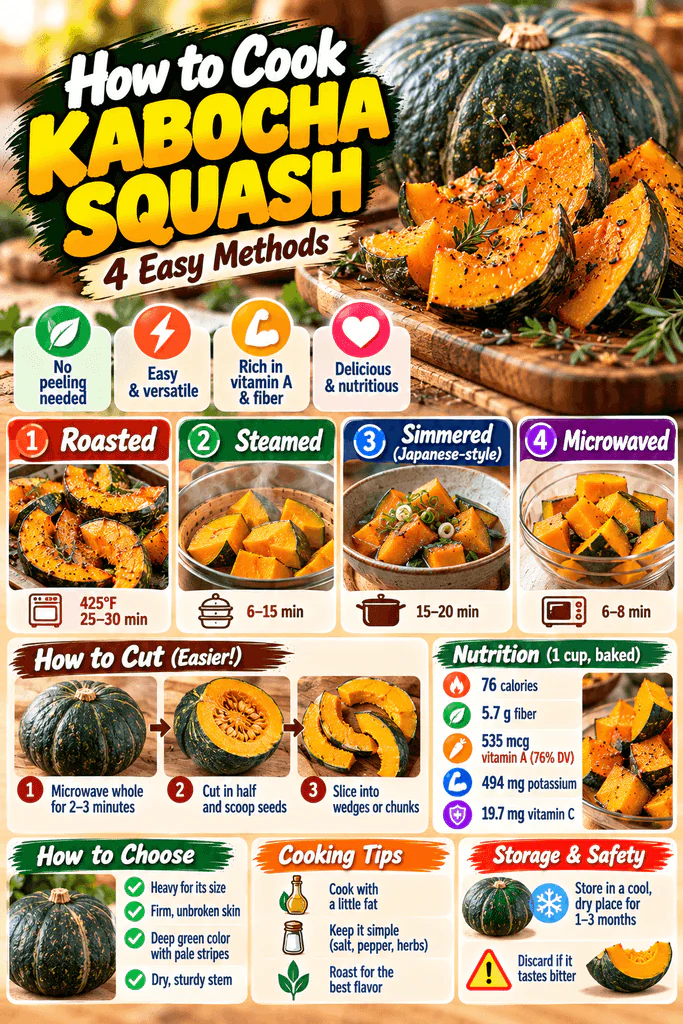
| Calories | 76 kcal | Low for a filling side dish |
| Carbohydrates | 18 g | Includes about 6.8 g natural sugars |
| Dietary fiber | 5.7 g | About a fifth of the 25–35 g daily target |
| Protein | 1.8 g | Small amount |
| Vitamin A (RAE) | 535 mcg | ~76% of the RDA for women, ~59% for men |
| Potassium | 494 mg | ~19% of women’s and ~15% of men’s daily needs |
| Vitamin C | 19.7 mg | ~26% of the RDA for women |
The percentages use the RDAs and adequate intakes from the NIH fact sheets on vitamin A, potassium and vitamin C.
Kabocha may differ from the average in two ways. A 2016 study in HortScience found kabocha flesh had around 29% dry matter, compared with about 19% for butternut. That means more solids and less water per bite, so a cup of kabocha is likely to be denser and somewhat higher in carbohydrates and calories than the average winter squash. The same study found kabocha-type squash had much higher total carotenoid levels than butternut. For more on what that means for your diet, read our full article on whether kabocha squash is healthy.
How to Choose and Store Kabocha Squash
A good kabocha is the start of a great dish. Look for these signs:
- Heavy for its size. Purdue Extension advises choosing heavy squash and avoiding any with moist, black or shriveled stems.
- A dry, corky stem. A stem that’s dried and firm is a good sign of maturity.
- Hard, dull skin. Press with a fingernail; a ripe kabocha resists. Avoid soft spots, cracks or mold.
- An orange or yellow ground spot. The patch where it rested in the field should be creamy orange, not white or green.
Why aged kabocha tastes sweeter
Kabocha is one of the few vegetables that gets better after harvest. According to Oregon State University Extension, kabocha and buttercup squash need “one or more months after harvest for best culinary quality,” because starch is converted to sugars during storage, making the flesh sweeter and smoother. The HortScience study also found that carotenoid levels in winter squash rose during storage.
How to store kabocha squash
Keep whole kabocha in a cool, dry place. OSU Extension recommends 52–54°F and 50–70% humidity for long storage, though a cool pantry works for a few weeks. Some varieties can keep for months. Once cut, wrap the pieces and refrigerate them, and use within a few days.
How to Cut Kabocha Squash Safely
Kabocha’s hard rind is the main reason people avoid it. These steps make cutting much easier and safer.
- Wash and dry. Scrub the skin well, since you’ll likely eat it.
- Soften it first. Pierce the squash a few times with a knife, then microwave it whole for 2–3 minutes. This softens the rind just enough to make cutting easier. Let it cool for a minute before handling.
- Make it stable. Place it stem-side up on a damp towel or non-slip mat on your cutting board.
- Cut in half. Insert the tip of a heavy chef’s knife beside the stem and press down firmly. Rotate and cut through the other side. Never hold the squash where the blade could slip toward your hand.
- Scoop the seeds. Use a sturdy spoon to remove seeds and pulp.
- Cut into wedges or chunks. Lay each half cut-side down and slice into 1-inch wedges, or cut those into 1½-inch chunks.
If you’ve cut a butternut before, the technique is similar; our guide to cutting butternut squash shows the same knife skills. The big difference is that you can skip the peeler with kabocha.
How to Cook Kabocha Squash: 4 Easy Methods
Here’s a quick comparison before we go method by method.
| Method | Heat | Time | Texture | Best for |
| Roasted wedges | 425°F oven | 25–30 min | Caramelized, creamy inside | Side dishes, meal prep |
| Steamed | Stovetop steamer | 10–15 min | Soft, moist | Mashing, soups, baby food |
| Simmered (nimono) | Simmering broth | 12–15 min | Tender, savory-sweet | Japanese-style side dish |
| Microwaved | High | 6–10 min | Soft, plain | Quickest option, purées |
Method 1: Roasted kabocha squash
Roasting brings out kabocha’s natural sweetness and gives you browned, caramelized edges.
- Heat the oven to 425°F and line a sheet pan with parchment.
- Toss 1-inch wedges with 1–2 tablespoons of oil, ½ teaspoon salt and a pinch of pepper.
- Arrange cut-side down in a single layer with space between pieces.
- Roast for 15 minutes, flip, then roast another 10–15 minutes until fork-tender and golden.
Olive oil and avocado oil both handle this heat well; our guide on whether olive oil is good for cooking explains smoke points and when to use each. Purdue Extension’s general guidance for winter squash is to roast for 30–45 minutes depending on size, so larger chunks or halves will need longer.
Method 2: Steamed kabocha
Steaming is gentle and gives soft, moist squash that’s ideal for mashing, soups or baby food.
- Bring 1–2 inches of water to a boil in a pot fitted with a steamer basket.
- Add 1½-inch chunks in a single layer, skin-side down.
- Cover and steam for 10–15 minutes, until a fork slides through easily.
Season with a pinch of salt and a drizzle of oil or butter, or mash with a little milk for a creamy side.
Method 3: Simmered kabocha (Japanese nimono)
In Japan, kabocha is often simmered in a light, savory-sweet broth. The squash soaks up the flavor and holds its shape.
- Place 1½-inch chunks, skin-side down, in a wide pan in a single layer.
- Add 1 cup of dashi or water, 1 tablespoon soy sauce, 1 tablespoon mirin and 1 teaspoon sugar (optional).
- Bring to a boil, then lower to a gentle simmer. Cover with a lid slightly smaller than the pan, or a sheet of foil, so the liquid circulates.
- Simmer for 12–15 minutes until tender, then let it rest in the broth for a few minutes before serving.
This method uses some sodium from soy sauce, so choose a reduced-sodium version if you’re watching salt.
Method 4: Microwaved kabocha
The microwave is the fastest way to cook kabocha, and it’s perfect when you plan to purée it. Purdue Extension notes that winter squash generally takes 5–20 minutes in the microwave, depending on size.
- Place chunks in a microwave-safe dish with 2–3 tablespoons of water.
- Cover loosely and microwave on high for 6–10 minutes, stirring once halfway.
- Check with a fork and continue in 1-minute bursts if needed.
How do you know when kabocha is done?
It’s ready when a fork slides easily through both the flesh and the skin. For roasted kabocha, look for golden-brown edges. Undercooked skin feels firm and chewy, so give it a few more minutes if it resists.
Seasoning Ideas: Sweet and Savory
Kabocha’s natural sweetness works with both savory and warm spices.
| Style | Seasoning | Finish with |
| Classic | Salt, pepper, garlic powder | Fresh herbs |
| Japanese | Soy sauce, mirin, sesame oil | Toasted sesame seeds |
| Smoky | Smoked paprika, cumin, chili flakes | Lime juice |
| Warm and sweet | Cinnamon, ginger, nutmeg | Drizzle of honey or maple syrup |
| Curry | Curry powder or paste, coconut milk | Fresh cilantro |
For the warm and sweet version, a homemade pumpkin pie spice blend works perfectly. Kabocha also shines in curries and stews; try it in place of butternut in our red lentil and squash curry stew.
Can you eat kabocha seeds?
Yes. Rinse them, pat them dry, toss with oil and salt, and roast at 325°F for 15–20 minutes until crisp. The process is the same as the one in our guide to roasting a pumpkin.
Health Benefits of Kabocha Squash
Kabocha isn’t a cure for anything, but it adds several useful nutrients to your plate. Here’s how each one works.
Rich in carotenoids, including beta-carotene
Kabocha’s deep orange flesh is a sign of carotenoids. Beta-carotene is converted by the body into vitamin A, which the NIH Office of Dietary Supplements notes is essential for normal vision, immune function and cell growth. The same fact sheet lists winter squash as a good food source. To see how this compares with its orange cousin, read whether pumpkin is high in vitamin A.
Lutein and zeaxanthin for the eyes
The HortScience study found that lutein, zeaxanthin and beta-carotene were the main carotenoids in kabocha-type squash. The National Eye Institute explains that lutein and zeaxanthin are antioxidants active in the retina, and its AREDS2 trial found that a supplement containing them helped slow the progression of age-related macular degeneration in people who already had the condition. That study used supplements in much larger amounts than food provides, so kabocha isn’t a treatment. But it’s one of many foods that add these pigments to your diet.
A good source of fiber
One cup of baked winter squash has about 5.7 g of fiber, per USDA data [VERIFY ID]. Harvard’s Nutrition Source says adults need at least 25 to 35 grams of fiber a day, but most Americans get only about 15. Fiber supports regular digestion, and soluble fiber can slow digestion, which may help prevent sharp blood sugar spikes. Eating the skin keeps more of the whole vegetable on your plate. Our article on whether pumpkin has fiber covers this in more detail.
Potassium and vitamin C
Winter squash provides nearly 500 mg of potassium per cup. The NIH potassium fact sheet explains that higher potassium intake may help lower blood pressure, partly by relaxing blood vessels and increasing sodium excretion. Kabocha also provides vitamin C, which acts as an antioxidant, supports collagen production and helps absorb iron from plant foods, according to the NIH vitamin C fact sheet.
Part of a vegetable-rich diet
Harvard’s Nutrition Source reports that diets rich in vegetables and fruits can lower blood pressure and reduce the risk of heart disease and stroke, and recommends eating a variety of colors, including yellow and orange vegetables.
How to Get the Most Nutrition From Kabocha
- Add a little fat. Carotenoids are fat-soluble. In a 2004 study in the American Journal of Clinical Nutrition, people absorbed almost no carotenoids from salads eaten with fat-free dressing, and much more with full-fat dressing. Roasting with oil, or finishing steamed kabocha with a drizzle of oil, follows the same idea.
- Steam or roast rather than boil in lots of water. Vitamin C is water-soluble and sensitive to heat, so cooking can reduce it. Steaming, roasting and microwaving use little or no water. If you simmer kabocha, serve the broth with it.
- Let it age a little. Kabocha tastes best a month or more after harvest, and carotenoids can increase during storage.
- Keep the skin on. It saves time and keeps the whole vegetable intact.
Who Benefits Most From Kabocha Squash?
- People who eat too few vegetables. A 2022 CDC report found that only about 10% of US adults met vegetable recommendations. Naturally sweet kabocha can make vegetables easier to enjoy.
- Families with young children. Steamed, mashed kabocha is soft and sweet, which many children enjoy.
- Anyone trying to eat more red and orange vegetables. MyPlate recommends about 5½ to 6 cups a week of red and orange vegetables for most adults under 51, and counts 1 cup of cooked, cubed winter squash as one cup.
If you have diabetes, remember that kabocha is a starchy vegetable, and its dense flesh may carry more carbohydrate per cup than lighter squashes. Count it in your meal plan, and see our pumpkin recipes for diabetics for balanced ideas.
Risks, Side Effects and Who Should Be Cautious
Kabocha is a safe, everyday food for most people, but keep these points in mind.
Bitter squash: throw it out
Very rarely, squash can contain high levels of bitter compounds called cucurbitacins. A study of 353 cases from French Poison Control Centers found that eating bitter, non-edible squash mainly caused vomiting, diarrhea and abdominal pain. No cases were fatal, but the authors recommend throwing away any squash with a bitter taste.
Knife injuries
Kabocha’s hard rind makes the knife more likely to slip. Softening it in the microwave, stabilizing it on a damp towel and keeping your hand clear of the blade all reduce the risk.
Skin irritation from raw squash
Some people get dry, tight or peeling skin on their hands after handling raw winter squash. A 2022 case report in Case Reports in Dermatology described this after peeling butternut squash. Since you don’t need to peel kabocha, you’ll handle less raw flesh, but wear gloves if you’ve reacted before.
Kidney disease and potassium
The NIH notes that people with chronic kidney disease or on certain medicines can develop high blood potassium even from normal dietary amounts. If you’ve been told to limit potassium, ask your doctor or dietitian about portion sizes.
Orange-tinted skin
Eating very large amounts of carotenoid-rich foods for a long time can turn the skin yellow-orange. The NIH describes this carotenodermia as harmless and reversible.
How Much Kabocha Should You Eat?
A typical serving is about 1 cup cooked. Most adults need 2 to 3 cups of vegetables a day, according to MyPlate, so a cup of kabocha covers a third to half of that. Rotate it with leafy greens, cruciferous vegetables and legumes for variety.
Storing and Reheating Cooked Kabocha
Cooked kabocha is great for meal prep. Follow USDA’s leftover safety guidelines:
- Refrigerate within 2 hours of cooking (1 hour if it’s above 90°F).
- Eat refrigerated leftovers within 3 to 4 days.
- Freeze for longer storage; quality is best within 3 to 4 months. Mashed or puréed kabocha freezes especially well.
- Reheat to 165°F.
Myths vs. Facts About Kabocha
| Myth | Fact |
| You have to peel kabocha. | The skin softens when cooked and is edible. Just wash it and trim any rough spots. |
| Kabocha is best eaten straight from the field. | OSU Extension says it tastes best a month or more after harvest, as starch turns to sugar. |
| Kabocha is basically the same as butternut. | It has drier, denser flesh and, in one study, much higher total carotenoids. |
| Adding oil cancels out the health benefits. | A little fat helps you absorb fat-soluble carotenoids. |
| A slightly bitter squash is fine to eat. | Bitterness can signal cucurbitacins, so discard bitter squash. |
How Kabocha Fits a Healthy Lifestyle
Once you know how to cook kabocha squash, it’s easy to work into everyday meals. Roast a tray on the weekend and use it in grain bowls, salads and soups, or mash it as a sweet side for chicken or fish. Steamed kabocha also makes a filling snack with a sprinkle of cinnamon.
If you enjoy kabocha, try other winter squashes as the season goes on. Our guides on how to cook delicata squash and how to cook acorn squash use many of the same techniques.
Frequently Asked Questions
Do you have to peel kabocha squash?
No. Kabocha’s green skin becomes tender when roasted, steamed or simmered, and it’s edible. Most people leave it on for color, texture and convenience. Wash the squash well before cutting, and trim away any rough, scarred or discolored patches rather than peeling the whole thing.
How long do you roast kabocha at 425°F?
Roast 1-inch wedges for 25–30 minutes total, flipping halfway, until fork-tender and golden at the edges. Larger chunks or halves take longer. Toss the pieces in a little oil and spread them in a single layer so they brown instead of steaming.
How do you cut a kabocha squash without hurting yourself?
Pierce the squash and microwave it whole for 2–3 minutes to soften the rind. Set it on a damp towel so it can’t roll, then cut beside the stem with a heavy chef’s knife, keeping your free hand clear of the blade. Scoop out the seeds before slicing.
How long does it take to steam kabocha?
Steam 1½-inch chunks, skin-side down, in a covered steamer basket for 10–15 minutes, until a fork slides through easily. Steamed kabocha is soft and moist, which makes it ideal for mashing, soups and baby food. Season with a little salt and oil after cooking.
How do you store kabocha squash?
Store whole kabocha in a cool, dry place; Oregon State University Extension recommends about 52–54°F for long storage. Many kabocha taste sweeter after a month or more. Refrigerate cut pieces and use within a few days, and eat cooked leftovers within 3 to 4 days.
Is kabocha squash healthy?
Yes. Kabocha is rich in carotenoids such as beta-carotene, lutein and zeaxanthin, and provides fiber, potassium and vitamin C. It’s a starchy vegetable, so people with diabetes should count its carbohydrates, and people who need to limit potassium should check portions with their doctor.
Conclusion
Learning how to cook kabocha squash is easier than it looks. Soften the rind in the microwave, cut it safely, and choose from four simple methods: roast wedges at 425°F for caramelized flavor, steam for soft mashable squash, simmer Japanese-style for a savory-sweet side, or microwave when you’re short on time. No peeling is needed.
Nutritionally, kabocha offers carotenoids, fiber, potassium and vitamin C, and cooking it with a little fat helps you absorb its beta-carotene. Discard any squash that tastes bitter, and talk to your doctor about portions if you have kidney disease or diabetes.
Medical disclaimer: This article is for general information only and isn’t a substitute for professional medical advice. If you have a health condition, such as kidney disease, diabetes or an eye condition, or take medications that affect potassium, talk with your doctor or a registered dietitian before making significant changes to your diet.
3. References
- U.S. Department of Agriculture, Agricultural Research Service. “Squash, winter, all varieties, cooked, baked, without salt.” FoodData Central (SR Legacy). https://fdc.nal.usda.gov/food-details/170490/nutrients [VERIFY: confirm the FDC ID opens this food; values match USDA SR Legacy NDB 11644.]
- NIH Office of Dietary Supplements. “Vitamin A and Carotenoids: Fact Sheet for Health Professionals.” National Institutes of Health. https://ods.od.nih.gov/factsheets/VitaminA-HealthProfessional/
- NIH Office of Dietary Supplements. “Potassium: Fact Sheet for Health Professionals.” National Institutes of Health. https://ods.od.nih.gov/factsheets/Potassium-HealthProfessional/
- NIH Office of Dietary Supplements. “Vitamin C: Fact Sheet for Health Professionals.” National Institutes of Health. https://ods.od.nih.gov/factsheets/VitaminC-HealthProfessional/
- Bonina-Noseworthy J, Loy JB, Curran-Celentano J, Sideman R, Kopsell DA. “Carotenoid Concentration and Composition in Winter Squash: Variability Associated with Different Cultigens, Harvest Maturities, and Storage Times.” HortScience, 2016;51(5):472–480. https://journals.ashs.org/view/journals/hortsci/51/5/article-p472.xml
- Formiga A, Wetzel J, Kawai S, Selman L, Stone A. “Kabocha and Buttercup Squash for Western Oregon Gardens.” Oregon State University Extension Service, EM 9270, 2019 (reviewed 2024). https://extension.oregonstate.edu/sites/default/files/documents/em9270.pdf (web version: https://extension.oregonstate.edu/node/209471)
- National Eye Institute. “NIH study confirms benefit of supplements for slowing age-related macular degeneration.” National Institutes of Health, 2022. https://www.nei.nih.gov/about/news-and-events/news/nih-study-confirms-benefit-supplements-slowing-age-related-macular-degeneration
- Harvard T.H. Chan School of Public Health. “Fiber.” The Nutrition Source. https://nutritionsource.hsph.harvard.edu/carbohydrates/fiber/
- Harvard T.H. Chan School of Public Health. “Vegetables and Fruits.” The Nutrition Source. https://nutritionsource.hsph.harvard.edu/what-should-you-eat/vegetables-and-fruits/
- U.S. Department of Agriculture. “Vegetables.” MyPlate. https://www.myplate.gov/eat-healthy/vegetables
- Lee SH, Moore LV, Park S, Harris DM, Blanck HM. “Adults Meeting Fruit and Vegetable Intake Recommendations — United States, 2019.” MMWR, Centers for Disease Control and Prevention, 2022;71(1):1–9. https://www.cdc.gov/mmwr/volumes/71/wr/mm7101a1.htm
- Brown MJ, Ferruzzi MG, Nguyen ML, et al. “Carotenoid bioavailability is higher from salads ingested with full-fat than with fat-reduced salad dressings as measured with electrochemical detection.” American Journal of Clinical Nutrition, 2004. https://pubmed.ncbi.nlm.nih.gov/15277161/
- Le Roux G, Leborgne I, Labadie M, et al. “Poisoning by non-edible squash: retrospective series of 353 patients from French Poison Control Centers.” Clinical Toxicology, 2018. https://pubmed.ncbi.nlm.nih.gov/29323540/
- Shah S, Feldman SR. “Hand Dermatitis Secondary to Exposure to Butternut Squash.” Case Reports in Dermatology, 2022;14(2):123. https://karger.com/cde/article/14/2/123/821867/Hand-Dermatitis-Secondary-to-Exposure-to-Butternut [VERIFY: author initials]
- Purdue University Cooperative Extension Service. “Winter Squash.” FoodLink. https://extension.purdue.edu/foodlink/includes/pubs/Print1perpaper/Seasonal/Winter_Squash.pdf
- U.S. Department of Agriculture, Food Safety and Inspection Service. “Leftovers and Food Safety.” https://www.fsis.usda.gov/food-safety/safe-food-handling-and-preparation/food-safety-basics/leftovers-and-food-safety