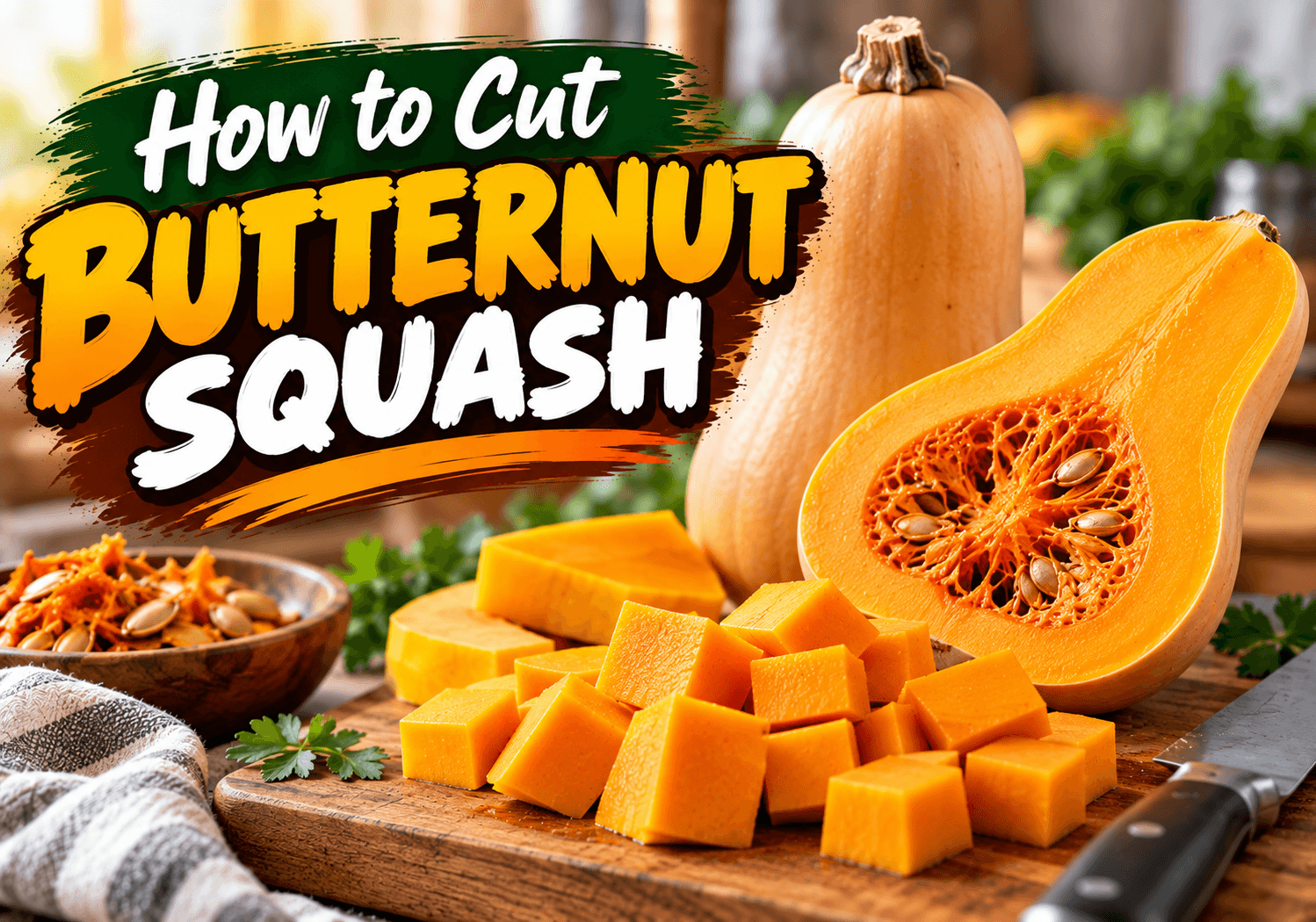
Butternut squash is one of the most delicious fall vegetables, sweet, nutty and silky when roasted. It’s also one of the most intimidating to prepare. The skin is tough, the shape is awkward and the squash tends to roll at exactly the wrong moment. The good news is that once you learn how to cut butternut squash the right way, it takes about 10 minutes and no special tools.
This guide walks you through the safest step-by-step method for peeling and cubing, two shortcuts (microwave-softening and roasting halves without peeling), how to protect your hands from “squash hands,” and how to store and freeze what you cut.
Key Takeaways
- Make it stable first: trim the ends so the squash sits flat, and put a damp towel under your cutting board.
- Separate the neck from the bulb. Two smaller, flat-sided pieces are far easier and safer to peel and cut.
- A sharp Y-peeler removes the skin fastest.
- Shortcut: microwave the whole squash for 2–3 minutes (pierce it first) to soften the skin.
- No-peel option: roast halves skin-on and scoop out the soft flesh.
- Some people get “squash hands”, tight, peeling skin after handling raw squash. Gloves help.
- Storage: whole squash keeps about four months; blanched, frozen cubes keep up to a year.
Why Butternut Squash Is Tricky to Cut
Butternut squash has a hard, smooth rind, a dense neck and a rounded, hollow bulb full of seeds. That combination causes three common problems:
- It rolls. Its curved shape makes it unstable on a cutting board.
- The knife sticks. The dense flesh grips the blade, tempting people to force it.
- The skin is slippery. A peeler or knife can slide off the rind.
The method below fixes all three by creating flat, stable surfaces before you make any big cuts.
Butternut squash is well worth the effort. According to USDA FoodData Central, one cup of baked butternut squash provides about 82 calories, 6.6 g of fiber and 1,144 µg RAE of vitamin A, 127% of the Daily Value. For the full health picture, see is butternut squash healthy.
Choosing a Butternut Squash That’s Easy to Cut
A good squash makes the job easier. Iowa State University Extension recommends choosing a squash with smooth, even tan skin, free of blemishes, cracks or soft spots, and picking ones with the longest, fattest necks, because the neck is the solid “meaty” part.
Tips for easier cutting:
- Long neck, small bulb: more solid flesh, fewer seeds, easier cubes.
- Smooth, straight neck: easier to peel than a curved or bumpy one.
- Heavy for its size: signals dense, moist flesh.
- Skip green streaks: a fully tan squash is mature and sweeter.
Tools You’ll Need
- A large, sharp chef’s knife (8–10 inches). A sharp knife is safer than a dull one, because it needs less force and is less likely to slip.
- A sturdy Y-peeler or swivel peeler. Y-peelers are especially good on butternut’s smooth skin.
- A large cutting board with a damp kitchen towel or non-slip mat underneath.
- A metal spoon or ice cream scoop for the seeds.
- Optional: kitchen gloves, if you’ve had “squash hands” before (see below).
Step 1: Wash the Squash
Even though you’ll peel it, wash it first. The FDA recommends washing produce under running water before peeling or cutting, so that dirt and bacteria on the surface aren’t transferred to the inside by your knife or peeler. Scrub firm produce with a clean produce brush, skip the soap, and dry the squash thoroughly so it doesn’t slip.
Step-by-Step: How to Cut Butternut Squash Into Cubes
This is the safest, most reliable method for peeled cubes, ideal for roasting, soups, stews and curries.
Step 2: Stabilize Your Board
Place a damp towel or non-slip mat under your cutting board. A board that slides is one of the biggest safety risks in the kitchen.
Step 3: Trim Both Ends
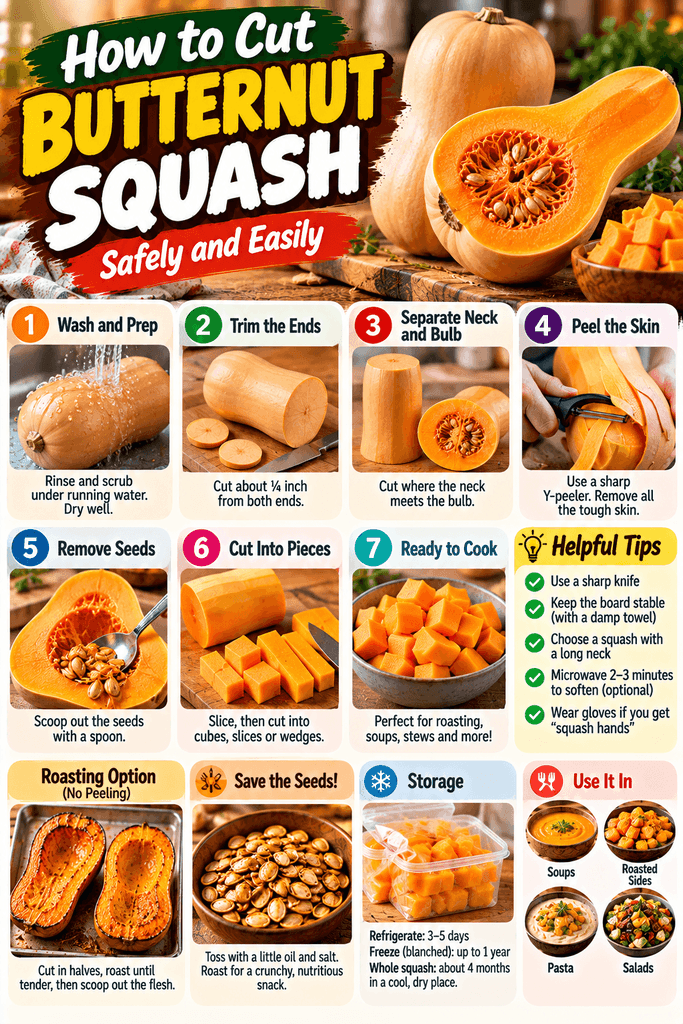
Lay the squash on its side. Cut off about ¼ inch from the stem end and the bottom (blossom) end. You now have two flat surfaces.
Step 4: Separate the Neck From the Bulb
Cut across the squash where the narrow neck meets the round bulb. You’ll have:
- A cylinder-shaped neck, solid flesh with no seeds
- A round bulb, which contains the seed cavity
Stand each piece on its flat cut end. Now nothing rolls.
Step 5: Peel
Hold one piece upright on its flat end and peel from top to bottom with a Y-peeler, rotating as you go. Peel until you reach the bright orange flesh and no pale-green layer remains. That layer is tough and fibrous.
Knife method: If you prefer a knife, stand the piece on its flat end and slice the skin off in downward strips, following the curve.
Step 6: Halve the Bulb and Remove the Seeds
Stand the peeled bulb on its flat end and cut it in half from top to bottom. Scoop out the seeds and stringy fibers with a spoon. Save the seeds for roasting if you like.
Step 7: Cut the Neck Into Planks, Then Sticks, Then Cubes
- Stand the neck on its flat end and cut it in half lengthwise.
- Lay each half flat side down, which makes it stable, and slice into ¾- to 1-inch-thick planks.
- Stack a few planks and cut them into sticks.
- Turn the sticks and cut across into cubes.
Step 8: Cube the Bulb
Lay each bulb half cut-side down and slice it into crescents or strips, then cut those into cubes. Bulb pieces will be less uniform than neck cubes, which is fine for soups and mashing.
Size tip: Cut cubes as evenly as possible so they cook at the same rate. 1-inch cubes are ideal for roasting, smaller ½-inch cubes for quick sautés.
Shortcut #1: Soften It in the Microwave First
If your squash is very hard, or your knife isn’t very sharp, a quick microwave makes peeling and cutting much easier.
- Pierce the whole squash 6–8 times with a fork or knife so steam can escape.
- Microwave on high for 2–3 minutes.
- Let it cool for a couple of minutes. It will be hot.
- Trim, peel and cut as above. The skin will come off more easily and the knife will glide through.
This doesn’t cook the squash. It just softens the outer layer. Always pierce the squash first so steam doesn’t build up inside.
Shortcut #2: Roast Halves Without Peeling
If you’re making soup, puree, mash or baby food, you don’t need to peel at all. Iowa State Extension notes that peeling isn’t necessary for pureed uses.
- Trim the stem end, then cut the squash in half lengthwise from top to bottom. Stand it on its trimmed end, or microwave it first if it’s hard.
- Scoop out the seeds.
- Brush the cut sides lightly with oil.
- Place cut-side down on a lined baking sheet.
- Roast at 400°F (200°C) until very tender when pierced with a fork, usually 40–60 minutes depending on size.
- Cool slightly, then scoop the soft flesh away from the skin.
This method works just like roasting a pumpkin. See our step-by-step guide on how to roast a pumpkin for more tips.
How to Cut Butternut Squash for Different Recipes
| Use | Cut | Peel? |
| Roasted side dish | 1-inch cubes | Yes |
| Soup or puree | Halves, roasted | No, scoop out flesh |
| Fries | ½-inch sticks from the neck | Yes |
| Curries and stews | ¾- to 1-inch cubes | Yes |
| Lasagna or gratin | Thin rounds from the neck | Yes |
| Salads | ½- to ¾-inch cubes, roasted | Yes |
| Stuffed squash | Halves | No |
Recipe ideas:
- Roasted cubes: Iowa State Extension suggests seasoning cubes, spreading them on a lightly oiled pan and baking at 400°F until tender and lightly browned, about 25–30 minutes. Toss them into this massaged kale salad with roasted butternut squash.
- Fries: Cut the neck into sticks for these curried butternut squash fries.
- Stews: Cubes hold their shape in this red lentil and butternut squash curry stew.
- Rounds: Thin neck slices layer beautifully in this individual butternut squash lasagna.
- Grain dishes: Small cubes work well in this winter squash wheat berry risotto.
“Squash Hands”: Why Your Skin Feels Tight After Peeling
Have you ever peeled a butternut squash and found your hands feeling tight, stiff, dry or peeling afterward? You’re not imagining it.
A 2022 report in Case Reports in Dermatology described a man who developed a tight sensation within 10–15 minutes of handling raw butternut squash, followed by dry, flaking skin on his palm and fingers. It resolved within several days once he avoided contact. The authors noted that the substance responsible is unknown and that this type of reaction is uncommon. An earlier published case of butternut squash (Cucurbita moschata) dermatitis appears in the medical literature as well.
How to prevent it:
- Wear kitchen gloves when peeling and cutting raw squash, especially if it has happened to you before.
- Roast halves skin-on and scoop out the cooked flesh, which avoids handling the raw cut surface.
- Wash your hands promptly after handling raw squash.
- See a doctor or dermatologist if you get a rash, blistering, itching or a reaction that doesn’t improve.
Safety Tips for Cutting Hard Squash
- Keep your knife sharp. Dull knives need more force and are more likely to slip.
- Always create a flat base before cutting. Never cut a round, rolling squash.
- Curl your fingertips under on the hand holding the squash (“claw grip”).
- Never pull a stuck knife toward you. If the blade gets stuck, carefully rock the squash and knife together on the board, or tap the spine of the knife with the heel of your hand, keeping your hand flat on top.
- Cut away from your body.
- Work slowly. Speed comes with practice.
- Soften very hard squash in the microwave first rather than forcing the knife.
How to Store Butternut Squash
Whole Squash
According to Iowa State Extension, butternut squash keeps well for about four months in a cool, dry, well-ventilated location. Squash that has been cured after harvest (air-dried in warm temperatures for about 10 days) stores best. Don’t refrigerate whole squash.
Cut Raw Squash
Wrap cut squash or store cubes in a covered container in the refrigerator, and use them within a few days. Keep the refrigerator at 40°F or below.
Freezing Butternut Squash
You can freeze butternut squash for later. University of Arkansas Cooperative Extension recommends:
- Wash, peel and cut the squash into uniform cubes.
- Blanch the cubes in boiling water for 3 minutes to stop enzyme activity.
- Drain well and spread on a baking sheet to flash-freeze.
- Transfer to labeled freezer bags or containers.
Frozen this way, butternut squash maintains quality for up to one year.
You can also freeze cooked, mashed squash or puree in rigid containers with headspace for expansion. Don’t home-can mashed or pureed squash. Missouri Extension, citing the National Center for Home Food Preservation, warns that puree is too dense for heat to adequately penetrate the jar during processing.
Can You Eat Butternut Squash Skin?
Yes. Butternut squash skin is edible, but it’s thicker and chewier than delicata or kabocha skin. It softens when roasted, especially in thin slices. Most people peel it for cubes and leave it on for halves, then scoop out the flesh. If you want a squash you never have to peel, try delicata. See is delicata squash healthy.
Don’t Toss the Seeds
Butternut seeds can be roasted just like pumpkin seeds. Separate them from the fibers, rinse and dry them well, toss with a little oil and salt, and roast at a low temperature until golden and crisp. Learn about their nutrition in are pumpkin seeds healthy.
Butternut vs. Other Squash: Which Is Easiest to Cut?
| Squash | Difficulty | Why |
| Delicata | Easiest | Thin, edible skin; no peeling |
| Butternut | Moderate | Smooth skin peels easily; neck is solid |
| Acorn | Harder | Deep ridges make peeling awkward |
| Kabocha | Hard | Very hard skin; usually left on |
| Hubbard | Hardest | Thick, tough rind; often sold pre-cut |
Butternut is the easiest of the squashes you peel, thanks to its smooth skin and solid neck. Acorn squash’s deep ridges make it awkward to peel, so it’s usually roasted in halves or slices. See is acorn squash healthy. For a full rundown of varieties, visit our winter squash guide.
Frequently Asked Questions
Do you need to peel butternut squash?
It depends on the recipe. For cubes, fries and stews, peel it. For soup, puree or mash, roast the halves skin-on and scoop out the soft flesh. The skin is edible and softens when roasted, but most people find it chewy in larger pieces.
How do you soften butternut squash before cutting?
Pierce the whole squash six to eight times with a fork, then microwave it on high for two to three minutes. Let it cool briefly. The skin will peel more easily and your knife will cut through with less force, which makes the job safer.
What is the easiest way to cut butternut squash?
Trim both ends, cut the neck away from the bulb, and stand each piece on its flat end to peel. Halve the bulb and scoop the seeds, then cut the neck into planks, sticks and cubes. Flat surfaces keep the squash from rolling.
Why do my hands feel tight after peeling butternut squash?
Some people develop “squash hands,” a reaction to raw butternut squash that causes tightness, dryness and peeling on the hands. Published case reports describe it resolving within days. Wearing gloves when peeling prevents it. See a doctor if you develop a rash or the reaction doesn’t improve.
How long does cut butternut squash last?
Store cut raw squash in a covered container in the refrigerator and use it within a few days. For longer storage, blanch the cubes for three minutes and freeze them. University of Arkansas Extension says frozen butternut squash keeps its quality for up to one year.
Can you freeze raw butternut squash?
For the best quality, Extension experts recommend blanching cubes in boiling water for three minutes before freezing, to stop enzyme activity. Then drain them, flash-freeze on a baking sheet and transfer to labeled freezer bags. Cooked, mashed squash also freezes well in rigid containers.
Conclusion
Learning how to cut butternut squash comes down to one principle: make flat, stable surfaces before you make big cuts. Wash the squash, trim both ends, separate the neck from the bulb, peel each piece standing upright, scoop the seeds, and cut the neck into planks, sticks and cubes. Microwave a very hard squash for 2–3 minutes to soften it, or skip peeling entirely by roasting halves for soup and puree. Wear gloves if raw squash irritates your hands, store whole squash somewhere cool and dry for up to four months, and freeze blanched cubes for up to a year.
Disclaimer: This article is for general educational purposes. Use caution when handling sharp knives. If you develop a skin reaction after handling squash that is severe or doesn’t improve, consult a healthcare provider.
(3) References
- Iowa State University Extension and Outreach. Geiger M. “How to Select, Peel, and Use Butternut Squash.” AnswerLine. https://blogs.extension.iastate.edu/answerline/2016/10/18/how-to-select-peel-and-use-butternut-squash/
- University of Arkansas Cooperative Extension Service. “How to Freeze Butternut Squash.” https://uaex.uada.edu/life-skills-wellness/at-home-with-uaex/posts/food/how-to-freeze-butternut-squash.aspx
- University of Missouri Extension (citing the National Center for Home Food Preservation). “Preserving winter squash.” https://extension.missouri.edu/news/preserving-winter-squash
- U.S. Food and Drug Administration. “Selecting and Serving Produce Safely.” https://www.fda.gov/food/buy-store-serve-safe-food/selecting-and-serving-produce-safely
- Shah MA, Feldman SR. “Hand Dermatitis Secondary to Exposure to Butternut Squash.” Case Reports in Dermatology. 2022;14(2):123. https://karger.com/cde/article/14/2/123/821867/Hand-Dermatitis-Secondary-to-Exposure-to-Butternut
- “Butternut squash (Cucurbita moschata) dermatitis.” Case report indexed in PubMed. https://pubmed.ncbi.nlm.nih.gov/8187500/ [VERIFY: authors, journal and year]
- U.S. Department of Agriculture. “Squash, winter, butternut, cooked, baked, without salt” (FDC ID 169296). FoodData Central. https://fdc.nal.usda.gov/fdc-app.html#/food-details/169296/nutrients