The best part of carving a pumpkin might be what’s inside it. A single pumpkin can give you a cup or more of seeds, and with a little prep they turn into a crunchy, salty snack that beats anything from a bag. In this guide, you’ll learn how to roast pumpkin seeds in the oven, the air fryer and a skillet, plus the three steps most people skip that make the difference between chewy and perfectly crisp.
We’ll also cover what roasted pumpkin seeds offer nutritionally, how many to eat, and a few safety points worth knowing.
Key Takeaways
- Dry them well. Moisture is the main reason seeds turn out chewy instead of crisp.
- Roast low and slow: 325°F for 20–30 minutes, stirring every 10 minutes, until golden.
- Optional boil: simmering seeds in salted water for 10 minutes seasons them all the way through.
- Let them cool completely. Seeds keep crisping as they cool.
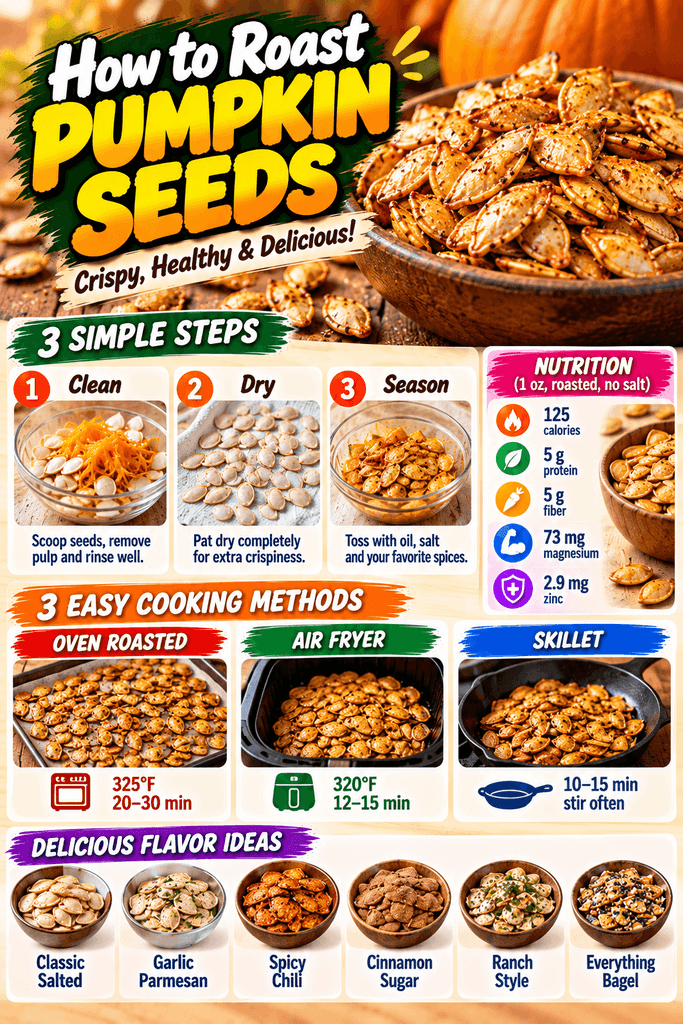
- Nutrition: one ounce of whole roasted seeds has about 125 calories, 5 g of fiber and 5 g of protein, plus magnesium and zinc.
- Keep salt in check, don’t burn them, and remember that whole seeds are a choking risk for young children.
Pumpkin Seeds vs Pepitas: What’s the Difference?
When you scoop seeds out of a pumpkin, you get whole seeds: a flat, cream-colored shell (hull) with a small green kernel inside. When you buy pepitas, you usually get just the green kernels, either from hulled seeds or from special hull-less pumpkin varieties.
Both are edible, but they’re not the same nutritionally. The shell adds a lot of fiber and crunch, while the kernel is richer in fat, protein and minerals per ounce. This guide focuses on roasting whole seeds from a fresh pumpkin or winter squash, since that’s what most home cooks have on hand.
You can roast seeds from almost any pumpkin or winter squash. Smaller squash, like the ones in our guides on how to cook kabocha squash and how to cook delicata squash, have smaller seeds that roast faster.
Roasted Pumpkin Seed Nutrition at a Glance
Here’s how one ounce (about 28 g) of roasted, unsalted seeds compares, based on USDA FoodData Central entries for whole roasted pumpkin and squash seeds and roasted seed kernels:
| Per 1 oz (28 g), roasted, no salt | Whole seeds (with shell) | Kernels (pepitas) |
| Calories | ~125 kcal | ~160 kcal |
| Protein | ~5 g | ~8.5 g |
| Total fat | ~5.5 g | ~14 g |
| Carbohydrates | ~15 g | ~4 g |
| Dietary fiber | ~5.2 g | ~2 g |
| Magnesium | ~73 mg | ~156 mg |
| Zinc | ~2.9 mg | ~2.2 mg |
| Sodium | ~5 mg | ~5 mg |
A few takeaways: whole seeds are lower in calories and much higher in fiber, because the shell is mostly fiber. Kernels are more concentrated in fat, protein and magnesium. Both are naturally very low in sodium until you add salt. For the pumpkin itself, see our full pumpkin nutrition facts.
What You’ll Need
Ingredients (makes about 1 cup):
- 1 cup fresh pumpkin seeds (from one medium pumpkin)
- 1–2 teaspoons oil (olive, avocado or melted coconut oil)
- ¼–½ teaspoon fine salt, to taste
- Optional seasonings (see the ideas below)
Equipment: a large bowl, a colander, clean kitchen towels, a rimmed baking sheet and parchment paper.
For the oil, choose one that handles moderate oven heat well. Our guide to whether olive oil is good for cooking explains how different oils behave in the oven.
Step 1: Clean the Seeds
Cleaning is the messiest part, but a bowl of water makes it quick.
- Scoop. Use a large metal spoon to scrape the seeds and stringy pulp from the pumpkin into a big bowl.
- Soak and separate. Fill the bowl with cold water. Swish the seeds with your hands; the seeds float to the top while most of the pulp sinks.
- Skim and rinse. Lift the seeds into a colander and rinse off any clinging strands. A little pulp left behind is fine and adds flavor, but large pieces will burn.
If you’re carving or cooking a whole pumpkin anyway, our guide on how to roast a pumpkin shows how to use the flesh, so nothing goes to waste.
One quick safety check: if the pumpkin or squash tasted unusually bitter, throw the seeds away along with it. We explain why in the safety section below.
Step 2 (Optional): Boil in Salted Water
This step is optional, but it’s the secret to evenly seasoned, extra-crisp seeds.
- Bring a pot of water to a boil and add about 1 tablespoon of salt per 4 cups of water.
- Add the seeds and simmer for 10 minutes.
- Drain well.
Boiling seasons the kernel inside the shell, not just the outside, and it softens the shell slightly so it roasts up crisp and light rather than tough. If you’re watching your sodium, use less salt in the water or skip this step and season lightly after roasting.
Step 3: Dry Them Thoroughly
This is the step most people skip, and it’s why their seeds come out chewy. Water on the surface has to evaporate before the seeds can start to crisp.
- Spread the seeds in a single layer on a clean kitchen towel.
- Pat them dry with a second towel.
- If you have time, let them air-dry for 30 minutes to an hour, or even overnight.
The seeds should feel dry to the touch, not damp or slippery, before you add oil.
Step 4: How to Roast Pumpkin Seeds in the Oven
Now you’re ready for the main event. The oven gives the most reliable, even results.
- Heat the oven to 325°F and line a rimmed baking sheet with parchment.
- Toss with oil and salt. Use about 1 teaspoon of oil per cup of seeds, just enough to coat them lightly. Add salt and any dry seasonings.
- Spread in a single layer. Crowded seeds steam instead of roast. Use two sheets if needed.
- Roast for 20–30 minutes, stirring every 10 minutes, until the seeds are golden and you hear the occasional pop.
- Cool completely on the pan. They’ll keep crisping as they cool.
Why 325°F?
A moderate oven dries the seeds out before the outsides brown too much. At higher temperatures, the shells can scorch before the inside is crisp. You can roast at 350°F for 15–20 minutes, but watch closely and stir more often. Small seeds from squash cook faster, so start checking them at 10–12 minutes.
Don’t over-brown
Aim for light golden, not dark brown. The FDA explains that acrylamide, a chemical that has caused cancer in animal studies at very high doses, can form in plant foods during high-temperature roasting, baking and frying. The agency’s advice is to avoid excessive browning or charring. Burnt seeds also taste bitter, so it’s an easy rule to follow.
How do you know when they’re done?
Taste one after it has cooled for a minute. It should be crisp all the way through, with a dry, crunchy shell. If it’s chewy in the middle, return the pan to the oven for another 5 minutes.
How to Roast Pumpkin Seeds in an Air Fryer or Skillet
The oven is the classic method, but you have faster options for small batches.
| Method | Heat | Time | Best for |
| Oven | 325°F | 20–30 min | Big batches, most even results |
| Air fryer | 350°F | 10–15 min | Small batches, fastest crisping |
| Skillet | Medium | 5–8 min | No oven needed, small amounts |
Air fryer pumpkin seeds
- Heat the air fryer to 350°F.
- Toss dried seeds with ½ teaspoon of oil and salt.
- Air-fry in a single layer for 10–15 minutes, shaking the basket every 4–5 minutes.
Seeds are light, so they can blow around; a perforated parchment liner helps. If you’re new to your machine, our air fryer recipes for beginners cover the basics.
Skillet pumpkin seeds
- Heat a dry or lightly oiled skillet over medium heat.
- Add the dried seeds in a single layer.
- Toast for 5–8 minutes, stirring often, until golden and fragrant. Season in the pan.
Skillet seeds brown quickly, so stay at the stove.
Seasoning Ideas
Plain salted seeds are classic, but pumpkin seeds take on flavor easily. Add dry spices before roasting and anything sugary near the end so it doesn’t burn.
| Flavor | What to add (per 1 cup) |
| Classic | ½ tsp salt |
| Garlic Parmesan | ½ tsp garlic powder; toss with 2 tbsp grated Parmesan after roasting |
| Smoky BBQ | ½ tsp smoked paprika, ¼ tsp garlic powder, pinch of brown sugar |
| Chili lime | ½ tsp chili powder; lime zest after roasting |
| Cinnamon sugar | 1 tsp cinnamon, 1–2 tsp sugar in the last 5 minutes |
| Pumpkin spice | 1 tsp pumpkin pie spice, 1 tsp maple syrup in the last 5 minutes |
For the pumpkin spice version, you can make your own pumpkin pie spice blend in a couple of minutes.
Health Benefits of Roasted Pumpkin Seeds
Pumpkin seeds aren’t a miracle food, but they pack a lot of nutrition into a small handful. Here’s what the evidence says and how each nutrient works.
Magnesium for muscles, nerves and blood sugar
The NIH Office of Dietary Supplements lists roasted pumpkin seeds among the richest food sources of magnesium. It notes that magnesium is involved in more than 300 enzyme systems, including muscle and nerve function, blood sugar control and blood pressure regulation. It also reports that 48% of Americans get less magnesium from food than they need. One ounce of whole seeds gives about 73 mg, roughly a fifth of the 310–420 mg adults need each day; shelled pepitas give about twice that.
Zinc for immune function
Zinc supports the immune system, wound healing and the body’s production of protein and DNA, according to the NIH zinc fact sheet. The RDA is 8 mg for women and 11 mg for men. The same fact sheet notes that plant foods contain phytates, which bind zinc and reduce how much you absorb, so plant sources like pumpkin seeds are useful but less efficiently absorbed than zinc from animal foods. That’s especially relevant for vegetarians.
Fiber from the shell
Eating the whole seed, shell and all, gives you about 5 g of fiber per ounce, based on USDA data. Harvard’s Nutrition Source notes that adults need at least 25 to 35 grams of fiber a day, but most Americans get only about 15. Fiber helps keep digestion regular and helps you feel full. Read more about fiber and appetite in our article on whether a high-fiber diet helps with weight loss.
Plant protein and healthy fats
Pumpkin seeds provide plant protein along with mostly unsaturated fats. Harvard’s Nutrition Source says unsaturated fats can improve blood cholesterol levels and ease inflammation, especially when they replace saturated fat. It also notes that nuts, seeds and other plant proteins are a healthy alternative to red and processed meat.
Part of a heart-healthy pattern
A 2023 meta-analysis in Food & Nutrition Research, covering 28 cohort studies with nearly 1.9 million participants, found that people who ate the most nuts and seeds had about a 19% lower risk of cardiovascular disease than those who ate the least. The benefit appeared to level off at around 30 g a day. Most of the evidence came from nuts, though; the authors note that seeds were studied explicitly in only a few studies, so the results can’t be applied to pumpkin seeds alone. If you enjoy seeds, also see our guide on whether sesame seeds are healthy and our complete guide to nuts.
Who Benefits Most?
- People looking for a better snack. A handful of homemade seeds is crunchy and satisfying, with fiber and protein, and you control the salt.
- Vegetarians and vegans. Seeds add plant protein, zinc and magnesium, though phytates mean plant zinc is less well absorbed.
- Anyone carving pumpkins. Roasting the seeds turns kitchen waste into food, and our guide on whether pumpkin is healthy covers the rest of the pumpkin.
- People trying to eat more plant protein. MyPlate counts ½ ounce of hulled, roasted pumpkin seeds as one ounce-equivalent of protein foods, and notes that many Americans don’t eat enough nuts, seeds and soy products.
Risks, Side Effects and Who Should Be Cautious
Roasted pumpkin seeds are a safe, everyday food for most people. Keep these points in mind.
Salt adds up fast
Pumpkin seeds are naturally very low in sodium, but salted seeds are not. The FDA recommends adults keep sodium under 2,300 mg a day and notes that higher intakes are associated with high blood pressure. Boiling in heavily salted water and then salting again can add a lot. If you’re watching sodium, use a light hand or try herbs and spices instead.
Calories add up too
Seeds are energy-dense. Whole seeds have about 125 calories per ounce and kernels about 160. A small handful is a snack; a whole bowl is a meal’s worth of calories.
A choking risk for young children
The CDC lists whole or chopped nuts and seeds among the foods young children shouldn’t eat because of choking risk. Keep roasted seeds away from babies and toddlers.
Seed allergies are rare but possible
Allergy to pumpkin seeds is uncommon, but serious reactions have been reported, including a case of anaphylaxis in a child after eating pumpkin seeds described in the Journal of Nature and Science of Medicine. If you or your child has a known seed allergy, or you notice itching, swelling or trouble breathing after eating seeds, stop and seek medical care.
Bitter squash means bitter seeds: throw them out
Rarely, squash and pumpkins can contain high levels of bitter compounds called cucurbitacins. A study of 353 cases from French Poison Control Centers found that eating bitter, non-edible squash mainly caused vomiting, diarrhea and abdominal pain, and the authors recommend throwing away any squash with a bitter taste. Don’t roast seeds from decorative gourds or from a squash that tasted bitter.
Digestive discomfort
Eating a large amount of whole seeds, with their fiber-rich shells, can cause bloating or discomfort if you’re not used to that much fiber. Start with a small handful, chew well and drink plenty of water.
How Many Pumpkin Seeds Should You Eat?
There’s no official limit, but a sensible serving is about 1 ounce, roughly a small handful or ¼ cup of whole seeds. That fits with the meta-analysis finding that heart benefits from nuts and seeds level off around 30 g a day. Enjoy them a few times a week as part of a varied diet, and swap them in for less healthy snacks rather than adding them on top.
How to Store Roasted Pumpkin Seeds
Once the seeds have cooled completely, store them in an airtight container at room temperature for up to about a week. For longer storage, keep them in the refrigerator or freezer, which helps protect their oils from going rancid. If they lose their crunch, re-crisp them in a 300°F oven for 5 minutes.
Raw, cleaned seeds that you don’t have time to roast can be dried, refrigerated and roasted within a couple of days.
Ways to Use Roasted Pumpkin Seeds
- Eat them as a snack straight from the jar.
- Sprinkle them on salads, soups, yogurt or oatmeal for crunch.
- Add them to homemade trail mix or granola.
- Use them to top roasted vegetables, such as roasted squash.
- Blend shelled pepitas into pesto in place of pine nuts.
Myths vs. Facts About Pumpkin Seeds
| Myth | Fact |
| You have to shell pumpkin seeds before eating them. | Whole roasted seeds are edible, shell and all. The shell adds fiber and crunch. |
| Higher heat makes crispier seeds. | Moderate heat (325°F) dries seeds before they burn. High heat can scorch the shells. |
| Pumpkin seeds and pepitas are identical. | Pepitas are the hull-less kernels, higher in fat and magnesium; whole seeds are higher in fiber. |
| Roasted seeds are a low-calorie snack, so eat as many as you like. | They’re energy-dense: about 125–160 calories per ounce. |
| Salted seeds are fine because seeds are healthy. | Salt can add up quickly. Season lightly if you’re watching sodium. |
How Pumpkin Seeds Fit a Healthy Lifestyle
Roasting pumpkin seeds is a small habit with real benefits: less food waste, a homemade snack you control, and a handful of minerals, fiber and plant protein. Make a batch every time you carve or cook a pumpkin or winter squash, and keep them on hand to swap in for chips or crackers. Pair them with other whole foods, such as vegetables, fruit, whole grains and legumes, rather than relying on any single “superfood”.
Frequently Asked Questions
Do you have to boil pumpkin seeds before roasting?
No, but it helps. Simmering the seeds in salted water for 10 minutes seasons them all the way through and softens the shells, so they roast up lighter and crispier. If you skip boiling, just make sure to dry the seeds thoroughly and season them before roasting.
How long do you roast pumpkin seeds at 350°F?
Roast for 15–20 minutes at 350°F, stirring every 5–7 minutes, until golden. At this temperature seeds brown faster, so watch them closely. At 325°F, allow 20–30 minutes. Smaller seeds from winter squash cook faster, so check them early and taste one after it cools.
Why are my roasted pumpkin seeds chewy?
Usually because they were still wet, crowded on the pan or not roasted long enough. Dry the seeds thoroughly, spread them in a single layer, and roast until they’re golden and dry inside. Let them cool completely, since they keep crisping as they cool.
Can you eat pumpkin seed shells?
Yes. Whole roasted pumpkin seeds are edible, shells included, and the shells add fiber and crunch. Chew them well. If you find the shells tough or they upset your stomach, try shelled pepitas instead, which are softer and lower in fiber.
How do you store roasted pumpkin seeds?
Let them cool completely, then store them in an airtight container at room temperature for up to about a week. For longer storage, refrigerate or freeze them to keep the oils fresh. Re-crisp soft seeds in a 300°F oven for about 5 minutes.
Are pumpkin seeds healthy?
Yes, in moderate amounts. They provide magnesium, zinc, plant protein and unsaturated fats, and whole seeds add about 5 g of fiber per ounce. They’re calorie-dense, so stick to a small handful, and go easy on the salt if you’re watching your sodium.
Conclusion
Now you know how to roast pumpkin seeds that turn out crisp every time: clean them in a bowl of water, boil them briefly in salted water if you like, dry them thoroughly, then roast at 325°F in a single layer until golden, and let them cool completely. The air fryer and skillet work too when you’re short on time.
The result is a crunchy snack with magnesium, zinc, fiber and plant protein. Keep portions to about an ounce, go easy on the salt, avoid burning them, and keep whole seeds away from young children.
Medical disclaimer: This article is for general information only and isn’t a substitute for professional medical advice. If you have a food allergy, high blood pressure, kidney disease or another health condition, talk with your doctor or a registered dietitian before making significant changes to your diet.
3. References
- U.S. Department of Agriculture, Agricultural Research Service. “Seeds, pumpkin and squash seeds, whole, roasted, without salt.” FoodData Central (SR Legacy, FDC ID 170188). https://fdc.nal.usda.gov/food-details/170188/nutrients : ID confirmed via a secondary database; open the link to check it loads.]
- U.S. Department of Agriculture, Agricultural Research Service. “Seeds, pumpkin and squash seed kernels, roasted, without salt.” FoodData Central (SR Legacy, FDC ID 170557). https://fdc.nal.usda.gov/food-details/170557/nutrients
- NIH Office of Dietary Supplements. “Magnesium: Fact Sheet for Health Professionals.” National Institutes of Health. https://ods.od.nih.gov/factsheets/Magnesium-HealthProfessional/
- NIH Office of Dietary Supplements. “Zinc: Fact Sheet for Health Professionals.” National Institutes of Health. https://ods.od.nih.gov/factsheets/Zinc-HealthProfessional/
- Harvard T.H. Chan School of Public Health. “Fiber.” The Nutrition Source. https://nutritionsource.hsph.harvard.edu/carbohydrates/fiber/
- Harvard T.H. Chan School of Public Health. “Types of Fat.” The Nutrition Source. https://nutritionsource.hsph.harvard.edu/what-should-you-eat/fats-and-cholesterol/types-of-fat/
- Harvard T.H. Chan School of Public Health. “Protein.” The Nutrition Source. https://nutritionsource.hsph.harvard.edu/what-should-you-eat/protein/
- Arnesen EK, Thorisdottir B, Bärebring L, et al. “Nuts and seeds consumption and risk of cardiovascular disease, type 2 diabetes and their risk factors: a systematic review and meta-analysis.” Food & Nutrition Research, 2023. https://pmc.ncbi.nlm.nih.gov/articles/PMC9930735/U.S. Department of Agriculture. “Protein Foods.” MyPlate. https://www.myplate.gov/eat-healthy/protein-foods
- U.S. Food and Drug Administration. “Sodium in Your Diet.” https://www.fda.gov/food/nutrition-education-resources-materials/sodium-your-diet
- U.S. Food and Drug Administration. “Acrylamide Questions and Answers.” https://www.fda.gov/food/process-contaminants-food/acrylamide-questions-and-answers
- Centers for Disease Control and Prevention. “Choking Hazards.” Infant and Toddler Nutrition. https://www.cdc.gov/infant-toddler-nutrition/foods-and-drinks/choking-hazards.html
- Alsukait SF, Alangari AA. “Anaphylaxis secondary to ingestion of pumpkin seeds in a child: A case report.” Journal of Nature and Science of Medicine, 2019;2(2):101–102. https://doi.org/10.4103/jnsm.jnsm_63_18
- Le Roux G, Leborgne I, Labadie M, et al. “Poisoning by non-edible squash: retrospective series of 353 patients from French Poison Control Centers.” Clinical Toxicology, 2018. https://pubmed.ncbi.nlm.nih.gov/29323540/