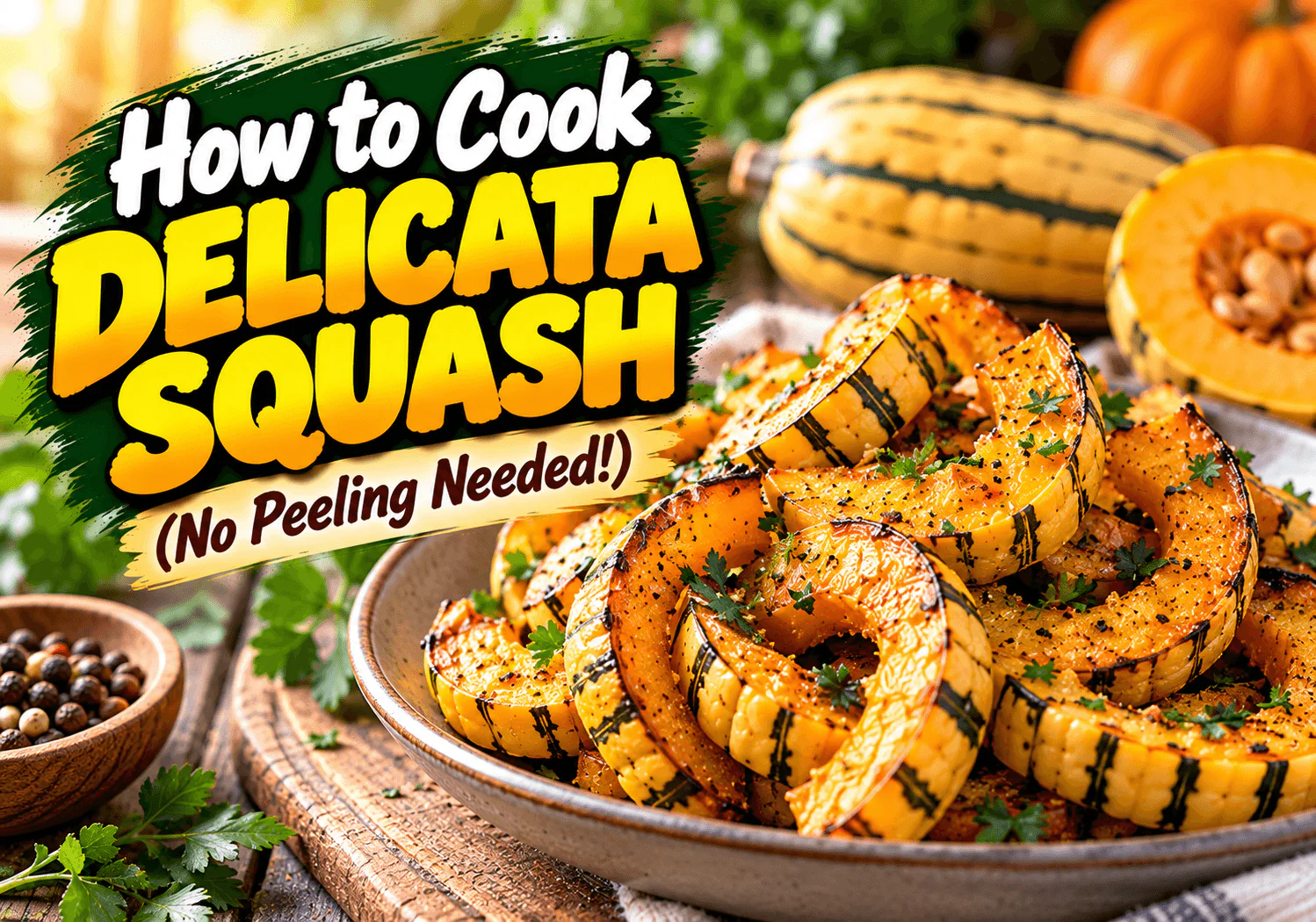
If you’ve ever wrestled a butternut squash with a vegetable peeler, delicata will feel like a gift. Its thin, striped skin softens in the oven, so you can skip peeling altogether. In this guide, you’ll learn how to cook delicata squash five ways: roasted, air-fried, stuffed, sautéed, and microwaved. You’ll also learn how to pick a good one, how to cut it safely, what it offers nutritionally, and a few safety points worth knowing before you cook.
Key Takeaways
- No peeling needed. Delicata’s skin is thin and becomes tender when cooked, so you can eat it.
- Fastest method: roast half-moon slices at 425°F for 20–25 minutes, flipping once.
- Other options: air fryer (about 12–15 minutes), stuffed halves, a quick sauté, or the microwave.
- Nutrition: USDA data for baked winter squash show about 76 calories, 5.7 g of fiber and more than half a day’s vitamin A in one cup.
- Cook it with a little fat. The carotenoids in orange vegetables are absorbed better when eaten with fat.
- Safety: throw away any squash that tastes unusually bitter, and wear gloves if raw squash irritates your skin.
What Is Delicata Squash?
Delicata is a small, oblong winter squash with cream-colored skin and green or orange stripes. It usually weighs about a pound, which makes it one of the easiest winter squashes to handle in a home kitchen. Botanically it belongs to Cucurbita pepo, the same species as acorn squash and zucchini.
It’s an heirloom from the 1800s that has made a comeback. North Dakota State University Extension calls it “sweet as honey,” with orange, fairly dry flesh and a nutty flavor, and notes that its skin is “easy to cut, tender and edible―this is rare among winter squashes”. That edible skin is the reason you don’t need to peel it.
If you’re new to the wider squash family, our winter squash guide compares delicata with acorn, butternut, kabocha and spaghetti squash.
What does delicata squash taste like?
Expect a mild, sweet flavor somewhere between sweet potato and butternut squash, with a slightly nutty edge. Roasting brings out caramelized, browned edges, and the skin turns soft with a little chew.
Delicata Squash Nutrition at a Glance
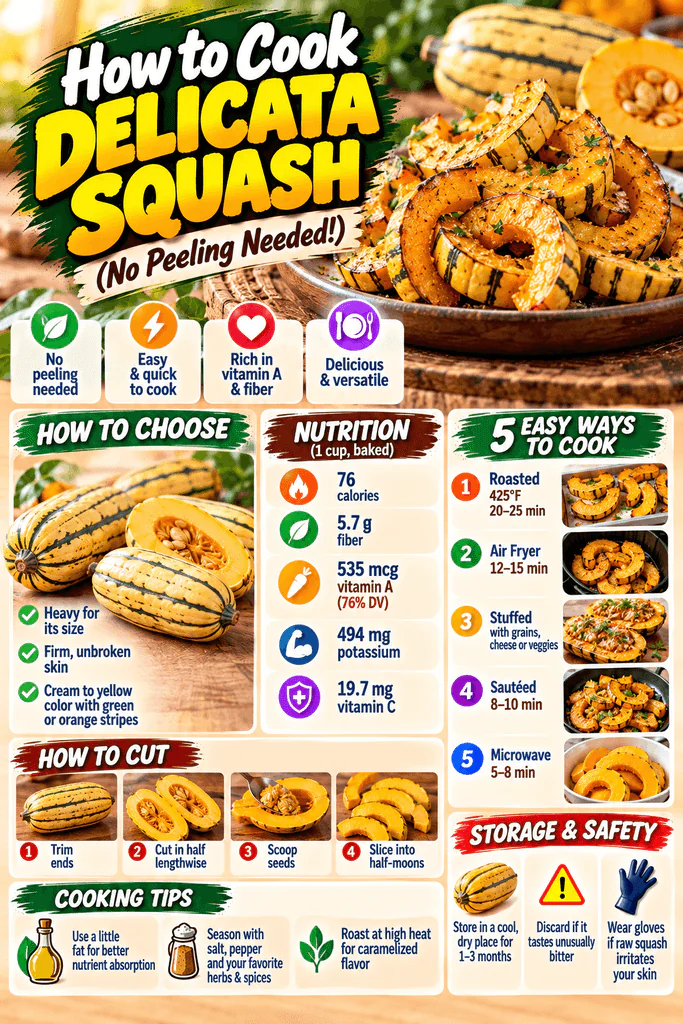
USDA FoodData Central doesn’t list delicata on its own, so the closest official data come from the entry for winter squash, all varieties, baked, without salt. One cup of cubes (about 205 g) provides:
| Nutrient (1 cup, baked) | Amount | How it compares |
| Calories | 76 kcal | Low for a filling side dish |
| Carbohydrates | 18 g | Includes about 6.8 g natural sugars |
| Dietary fiber | 5.7 g | About a fifth of the 25–35 g daily target |
| Protein | 1.8 g | Small amount |
| Vitamin A (RAE) | 535 mcg | ~76% of the RDA for women, ~59% for men |
| Potassium | 494 mg | ~19% of women’s and ~15% of men’s daily needs |
| Vitamin C | 19.7 mg | ~26% of the RDA for women |
| Magnesium | 26.7 mg | A modest contribution |
The percentages use the NIH vitamin A fact sheet (RDA of 700 mcg RAE for women and 900 mcg for men), the NIH potassium fact sheet (2,600 mg for women and 3,400 mg for men) and the NIH vitamin C fact sheet (75 mg for women and 90 mg for men). Exact values for delicata will vary with variety, growing conditions and how long the squash was stored. For a deeper breakdown, see our article on whether delicata squash is healthy.
How to Choose and Store Delicata Squash
A good delicata makes cooking easier and tastier. Look for these signs at the store or market:
- Heavy for its size. Purdue Extension advises choosing squash that feels heavy and avoiding ones with moist, black or shriveled stems.
- Firm, unbroken skin. Montana State University Extension recommends avoiding squash with cuts, moldy spots, sunken areas or punctures.
- Cream to yellow background color. Green-tinged skin can mean it was picked early, while deep yellow usually means a riper, sweeter squash.
How to store delicata squash
Whole delicata keeps best in a cool, dry place, not the refrigerator. Purdue Extension suggests 50–60°F for winter squash and notes that delicata-type squash is best within a month or two of harvest. That’s shorter than thick-skinned varieties like butternut, because the thinner skin protects it less. Once cut, wrap the pieces and refrigerate them, and cook within a few days.
How to Prep Delicata Squash (No Peeler Required)
The first step in learning how to cook delicata squash is the prep, and it takes about five minutes. You only need a sharp chef’s knife, a cutting board and a spoon.
- Wash and dry. Scrub the skin under running water, since you’ll be eating it. Dry it well so it doesn’t slip.
- Trim the ends. Cut a thin slice off each end to create flat surfaces.
- Halve lengthwise. Stand the squash on one flat end, or lay it on its side, and cut down the middle from end to end.
- Scoop the seeds. Use a spoon to scrape out the seeds and stringy pulp. Save the seeds if you’d like to roast them.
- Slice. For roasting, lay each half cut-side down and slice into ½-inch half-moons. For stuffing, leave the halves whole.
Compared with peeling and cubing a large, hard squash, this is much quicker. If you’d like to see the difference, our guide to cutting butternut squash shows the extra steps a thick-skinned squash needs.
How to Cook Delicata Squash: 5 Easy Methods
Here’s a quick comparison before we go method by method.
| Method | Temperature / heat | Time | Best for |
| Oven-roasted half-moons | 425°F | 20–25 min | Caramelized edges, meal prep |
| Air fryer | 400°F | 12–15 min | Small batches, extra crispy |
| Stuffed halves | 400°F | 30–40 min total | Main dishes |
| Pan-sautéed | Medium-high | 8–12 min | Quick weeknight side |
| Microwave | High | 5–8 min | Fastest, softest texture |
1. Roasted delicata squash (the classic)
Roasting is the most popular way to cook delicata, and for good reason: the natural sugars caramelize and the skin turns tender.
- Heat the oven to 425°F and line a sheet pan with parchment.
- Toss the half-moons with 1–2 tablespoons of oil, ½ teaspoon of salt and a pinch of pepper.
- Spread them out in a single layer with space between pieces. Crowding makes them steam instead of brown.
- Roast for 10–12 minutes, flip, then roast another 10–12 minutes until golden and fork-tender.
Olive oil and avocado oil both work well at this temperature. If you’re unsure which oil to use, read our guide on whether olive oil is good for cooking.
2. Delicata squash in the air fryer
The air fryer gives you crisp edges in less time, which makes it ideal for one or two servings.
- Heat the air fryer to 400°F.
- Toss half-moons with 2 teaspoons of oil and your seasoning.
- Cook in a single layer for 12–15 minutes, shaking the basket halfway through.
If you’re still learning your machine, our air fryer recipes for beginners cover basic times and temperatures.
3. Stuffed delicata squash halves
The boat shape of a halved delicata is perfect for stuffing, which turns it into a full meal. NDSU Extension notes its shape makes it easy to stuff with ground meat, grains, nuts, cheese or other vegetables.
- Brush the cut sides with oil and roast the halves cut-side down at 400°F for 15–20 minutes.
- Meanwhile, cook your filling, such as quinoa with sautéed onions, beans and herbs, or lean ground turkey with spinach.
- Flip the halves, spoon in the filling, top with a little cheese if you like, and bake another 10–15 minutes.
4. Pan-sautéed delicata
The stovetop is the fastest way to get browned squash.
- Heat 1 tablespoon of oil in a large skillet over medium-high heat.
- Add half-moons in a single layer and cook 4–5 minutes without stirring.
- Flip, lower the heat to medium, and cook another 4–6 minutes until tender. Add a splash of water and cover for a minute if the pieces brown before softening.
5. Microwave delicata
The microwave won’t caramelize, but it’s fast. Purdue Extension’s general guidance for winter squash is 5–20 minutes in the microwave, depending on size. For a delicata, place the halves cut-side down in a microwave-safe dish with 2 tablespoons of water, cover, and cook on high for 5–8 minutes until fork-tender.
How do you know when delicata squash is done?
It’s ready when a fork slides easily through the flesh and skin, and the edges are golden or lightly charred. Undercooked delicata skin can feel chewy, so give it another few minutes if it resists.
Seasoning Ideas: Sweet and Savory
Delicata’s mild sweetness pairs with almost anything. Try one of these combinations:
| Style | Seasoning (per 1 squash) | Finish with |
| Classic savory | Salt, pepper, garlic powder | Fresh thyme or parsley |
| Smoky | Smoked paprika, cumin, chili flakes | Squeeze of lime |
| Warm and sweet | Cinnamon, nutmeg, pinch of salt | Drizzle of maple syrup |
| Italian | Dried oregano, garlic | Grated Parmesan |
| Za’atar | Za’atar, lemon zest | Tahini drizzle |
For the warm and sweet version, a small amount of maple syrup goes a long way. Add it in the last five minutes so it caramelizes without burning.
Can you eat delicata squash seeds?
Yes. Rinse the seeds, pat them dry, toss with a little oil and salt, and roast at 325°F for 12–18 minutes until crisp. The method is the same as for pumpkin seeds, which we cover in our guide to roasting a pumpkin.
Health Benefits of Delicata Squash
Like other orange winter squash, delicata brings several useful nutrients to the table. Here’s how each one works in the body.
Rich in beta-carotene (vitamin A)
Orange flesh is a sign of beta-carotene, a plant pigment the body converts into vitamin A. According to the NIH Office of Dietary Supplements, vitamin A is essential for normal vision, because it forms part of rhodopsin, the light-sensitive protein in the retina. It also supports immune function and normal cell growth. The same fact sheet lists winter squash among good food sources. Our article on whether pumpkin is high in vitamin A explains how this works in its orange cousin.
A good source of fiber
One cup of baked winter squash has about 5.7 g of fiber, per USDA data . Harvard’s Nutrition Source notes that adults need at least 25 to 35 grams of fiber per day, but most Americans get only about 15 grams. Fiber helps keep digestion regular, and soluble fiber can slow digestion, which may help prevent sharp rises in blood sugar. Eating the skin, rather than peeling it, keeps the whole vegetable on your plate. If you’re interested in fiber and appetite, read our look at whether a high-fiber diet helps with weight loss.
Potassium for healthy blood pressure
Winter squash provides nearly 500 mg of potassium per cup. The NIH potassium fact sheet explains that higher potassium intakes may help lower blood pressure, partly by relaxing blood vessels and increasing sodium excretion in urine. It also lists acorn squash, a close relative of delicata, as one of the richer food sources.
Vitamin C as an antioxidant
Vitamin C acts as an antioxidant, helps the body make collagen and improves absorption of the iron found in plant foods, according to the NIH vitamin C fact sheet. One cup of baked winter squash gives roughly a quarter of a woman’s daily needs.
Part of a vegetable-rich eating pattern
No single vegetable protects your health on its own. But Harvard’s Nutrition Source reports that diets rich in vegetables and fruits can lower blood pressure and reduce the risk of heart disease and stroke, and it recommends eating a variety of colors, including yellow and orange produce.
How to Get the Most Nutrition From Delicata Squash
How you cook delicata squash can affect how much of its nutrition you absorb.
- Pair it with a little fat. Beta-carotene is fat-soluble. In a 2004 study in the American Journal of Clinical Nutrition, people absorbed almost no carotenoids from a salad eaten with fat-free dressing, and much more with full-fat dressing. That study used salad vegetables rather than squash, but roasting with a tablespoon of oil follows the same principle.
- Roast or air-fry rather than boil. The NIH vitamin C fact sheet notes that vitamin C is water-soluble and sensitive to heat, so cooking, especially in water, can reduce it. Dry-heat methods avoid losing nutrients into cooking water.
- Keep the skin on. Not peeling saves time and keeps the whole vegetable intact.
- Don’t store it for months. Prolonged storage can also reduce vitamin C, and Purdue Extension notes that delicata is best within a month or two of harvest.
Who Benefits Most From Delicata Squash?
Delicata can fit into most eating patterns, but it’s especially useful for:
- People who eat too few vegetables. A 2022 CDC report found that only about 10% of US adults met vegetable intake recommendations. An easy, no-peel squash removes a common excuse.
- Beginner cooks. It’s small, quick to cut and hard to get wrong.
- People watching calories. At about 76 calories per cup, it adds volume and fiber to a meal.
- Anyone trying to eat more red and orange vegetables. MyPlate recommends about 5½ to 6 cups a week of red and orange vegetables for most adults under 51, and counts 1 cup of cooked, cubed winter squash as one cup.
If you manage diabetes, winter squash is a starchy vegetable with about 18 g of carbohydrate per cup, so count it in your meal plan. Our collection of pumpkin recipes for diabetics shows how to build balanced meals around winter squash.
Risks, Side Effects and Who Should Be Cautious
Delicata is a safe, everyday food for most people. Still, a few situations call for care.
Bitter squash: throw it out
Rarely, squash can contain high levels of bitter compounds called cucurbitacins, usually from cross-pollination with ornamental gourds. A study of 353 cases from French Poison Control Centers found that eating non-edible, bitter squash mainly caused vomiting, diarrhea and abdominal pain, sometimes with dehydration. No cases were fatal, but the authors recommend disposing of any squash with a bitter taste. If a piece of cooked delicata tastes unusually bitter, stop eating and discard the rest.
Skin irritation when handling raw squash
Some people develop dry, tight or peeling skin on their hands after handling raw winter squash. A 2022 case report in Case Reports in Dermatology described this reaction after peeling butternut squash, and a 2024 case report in Cureus described a more severe reaction in someone who handled butternut squash and later zucchini. Not having to peel delicata means less contact with raw flesh, but if you’ve reacted before, wear kitchen gloves while cutting.
Kidney disease and potassium
People with chronic kidney disease or who take certain medicines may need to limit potassium. The NIH notes that for these individuals, even normal dietary amounts can cause high blood potassium. If you’ve been told to watch potassium, ask your doctor or dietitian about portion sizes.
Orange-tinted skin from carotenoids
Eating very large amounts of beta-carotene-rich foods for a long time can turn the skin yellow-orange. The NIH describes this carotenodermia as harmless and reversible.
How Much Delicata Squash Should You Eat?
A typical serving is about 1 cup cooked, roughly half of a small squash. Most adults need 2 to 3 cups of vegetables a day, according to MyPlate, so a cup of delicata covers a third to half of that. Rotate it with greens, cruciferous vegetables and legumes for variety.
Storing and Reheating Leftovers
Cooked delicata keeps well for meal prep. Follow USDA’s leftover safety guidelines:
- Refrigerate within 2 hours of cooking (1 hour if it’s above 90°F).
- Eat refrigerated leftovers within 3 to 4 days.
- Freeze for longer storage; quality is best within 3 to 4 months.
- Reheat to 165°F.
For crispy reheated squash, use a 400°F oven or air fryer for 5–8 minutes instead of the microwave. Cold roasted delicata is also tasty in grain bowls and salads, such as a kale salad with roasted squash, with delicata in place of butternut.
Myths vs. Facts About Delicata Squash
| Myth | Fact |
| You have to peel all winter squash. | Delicata’s skin is thin and edible, according to NDSU Extension. Just wash it well. |
| Winter squash keeps for months, so delicata does too. | Thin-skinned delicata is best within a month or two of harvest. |
| Boiling is the healthiest way to cook vegetables. | Boiling can leach vitamin C into the water. Roasting, air-frying or steaming keeps more in the squash. |
| Adding oil cancels out the health benefits. | A little fat helps you absorb fat-soluble carotenoids like beta-carotene. |
| A bitter squash is just a bad batch; you can eat around it. | Bitterness can signal cucurbitacins, so discard bitter squash. |
How Delicata Fits a Healthy Lifestyle
Knowing how to cook delicata squash in bulk makes it easy to fold into everyday meals. Roast a full sheet pan on Sunday and use it all week: as a side with chicken or fish, tossed into salads, or puréed into soup.
If you enjoy delicata, try other winter squashes as the season goes on. Acorn squash has a similar texture and cooks in about the same time; see our guide on how to cook acorn squash.
Frequently Asked Questions
Do you have to peel delicata squash?
No. Delicata has thin, tender skin that softens during cooking and is completely edible. Wash it well, trim the ends, scoop out the seeds and slice. If a spot on the skin looks woody or damaged, trim just that area rather than peeling the whole squash.
How long do you roast delicata squash at 425°F?
Roast ½-inch half-moons for 20–25 minutes total, flipping halfway through. They’re done when the flesh is fork-tender and the edges are golden brown. Spread the slices in a single layer with space between them; crowding traps steam and stops the squash from caramelizing.
Can you cook delicata squash in an air fryer?
Yes. Toss half-moon slices with a little oil and seasoning, then air-fry at 400°F for 12–15 minutes, shaking the basket halfway. Cook in a single layer and work in batches for the crispiest results. It’s a good option when you’re cooking one or two servings.
Can you eat delicata squash seeds?
Yes. Rinse the seeds to remove the pulp, pat them dry, toss with oil and salt, and roast at 325°F for 12–18 minutes until crisp. They’re smaller than pumpkin seeds, so check them early. Enjoy them as a snack or a crunchy topping for salads and soups.
How long does delicata squash last?
Whole delicata keeps best in a cool, dry place around 50–60°F and is best used within a month or two of harvest. Cut raw squash should be refrigerated and cooked within a few days. Cooked leftovers last 3 to 4 days in the refrigerator.
Is delicata squash healthy?
Yes. Like other orange winter squash, it provides beta-carotene (vitamin A), fiber, potassium and vitamin C, with about 76 calories per cooked cup. Eating the skin keeps the whole vegetable intact. People who need to limit potassium should check portion sizes with their doctor.
Conclusion
Once you know how to cook delicata squash, it becomes one of the easiest vegetables in your fall rotation. There’s no peeling, it’s ready in about 25 minutes, and it works roasted, air-fried, stuffed, sautéed or microwaved. For the best results, roast it at 425°F in a single layer with a little oil. That fat also helps your body absorb its beta-carotene.
Nutritionally, delicata brings vitamin A, fiber, potassium and vitamin C to your plate for very few calories. Just discard any squash that tastes bitter, wear gloves if raw squash bothers your skin, and check with your doctor about potassium if you have kidney disease.
Medical disclaimer: This article is for general information only and isn’t a substitute for professional medical advice. If you have a health condition, such as kidney disease or diabetes, or take medications that affect potassium, talk with your doctor or a registered dietitian before making significant changes to your diet.
3. References
- U.S. Department of Agriculture, Agricultural Research Service. “Squash, winter, all varieties, cooked, baked, without salt.” FoodData Central (SR Legacy). https://fdc.nal.usda.gov/food-details/170490/nutrients
- NIH Office of Dietary Supplements. “Vitamin A and Carotenoids: Fact Sheet for Health Professionals.” National Institutes of Health. https://ods.od.nih.gov/factsheets/VitaminA-HealthProfessional/
- NIH Office of Dietary Supplements. “Potassium: Fact Sheet for Health Professionals.” National Institutes of Health. https://ods.od.nih.gov/factsheets/Potassium-HealthProfessional/
- NIH Office of Dietary Supplements. “Vitamin C: Fact Sheet for Health Professionals.” National Institutes of Health. https://ods.od.nih.gov/factsheets/VitaminC-HealthProfessional/
- Harvard T.H. Chan School of Public Health. “Fiber.” The Nutrition Source. https://nutritionsource.hsph.harvard.edu/carbohydrates/fiber/
- Harvard T.H. Chan School of Public Health. “Vegetables and Fruits.” The Nutrition Source. https://nutritionsource.hsph.harvard.edu/what-should-you-eat/vegetables-and-fruits/
- U.S. Department of Agriculture. “Vegetables.” MyPlate. https://www.myplate.gov/eat-healthy/vegetables
- Lee SH, Moore LV, Park S, Harris DM, Blanck HM. “Adults Meeting Fruit and Vegetable Intake Recommendations — United States, 2019.” MMWR Morbidity and Mortality Weekly Report, Centers for Disease Control and Prevention, 2022;71(1):1–9. https://www.cdc.gov/mmwr/volumes/71/wr/mm7101a1.htm
- Brown MJ, Ferruzzi MG, Nguyen ML, et al. “Carotenoid bioavailability is higher from salads ingested with full-fat than with fat-reduced salad dressings as measured with electrochemical detection.” American Journal of Clinical Nutrition, 2004. https://pubmed.ncbi.nlm.nih.gov/15277161/
- Le Roux G, Leborgne I, Labadie M, et al. “Poisoning by non-edible squash: retrospective series of 353 patients from French Poison Control Centers.” Clinical Toxicology, 2018. https://pubmed.ncbi.nlm.nih.gov/29323540/
- Shah S, Feldman SR. “Hand Dermatitis Secondary to Exposure to Butternut Squash.” Case Reports in Dermatology, 2022;14(2):123. https://karger.com/cde/article/14/2/123/821867/Hand-Dermatitis-Secondary-to-Exposure-to-Butternut
- Ravichandran KR, Revankar P, Rahnama-Moghadam S. “Hand and Foot Dermatitis Secondary to Zucchini Exposure.” Cureus, 2024;16(5):e60359. https://pmc.ncbi.nlm.nih.gov/articles/PMC11178144/
- Kalb T. “Delicata Squash: The Super Sweet Winter Squash.” North Dakota State University Extension, 2021 (revised 2024). https://ndsu.edu/agriculture/node/921
- Purdue University Cooperative Extension Service. “Winter Squash.” FoodLink. https://extension.purdue.edu/foodlink/includes/pubs/Print1perpaper/Seasonal/Winter_Squash.pdf
- Montana State University Extension. “Winter Squash.” Food $ense Fact Sheet, 2015. https://montanapbs.montana.edu/extension/nutrition/nutrition-cooking-culture/documents/WinterSquashFFS.pdf
- U.S. Department of Agriculture, Food Safety and Inspection Service. “Leftovers and Food Safety.” https://www.fsis.usda.gov/food-safety/safe-food-handling-and-preparation/food-safety-basics/leftovers-and-food-safety