Pumpkin often gets called a “high-fiber food,” usually in a fall recipe or a constipation remedy. But how much fiber is actually in it, and how does it stack up against broccoli, carrots, sweet potatoes or beans? Does pumpkin have fiber? Yes, but the amount depends heavily on which form you eat. Plain canned pumpkin is one of the more fiber-rich vegetables per cup. Boiled fresh pumpkin has much less.
This guide gives you the exact fiber numbers from USDA data, compares pumpkin side by side with other common vegetables, explains why canned and fresh differ so much, and shows practical ways to use pumpkin to meet your daily fiber goal.
Key Takeaways
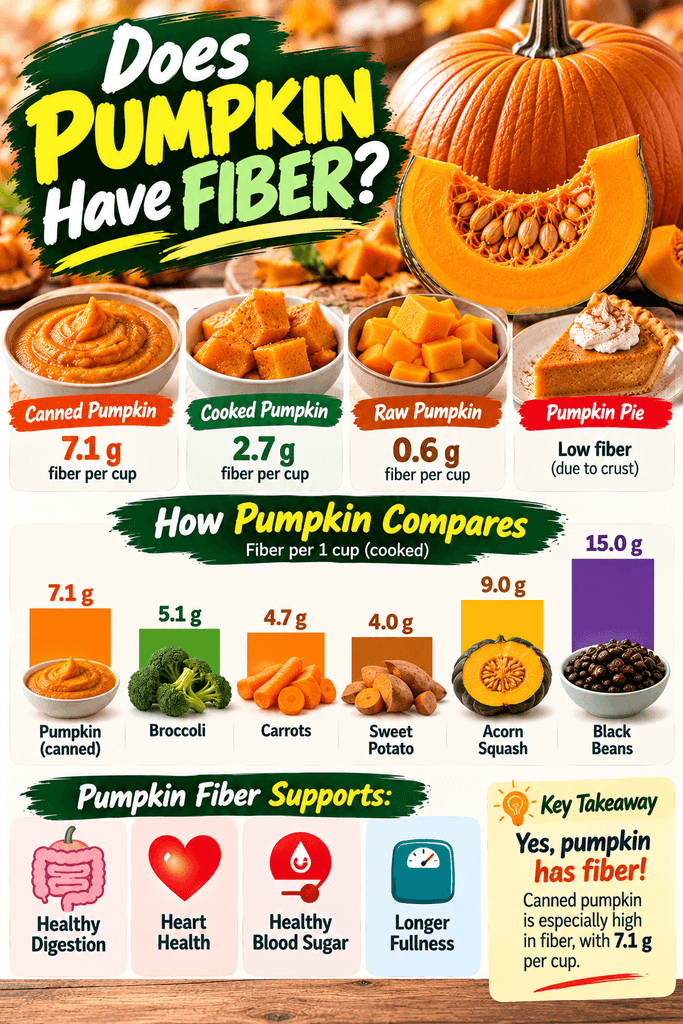
- Canned pumpkin: about 7.1 g fiber per cup, 25% of the Daily Value.
- Cooked fresh pumpkin: about 2.7 g fiber per cup. It’s mostly water, so it has less fiber per cup.
- Per calorie, canned pumpkin is about as fiber-dense as carrots and close to broccoli.
- Beans and some winter squashes (acorn, Hubbard) have more fiber per cup than pumpkin.
- Most adults need about 21–38 g of fiber a day, and many fall short.
- Increase fiber gradually and drink plenty of fluids to avoid gas and bloating.
What Is Dietary Fiber?
Dietary fiber is the part of plant foods your body can’t fully digest. Instead of being absorbed, it passes through your digestive system, where it does several useful jobs.
According to Mayo Clinic, there are two main types:
- Soluble fiber dissolves in water and forms a gel-like material that slows digestion. It’s found in oats, beans, apples and citrus, and it can help lower cholesterol and blood sugar.
- Insoluble fiber doesn’t dissolve in water. It adds bulk to stool and helps material move through the digestive system. Whole-wheat flour, nuts and many vegetables are good sources.
Like most vegetables, pumpkin contains a mix of both. USDA FoodData Central reports total dietary fiber for pumpkin but doesn’t break it down into soluble and insoluble fiber, so we focus on total fiber here.
Does Pumpkin Have Fiber? The Numbers
Here’s how much fiber is in each form of pumpkin, according to USDA FoodData Central records for raw, cooked and canned pumpkin:
| Pumpkin form | Serving | Fiber | % Daily Value | Calories |
| Canned, no salt | 1 cup (245 g) | 7.1 g | 25% | 83 |
| Canned, no salt | ½ cup (122 g) | 3.6 g | 13% | 42 |
| Cooked, boiled, mashed | 1 cup (245 g) | 2.7 g | 10% | 49 |
| Raw, cubed | 1 cup (116 g) | 0.6 g | 2% | 30 |
% DV is based on the FDA’s Daily Value for fiber of 28 grams.
The FDA considers a food with 20% DV or more per serving a high source of a nutrient. By that measure, a full cup of canned pumpkin is high in fiber, ½ cup is a good contribution, and fresh boiled pumpkin is a modest source.
For the full nutrient panel, including vitamins and minerals, see our pumpkin nutrition facts.
Why Canned Pumpkin Has More Fiber Than Fresh
At first glance it seems backwards: how can processed pumpkin have more than twice the fiber of fresh? The answer is water.
| Per 100 g | Water | Fiber |
| Raw pumpkin | 91.6 g | 0.5 g |
| Cooked, boiled pumpkin | 93.7 g | 1.1 g |
| Canned pumpkin | 90.0 g | 2.9 g |
Canned pumpkin is cooked down and packed densely, while boiled pumpkin absorbs and holds water. A cup of canned pumpkin therefore contains much more actual pumpkin, and more fiber.
Does processing destroy fiber? Not much. A University of California, Davis review published in the Journal of the Science of Food and Agriculture found that “changes in fiber during processing, storage, and cooking appear to be minimal.” The same review found that products with peels removed had less fiber than their unpeeled forms.
Bottom line: plain canned pumpkin is one of the easiest ways to get pumpkin’s fiber. Learn what to look for on the label in is canned pumpkin healthy.
How Pumpkin Compares to Other Vegetables
Here’s pumpkin’s fiber compared with common vegetables, per one-cup cooked serving, using USDA FoodData Central data:
| Food (1 cup, cooked) | Fiber | Calories | Fiber per 100 calories |
| Black beans, boiled (172 g) | 15.0 g | 227 | 6.6 g |
| Hubbard squash, baked (205 g) | 10.0 g | 103 | 9.7 g |
| Acorn squash, baked (205 g) | 9.0 g | 115 | 7.8 g |
| Canned pumpkin (245 g) | 7.1 g | 83 | 8.6 g |
| Butternut squash, baked (205 g) | 6.6 g | 82 | 8.0 g |
| Sweet potato, baked (200 g) | 6.6 g | 180 | 3.7 g |
| Broccoli, boiled (156 g) | 5.1 g | 55 | 9.4 g |
| Carrots, boiled (156 g) | 4.7 g | 55 | 8.6 g |
| Spinach, boiled (180 g) | 4.3 g | 41 | 10.4 g |
| Fresh pumpkin, boiled (245 g) | 2.7 g | 49 | 5.5 g |
Sources: USDA FoodData Central records for black beans, Hubbard squash, acorn squash, butternut squash, sweet potato, broccoli, carrots and spinach. Fiber per 100 calories is calculated from the USDA values.
What the Comparison Shows
- Per cup, beans win easily. Legumes like black beans have about twice canned pumpkin’s fiber per cup. See are black beans healthy.
- Canned pumpkin holds its own among vegetables. It has more fiber per cup than broccoli, carrots or spinach, and about the same as butternut squash and sweet potato.
- Per calorie, pumpkin is efficient. Canned pumpkin delivers about 8.6 g fiber per 100 calories, the same as carrots and more than twice sweet potato’s 3.7 g. If you’re watching calories, that’s useful.
- Some winter squashes beat pumpkin. Acorn and Hubbard squash have more fiber per cup. Learn more in is acorn squash healthy.
- Fresh boiled pumpkin is the weakest option for fiber per cup, because of its high water content.
Want to compare more? See does broccoli have fiber, are carrots healthy and are sweet potatoes healthy.
How Much Fiber Do You Need?
According to Mayo Clinic, citing the National Academy of Medicine, daily fiber recommendations are:
| Group | Daily fiber |
| Women 50 and younger | 25 g |
| Women over 50 | 21 g |
| Men 50 and younger | 38 g |
| Men over 50 | 30 g |
The National Institute of Diabetes and Digestive and Kidney Diseases gives a similar range of 22 to 34 grams a day for adults, depending on age and sex. The Harvard T.H. Chan School of Public Health notes that most people eat far less fiber than recommended.
Where pumpkin fits: A ½-cup serving of canned pumpkin (3.6 g) covers about 14% of a 25-gram target. A full cup (7.1 g) covers more than a quarter.
Health Benefits of Pumpkin’s Fiber
Pumpkin’s fiber contributes to the same benefits as fiber from other whole foods. According to Mayo Clinic, a high-fiber diet:
Supports Regular Bowel Movements
Fiber adds weight and size to stool and softens it, making it easier to pass. This can help prevent constipation.
May Help Lower Cholesterol
Soluble fiber may help lower total and LDL (“bad”) cholesterol levels.
Helps Control Blood Sugar
Soluble fiber slows the absorption of sugar, which can help improve blood sugar levels.
Helps With Weight Management
High-fiber foods tend to be more filling, so you may eat less and stay satisfied longer. Pumpkin’s low calorie count adds to this effect. Read more in our article on whether a high-fiber diet is good for weight loss.
Linked With Lower Disease Risk
Mayo Clinic and Harvard both note that higher fiber intake is associated with lower risk of heart disease, type 2 diabetes and colorectal cancer.
For pumpkin’s other benefits, such as vitamin A and potassium, see is pumpkin healthy.
Is Pumpkin Good for Constipation?
Pumpkin can help as part of a fiber-rich diet. The NIDDK recommends eating more high-fiber foods, including vegetables, fruits, whole grains and legumes, to help relieve and prevent constipation, along with drinking enough water and other liquids.
A ½ to 1 cup of canned pumpkin adds 3.6–7.1 g of fiber. That’s helpful, but it’s not a quick fix on its own. Pumpkin works best alongside other fiber sources throughout the day: oatmeal at breakfast, beans at lunch, vegetables at dinner. See also is oatmeal high in fiber.
If constipation is severe, lasts more than a few weeks, or comes with pain, bleeding or weight loss, see a healthcare provider.
Don’t Forget the Seeds
Pumpkin seeds are a concentrated fiber source. According to USDA data for roasted pumpkin seed kernels, one ounce provides about 2 grams of fiber, along with 8 grams of protein and plenty of magnesium. They’re calorie-dense, about 160 calories an ounce, so a small handful is a serving. Learn more in are pumpkin seeds healthy.
Tips for Adding Pumpkin Fiber to Your Diet
Increase fiber slowly. Both Mayo Clinic and the NIDDK advise adding fiber gradually so your digestive system can adjust, which helps limit gas and bloating. Mayo Clinic also stresses drinking plenty of water, because fiber works best when it absorbs water.
Easy ways to use canned pumpkin for fiber:
- Breakfast: Stir ½ cup into oatmeal (about 3.6 g fiber from the pumpkin alone) with cinnamon.
- Smoothies: Blend ¼–½ cup pumpkin with yogurt, banana and spices. See is yogurt good for gut health.
- Chili and soups: Add a cup of pumpkin to bean chili to stack two fiber sources.
- Pasta sauce: Blend pumpkin into tomato or cream sauces.
- Baking: Replace some of the oil or butter in muffins and quick breads with pumpkin puree.
- Toppings: Sprinkle roasted pumpkin seeds on salads, soups and yogurt.
Who Should Be Careful With Extra Fiber
- People with digestive conditions such as inflammatory bowel disease, strictures or recent bowel surgery may need to follow a specific fiber plan. Ask your doctor.
- People increasing fiber quickly may get gas, bloating or cramping. Go slowly and drink fluids.
- People with chronic kidney disease should note that pumpkin is also a source of potassium and check portions with their dietitian.
- People relying on fiber supplements: Mayo Clinic recommends getting fiber from whole foods when possible, because foods also provide vitamins, minerals and other nutrients supplements lack.
Pumpkin Fiber Myths vs. Facts
Myth: Pumpkin is one of the highest-fiber foods.
Fact: Canned pumpkin is high in fiber for a vegetable, but beans, lentils and some winter squashes provide more per cup.
Myth: Fresh pumpkin has more fiber than canned.
Fact: Per cup, canned pumpkin has about 7.1 g of fiber versus 2.7 g for boiled fresh pumpkin, because it contains less water.
Myth: Cooking or canning destroys fiber.
Fact: Research shows fiber changes very little during processing and cooking.
Myth: Pumpkin pie is a good fiber source.
Fact: Pie contains some pumpkin fiber, but it comes with added sugar and refined flour. Plain pumpkin is the better choice.
Myth: You can’t get too much fiber too fast.
Fact: A sudden jump in fiber can cause gas and bloating. Increase it gradually and drink water.
Frequently Asked Questions
How much fiber is in canned pumpkin?
According to USDA data, one cup of plain canned pumpkin has about 7.1 grams of fiber, or 25% of the Daily Value. A half-cup serving, the typical label serving, has about 3.6 grams. Choose cans labeled 100% pumpkin, not pumpkin pie mix, which contains added sugar.
Is pumpkin good for constipation?
Pumpkin can help as part of a high-fiber diet. A half cup of canned pumpkin adds about 3.6 grams of fiber. For constipation, the NIDDK recommends eating a variety of high-fiber foods and drinking enough fluids. See a doctor if constipation is severe or lasts several weeks.
Does pumpkin have more fiber than sweet potato?
Per cup, canned pumpkin and baked sweet potato have similar fiber, about 7 grams each. Canned pumpkin has far fewer calories, though: about 83 per cup versus 180 for sweet potato. Fresh boiled pumpkin has less fiber than either, at about 2.7 grams per cup.
Which vegetable has the most fiber?
Among the foods compared here, black beans lead with about 15 grams per cup. Hubbard and acorn squash follow, at roughly 9 to 10 grams per cup. Canned pumpkin, butternut squash and sweet potato each provide about 7 grams per cup, more than broccoli, carrots or spinach.
Does cooking pumpkin reduce its fiber?
Cooking has little effect on fiber. Research from UC Davis found minimal fiber changes during cooking and processing. Boiled pumpkin looks lower in fiber per cup only because it absorbs water, which dilutes the fiber. Canned pumpkin is more concentrated.
Do pumpkin seeds have fiber?
Yes. According to USDA data, one ounce of roasted pumpkin seed kernels provides about 2 grams of fiber, plus 8 grams of protein and a lot of magnesium. They’re calorie-dense at about 160 calories per ounce, so keep portions to a small handful.
Conclusion
So, does pumpkin have fiber? Yes, especially canned pumpkin. One cup of plain canned pumpkin provides about 7.1 grams of fiber, a quarter of the Daily Value, for only 83 calories. That’s more per cup than broccoli, carrots or spinach and about the same as butternut squash and sweet potato. Fresh boiled pumpkin is much lower, at about 2.7 grams per cup, because of its water content. Beans and squashes like acorn and Hubbard offer even more. Use pumpkin as one of several fiber sources, increase fiber gradually, drink plenty of fluids, and choose plain pumpkin over pie mix.
Medical disclaimer: This article is for general educational purposes only and is not a substitute for professional medical advice, diagnosis or treatment. If you have a digestive condition, chronic constipation or kidney disease, talk with your doctor or a registered dietitian before making significant changes to your diet.
(3) References
- U.S. Department of Agriculture. “Pumpkin, raw” (FDC ID 168448). FoodData Central. https://fdc.nal.usda.gov/fdc-app.html#/food-details/168448/nutrients
- U.S. Department of Agriculture. “Pumpkin, cooked, boiled, drained, without salt” (FDC ID 168449). FoodData Central. https://fdc.nal.usda.gov/fdc-app.html#/food-details/168449/nutrients
- U.S. Department of Agriculture. “Pumpkin, canned, without salt” (FDC ID 168450). FoodData Central. https://fdc.nal.usda.gov/fdc-app.html#/food-details/168450/nutrients
- U.S. Department of Agriculture. “Beans, black, mature seeds, cooked, boiled, without salt” (FDC ID 173735). FoodData Central. https://fdc.nal.usda.gov/fdc-app.html#/food-details/173735/nutrients
- U.S. Department of Agriculture. “Squash, winter, hubbard, baked, without salt” (FDC ID 168476). FoodData Central. https://fdc.nal.usda.gov/fdc-app.html#/food-details/168476/nutrients
- U.S. Department of Agriculture. “Squash, winter, acorn, cooked, baked, without salt” (FDC ID 169293). FoodData Central. https://fdc.nal.usda.gov/fdc-app.html#/food-details/169293/nutrients
- U.S. Department of Agriculture. “Squash, winter, butternut, cooked, baked, without salt” (FDC ID 169296). FoodData Central. https://fdc.nal.usda.gov/fdc-app.html#/food-details/169296/nutrients
- U.S. Department of Agriculture. “Sweet potato, cooked, baked in skin, flesh, without salt” (FDC ID 168483). FoodData Central. https://fdc.nal.usda.gov/fdc-app.html#/food-details/168483/nutrients
- U.S. Department of Agriculture. “Broccoli, cooked, boiled, drained, without salt” (FDC ID 169967). FoodData Central. https://fdc.nal.usda.gov/fdc-app.html#/food-details/169967/nutrients
- U.S. Department of Agriculture. “Carrots, cooked, boiled, drained, without salt” (FDC ID 170394). FoodData Central. https://fdc.nal.usda.gov/fdc-app.html#/food-details/170394/nutrients
- U.S. Department of Agriculture. “Spinach, cooked, boiled, drained, without salt” (FDC ID 168463). FoodData Central. https://fdc.nal.usda.gov/fdc-app.html#/food-details/168463/nutrients
- U.S. Department of Agriculture. “Seeds, pumpkin and squash seed kernels, roasted, without salt” (FDC ID 170557). FoodData Central. https://fdc.nal.usda.gov/fdc-app.html#/food-details/170557/nutrients
- U.S. Food and Drug Administration. “Daily Value on the Nutrition and Supplement Facts Labels.” https://www.fda.gov/food/nutrition-facts-label/daily-value-nutrition-and-supplement-facts-labels
- Mayo Clinic Staff. “Dietary fiber: Essential for a healthy diet.” Mayo Clinic. https://www.mayoclinic.org/healthy-lifestyle/nutrition-and-healthy-eating/in-depth/fiber/art-20043983
- Harvard T.H. Chan School of Public Health. “Fiber.” The Nutrition Source. https://nutritionsource.hsph.harvard.edu/carbohydrates/fiber/
- National Institute of Diabetes and Digestive and Kidney Diseases. “Eating, Diet, & Nutrition for Constipation.” https://www.niddk.nih.gov/health-information/digestive-diseases/constipation/eating-diet-nutrition
- Rickman JC, Bruhn CM, Barrett DM. “Nutritional comparison of fresh, frozen, and canned fruits and vegetables II. Vitamin A and carotenoids, vitamin E, minerals and fiber.” Journal of the Science of Food and Agriculture. 2007. https://ucanr.edu/sites/default/files/2010-06/19188.pdf