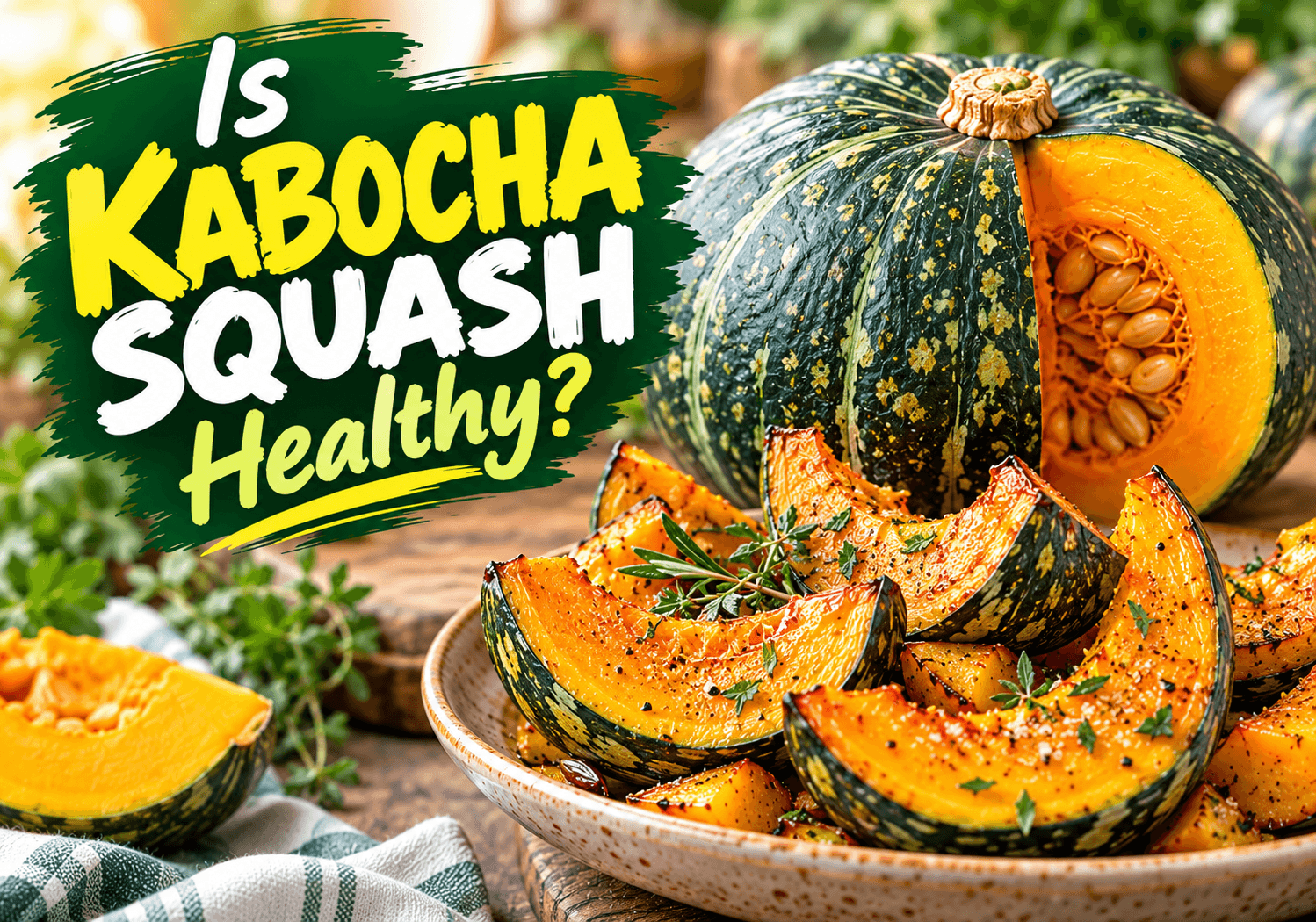
Kabocha is the squat, dark-green squash with bright orange flesh you’ve probably seen in Japanese restaurants, simmered in sweet soy broth or fried as tempura. Often called “Japanese pumpkin,” it’s denser and sweeter than most squash, with a flavor somewhere between sweet potato and roasted chestnut. That sweetness makes people wonder: is kabocha squash healthy, or is it closer to dessert? The short answer is yes, it’s healthy. Kabocha belongs to a squash family known for high carotenoid levels, and research suggests it may be one of the richest squashes in beta-carotene. Like its relatives, it’s also high in fiber.
This guide covers kabocha nutrition, the research behind its benefits, how it compares to butternut and pumpkin, who should watch portions, and the best ways to cook it, skin and all.
Key Takeaways
- Kabocha is a winter squash (Cucurbita maxima), the same species as Hubbard, buttercup and banana squash.
- USDA doesn’t list kabocha separately. Its closest USDA relative, Hubbard squash, has about 103 calories, 10 g fiber and 76% of the Daily Value for vitamin A per cooked cup.
- A 2016 study found kabocha-type squashes had higher carotenoid levels than butternut and more dry matter (denser flesh), and carotenoids increased during storage.
- Kabocha is sweet and starchy, so people managing blood sugar should count it as a carb serving.
- The skin is edible once cooked, so there’s no need to peel it.
- People with kidney disease should watch portions because of its potassium.
What Is Kabocha Squash?
Kabocha (Cucurbita maxima) is a winter squash that originated in the Americas and became a staple of Japanese cooking. “Kabocha” is simply the Japanese word for pumpkin or squash. It’s round and slightly flattened, typically 2–4 pounds, with a hard, dark-green skin (sometimes with pale stripes or bumps) and deep yellow-orange flesh. Red kuri and “sweet mama” are related C. maxima types, and buttercup squash looks very similar but has a small cap on its blossom end.
Compared with butternut or acorn squash, kabocha is drier, denser and sweeter. When cooked, the flesh turns fluffy and velvety, almost like a sweet potato.
For how kabocha fits among other varieties, see our complete winter squash guide.
Kabocha Squash Nutrition
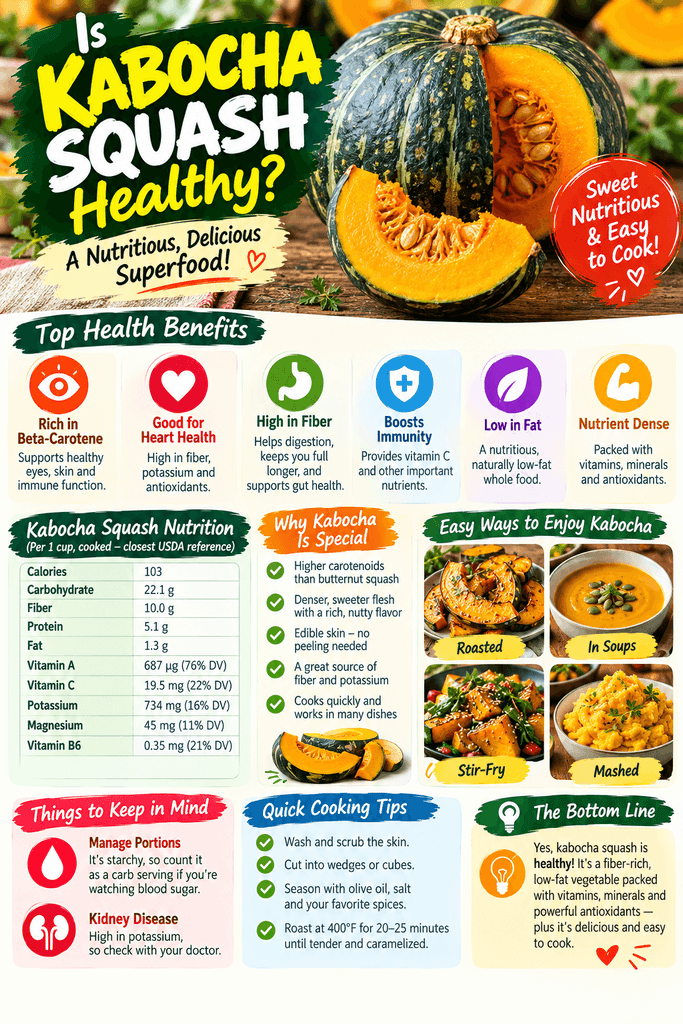
USDA FoodData Central does not list kabocha as a separate food. The closest reliable U.S. data comes from Hubbard squash, which belongs to the same species (C. maxima) and has similarly dense, orange flesh. According to USDA’s record for baked Hubbard squash, one cup of cubes (205 g) provides:
| Nutrient (1 cup, baked) | Hubbard (closest USDA reference) | % Daily Value |
| Calories | 103 | — |
| Carbohydrate | 22.1 g | 8% |
| Fiber | 10.0 g | 36% |
| Total sugars | 10.0 g (natural) | — |
| Protein | 5.1 g | — |
| Fat | 1.3 g | 2% |
| Vitamin A (RAE) | 687 µg | 76% |
| Beta-carotene | 7,339 µg | — |
| Potassium | 734 mg | 16% |
| Vitamin C | 19.5 mg | 22% |
| Vitamin B6 | 0.35 mg | 21% |
| Magnesium | 45 mg | 11% |
| Sodium | 16 mg | 1% |
% DV is based on FDA Daily Values. Kabocha’s exact values vary by variety, growing conditions and storage time. Treat these as estimates.
What Kabocha-Specific Research Shows
Two peer-reviewed studies help fill the gap:
- Carotenoids and density. A University of New Hampshire study in HortScience (2016) compared kabocha and buttercup hybrids (C. maxima) with butternut types (C. moschata). The kabocha types had higher total carotenoid concentrations than the butternut types, both at harvest and after storage. They also had much more dry matter: about 29% versus 19% for butternut. In other words, kabocha flesh is denser and less watery.
- Kabocha vs. pumpkin. A 2005 study in the Korean Journal of Food Science and Technology found kabocha had higher protein and fat content than pumpkin, twice-as-firm flesh, and about 2.1 times more sucrose. That last finding explains its noticeably sweeter taste.
Together, these studies suggest kabocha is a dense, sweet, carotenoid-rich squash, so cup for cup it likely delivers more nutrients, and more calories and carbs, than watery pumpkin.
Is Kabocha Squash Healthy? 6 Benefits
1. Rich in Beta-Carotene and Vitamin A
Kabocha’s deep orange color comes from carotenoids, especially beta-carotene, which the body converts to vitamin A as needed. The NIH Office of Dietary Supplements explains that vitamin A supports normal vision, immune function, and the health of the skin and organs. Its closest USDA relative provides about three-quarters of the Daily Value per cup, and the HortScience study suggests kabocha-type squash may be at least as carotenoid-rich as butternut.
2. Carotenoids May Increase During Storage
The same HortScience study found that carotenoid levels in kabocha-type squash rose substantially during storage, roughly doubling in some cultivars after 60 days. That’s good news: a kabocha that has sat on your counter for a few weeks may be even more nutritious than a freshly harvested one, as long as it’s still firm and sound.
3. High in Fiber
Hubbard squash, kabocha’s closest USDA relative, provides about 10 grams of fiber per cup, more than a third of the Daily Value. Montana State University Extension notes that winter squash is high in complex carbohydrates and fiber. According to the Harvard T.H. Chan School of Public Health, higher fiber intake is linked with better digestion, steadier blood sugar, and lower risk of heart disease and type 2 diabetes.
4. A Source of Potassium
With roughly 700+ mg of potassium per cup in its closest relative, kabocha contributes meaningfully to daily potassium needs. The Office of Dietary Supplements notes that potassium helps balance sodium’s effect on blood pressure, and that many adults don’t get enough.
5. Vitamin C and Vitamin B6
C. maxima squash provides about a fifth of the Daily Value for both vitamin C and vitamin B6 per cup. The Office of Dietary Supplements explains that vitamin C supports collagen production and immune function and improves iron absorption. Vitamin B6 is involved in protein metabolism and immune health.
6. A Satisfying Whole-Food Starch
Kabocha’s dense, sweet flesh makes it filling. It can replace rice, potatoes or bread as the starch in a meal while adding fiber and vitamins. A large 2017 meta-analysis in the International Journal of Epidemiology found that higher fruit and vegetable intake was associated with lower risk of heart disease, cancer and early death. The USDA’s MyPlate counts winter squash among the red and orange vegetables.
Kabocha vs. Butternut vs. Pumpkin
| Feature | Kabocha | Butternut | Pumpkin |
| Species | C. maxima | C. moschata | Usually C. pepo |
| Texture | Dense, dry, fluffy | Smooth, moist | Watery, stringy |
| Sweetness | Very sweet | Sweet | Mild |
| Skin | Edible when cooked | Usually peeled | Small pie pumpkins edible |
| Carotenoids | High (higher than butternut in HortScience study) | High | High |
| USDA data | Not listed (Hubbard closest) | Yes | Yes |
Per cup, butternut squash has about 82 calories and 21.5 g of carbs, according to USDA’s record for baked butternut squash. Kabocha’s denser flesh likely means somewhat more calories and carbs per cup. All three are healthy. Learn more in is butternut squash healthy and is pumpkin healthy, or compare the numbers in our pumpkin nutrition facts.
Who Benefits Most From Kabocha?
- People who want more vitamin A from food. Kabocha is among the most carotenoid-dense squashes.
- Anyone looking for a satisfying starch. Its dense, sweet flesh is filling and can replace potatoes or rice.
- People who need more fiber. C. maxima squash is among the highest-fiber vegetables per cup.
- Busy cooks. No peeling needed, and kabocha steams or microwaves quickly.
- Kids and picky eaters. Its natural sweetness makes it easy to like without added sugar.
Risks and Who Should Be Cautious
Blood Sugar and Carbs
Kabocha is a starchy, naturally sweet vegetable, and the Korean study found it has more sucrose than pumpkin. People with diabetes should count kabocha as a carbohydrate serving, keep portions to about ½ to 1 cup, and pair it with protein and healthy fat. It doesn’t fit easily into strict keto diets.
Kidney Disease
Winter squash is high in potassium. The National Institute of Diabetes and Digestive and Kidney Diseases advises that people with chronic kidney disease may need to limit high-potassium foods. Ask your renal dietitian about portions.
Orange-Tinted Skin
Eating large amounts of carotene-rich foods every day can give the skin a yellow-orange tint. An NCBI StatPearls review describes this condition, carotenemia, as harmless and reversible once intake drops.
Sweet and Fried Preparations
Kabocha tempura is deep-fried, and traditional simmered kabocha (kabocha no nimono) is cooked in soy sauce, mirin and sugar. These dishes are delicious but add fat, sodium and sugar. Enjoy them occasionally, and steam or roast kabocha for everyday meals.
Bitter Squash
As with any squash, an unusually bitter taste can signal high levels of natural compounds called cucurbitacins, which can cause stomach upset. If kabocha tastes bitter, don’t eat it.
How Much Kabocha Should You Eat?
A typical serving is ½ to 1 cup of cooked kabocha, about 1/6 to 1/4 of a medium squash. One cup counts as one cup of vegetables toward MyPlate’s recommended 2–4 cups a day for most adults. Adjust portions if you manage diabetes, kidney disease or a low-carb diet.
How to Cook Kabocha Squash
Cutting Kabocha Safely
Kabocha’s hard skin makes it one of the trickiest squashes to cut.
- Wash and scrub the skin under running water. The FDA recommends scrubbing firm produce with a clean brush before cutting. Dry it well.
- Microwave the whole squash for 2–3 minutes to soften the skin. Pierce it a few times first.
- Place it stem-side up on a cutting board set on a damp towel. Cut down beside the stem with a heavy chef’s knife, then rotate and cut the other side.
- Scoop out the seeds and cut the squash into wedges or chunks.
Can You Eat Kabocha Skin?
Yes. Kabocha skin softens completely when steamed, roasted or simmered, and it’s traditionally left on in Japanese cooking. Trim off any rough, bumpy or discolored patches.
Roasted Kabocha Wedges
Toss wedges with olive or sesame oil, salt and pepper, and roast at 425°F (220°C) for 25–30 minutes, until tender and caramelized. Adding a little fat matters: a study in the American Journal of Clinical Nutrition found people absorbed significantly more carotenoids from vegetables eaten with full-fat rather than fat-free dressing. Learn about one flavorful option in is sesame oil healthy.
Steamed or Microwaved
Steam 1–2-inch chunks for 10–15 minutes, or microwave them covered with a splash of water for 5–8 minutes. Steamed kabocha needs little more than a pinch of salt.
Simmered (Lighter Nimono)
Simmer chunks skin-side down in dashi or water with a small amount of soy sauce and mirin until tender. Use less sugar than traditional recipes. Serve alongside a bowl of miso soup for a simple Japanese-style meal.
Soups and Curries
Kabocha’s dense flesh holds its shape in curries and turns velvety in pureed soups. Swap it for butternut in this red lentil and butternut squash curry stew, or add it to a coconut curry. See our take on whether Thai green curry is healthy.
Save the Seeds
Kabocha seeds can be rinsed, dried, tossed with oil and roasted at 300–325°F until golden. Read about their nutrition in are pumpkin seeds healthy.
Buying and Storing Kabocha
- Choose a kabocha that feels heavy for its size, with a dull, hard, dark-green rind and a dry, corky stem. A yellow-orange patch where it rested on the ground is normal.
- Store whole kabocha in a cool, dry, well-ventilated place. Montana State University Extension notes that winter squash keeps anywhere from 30 to 180 days depending on variety. Given the HortScience findings, a few weeks of storage may even improve its carotenoid content.
- Refrigerate cut kabocha, wrapped, with the seeds removed, and use it within a few days.
- Freeze cooked kabocha in chunks or as a puree for soups and baking.
Kabocha Myths vs. Facts
Myth: Kabocha is too sweet to be healthy.
Fact: Its sweetness comes from natural sugars, and it’s packed with fiber, carotenoids and minerals. Portion size is what matters.
Myth: You have to peel kabocha.
Fact: The skin softens when cooked and is commonly eaten in Japanese cuisine.
Myth: Kabocha and pumpkin are nutritionally identical.
Fact: Research found kabocha is denser, firmer and higher in protein, fat and sucrose than pumpkin.
Myth: Fresher squash is always more nutritious.
Fact: In kabocha-type squash, carotenoids increased during storage.
Myth: Sweet potatoes are a better choice than kabocha.
Fact: Both are dense, sweet, carotenoid-rich starches. Compare them in are sweet potatoes healthy.
How Kabocha Fits a Healthy Lifestyle
Treat kabocha as a nutrient-dense starch: roast or steam it in place of potatoes or rice, pair it with a lean protein and a green vegetable, and use a little oil to help your body absorb its carotenoids. Save tempura and sugar-glazed versions for occasional treats.
Frequently Asked Questions
Is kabocha healthier than butternut squash?
Both are healthy. A 2016 HortScience study found kabocha-type squashes had higher carotenoid levels and denser flesh than butternut types. Butternut is likely lower in calories and carbs per cup because it’s more watery. Eating a variety of orange squashes is the best approach.
Is kabocha good for weight loss?
Kabocha can support weight management because it’s high in fiber, which helps you feel full, and it’s very low in fat. It’s denser and sweeter than many vegetables, though, so keep portions to about one cup, prepare it without much added sugar or oil, and pair it with protein.
Is kabocha keto-friendly?
Not really. Kabocha is a starchy squash with naturally high sugar, and its closest USDA relative has about 22 grams of carbohydrate per cup. Small portions may fit a moderate low-carb diet, but kabocha is hard to fit into a strict keto plan.
Can you eat the skin of kabocha squash?
Yes. Kabocha skin is edible and becomes soft and tender when steamed, roasted or simmered. It’s commonly left on in Japanese dishes. Scrub the squash well under running water before cutting, and trim away any rough or discolored spots.
Is kabocha good for people with diabetes?
Kabocha can fit a diabetes meal plan in measured portions. Its fiber helps slow how quickly sugar enters the bloodstream, but it’s naturally sweet and starchy. Count it as a carbohydrate serving, stick to about half to one cup, and pair it with protein and healthy fats.
How long does kabocha squash last?
Whole kabocha stored in a cool, dry, well-ventilated place can last several weeks to a few months. Research found its carotenoid content may even increase during storage. Once cut, refrigerate it and use it within a few days, or freeze cooked kabocha for longer storage.
Conclusion
So, is kabocha squash healthy? Yes. Kabocha is a dense, naturally sweet winter squash with high levels of carotenoids. Research found kabocha types had more carotenoids than butternut and more dry matter, and its closest USDA relative is high in fiber and vitamin A and provides potassium, vitamin C and vitamin B6. USDA hasn’t published kabocha-specific data, so treat exact numbers as estimates. Count it as a starch if you manage blood sugar, watch potassium if you have kidney disease, keep the skin on, and roast, steam or simmer it with a little healthy fat.
Medical disclaimer: This article is for general educational purposes only and is not a substitute for professional medical advice, diagnosis or treatment. If you have a health condition such as diabetes or kidney disease, talk with your doctor or a registered dietitian before making significant changes to your diet.
(3) References
- U.S. Department of Agriculture. “Squash, winter, hubbard, baked, without salt” (FDC ID 168476). FoodData Central, SR Legacy. https://fdc.nal.usda.gov/fdc-app.html#/food-details/168476/nutrients
- U.S. Department of Agriculture. “Squash, winter, butternut, cooked, baked, without salt” (FDC ID 169296). FoodData Central, SR Legacy. https://fdc.nal.usda.gov/fdc-app.html#/food-details/169296/nutrients
- U.S. Food and Drug Administration. “Daily Value on the Nutrition and Supplement Facts Labels.” https://www.fda.gov/food/nutrition-facts-label/daily-value-nutrition-and-supplement-facts-labels
- Bonina-Noseworthy J, Loy JB, Curran-Celentano J, Sideman R, Kopsell DA. “Carotenoid concentration and composition in winter squash: Variability associated with different cultigens, harvest maturities, and storage times.” HortScience. 2016;51(5):472–480. https://journals.ashs.org/downloadpdf/view/journals/hortsci/51/5/article-p472.pdf
- Kim SR, Ha TY, Song HN, Kim YS, Park YK. “Comparison of Nutritional Composition and Antioxidative Activity for Kabocha Squash and Pumpkin.” Korean Journal of Food Science and Technology. 2005;37(2):171–177. https://agris.fao.org/search/ar/records/647244fa08fd68d5460075a5
- Montana State University Extension. “Winter Squash.” 2015. https://exponent.montana.edu/extension/nutrition/nutrition-cooking-culture/documents/WinterSquashFFS.pdf
- NIH Office of Dietary Supplements. “Vitamin A and Carotenoids: Fact Sheet for Health Professionals.” https://ods.od.nih.gov/factsheets/VitaminA-HealthProfessional/
- NIH Office of Dietary Supplements. “Potassium: Fact Sheet for Health Professionals.” https://ods.od.nih.gov/factsheets/Potassium-HealthProfessional/
- NIH Office of Dietary Supplements. “Vitamin C: Fact Sheet for Health Professionals.” https://ods.od.nih.gov/factsheets/VitaminC-HealthProfessional/
- NIH Office of Dietary Supplements. “Vitamin B6: Fact Sheet for Health Professionals.” https://ods.od.nih.gov/factsheets/VitaminB6-HealthProfessional/
- Harvard T.H. Chan School of Public Health. “Fiber.” The Nutrition Source. https://nutritionsource.hsph.harvard.edu/carbohydrates/fiber/
- Aune D, et al. “Fruit and vegetable intake and the risk of cardiovascular disease, total cancer and all-cause mortality—a systematic review and dose-response meta-analysis of prospective studies.” International Journal of Epidemiology. 2017. https://pubmed.ncbi.nlm.nih.gov/28338764/
- U.S. Department of Agriculture. “Vegetables.” MyPlate. https://www.myplate.gov/eat-healthy/vegetables
- National Institute of Diabetes and Digestive and Kidney Diseases. “Eating Right for Chronic Kidney Disease.” https://www.niddk.nih.gov/health-information/kidney-disease/chronic-kidney-disease-ckd/eating-nutrition
- Al Nasser Y, Jamal Z, Albugeaey M. “Carotenemia.” StatPearls, NCBI Bookshelf. https://www.ncbi.nlm.nih.gov/books/NBK534878/
- U.S. Food and Drug Administration. “Selecting and Serving Produce Safely.” https://www.fda.gov/food/buy-store-serve-safe-food/selecting-and-serving-produce-safely
- Brown MJ, et al. “Carotenoid bioavailability is higher from salads ingested with full-fat than with fat-reduced salad dressings.” American Journal of Clinical Nutrition. 2004. https://pubmed.ncbi.nlm.nih.gov/15277161/