Acorn squash is the small, dark-green, deeply ridged squash that turns up in every fall farmers market. It’s sweet, nutty and naturally shaped like a bowl, which makes it one of the most versatile winter squashes in the kitchen. If you’ve wondered how to cook acorn squash, the good news is you don’t need to peel it, and you have several easy options: roast it in halves, slice it into caramelized half-moons, microwave it for a fast side, or stuff it for a complete meal.
This guide covers every method step by step, with tested oven temperatures and times from university Extension recipes, plus tips for cutting it safely, telling when it’s done, seasoning it, and storing leftovers.
Key Takeaways
- No peeling needed. Acorn squash’s ridged skin is hard to peel but softens when cooked, and you can eat it or scoop the flesh out.
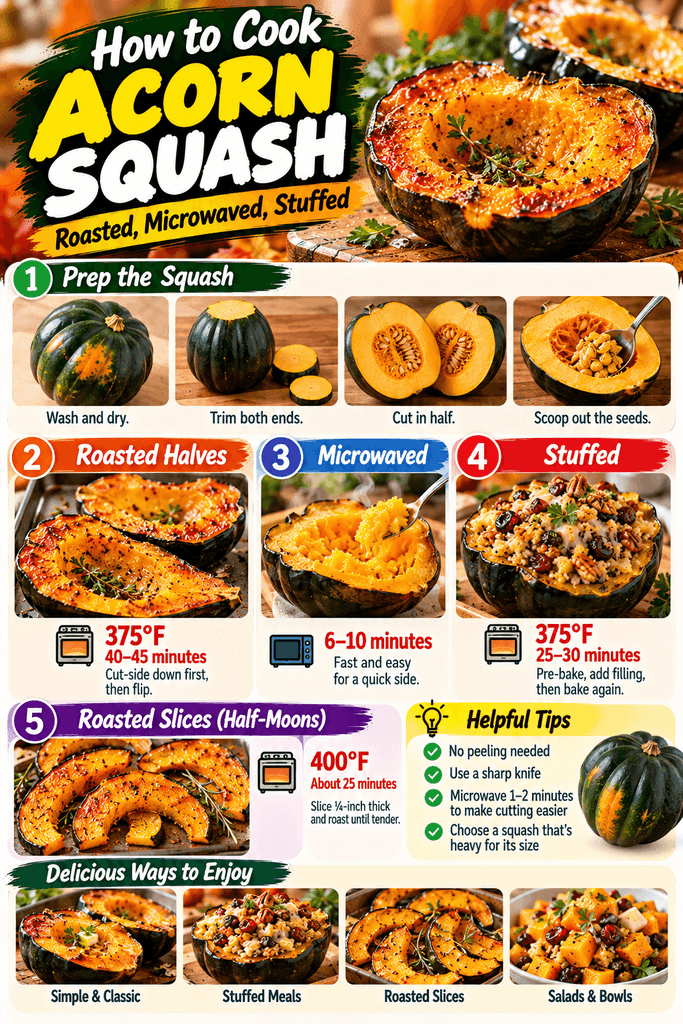
- Roasted halves: about 375°F for 40–45 minutes total, cut-side down first, then flipped.
- Roasted slices: ¼-inch half-moons at 400°F for about 25 minutes.
- Microwave whole squash for 1–2 minutes first to make cutting easier.
- Stuffed: pre-bake halves, then fill and bake another 25–30 minutes. Fillings with meat should reach a safe internal temperature.
- Go easy on butter and brown sugar. A little oil, spices or a light drizzle of maple adds flavor without many extra calories.
Why Acorn Squash Is Worth Cooking
Acorn squash is affordable, keeps for weeks and is packed with nutrients. According to USDA FoodData Central, one cup of baked acorn squash has about 115 calories, 9 grams of fiber and 896 mg of potassium, along with good amounts of magnesium, vitamin C and B vitamins. For the full nutrition breakdown, including how it compares to butternut, see is acorn squash healthy.
How to Choose an Acorn Squash
University of Illinois Extension describes acorn squash as round and small, usually about four inches in diameter, with deeply ridged, dark-green skin that sometimes has orange markings, and yellow to orange flesh. When shopping:
- Pick one that feels heavy for its size. That signals dense, moist flesh.
- Look for dull, dark-green skin. A small orange patch where it rested on the ground is normal. A squash that’s mostly orange may be overripe and stringy.
- Avoid soft spots, cracks and mold.
- Check the stem. A dry, firm stem helps the squash last longer.
Prep: Washing and Cutting Acorn Squash Safely
Wash First
Rinse the squash under running water before you cut it. The FDA recommends washing produce before cutting so dirt and bacteria on the skin aren’t carried into the flesh, and scrubbing firm produce with a clean brush. Dry it well so it won’t slip.
Soften It (Optional but Helpful)
Acorn squash has a hard rind and an awkward shape. To make cutting easier, Mississippi State University Extension suggests softening the squash by microwaving it for one minute or baking it for 10 minutes. Illinois Extension suggests microwaving for two minutes. Pierce the skin a few times first so steam can escape.
Cut It in Half
- Place a damp towel under your cutting board so it won’t slide.
- Trim a thin slice off the stem end and the pointed bottom to create flat surfaces. Mississippi State Extension recommends cutting flat ends first.
- Stand the squash on one flat end. Insert the tip of a large, sharp chef’s knife near the top and press straight down through the center, then rotate and cut the other side.
- Scoop out the seeds and stringy pulp with a sturdy spoon. Save the seeds for roasting.
For more knife-safety tips on hard squash, see our guide on how to cut butternut squash.
Do You Have to Peel Acorn Squash?
No. The deep ridges make peeling difficult and wasteful. The skin softens when cooked, especially in thin slices, and is edible. With halves, most people scoop the flesh out and leave the skin behind. Illinois Extension notes you can eat the squash right out of the skin or scoop it out to use as a puree.
Method 1: Roasted Acorn Squash Halves (Classic)
This is the most popular way to cook acorn squash, and the halves double as serving bowls.
Based on University of Illinois Extension‘s method:
- Preheat the oven to 375°F (190°C).
- Halve and seed the squash as described above.
- Place halves cut-side down in a baking dish with about ¼ inch of water. The water creates steam and keeps the flesh moist.
- Bake for 25 minutes.
- Flip the halves cut-side up. Brush the flesh with a little oil, or add your seasoning (see ideas below).
- Roast another 15–20 minutes, until the squash is fork-tender.
Total time: about 40–45 minutes of baking, depending on size.
Seasoning Ideas for Halves
- Savory: olive oil, salt, pepper, garlic and fresh thyme or rosemary
- Lightly sweet: a small drizzle of maple syrup, a pinch of cinnamon and a dash of salt. See is maple syrup healthy.
- Spicy: chili powder, smoked paprika and a squeeze of lime
- Parmesan-herb: olive oil, Italian seasoning and grated Parmesan in the last 5 minutes
Healthier tip: The classic preparation is a pat of butter and a spoonful of brown sugar in each half. That’s tasty, but it adds saturated fat and added sugar. A teaspoon of olive oil and spices, or a light drizzle of maple, delivers flavor with less of both.
Method 2: Roasted Acorn Squash Slices (Half-Moons)
Thin slices roast faster and get caramelized edges, and the skin becomes tender enough to eat.
Based on Mississippi State University Extension‘s Roasted Acorn Squash recipe:
- Preheat the oven to 400°F (200°C).
- Soften the squash in the microwave for 1 minute (pierce it first), or bake it for 10 minutes.
- Cut flat ends, halve lengthwise and remove the seeds.
- Slice each half into ¼-inch strips, following the ridges to make half-moon shapes.
- Toss with about 2 tablespoons of vegetable oil, 1 teaspoon of Italian seasoning, 2 tablespoons of grated Parmesan and ½ teaspoon of pepper. A zip-top bag works well for shaking to coat.
- Arrange in a single layer on a baking pan.
- Bake for about 25 minutes, until tender and golden.
This recipe serves 4–6. Slices make a great side dish and are easy for kids to pick up and eat.
Tip: Don’t crowd the pan. Overlapping slices steam instead of roasting. Use two pans if needed.
Method 3: Microwaved Acorn Squash (Fastest)
When you’re short on time, the microwave is the quickest way to cook acorn squash. Illinois Extension notes that acorn squash can be cooked in the microwave too.
- Halve and seed the squash. Microwave the whole squash for 1–2 minutes first if it’s hard to cut.
- Place halves cut-side down in a microwave-safe dish with about ¼ inch of water.
- Cover with a microwave-safe lid or vented plastic wrap.
- Microwave on high until fork-tender, typically 8–12 minutes for a medium squash, depending on your microwave’s power.
- Let it stand for 2–3 minutes. It will be very hot and steamy.
- Season and serve, or scoop the flesh for mashing.
Microwaved squash won’t caramelize, but it’s tender and ready in minutes. For extra flavor, slide it under the broiler for 2–3 minutes after seasoning.
Method 4: Stuffed Acorn Squash (A Complete Meal)
Acorn squash’s natural bowl shape makes it perfect for stuffing.
Based on University of Maryland Extension‘s Turkey Stuffed Acorn Squash (SNAP-Ed):
Ingredients (serves 4):
- 2 medium acorn squash (about 1½ lb each)
- 2 cups cooked turkey or chicken, chopped
- 2 cups cooked stuffing
- 1 small onion, finely chopped
- ½ cup cranberry sauce, or ⅓ cup dried cranberries
- ½ cup low-sodium broth
Steps:
- Preheat the oven to 350°F.
- Halve and seed the squash. Microwave the halves for about 2 minutes to soften.
- Bake cut-side down in a baking pan with a little water for 30 minutes.
- Meanwhile, microwave the onion until soft, then mix with the turkey, stuffing, cranberries and broth.
- Drain the squash, turn it cut-side up and fill each half.
- Bake uncovered for 25–30 minutes, until heated through.
According to the University of Maryland Extension, each serving (½ squash) provides about 440 calories, 30 g protein, 10 g fat, 59 g carbohydrate, 4 g fiber and 480 mg sodium.
Make It Safe: Check the Temperature
When stuffing squash with meat or poultry, use a food thermometer. According to FoodSafety.gov:
- Ground beef or pork: 160°F
- Ground turkey or chicken, and all poultry: 165°F
- Casseroles and leftovers being reheated: 165°F
If you’re using pre-cooked meat, as in the recipe above, heat the filled squash until the center of the stuffing reaches 165°F.
More Stuffing Ideas
- Wild rice, cranberries and walnuts: Our fruited wild rice salad makes a ready-made filling.
- Turkey or chicken sausage with apples and onions: See is turkey sausage healthy for choosing a leaner sausage.
- Quinoa, black beans and corn, topped with a little cheese: Try filling with this colorful cumin quinoa salad.
- Grain-and-squash risotto: Serve alongside, or spoon into the halves, this winter squash wheat berry risotto.
Method 5: Whole-Baked and Twice-Baked Acorn Squash
If cutting a raw squash makes you nervous, bake it whole first.
Based on University of Illinois Extension’s Eat.Move.Save. Baked Acorn Squash recipe:
- Bake the whole squash at 400°F for about one hour. Pierce it a few times first so steam can escape.
- Cool until safe to handle, then halve and remove the seeds.
- Scoop the flesh into a bowl, leaving the shells intact.
- Mix the flesh with sautéed onions and peppers and cheddar cheese.
- Spoon the mixture back into the shells, top with a breadcrumb-cheese topping, and bake at 350°F for 20–25 minutes.
The recipe serves 6 at about 230 calories, 15 g fat, 11 g protein and 2 g fiber per serving. To lower fat and raise fiber, Illinois Extension suggests using reduced-fat cheese and 100% whole-wheat bread for the topping.
How to Tell When Acorn Squash Is Done
- A fork or knife slides in easily, with no resistance, through the thickest part of the flesh.
- The flesh looks deeper in color and slightly translucent rather than pale and firm.
- Slices are golden at the edges and tender in the center.
- Halves feel soft when pressed gently (use an oven mitt).
If it’s still firm, keep cooking in 5–10-minute increments. Sizes vary, so trust tenderness over the timer.
Roasting Acorn Squash Seeds
Don’t toss the seeds. Separate them from the stringy pulp, rinse and dry them thoroughly, toss with a little oil and salt, and roast at a low temperature until golden and crisp, stirring occasionally. Watch them closely near the end. Learn about their nutrition in are pumpkin seeds healthy.
How to Store Acorn Squash
Whole
Store whole acorn squash in a cool, dry, well-ventilated place, not the refrigerator. Acorn squash keeps for several weeks, though it doesn’t last as long as thicker-skinned squash like butternut.
Cooked Leftovers
Refrigerate cooked squash promptly. Mississippi State Extension advises storing leftovers in the refrigerator within 2 hours. Keep them in a covered container and use within a few days. Reheat stuffed squash to 165°F, per FoodSafety.gov.
Freezing
Cooked acorn squash flesh freezes well. Scoop it out, mash or cube it, and freeze in airtight containers with a little headspace. It’s great later for soups, muffins or mashed sides.
Ways to Serve Cooked Acorn Squash
- As a side: Serve roasted halves or slices with roast chicken, pork or salmon.
- As a bowl: Fill roasted halves with grains, beans and greens for a vegetarian main.
- Mashed: Scoop and mash with a little olive oil, salt and pepper, like mashed potatoes.
- In salads: Add roasted slices or cubes to greens with nuts and a vinaigrette.
- In soup: Puree cooked flesh with broth, onion and spices.
- For breakfast: Warm mashed squash with cinnamon and a dollop of Greek yogurt.
Acorn Squash vs. Other Squash in the Kitchen
| Squash | Peel? | Best cooking method |
| Acorn | No (ridges) | Halves, slices, stuffed |
| Butternut | Yes, for cubes | Cubes, soup, puree |
| Delicata | No (thin skin) | Slices, rings, stuffed |
| Pumpkin (pie) | No, for puree | Halves or whole, roasted |
| Spaghetti | No | Halves, then shred into strands |
If you like acorn squash slices, try delicata, which roasts even faster and has thinner skin. See is delicata squash healthy. For smooth cubes or soup, butternut is easier to peel. See is butternut squash healthy. To roast a pie pumpkin the same way, see how to roast a pumpkin, and for every variety, visit our winter squash guide.
Frequently Asked Questions
How long does it take to cook acorn squash?
In the oven, acorn squash halves take about 40 to 45 minutes at 375°F: 25 minutes cut-side down, then 15 to 20 minutes cut-side up. Quarter-inch slices take about 25 minutes at 400°F. In the microwave, covered halves usually take 8 to 12 minutes, depending on size and power.
Do you cook acorn squash cut side up or down?
Start cut-side down in a dish with about a quarter inch of water so the flesh steams and stays moist. University of Illinois Extension suggests 25 minutes cut-side down at 375°F, then flipping the halves cut-side up for another 15 to 20 minutes to brown and add seasoning.
Do you have to peel acorn squash?
No. Its deep ridges make peeling difficult. Roast it in halves and scoop out the flesh, or slice it into thin half-moons, where the skin becomes tender enough to eat. Wash and scrub the squash well before cutting if you plan to eat the skin.
Can you microwave acorn squash?
Yes. Place seeded halves cut-side down in a covered microwave-safe dish with a little water and cook on high until fork-tender, usually 8 to 12 minutes. You can also microwave a whole squash for one to two minutes to soften it before cutting.
How do you know when acorn squash is done?
It’s done when a fork slides easily into the thickest part of the flesh, with no resistance. The flesh will look deeper in color and slightly translucent, and roasted slices will be golden at the edges. If it’s still firm, keep cooking in five- to ten-minute increments.
How do you soften acorn squash before cutting?
Pierce the skin a few times, then microwave the whole squash for one to two minutes or bake it for about ten minutes. Mississippi State and Illinois Extension both recommend this step. It softens the rind so your knife goes through more easily and safely.
Conclusion
Now you know how to cook acorn squash five ways:
- Roasted halves: 375°F, cut-side down, then flipped, for about 40–45 minutes.
- Caramelized slices: 400°F for about 25 minutes.
- Microwaved halves: about 8–12 minutes.
- Stuffed: pre-bake, fill, and bake another 25–30 minutes, heating meat fillings to a safe 165°F.
- Whole-baked and twice-baked: whole at 400°F for an hour, then refilled and baked again.
Skip the peeling, season with olive oil, herbs, spices or a light drizzle of maple instead of heaps of butter and brown sugar, and refrigerate leftovers within two hours.
Disclaimer: This article is for general educational purposes. Cooking times are guidelines and vary by oven, microwave and squash size. Always use a food thermometer for stuffed squash containing meat or poultry. If you have a health condition affecting your diet, such as kidney disease (acorn squash is high in potassium), talk with your doctor or a registered dietitian.
(3) References
- Smith J. “Winter Squash: An Autumn Favorite.” University of Illinois Extension, Simply Nutritious, Quick and Delicious. 2019. https://extension.illinois.edu/blogs/simply-nutritious-quick-and-delicious/2019-10-22-winter-squash-autumn-favorite
- University of Illinois Extension. “Baked Acorn Squash.” Eat.Move.Save. https://eat-move-save.extension.illinois.edu/eat/recipes/baked-acorn-squash
- Mississippi State University Extension Service. “Roasted Acorn Squash.” HappyHealthy. https://happyhealthy.extension.msstate.edu/node/517
- University of Maryland Extension, SNAP-Ed. “Turkey Stuffed Acorn Squash.” https://extension.umd.edu/programs/family-consumer-sciences/snap-ed/eat-smart/recipes/turkey-stuffed-acorn-squash
- FoodSafety.gov (U.S. Department of Health and Human Services). “Safe Minimum Internal Temperatures.” https://www.foodsafety.gov/food-safety-charts/safe-minimum-internal-temperatures
- U.S. Food and Drug Administration. “Selecting and Serving Produce Safely.” https://www.fda.gov/food/buy-store-serve-safe-food/selecting-and-serving-produce-safely
- U.S. Department of Agriculture. “Squash, winter, acorn, cooked, baked, without salt” (FDC ID 169293). FoodData Central. https://fdc.nal.usda.gov/fdc-app.html#/food-details/169293/nutrients