Chicken breast is one of the most popular proteins in the world, and one of the easiest to get wrong. Cook it too little and it isn’t safe; cook it too long and it turns dry and stringy. The good news is that a few simple habits fix both problems. In this guide, you’ll learn how to cook chicken breast five ways: baked in the oven, pan-seared on the stove, air-fried, boiled and grilled, with exact times and temperatures for each.
You’ll also learn the one tool that guarantees juicy, safe chicken, the prep steps that matter most, and what a chicken breast offers nutritionally.
Key Takeaways
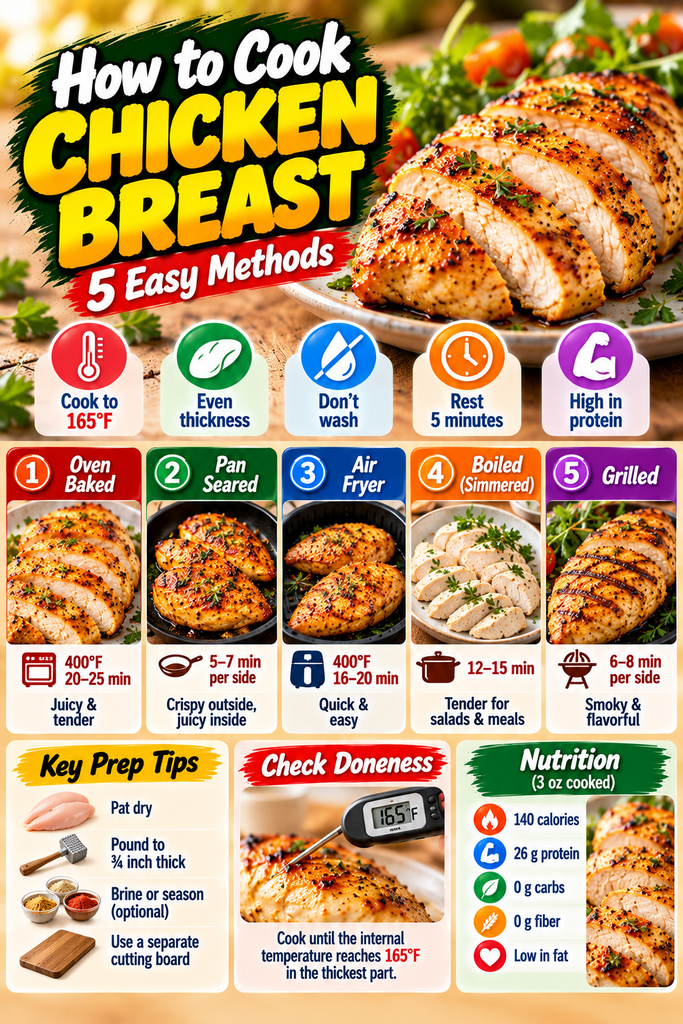
- Cook to 165°F. USDA says all poultry is safe at an internal temperature of 165°F, measured with a food thermometer.
- Even thickness = even cooking. Pound thick breasts to about ¾ inch so the thin end doesn’t dry out.
- Quick guide for boneless breasts: oven 400°F for 20–25 min; air fryer 400°F for 16–20 min; pan 5–7 min per side; simmer 12–15 min; grill 6–8 min per side.
- Don’t wash raw chicken. It spreads bacteria around your kitchen and doesn’t make the chicken safer.
- Rest 5 minutes before slicing so the juices stay in the meat.
- Nutrition: a 3-ounce serving of roasted breast has about 26 g of protein and 140 calories.
Before You Start: The Golden Rule of Chicken Breast
Every method in this guide comes back to one number: 165°F. According to the USDA Food Safety and Inspection Service, all poultry should be cooked to an internal temperature of 165°F, measured with a food thermometer in the thickest part.
Cooking times are only a guide, because breasts vary a lot in size. A small 5-ounce breast and a 10-ounce one need very different times. That’s why an instant-read thermometer is the most useful tool you can buy for cooking chicken. It tells you exactly when the chicken is safe, so you can take it off the heat before it dries out.
How to check the temperature correctly
Insert the thermometer into the thickest part of the breast, from the side, so the tip sits in the center. For bone-in breasts, avoid touching the bone. University of Missouri Extension advises placing the thermometer in the thickest part, away from bone, fat and gristle, and checking its accuracy when you first get it and whenever you drop it.
How to Prep Chicken Breast for Juicy Results
Good prep matters as much as the cooking method. These steps take just a few minutes.
1. Don’t wash it
It may feel cleaner, but rinsing raw chicken spreads germs. In a 2019 USDA study, 26% of participants who washed raw poultry transferred bacteria to a salad they made afterward, and 60% had bacteria in their sink. The CDC agrees: don’t wash chicken. Cooking to 165°F is what kills bacteria.
2. Pat it dry
Use paper towels to blot the surface. A dry surface browns better in the oven, pan and air fryer. Throw the towels away and wash your hands right after.
3. Pound to an even thickness
Chicken breasts are thick at one end and thin at the other, so the thin end overcooks while the thick end catches up. Place the breast in a zip-top bag or between sheets of parchment and gently pound the thick end with a meat mallet or rolling pin until it’s about ¾ inch thick all over. Very large breasts can also be sliced in half horizontally into two thin cutlets.
4. Brine or season ahead (optional)
A quick brine helps chicken stay juicy. Dissolve 1 tablespoon of salt in 4 cups of water, add the breasts and refrigerate for 15–30 minutes, then pat dry. If you’re watching sodium, skip the brine and simply season with herbs and spices. Even 30 minutes of seasoning in the fridge before cooking helps flavor soak in.
5. Keep raw chicken separate
Use a separate cutting board for raw chicken, and wash hands, boards and knives with hot, soapy water after handling it. The CDC notes that about 1 in 25 packages of chicken at the store is contaminated with Salmonella.
Chicken Breast Cooking Times at a Glance
These times are for boneless, skinless breasts about ¾ inch thick (roughly 6–8 ounces each). Always confirm with a thermometer.
| Method | Temperature / heat | Approx. time | Texture |
| Oven (bake) | 425°F | 18–22 min | Juicy, lightly golden |
| Oven (bake) | 400°F | 20–25 min | Juicy, classic baked |
| Oven (bake) | 375°F | 25–30 min | Tender, gentle |
| Oven (bake) | 350°F | 25–35 min | Very tender, little browning |
| Air fryer | 400°F | 16–20 min | Browned outside, juicy inside |
| Pan-seared | Medium to medium-high | 5–7 min per side | Golden crust |
| Boiled / poached | Gentle simmer | 12–15 min | Soft, ideal for shredding |
| Grilled | Medium-high (400–450°F) | 6–8 min per side | Smoky, charred marks |
| Bone-in, skin-on (oven) | 425°F | 35–45 min | Crispy skin, very moist |
Method 1: How to Cook Chicken Breast in the Oven
Baking is the easiest hands-off method and the best choice for meal prep, because you can cook several breasts at once.
- Heat the oven to 400°F and lightly oil a baking dish or line a sheet pan with parchment.
- Season. Rub each breast with 1–2 teaspoons of oil, then season with salt, pepper, garlic powder and paprika.
- Arrange with space. Leave room between breasts so they roast instead of steaming.
- Bake for 20–25 minutes, until the thickest part reads 165°F.
- Rest for 5 minutes before slicing.
How long to cook chicken breast in the oven at 350°F vs 400°F
At 350°F, allow 25–35 minutes. The lower heat is gentle and forgiving, but you’ll get less browning. At 400°F to 425°F, breasts cook faster, in about 18–25 minutes, and get a little golden color, which most people prefer. Higher heat also gives you less time to overcook, so start checking the temperature a few minutes early.
For the oil, olive oil and avocado oil both work well at these temperatures; see our guide on whether olive oil is good for cooking.
Method 2: How to Cook Chicken Breast in a Pan
Pan-searing gives you a golden, flavorful crust in under 15 minutes, and it’s the best way to make a quick pan sauce.
- Heat 1 tablespoon of oil in a heavy skillet over medium-high heat until it shimmers.
- Add the seasoned breasts and don’t move them for 5–6 minutes, until the bottom is deep golden and releases easily.
- Flip, then lower the heat to medium. Cook another 5–7 minutes until the center reaches 165°F.
- For thicker breasts, cover the pan after flipping so the heat cooks the middle through without burning the outside.
- Rest for 5 minutes, then slice.
How to make a simple pan sauce
After removing the chicken, pour ½ cup of low-sodium broth into the hot pan and scrape up the browned bits. Add a squeeze of lemon and a teaspoon of butter or a drizzle of olive oil, simmer for 2 minutes, and spoon it over the sliced chicken. This is the easiest way to cook chicken breast in a pan with sauce.
Serve it with vegetables, such as in our chicken and broccoli recipe.
Method 3: How to Cook Chicken Breast in the Air Fryer
The air fryer gives you a browned outside and juicy inside with very little oil. It’s perfect for one or two breasts.
- Heat the air fryer to 400°F for a few minutes.
- Lightly oil and season the breasts.
- Cook in a single layer for 16–20 minutes, flipping halfway through.
- Check the thickest part for 165°F, then rest for 5 minutes.
Don’t stack the breasts; overcrowding blocks the hot air and leads to uneven cooking. Smaller breasts (5–6 ounces) may be done in 14–16 minutes. If you’re new to your machine, our air fryer recipes for beginners cover the basics.
Method 4: How to Boil (Poach) Chicken Breast
Boiling, or more accurately poaching, gives soft, mild chicken that’s easy to shred for salads, soups, tacos and casseroles.
- Place the breasts in a pot in a single layer and cover with water or low-sodium broth by about an inch.
- Add flavor: a pinch of salt, a bay leaf, peppercorns, garlic or onion.
- Bring to a boil, then reduce to a gentle simmer. A hard boil makes the meat tough.
- Simmer for 12–15 minutes for boneless breasts, until they reach 165°F.
- Rest, then shred with two forks.
For exact times by size and for bone-in or frozen pieces, see our detailed guide on how long to boil chicken. Shredded poached chicken is the perfect base for homemade chicken salad.
Method 5: How to Grill Chicken Breast
Grilling adds smoky flavor and char marks, and it’s ideal for summer meals.
- Heat the grill to medium-high (about 400–450°F) and clean and oil the grates.
- Pound the breasts to an even ¾ inch so they cook through before the outside chars.
- Grill for 6–8 minutes per side with the lid closed, flipping once.
- Move to a cooler part of the grill if the outside is browning too fast.
- Check for 165°F and rest for 5 minutes.
Avoid heavy charring. We explain why in the safety section below.
How to Tell When Chicken Breast Is Done
A thermometer is the only reliable test. Color and clear juices can be misleading: chicken can look done before it’s safe, or still look slightly pink when it’s fully cooked. Aim for 165°F in the thickest part.
To keep chicken juicy, check the temperature a few minutes before the end of the suggested time and take it off the heat as soon as it reaches 165°F. Every extra minute after that dries it out.
Why resting matters
Let cooked chicken rest on a cutting board for about 5 minutes before slicing. Resting gives the juices time to settle back into the meat, so they don’t run out onto the board when you cut it.
Common Mistakes and How to Fix Them
| Problem | Likely cause | Fix |
| Dry, stringy chicken | Overcooked | Use a thermometer and pull at 165°F; try a quick brine |
| Raw center, dark outside | Heat too high or breast too thick | Pound to ¾ inch; finish over lower heat or covered |
| Pale, rubbery surface | Wet chicken or crowded pan | Pat dry; leave space between pieces |
| Uneven cooking | Thick and thin ends | Pound evenly or butterfly into cutlets |
| Bland flavor | Under-seasoned | Season generously and ahead of time; add a pan sauce |
Chicken Breast Nutrition
Chicken breast is popular for a reason: it’s high in protein and low in fat. According to USDA FoodData Central [VERIFY ID], 100 g of roasted, skinless chicken breast provides about 165 calories, 31 g of protein and 3.6 g of fat. For a typical 3-ounce (85 g) serving, that works out to roughly:
| Nutrient (3 oz roasted, skinless) | Amount | Notes |
| Calories | ~140 kcal | Low for the amount of protein |
| Protein | ~26 g | About half a day’s needs for many adults |
| Total fat | ~3 g | Mostly unsaturated |
| Carbohydrates | 0 g | Naturally carb-free |
| Niacin (vitamin B3) | ~10 mg | 64% of the Daily Value |
| Selenium | ~22 mcg | 40% of the Daily Value |
The niacin and selenium figures come from the NIH fact sheets on niacin and selenium, both of which list chicken breast as a top food source. For a full breakdown by size, see our guide to how much protein is in a chicken breast.
Health Benefits of Chicken Breast
High-quality protein
Protein helps build and repair muscle and keeps you feeling full. Chicken breast provides all the essential amino acids in a lean package. Harvard’s Nutrition Source notes that eating healthy protein sources like beans, nuts, fish or poultry in place of red and processed meat can lower the risk of several diseases and early death. Our comparison of whether chicken or beef is healthier goes into more detail.
Niacin for energy metabolism
Niacin helps your body turn carbohydrates, fat and protein into usable energy. The NIH niacin fact sheet explains that the body converts it into NAD, a coenzyme involved in hundreds of reactions, including energy production and cell maintenance. A 3-ounce serving of chicken breast provides most of a woman’s daily needs (14 mg) and well over half of a man’s (16 mg).
Selenium for antioxidant defense and thyroid health
Selenium is part of proteins that help protect cells from oxidative damage and support thyroid hormone metabolism, according to the NIH selenium fact sheet. Adults need 55 mcg a day, and one serving of chicken breast covers about 40%.
A lean choice for many eating plans
Skinless chicken breast is low in fat and saturated fat compared with many other meats. MyPlate recommends choosing a variety of protein foods and limiting sodium and saturated fat, which makes plainly cooked chicken breast an easy fit. For a broader look at chicken’s pros and cons, read whether chicken is healthy, or compare it with chicken thigh nutrition, which is juicier but higher in fat.
Who Benefits Most From Chicken Breast?
- People trying to eat more protein, such as older adults working to maintain muscle, or active people.
- Anyone managing their weight, since it’s filling and relatively low in calories.
- People reducing red and processed meat, using chicken as a leaner swap.
- Meal preppers, because baked or poached chicken keeps for several days and works in many dishes.
Risks and Cautions
Chicken breast is a healthy, everyday food for most people, but a few precautions matter.
Foodborne illness from undercooked chicken
Raw chicken can carry Salmonella, Campylobacter and Clostridium perfringens. The CDC estimates that about a million Americans get sick each year from contaminated poultry. Cook to 165°F, avoid cross-contamination and refrigerate leftovers promptly. Older adults, pregnant people, young children and people with weakened immune systems are at higher risk of serious illness.
High-heat cooking and charring
Grilling and pan-frying at very high heat can form chemicals called heterocyclic amines (HCAs) and polycyclic aromatic hydrocarbons (PAHs). The National Cancer Institute explains that these compounds caused cancer in animal studies, but the evidence in humans is still unclear. To reduce exposure, NCI suggests avoiding direct flame and long cooking times, flipping meat often and cutting off charred parts.
Sodium in brines, marinades and seasonings
Plain chicken breast is naturally low in sodium, but brines, marinades, sauces and seasoning blends can add a lot. The FDA recommends adults keep sodium under 2,300 mg a day. If you have high blood pressure, use herbs, spices, citrus and garlic instead of salty sauces.
Thawing frozen chicken safely
Never thaw chicken on the counter. USDA recommends three safe ways to thaw chicken: in the refrigerator, in cold water changed every 30 minutes, or in the microwave, followed by cooking right away. You can also cook chicken from frozen, but it will take noticeably longer, so always check the temperature.
Storing and Reheating Cooked Chicken Breast
Raw chicken keeps in the refrigerator for 1 to 2 days; use it or freeze it within that time. For cooked chicken, follow USDA’s leftover guidelines:
- Refrigerate within 2 hours of cooking (1 hour if it’s above 90°F).
- Eat refrigerated leftovers within 3 to 4 days.
- Freeze for longer storage, ideally within 3 to 4 months.
- Reheat to 165°F.
For more detail, see our guide on how long chicken is good in the fridge. To keep reheated chicken moist, add a splash of broth and cover it, or slice it thinly and warm it briefly in a pan.
Myths vs Facts About Cooking Chicken Breast
| Myth | Fact |
| Washing raw chicken makes it safer. | It spreads bacteria; a USDA study found 26% of people who washed poultry contaminated a salad. |
| If the juices run clear, it’s done. | Only a thermometer reading of 165°F confirms it’s safe. |
| Chicken breast is always dry. | Even thickness, a quick brine and pulling it at 165°F keep it juicy. |
| A little pink means it’s undercooked. | Color isn’t reliable; temperature is. |
| Grilled chicken is always the healthiest option. | Heavy charring can form HCAs and PAHs; baking, poaching and moderate pan heat are good options too. |
How Chicken Breast Fits a Healthy Lifestyle
Learning how to cook chicken breast well makes healthy eating much easier. Bake a batch on Sunday and use it all week: sliced over salads, tucked into wraps, stirred into soups, or served with roasted vegetables and a whole grain. Shredded poached chicken turns into quick lunches, and grilled chicken is great on sandwiches.
To keep meals balanced, pair chicken with vegetables and fiber-rich sides rather than heavy, salty sauces. Rotating chicken with fish, beans and other proteins through the week also gives you a wider range of nutrients. If you’re short on time, sheet-pan dinners like our crispy baked chicken tenders are an easy weeknight win.
Frequently Asked Questions
How long do you cook chicken breast in the oven at 400°F?
Bake boneless, skinless chicken breasts at 400°F for about 20–25 minutes, depending on size, until the thickest part reaches 165°F on a food thermometer. Pound thick breasts to an even ¾ inch first so they cook evenly, and let them rest for 5 minutes before slicing.
How long do you cook chicken breast in an air fryer at 400°F?
Cook boneless breasts at 400°F for about 16–20 minutes, flipping halfway through, until they reach 165°F inside. Smaller breasts may be done in 14–16 minutes. Cook in a single layer without crowding so the hot air can circulate, and rest the chicken for 5 minutes before cutting.
How do you cook juicy chicken breast in a pan?
Pound the breast to an even thickness and pat it dry. Sear it in a hot, oiled skillet for 5–6 minutes without moving it, flip, lower the heat to medium and cook 5–7 minutes more until it reaches 165°F. Cover the pan for thick pieces, then rest it for 5 minutes.
How long does it take to boil chicken breast?
Boneless chicken breasts take about 12–15 minutes at a gentle simmer once the water returns to a boil. Larger or bone-in pieces take longer. Keep the water at a simmer rather than a hard boil to avoid tough meat, and always check for an internal temperature of 165°F.
Should you wash chicken before cooking it?
No. Washing raw chicken doesn’t remove bacteria and can splash germs onto your sink, counters and other foods. A USDA study found that 26% of people who washed raw poultry transferred bacteria to a salad. Cooking chicken to 165°F is what makes it safe to eat.
How long does cooked chicken breast last in the fridge?
Cooked chicken keeps for 3 to 4 days in the refrigerator if you chill it within 2 hours of cooking. Store it in a shallow, airtight container. For longer storage, freeze it for up to about 4 months, and reheat leftovers to 165°F before eating.
Conclusion
Now you know how to cook chicken breast five ways: baked at 400°F for 20–25 minutes, pan-seared for 5–7 minutes per side, air-fried at 400°F for 16–20 minutes, poached for 12–15 minutes, or grilled for 6–8 minutes per side. Whatever method you choose, the keys are the same: don’t wash it, pound it to an even thickness, cook it to 165°F with a thermometer, and let it rest before slicing.
Cooked well, chicken breast is a lean, versatile source of protein, niacin and selenium that fits into almost any healthy eating plan. Keep the seasoning flavorful but not too salty, avoid heavy charring, and store leftovers safely.
Medical disclaimer: This article is for general information only and isn’t a substitute for professional medical advice. If you have a health condition such as high blood pressure or kidney disease, are pregnant, or have a weakened immune system, talk with your doctor or a registered dietitian about your diet and food safety needs.
3. References
- U.S. Department of Agriculture, Food Safety and Inspection Service. “Chicken from Farm to Table.” https://www.fsis.usda.gov/food-safety/safe-food-handling-and-preparation/poultry/chicken-farm-table
- U.S. Department of Agriculture, Food Safety and Inspection Service. “Leftovers and Food Safety.” https://www.fsis.usda.gov/food-safety/safe-food-handling-and-preparation/food-safety-basics/leftovers-and-food-safety
- U.S. Department of Agriculture. “Washing Raw Poultry: Our Science, Your Choice.” 2019. https://www.usda.gov/article/washing-raw-poultry-our-science-your-choice
- Centers for Disease Control and Prevention. “Chicken and Food Poisoning.” https://www.cdc.gov/food-safety/foods/chicken.html
- University of Missouri Extension. “Pass the Taste Test… Use a Thermometer!” (adapted from University of Nebraska Cooperative Extension and FightBAC!; reviewed 2022). https://extension.missouri.edu/media/wysiwyg/Extensiondata/Pub/pdf/hesguide/foodnut/n00360.pdf
- National Cancer Institute. “Chemicals in Meat Cooked at High Temperatures and Cancer Risk.” National Institutes of Health. https://www.cancer.gov/about-cancer/causes-prevention/risk/diet/cooked-meats-fact-sheet
- U.S. Department of Agriculture, Agricultural Research Service. “Chicken, broilers or fryers, breast, meat only, cooked, roasted.” FoodData Central (SR Legacy). https://fdc.nal.usda.gov/food-details/171477/nutrients [VERIFY: the ID is inferred from the neighboring “stewed” entry, 171478; open the link to confirm.]
- NIH Office of Dietary Supplements. “Niacin: Fact Sheet for Health Professionals.” National Institutes of Health. https://ods.od.nih.gov/factsheets/Niacin-HealthProfessional/
- NIH Office of Dietary Supplements. “Selenium: Fact Sheet for Health Professionals.” National Institutes of Health. https://ods.od.nih.gov/factsheets/Selenium-HealthProfessional/
- Harvard T.H. Chan School of Public Health. “Protein.” The Nutrition Source. https://nutritionsource.hsph.harvard.edu/what-should-you-eat/protein/
- U.S. Department of Agriculture. “Protein Foods.” MyPlate. https://www.myplate.gov/eat-healthy/protein-foods
- U.S. Food and Drug Administration. “Sodium in Your Diet.” https://www.fda.gov/food/nutrition-education-resources-materials/sodium-your-diet