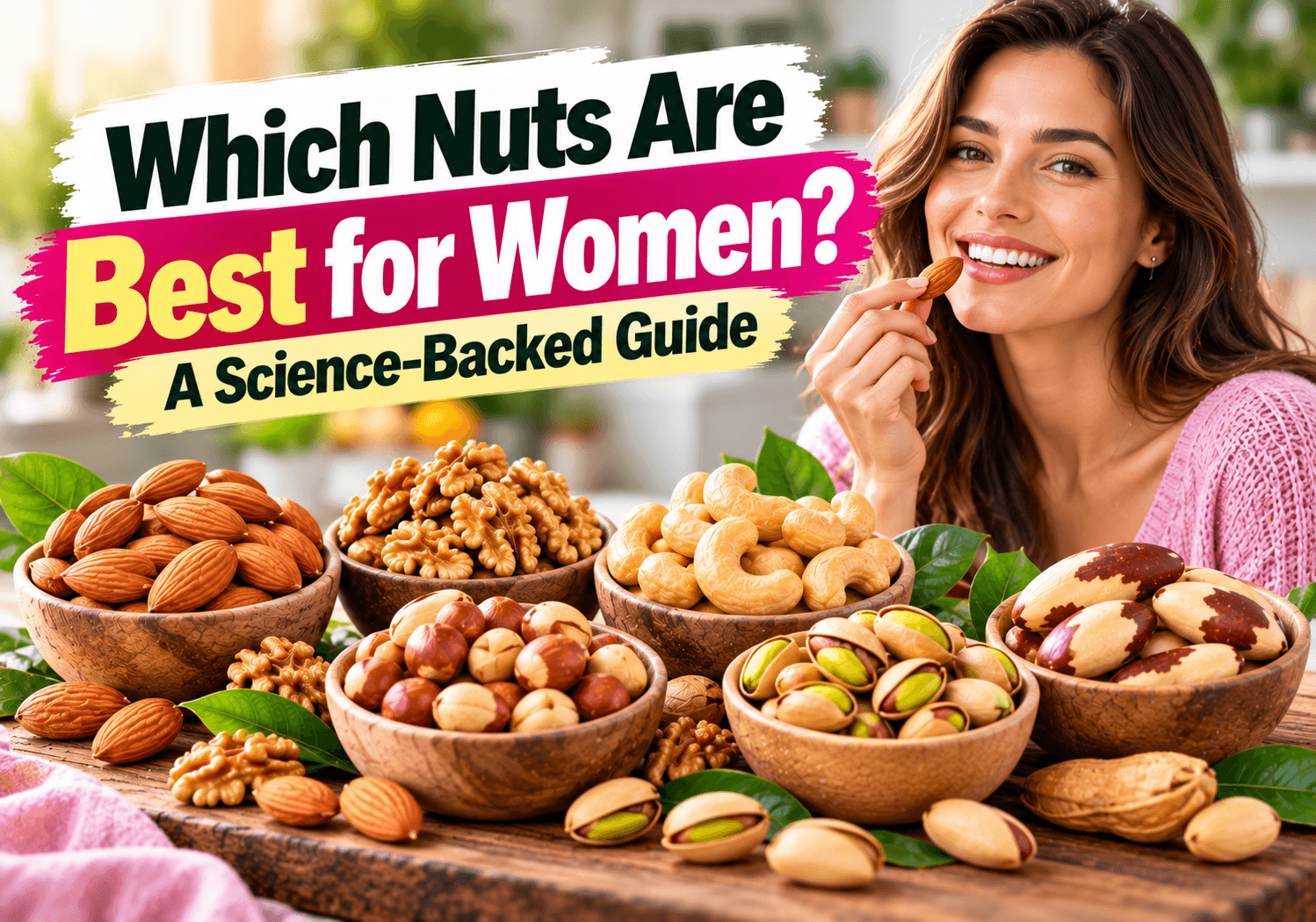
A handful of nuts is one of the simplest ways to eat better, whether you’re snacking at your desk, planning for pregnancy, or thinking about heart and bone health later in life. But not all nuts offer the same benefits. So which nuts are best for women, and why?
In this guide, you’ll learn which nuts deliver the nutrients women need most, what large studies of women have found about heart disease, diabetes, and weight, and how nuts fit into pregnancy. You’ll also see which nuts to limit, how much to eat, and simple ways to add them to your day.
Key Takeaways
- Almonds, walnuts, cashews, pistachios, and peanuts are among the best nuts for women, each with different strengths.
- Heart health comes first. Heart disease is the leading cause of death for women, and women who ate nuts often had a 35% lower risk of coronary heart disease in a large study.
- Almonds offer calcium, magnesium, and vitamin E, nutrients that support bones and overall health.
- Cashews and pistachios add plant-based iron, which matters for women with heavy periods or who are pregnant.
- Nuts didn’t lead to extra weight gain in a study of more than 51,000 women.
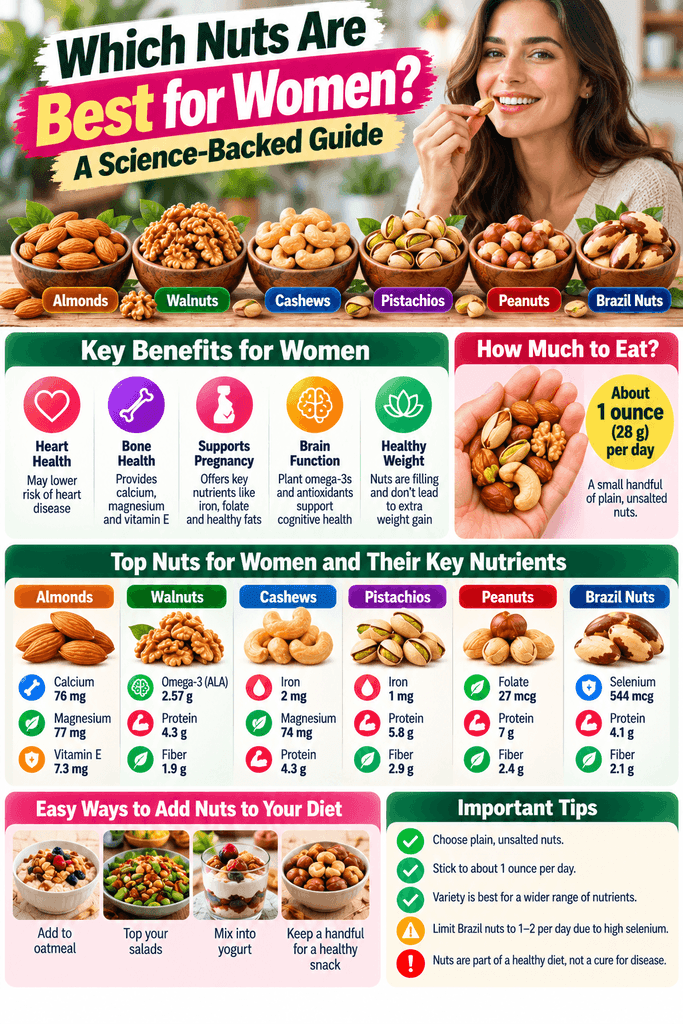
- About 1 ounce a day of plain, unsalted nuts is a smart target, with Brazil nuts limited to one or two.
Why Nuts Matter for Women’s Health
Many people think of heart disease as a “man’s disease,” but that’s a myth. The CDC reports that heart disease is the leading cause of death for men, women, and people of most racial and ethnic groups.
Nuts are a heart-friendly food. Harvard’s Nutrition Source notes that eating about one ounce of nuts five or more times per week is linked to lower cardiovascular risk. Nuts also provide healthy fats, protein, vitamin E, folate, potassium, and fiber. Learn more in our guide to nuts and heart health.
Women also have unique nutrient needs at different life stages. For example, women aged 19 to 50 need 18 mg of iron a day, more than double the amount men need, and calcium needs rise to 1,200 mg a day after age 50. Nuts can help with several of these nutrients.
Nutritional Profile: The Best Nuts for Women Compared
Here’s how popular nuts stack up on nutrients that matter for women. Values are for a 1-ounce (about 28-gram) serving.
| Nut (1 oz) | Key nutrient for women | Amount | Source |
| Almonds | Calcium | 76 mg | USDA FDC |
| Almonds | Magnesium | 77 mg | USDA FDC |
| Almonds | Vitamin E | 7.3 mg | USDA FDC |
| Walnuts | ALA (plant omega-3) | 2.57 g | NIH ODS |
| Cashews (oil roasted) | Iron | 2 mg | NIH ODS |
| Pistachios (dry roasted) | Iron | 1 mg | NIH ODS |
| Peanuts (dry roasted) | Folate | 27 mcg DFE | NIH ODS |
| Brazil nuts (6–8 nuts) | Selenium | 544 mcg | NIH ODS |
Peanuts are technically legumes, but they’re usually grouped with nuts.
Nuts also bring protein and fiber. One ounce of almonds has about 6 grams of protein and 3.5 grams of fiber. See whether nuts are high in protein for more.
Which Nuts Are Best for Women? The Top Picks
Based on nutrients and research in women, here are the best nuts for women and what each offers.
1. Almonds: Best Nuts for Women’s Bones and Overall Nutrition
Almonds are an all-around star. One ounce provides about 76 mg of calcium, 77 mg of magnesium, and 7.3 mg of vitamin E. That calcium is modest compared with dairy, but it adds up as part of a varied diet.
Vitamin E is a bonus. Adults need 15 mg of vitamin E a day, so one ounce of almonds covers almost half. The NIH notes that most research does not support vitamin E supplements for protecting thinking skills, which makes whole-food sources like almonds a better everyday choice.
Magnesium matters too. Women need 310 to 320 mg of magnesium a day, and the NIH reports that 48% of Americans get less magnesium from food than they need. Read more about whether almonds are healthy.
2. Walnuts: Best Nuts for Women Seeking Plant Omega-3s
Walnuts are a standout source of ALA, a plant omega-3 fat. One ounce provides 2.57 grams of ALA, more than double the 1.1 grams most adult women need each day.
Walnuts also have about 185 calories and 4.3 grams of protein per ounce, so they’re filling. Our guide on whether walnuts are healthy covers more.
3. Cashews and Pistachios: Best Nuts for Women Who Need Iron
Iron is a key nutrient for women. One ounce of oil-roasted cashews provides about 2 mg of iron, and an ounce of dry-roasted pistachios provides about 1 mg.
Keep in mind that iron from plants is less easily absorbed than iron from meat. The NIH notes that vegetarians need about 1.8 times as much iron for this reason. Nuts help, but they won’t meet iron needs on their own. Learn more about whether cashews are healthy and whether pistachios are healthy.
4. Peanuts: Best Budget Nuts for Women Planning Pregnancy
Peanuts provide folate, a B vitamin that’s especially important before and during pregnancy. One ounce of dry-roasted peanuts offers 27 mcg DFE of folate, or 7% of the Daily Value.
That’s a small contribution, so peanuts don’t replace folic acid. Folate matters because it helps prevent neural tube defects, which the NIH calls the most common major congenital malformations of the central nervous system. Women who could become pregnant are advised to get 400 mcg of folic acid daily from supplements, fortified foods, or both, on top of folate from food.
5. Brazil Nuts: Best for Women Only in Tiny Amounts
Brazil nuts are extremely high in selenium. A single nut has 68 to 91 micrograms, more than the 55 micrograms most adults need daily, and the upper limit is 400 micrograms a day.
One or two Brazil nuts at a time is plenty. Other nuts, like pecans, hazelnuts, and macadamias, also fit a healthy diet, and our complete guide to nuts compares them all. Our guide on how many Brazil nuts to eat explains safe portions.
Heart Health: Why Nuts Are Best for Women’s Hearts
Because heart disease is the top cause of death in women, this is the biggest reason to make nuts a habit.
What Studies of Women Show
The Nurses’ Health Study is one of the largest long-term studies of women’s health. In a 1998 analysis published in The BMJ, researchers followed 86,016 women aged 34 to 59 for 14 years.
Women who ate more than five 1-ounce servings of nuts a week had a 35% lower risk of coronary heart disease than women who rarely ate nuts (relative risk 0.65). This was an observational study, so it shows a link, not proof that nuts caused the benefit. Still, it’s one of the strongest reasons to include the best nuts for women in your weekly meals.
How Nuts May Help the Heart
Researchers believe several nutrients work together. Nuts are rich in healthy fats, fiber, and arginine, an amino acid. They also supply magnesium, which the NIH says helps run more than 300 enzyme systems, including those involved in blood pressure regulation.
Blood Sugar and Diabetes: Nuts for Women’s Metabolic Health
Nuts may also be linked to lower diabetes risk in women.
In a 2002 Nurses’ Health Study analysis in JAMA, researchers followed 83,818 women. Those who ate nuts at least five times a week had a 26% lower risk of type 2 diabetes than women who almost never ate nuts, after accounting for body weight and other factors (relative risk 0.74).
Interestingly, most women in the study ate few nuts. About 35% almost never ate nuts, and only 5% ate them five or more times a week. That suggests many women have room to add more.
Peanut butter showed a similar pattern. Women who ate it five times a week had a relative risk of 0.79 compared with those who rarely ate it. For women watching blood sugar, plain almonds, walnuts, and peanuts are among the best nuts for women to keep on hand as part of a balanced diet. If you’re managing blood sugar, see our guide to the best nuts for diabetics.
Weight Management: Do Nuts Cause Weight Gain in Women?
Many women skip nuts because they’re high in calories. Nuts do average about 185 calories per ounce. But the research in women is reassuring.
A 2009 study in the American Journal of Clinical Nutrition followed 51,188 women aged 20 to 45 for 8 years. Women who ate nuts at least twice a week gained slightly less weight on average than women who rarely ate them, about 5.0 kg versus 5.6 kg.
The study included only women who didn’t have heart disease, diabetes, or cancer at the start. Nut eaters also had a lower risk of obesity, though that result wasn’t statistically significant. The takeaway: in this study, nuts didn’t lead to extra weight gain. For more, see whether nuts are fattening.
Pregnancy: Which Nuts Are Best for Women Who Are Expecting?
Pregnancy raises the need for several nutrients that nuts provide.
Key Nutrient Needs in Pregnancy
| Nutrient | Pregnancy need | Nut sources | Source |
| Folate | 600 mcg DFE/day | Peanuts | NIH ODS |
| Iron | 27 mg/day | Cashews, pistachios | NIH ODS |
| Magnesium | 350–360 mg/day | Almonds, cashews | NIH ODS |
| ALA omega-3 | 1.4 g/day | Walnuts | NIH ODS |
Needs stay high while breastfeeding, too. The NIH lists 500 mcg DFE of folate and 1.3 grams of ALA a day during lactation, so a daily handful of walnuts or peanuts remains useful after the baby arrives.
Nuts can help you meet these needs, but they aren’t enough on their own. Iron deficiency during pregnancy increases the risk of maternal and infant mortality, so follow your prenatal care team’s advice on supplements.
Nuts and a Baby’s Brain Development
A Spanish study of 2,208 mother-child pairs found that mothers who ate more nuts in the first trimester (more than about 32 grams a week) had children who scored somewhat better on some attention and memory tests up to age 8.
However, most results weren’t significant after strict statistical checks, and the study was observational. The authors called for more research before changing diet guidelines. Nuts are a healthy pregnancy food, but they’re not a proven brain booster for babies.
Omega-3s and Seafood
Walnuts provide ALA, but the omega-3 DHA is especially important during pregnancy. DHA accumulates most rapidly during the third trimester. Experts recommend 8 to 12 ounces of lower-mercury seafood per week for pregnant women, so walnuts complement fish rather than replace it.
Bone Health After Menopause: Best Nuts for Women Over 50
Bone health becomes a bigger concern after menopause. The NIH notes that women lose about 1% of their bone mineral density per year after menopause on average, and calcium needs rise to 1,200 mg a day after age 50.
Almonds are the best nut choice here, with about 76 mg of calcium and 77 mg of magnesium per ounce. They won’t meet calcium needs alone, but they’re a helpful addition alongside dairy, fortified foods, and leafy greens. That makes almonds one of the best nuts for women after menopause.
Brain health is another concern as women age. A UK Biobank study of 50,386 adults, about half of them women, found that daily nut eating was linked to a 12% lower risk of dementia. See our guide to nuts for brain health.
Who Benefits Most From the Best Nuts for Women?
Most women can benefit from nuts, but these groups may gain the most:
- Women with heart disease risk factors: The strongest research in women links frequent nut eating to lower coronary heart disease risk.
- Women at risk of type 2 diabetes: Frequent nut and peanut butter eating was linked to lower diabetes risk in the Nurses’ Health Study.
- Women with heavy periods: They lose significantly more iron, so iron-containing nuts like cashews can help as part of an iron-rich diet.
- Women who are pregnant or planning pregnancy: Nuts supply folate, iron, magnesium, and ALA.
- Women over 50: Almonds add calcium and magnesium as bone needs increase.
- Vegetarian and vegan women: Nuts are a convenient plant source of protein, iron, and zinc.
Risks of the Best Nuts for Women and Who Should Be Cautious
Nuts are safe for most women, but keep these points in mind.
Allergies. Tree nuts and peanuts are among the FDA’s nine major food allergens. Severe reactions can cause anaphylaxis, a life-threatening reaction. Avoid nuts you’re allergic to.
Selenium from Brazil nuts. Too much selenium can cause hair loss, brittle nails, and a garlic odor on the breath. Even during pregnancy, women need only 60 micrograms a day, less than a single large Brazil nut can provide.
Salted and candied nuts. Harvard notes that nuts covered in chocolate or with lots of sugar or sodium are probably not as good as plain nuts.
Portion size. Nuts are healthy but calorie-dense. A small handful is enough for most women.
How Many of the Best Nuts for Women Should You Eat Daily?
For most women, about 1 ounce (28 to 30 grams) a day is a good target. Harvard defines a handful as about 28 grams, or one ounce.
This lines up with the research. In the Nurses’ Health Study, the women with the lowest heart disease risk ate more than five 1-ounce servings a week. Brazil nuts are the exception: stick to one or two at a time.
Practical Tips for Eating the Best Nuts for Women
Here are simple ways to add more nuts to your day:
- Boost breakfast. Stir sliced almonds or chopped walnuts into oatmeal or yogurt.
- Pre-portion snacks. Pack 1-ounce servings in small containers for work or errands.
- Pair with fruit. Combine cashews or pistachios with an apple or orange for a balanced snack.
- Use nut butters. Spread natural peanut or almond butter on whole-grain toast.
- Top salads and grain bowls. Add toasted almonds, walnuts, or pistachios for crunch.
- Choose plain or dry-roasted. Skip heavily salted or candied nuts. See whether roasted nuts are healthy.
Myths vs. Facts About the Best Nuts for Women
| Myth | Fact |
| Nuts make women gain weight. | In a study of 51,188 women, nut eaters gained slightly less weight over 8 years. |
| Heart disease mostly affects men. | Heart disease is the leading cause of death for women, too. |
| Nuts can replace folic acid in pregnancy. | Women who could become pregnant still need 400 mcg of folic acid daily from supplements or fortified foods. |
| More Brazil nuts are better. | One nut can exceed daily selenium needs, and too much can be toxic. |
| Eating nuts in pregnancy guarantees a smarter baby. | A large study found only modest, mostly non-significant links with child brain development. |
How the Best Nuts for Women Fit a Healthy Lifestyle
Nuts work best as part of an overall healthy eating pattern. Think of them as a nutrient-rich swap for chips, cookies, or candy, alongside vegetables, fruits, whole grains, beans, fish, and dairy or fortified alternatives.
Here’s what a nut-friendly day might look like:
- Breakfast: Yogurt with sliced almonds and berries.
- Mid-morning: A 1-ounce mix of cashews and pistachios.
- Lunch: A salad topped with walnuts.
- Snack: Apple slices with natural peanut butter.
This spreads different nuts across the day, giving you calcium, iron, magnesium, omega-3s, and folate without overdoing calories. Because heart disease is the leading cause of death for women, pairing healthy eating with regular checkups is a smart plan.
Frequently Asked Questions
What is the healthiest nut for women?
There isn’t just one. Almonds stand out for calcium, magnesium, and vitamin E, and walnuts lead in plant omega-3s. Cashews and pistachios add iron, while peanuts offer folate at a low cost. Eating a variety of nuts gives women the widest range of nutrients for heart, bone, and overall health.
Are nuts good for women’s heart health?
Yes, research suggests so. In the Nurses’ Health Study, women who ate more than five 1-ounce servings of nuts a week had a 35% lower risk of coronary heart disease than women who rarely ate nuts. Since heart disease is the top cause of death in women, this is an important benefit.
Which nuts are good during pregnancy?
Walnuts, almonds, cashews, pistachios, and peanuts are all good choices if you’re not allergic. They provide folate, iron, magnesium, and plant omega-3s. Limit Brazil nuts to one or two because of their selenium, and continue taking folic acid and other supplements your prenatal care team recommends.
Do nuts cause weight gain in women?
Not in the research so far. In a study of more than 51,000 women followed for 8 years, those who ate nuts at least twice a week gained slightly less weight than women who rarely ate nuts. Sticking to about a 1-ounce portion helps keep calories in check.
Are almonds good for women over 50?
Yes. Almonds provide about 76 mg of calcium and 77 mg of magnesium per ounce, nutrients that support bone health. Calcium needs rise to 1,200 mg a day for women over 50, so almonds are a helpful addition, though they should be paired with dairy, fortified foods, or other calcium sources.
How many nuts should a woman eat per day?
About 1 ounce, or a small handful, is a good daily target for most women. That amount fits the research linking frequent nut eating to lower heart and diabetes risk. Choose plain or dry-roasted nuts, and limit Brazil nuts to one or two at a time.
Conclusion: Which Nuts Are Best for Women?
So, which nuts are best for women? Almonds, walnuts, cashews, pistachios, and peanuts top the list, with Brazil nuts as an occasional, tiny extra. Together, they provide calcium, magnesium, iron, folate, vitamin E, and omega-3s, nutrients that support women at every life stage.
The strongest research in women links frequent nut eating to lower heart disease and diabetes risk, without extra weight gain. Your best move is to enjoy about 1 ounce of plain, unsalted nuts most days as part of a balanced diet and regular checkups with your doctor.
Medical disclaimer: This article is for general information only and is not a substitute for professional medical advice, diagnosis, or treatment. If you are pregnant, planning a pregnancy, managing a health condition, or have a nut allergy, talk with your doctor or a registered dietitian before changing your diet.
(3) References
- Centers for Disease Control and Prevention. Heart Disease Facts. 2024. https://www.cdc.gov/heart-disease/data-research/facts-stats/index.html
- Harvard T.H. Chan School of Public Health, The Nutrition Source. Nuts for the Heart. https://nutritionsource.hsph.harvard.edu/food-features/nuts-for-the-heart/
- Hu FB, Stampfer MJ, Manson JE, et al. Frequent nut consumption and risk of coronary heart disease in women: prospective cohort study. BMJ. 1998;317:1341. https://doi.org/10.1136/bmj.317.7169.1341
- Jiang R, Manson JE, Stampfer MJ, et al. Nut and peanut butter consumption and risk of type 2 diabetes in women. JAMA. 2002;288:2554–2560. https://doi.org/10.1001/jama.288.20.2554
- Bes-Rastrollo M, Wedick NM, Martinez-Gonzalez MA, et al. Prospective study of nut consumption, long-term weight change, and obesity risk in women. American Journal of Clinical Nutrition. 2009;89(6):1913–1919. https://doi.org/10.3945/ajcn.2008.27276
- Gignac F, Romaguera D, Fernández-Barrés S, et al. Maternal nut intake in pregnancy and child neuropsychological development up to 8 years old: a population-based cohort study in Spain. European Journal of Epidemiology. 2019;34(7):661–673. https://doi.org/10.1007/s10654-019-00521-6
- Bizzozero-Peroni B, Díaz-Goñi V, Beneit N, et al. Nut consumption is associated with a lower risk of all-cause dementia in adults: a community-based cohort study from the UK Biobank. GeroScience. 2024. https://doi.org/10.1007/s11357-024-01365-z
- NIH Office of Dietary Supplements. Folate: Fact Sheet for Health Professionals. https://ods.od.nih.gov/factsheets/Folate-HealthProfessional/
- NIH Office of Dietary Supplements. Iron: Fact Sheet for Health Professionals. https://ods.od.nih.gov/factsheets/Iron-HealthProfessional/
- NIH Office of Dietary Supplements. Calcium: Fact Sheet for Health Professionals. https://ods.od.nih.gov/factsheets/Calcium-HealthProfessional/
- NIH Office of Dietary Supplements. Magnesium: Fact Sheet for Health Professionals. https://ods.od.nih.gov/factsheets/Magnesium-HealthProfessional/
- NIH Office of Dietary Supplements. Vitamin E: Fact Sheet for Health Professionals. https://ods.od.nih.gov/factsheets/VitaminE-HealthProfessional/
- NIH Office of Dietary Supplements. Selenium: Fact Sheet for Health Professionals. https://ods.od.nih.gov/factsheets/Selenium-HealthProfessional/
- NIH Office of Dietary Supplements. Omega-3 Fatty Acids: Fact Sheet for Health Professionals. https://ods.od.nih.gov/factsheets/Omega3FattyAcids-HealthProfessional/
- USDA FoodData Central. Nuts, almonds (FDC ID 170567). https://fdc.nal.usda.gov/fdc-app.html#/food-details/170567/nutrients
- USDA FoodData Central. Nuts, walnuts, English (FDC ID 170187). https://fdc.nal.usda.gov/fdc-app.html#/food-details/170187/nutrients
- U.S. Food and Drug Administration. Food Allergies. https://www.fda.gov/food/nutrition-food-labeling-and-critical-foods/food-allergies