



Quick Answer: A single ostrich egg contains approximately 170 to 235 grams of protein, which is roughly equivalent to the protein found in 24 chicken eggs. In terms of density, ostrich eggs provide about 13 grams of protein per 100g, making them nutritionally similar to chicken eggs but significantly larger in volume and total calories (~2,000 kcal per egg).
Imagine standing in your kitchen, holding an egg that weighs as much as a small dumbbell. It requires two hands to hold; the shell is as thick as porcelain, and it holds the culinary potential of two dozen standard breakfast eggs.
This is the ostrich egg, the largest single cell produced by any living animal on Earth. While they are often bought for the sheer novelty or for decorative carving, health enthusiasts, bodybuilders, and curious foodies are asking a more functional question: How much protein in an ostrich egg?
In the world of nutrition, protein is king. Whether you are looking to build muscle, maintain satiety, or simply find a sustainable alternative to factory-farmed poultry, the ostrich egg presents a fascinating case study. Is it a super-sized superfood, or just a giant version of what we already eat?
This comprehensive guide dives deep into the nutritional profile of this avian giant. We will explore ostrich egg protein, break down the macros per 100g, compare it against the gold-standard chicken egg, and analyze the costs to see if this prehistoric-looking delicacy is worth your money.
If you have ever wondered are ostrich eggs high in protein enough to fuel a week of workouts, you are in the right place.
How Much Protein Does an Ostrich Egg Have?
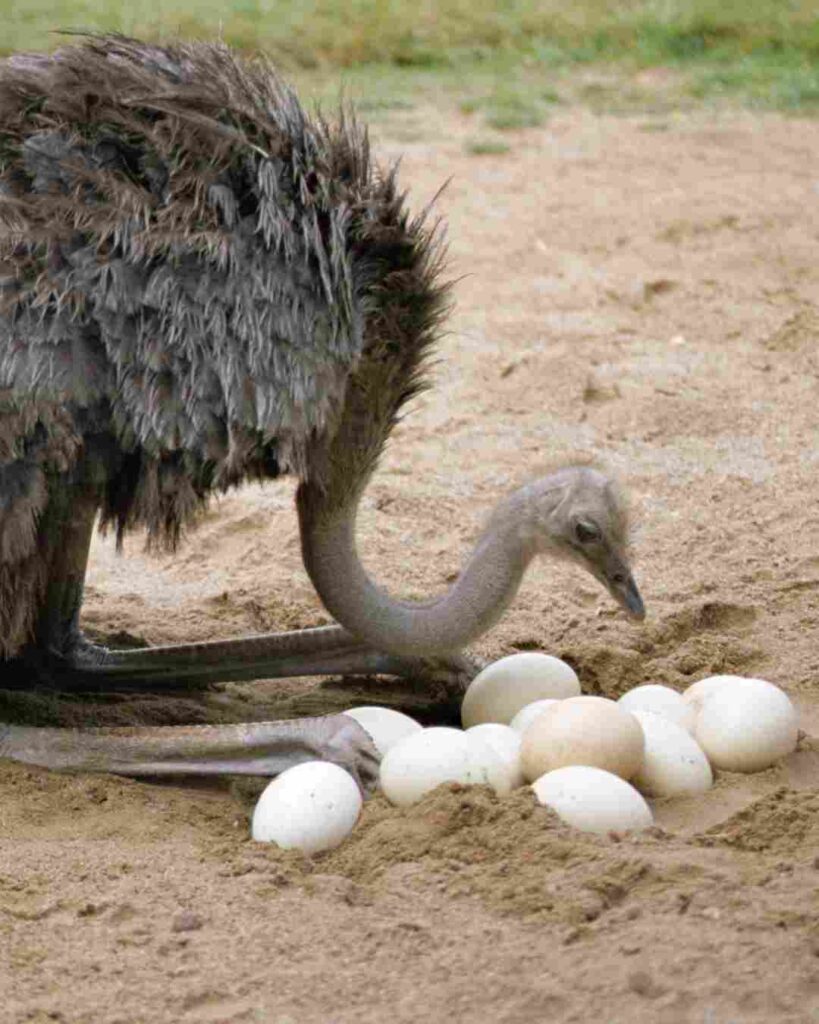
When discussing the protein content of an ostrich egg, we are dealing with numbers that dwarf standard nutritional charts. To understand the protein value, we have to look at the egg both as a massive individual unit and as a consumable food source by weight.
The ostrich egg is a powerhouse of nutrition. Because the ostrich is a large, flightless bird that evolved to survive in harsh environments, its egg is packed with dense nutrients to support the development of a large chick. This translates directly into a massive hit of macronutrients for humans.
How Much Protein Is in One Ostrich Egg?
The short answer is: a staggering amount. When you crack open one whole ostrich egg protein numbers can range significantly based on the size of the egg, but the averages are impressive.
On average, a single ostrich egg weighs between 1.3 kg to 1.5 kg (roughly 3 to 3.3 lbs). Within this massive shell lies a reservoir of albumin (egg white) and yolk that contains approximately 170 grams to 235 grams of protein.
To put that into perspective, the recommended daily protein intake for a sedentary adult male is about 56 grams. How much protein in one ostrich egg?
Enough to meet that requirement for three to four days. If you are an athlete aiming for high protein intake, a single egg provides the protein equivalent of nearly 2 pounds of steak.
However, it is important to note that size variations occur. A “small” ostrich egg might “only” yield 160g of protein, while a jumbo-sized specimen from a healthy breeder could push toward 250g.
When asking how much protein is in one ostrich egg, you are essentially asking about the protein content of a family-sized meal in a single shell.
How Many Grams of Protein Are in an Ostrich Egg?
If we drill down into the specifics of how many grams of protein in an ostrich egg, we need to look at the yield of the edible contents.
A typical ostrich egg yields about 1.1 kg to 1.3 kg of liquid (egg white and yolk combined) once the heavy shell is discarded.
- Total Liquid Weight: ~1200g
- Protein Factor: ~12.5% to 13% protein by weight
- Calculated Protein: ~156g to 200g+
When you cook the egg, the protein structure denatures and solidifies, but the actual grams of protein remain relatively stable. Whether you scramble it or boil it, how many grams of protein are in an ostrich egg remains consistent, though the volume may appear to change based on water loss or added ingredients like milk or butter.
For those tracking macros strictly, you can safely estimate that a standard, store-bought ostrich egg contains 175 grams of protein as a conservative baseline. This answers how many grams of protein is in an ostrich egg for the vast majority of commercially available eggs.
Ostrich Egg Protein Content Per 100g

While the total numbers are fun to look at, they can be misleading because no single person (hopefully) eats an entire ostrich egg in one sitting. To make a fair comparison with other foods, we need to standardize the measurement.
This is where ostrich egg protein per 100g becomes the most useful metric for diet tracking.
The nutritional density of an ostrich egg is surprisingly similar to that of a chicken egg, despite the size difference.
- Ostrich Egg Protein per 100g: Approximately 12.5g to 13.3g.
- Comparison: A standard chicken egg contains about 12.6g to 13g of protein per 100g.
This reveals a crucial truth: ostrich egg protein content grams are not “super-concentrated” compared to chicken eggs; there is just more of it because of the sheer volume. The ostrich egg protein percentage remains consistent with avian eggs in general.
For athletes and dieters, this means you can substitute an ostrich egg for a chicken egg in recipes at a 1:1 ratio by weight without altering the protein profile of your meal. If your diet plan calls for 200g of egg whites, 200g of ostrich egg whites will provide the same nutritional function.
Ostrich Egg Protein and Calories Breakdown
If you are consuming this much protein, you must also be aware of the caloric tag that comes with it. Protein does not exist in a vacuum; in an ostrich egg, it is accompanied by fats and micronutrients that contribute to the total energy load.
Ostrich Egg Calories
The calorie count of an ostrich egg is as massive as its shell.
- Total Calories: A single ostrich egg contains roughly 2,000 calories.
This is nearly 100% of the daily caloric limit for an average adult. If you are considering ostrich egg calories as part of a weight-loss diet, it is essential to be extremely careful with portion control.
However, for bodybuilders in a “bulking” phase, an ostrich egg omelet is an incredibly efficient way to hit a calorie surplus.
- Calories per 100g: Approximately 140–145 kcal.
(Slightly equivalent to chicken eggs, which hover around 143 kcal per 100g).
Protein-to-Calorie Ratio
Is ostrich egg protein and calories a good trade-off?
The ratio is standard for whole eggs. You are looking at a macronutrient split that is roughly:
- Fat: ~10g per 100g
- Protein: ~13g per 100g
- Carbohydrates: ~1g per 100g
This makes the ostrich egg protein calories ratio efficient for those on Keto or Paleo diets, where fat and protein are the primary fuel sources.
It is less efficient for those on low-fat diets, who might prefer separating the whites from the yolk—a task that is considerably messier with an ostrich egg than a chicken egg!
Boiled Ostrich Egg Protein vs Raw
Cooking methods can influence how our bodies utilize protein. The debate of boiled ostrich egg protein versus raw consumption is common among fitness enthusiasts, largely driven by “Rocky”-style pop culture.
Does boiling an ostrich egg reduce the protein count? No.
The ostrich egg protein amount remains the same whether the egg is raw, soft-boiled, or hard-boiled. However, the bioavailability changes.
- Bioavailability: Studies suggest that the human body absorbs cooked egg protein much more efficiently (over 90%) compared to raw egg protein (around 50%). Cooking breaks down the protein structure (denaturation), making it easier for digestive enzymes to process.
- The Avidin Factor: Raw egg whites contain avidin, a protein that binds to Biotin (Vitamin B7) and prevents its absorption. Cooking neutralizes avidin.
Therefore, while the grams of protein don’t change, the amount your body actually uses is higher in a boiled ostrich egg.
Note on Boiling: Boiling an ostrich egg is a project. It takes approximately 60 to 90 minutes to hard-boil an ostrich egg due to its volume and shell thickness.
Ostrich Egg White Protein vs Whole Egg
Just like chicken eggs, the protein in an ostrich egg is distributed between the white (albumin) and the yolk, but not evenly.
Ostrich Egg White Protein
The egg white accounts for the majority of the liquid weight.
- Protein Content: The whites contain virtually no fat and are almost pure protein and water.
- Volume: In an average ostrich egg, you might get nearly 700g–800g of egg white.
- Dietary Use: Ostrich egg white protein is an incredible source of lean amino acids. If you were to separate the yolk, you could have a massive volume of food with very low calories.
The Yolk
The yolk is where the fat, cholesterol, and vitamins reside. It also contains a significant portion of the protein (about 40% of the total protein is in the yolk).
- Ostrich Egg Protein Grams (Yolk): Richer and creamier than chicken yolk, it contributes significantly to the satiety factor.
If you are looking for the absolute highest protein-to-calorie ratio, sticking to the whites is the strategy, but you miss out on the rich micronutrients found in the massive yolk.
Ostrich Egg Protein vs Chicken Egg
This is the ultimate showdown. When shoppers ask are ostrich eggs better than chicken eggs, they are usually looking for a reason to switch. Let’s break down the ostrich egg protein vs chicken egg comparison.
The general rule of thumb is: 1 Ostrich Egg ≈ 24 Chicken Eggs.
Comparison Table: Ostrich vs. Chicken
| Nutrient | Ostrich Egg (Average) | Chicken Egg (Large) | Per 100g (Both) |
| Weight | 1.4 kg (3 lbs) | 50g | – |
| Total Protein | ~175g | 6g | ~13g |
| Total Calories | ~2000 kcal | 70 kcal | ~143 kcal |
| Total Fat | ~135g | 5g | ~10g |
| Cholesterol | ~1200mg+ | 185mg | High in both |
| Cost | $30 – $50 | $0.20 – $0.50 | Ostrich is pricier |
Key Differences:
- Magnesium & Iron: Ostrich eggs tend to be slightly higher in Magnesium and Iron content compared to chicken eggs.
- Vitamins: They have similar Vitamin A and E profiles, though ostrich eggs are often cited as having a richer, more buttery yolk due to slightly different fatty acid profiles.
- Sodium: Ostrich eggs naturally contain slightly less sodium per gram than chicken eggs.
So, is ostrich egg protein better? Not necessarily “better” in terms of amino acids—both are complete proteins with high bioavailability. The difference is purely in volume and novelty.
Which Animal Egg Has the Highest Protein?
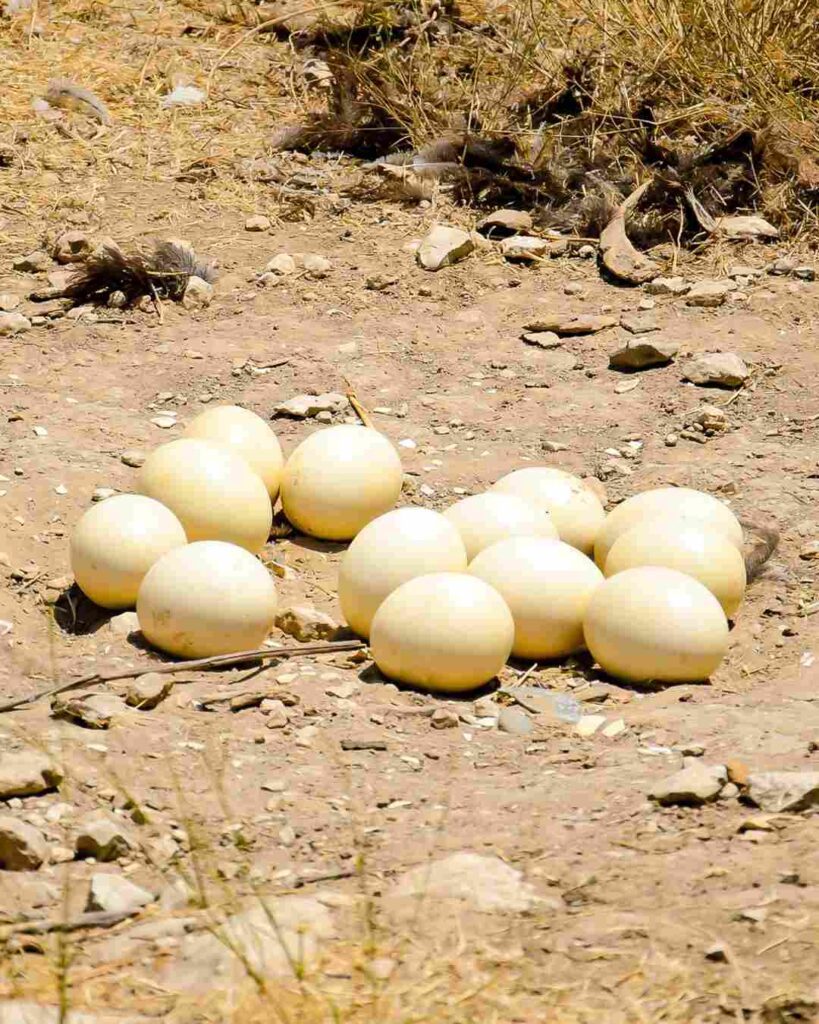
In the animal kingdom, not all eggs are created equal. While the ostrich egg wins in terms of total size, how does it compare in terms of protein density?
When we ask which animal egg has the highest protein percentage (per 100g), the ranking looks something like this:
- Turkey Eggs: Often cited as having slightly higher protein density (~13.7g per 100g) and a richer yolk.
- Goose Eggs: Very high in fat, but also high in protein (~13.9g per 100g).
- Ostrich Eggs: Balanced (~13g per 100g).
- Chicken Eggs: Standard (~12.6g per 100g).
- Quail Eggs: Similar density to chicken (~13g per 100g), but eaten in larger numbers.
Are ostrich eggs high in protein compared to the rest? They are squarely in the middle of the pack for density. They don’t offer a magical concentration of protein that outperforms a turkey or goose egg, but they offer the convenience (or inconvenience) of having it all in one shell.
Ostrich Egg Weight and Size Explained
To truly understand how much ostrich egg protein you are getting, you have to appreciate the physical dimensions.
- Average Weight: 3 lbs (1.4 kg).
- Shell Thickness: The shell is about 2mm thick. It is so strong that an adult human can often stand on an ostrich egg without breaking it.
- Volume: roughly 1.5 liters of liquid.
Why does this matter for protein? The ostrich egg weight includes a very heavy shell (roughly 250g-300g of the total weight). When you buy an ostrich egg priced by weight, remember that a chunk of that price is for the inedible shell (which, admittedly, makes for a great souvenir).
When calculating your macros, always calculate based on the liquid weight (approx 1.1kg) rather than the purchasing weight.
Can You Eat Ostrich Eggs Daily?
Given the massive nutritional load, can I eat ostrich eggs daily?
Technically, yes, provided you are eating portions of the egg, not a whole egg. Eating a whole ostrich egg daily would result in:
- Caloric Surplus: 2000 calories just from breakfast would lead to rapid weight gain for most people.
- Cholesterol: While dietary cholesterol is less demonized now than in the past, an ostrich egg contains massive amounts. If you are sensitive to dietary cholesterol, moderation is key.
Portion Control:
An ostrich egg is a communal food. It is designed to be scrambled and shared among 8 to 10 people. If you are a solo eater, you can cook it and store the leftovers. A scrambled ostrich egg keeps in the fridge for 3-4 days, similar to chicken eggs.
Ostrich Egg Protein Powder & Supplements
The supplement industry is constantly looking for the next big thing. This brings us to ostrich egg protein powder.
Does it exist?
Currently, ostrich egg protein for sale in powder form is a niche market. It is not as widely available as whey or chicken egg white powder. However, it is emerging in luxury health markets and sustainable farming sectors.
Comparison to Whey and Egg White Protein
- Digestion: Like chicken egg protein, ostrich egg protein is medium-digesting (slower than whey, faster than casein), keeping you full longer.
- Allergies: Some anecdotal evidence suggests that people with mild allergies to chicken eggs might tolerate ostrich eggs better, though cross-reactivity is high. Consult a doctor before trying this.
- Sustainability: Ostriches require less land and water than cattle (whey), making ostrich egg protein powder a potentially more eco-friendly choice in the future.
Ostrich Egg Protein Price & Why They Are Expensive
If you are sold on the nutrition, you might be shocked by the sticker price.
Ostrich Egg Protein Price
- Fresh Egg: $30.00 – $60.00 USD per egg.
- Empty Shell: $15.00 – $25.00 USD.
If we break this down to cost per gram of protein:
- Ostrich: ~$0.20 per gram of protein ($35 egg / 175g protein).
- Chicken: ~$0.03 per gram of protein ($0.20 egg / 6g protein).
Chicken eggs are roughly 6 to 7 times cheaper as a protein source.
Why Are Ostrich Eggs So Expensive?
- Seasonality: Ostriches do not lay eggs year-round like factory chickens. They have a laying season (usually spring/summer).
- Frequency: An ostrich hen lays only 40–60 eggs per year, compared to a chicken’s 250–300.
- Farming Costs: Ostriches are large, dangerous animals requiring strong fencing, large spaces, and significant food.
- Incubation: Many eggs are kept for hatching to grow the flock, reducing the supply available for eating.
How Does an Ostrich Egg Taste?
We’ve covered the science and the cost, but how does an ostrich egg taste like?
Many people expect a “gamey” or “wild” flavor, but the reality is more subtle.
- Flavor: It tastes remarkably similar to a chicken egg. Most people cannot tell the difference in a blind taste test.
- Texture: This is where the difference lies. What does ostrich taste like regarding texture? The whites are slightly more gelatinous and translucent when cooked. The yolk is often described as richer, creamier, and more “buttery” than a chicken egg.
- Cooking: Because of the volume, scrambled ostrich egg tends to be fluffier.
If you are worried about a strange taste ruining your protein meal, don’t be. It is familiar, just bigger.
Are Ostrich Eggs Worth It for Protein?
So, is the juice (or yolk) worth the squeeze?
Are ostrich eggs high in protein? Yes.
Are they a cost-effective source of protein? No.
Who Should Buy Them?
- The Host: If you are hosting a brunch for 10 people, cracking one ostrich egg is a spectacular event that feeds everyone.
- The Curious Foodie: It’s a bucket-list food item.
- The Paleo/Primal Eater: Seeking variety in animal protein sources.
Who Should Skip?
- The Budget Bodybuilder: If you need cheap daily protein, stick to chicken eggs, tuna, and whey.
- The Solo Eater: Unless you want to eat leftovers for four days, it’s too much food.
Verdict: Ostrich eggs are a premium, novelty protein source. They are nutritionally sound and delicious, but they are a luxury rather than a pantry staple.
FAQs
How much protein does an ostrich egg have?
A whole ostrich egg typically contains between 170g and 235g of protein, depending on the size of the egg.
How many grams of protein are in a ostrich egg?
In terms of pure grams per 100g, an ostrich egg has about 13g of protein, which is very similar to a standard chicken egg.
Is ostrich egg protein better than chicken egg?
It is not necessarily “better” biologically, as the amino acid profile is similar. However, ostrich eggs are richer in magnesium and iron. The main difference is the size and price.
How many people can one ostrich egg feed?
One ostrich egg is equivalent to about 24 chicken eggs. It can comfortably feed 8 to 12 people depending on what else is served with it.
Is ostrich egg protein good for bodybuilding?
Yes, it is an excellent source of complete protein for muscle building. However, due to the high calorie and fat content (if eating the yolk) and the high price, it is not the most practical daily supplement compared to chicken eggs or protein powder.
References
- Ostrich Egg Protein & Nutrition Facts
- Comparison to Chicken Eggs (Size & Equivalent)
- Holland & Barrett: Detailed comparison of chicken, duck, and ostrich eggs, confirming the “1 egg = 24 chicken eggs” ratio and shell thickness.
- Beastlife: Analysis of protein density and equivalence for athletes.
- Taste Profile & Culinary Use
- Market Price Examples