


As a physician specializing in public health and nutrition, I get this question all the time: “Is coconut water really healthy?”
It’s marketed as nature’s perfect sports drink, a miracle hydrator, and a wellness staple. But is that hype, or is it health?
The short answer is: Yes, unsweetened coconut water can be a healthy choice for most people, but it is not a magic cure-all.
It’s a beverage with a very specific nutritional profile—one that is beneficial for some, but potentially risky for others. Let’s break down the evidence.
TL;DR: Is Coconut Water Healthy?
Yes, for most healthy people, unsweetened coconut water is a healthy choice in moderation (about 4–8 ounces a day). An 8-ounce serving typically contains 45–60 calories and 6–12 grams of natural sugar, but is an excellent source of the electrolyte potassium. It is not a “super-hydrator” compared to water, but it is a healthier alternative to sugary sodas or juices.
Caution: People with Chronic Kidney Disease (CKD) or those on potassium-raising medications (like some blood pressure drugs) should avoid or limit coconut water due to its high potassium content.
What Is Coconut Water?
First, let’s be clear. Coconut water is not the same as coconut milk.
- Coconut Water: This is the clear, watery liquid found inside young, green coconuts. It’s about 95% water and contains electrolytes and a small amount of sugar.
- Coconut Milk: This is a processed product made by grating the white flesh of mature, brown coconuts and soaking it in water. It is white, opaque, and very high in fat.
This article is only about the clear coconut water.
Coconut Water Nutrition at a Glance
The health benefits and risks of coconut water all come down to its unique nutritional profile. Values can vary significantly between brands, especially between fresh, pasteurized, and “from concentrate” versions.
Here is a typical nutritional breakdown for one 8-ounce (240ml) serving of unsweetened coconut water.
TABLE 1: Typical Nutrition for 8 oz Unsweetened Coconut Water
| Nutrient | Per 8 oz (Typical) | Notes |
| Calories | 45–60 kcal | A low-calorie beverage, but not zero. |
| Total Sugars | 6–12 grams | These are natural sugars (glucose, fructose, sucrose). |
| Potassium | 450–600 mg | This is the standout nutrient (10–13% DV). |
| Sodium | 40–60 mg | Naturally low in sodium (but some brands add it). |
| Magnesium | 15–60 mg | A decent source (4–15% DV). |
Source: USDA FoodData Central. Values are approximate and vary by brand.
As you can see, coconut water’s claim to fame is potassium. One 8-ounce glass can have more potassium than a medium banana. This is the source of both its main benefit and its main risk.
Is Coconut Water “Super Hydrating”?
Marketers love to call coconut water a “super-hydrator.” As a physician, I have to look at the clinical evidence.
Here’s what the science says:
- What it is: Coconut water is an isotonic beverage. This means it has a similar concentration of salt and sugar as the human body, which can help it be absorbed efficiently.
- What the evidence shows: Studies comparing coconut water to sports drinks and plain water for rehydration (mostly in athletes) find no significant difference.
- A key 2012 study in the Journal of the International Society of Sports Nutrition found that water, coconut water, and sports drinks were all capable of rehydrating subjects after a 60-minute workout.
- A 2002 review found that coconut water was easy to consume in large amounts (good palatability) and didn’t cause the nausea or GI upset that some sports drinks do, but it was not superior in terms of rehydration.
My clinical guidance:
- For light/moderate activity (<60 minutes): Coconut water is a fine choice for hydration, but it offers no real advantage over plain water, which is calorie-free and significantly cheaper.
- For long/hot/high-sweat scenarios (>60 minutes): This is where coconut water falls short. During intense, sweaty exercise, you lose significantly more sodium than potassium. Coconut water is low in sodium. In this scenario, a traditional sports drink (or water with salt tablets) is better formulated to replace what you’re actually losing and prevent muscle cramps.
Verdict: Is coconut water super hydrating? No. It’s hydrating because it’s mostly water. It’s not a “super-drink.”
Is It Okay to Drink Coconut Water Daily?
For most healthy adults, yes, it is generally safe to drink coconut water daily—if you stick to a few important rules.
- Moderation is Key: “Daily” does not mean “all day.” A reasonable portion is one 4- to 8-ounce serving per day. If you drink 32 ounces, you’re consuming 180-240 calories and 24-48 grams of sugar you may not need.
- Water Is Your Primary: Your main hydration source should always be plain water. The CDC recommends water as the best choice for hydration, as it’s calorie-free. Use coconut water as a supplement or a flavorful alternative, not as your main beverage.
- Choose Unsweetened: “Flavored” or “enhanced” coconut waters (like pineapple or mango) are often loaded with added sugars, turning a healthy drink into a soda equivalent. Always read the label.
Decision Tree: Should I Drink Coconut Water?
If you are a healthy adult with no underlying conditions…
- Yes, as a refreshing, low-sugar alternative to soda or juice. Stick to 4-8 oz of an unsweetened version.
If you are an athlete…
- Maybe. It’s fine for light hydration. If you are a heavy sweater or exercising in the heat for over an hour, you need a drink with more sodium, which coconut water lacks.
If you have medical conditions (CKD, Diabetes, Pregnancy)…
- Talk to your doctor first.
- CKD: Likely no. The high potassium can be dangerous.
- Diabetes: In moderation. You must choose unsweetened and account for the ~10-15g of carbohydrates.
- Pregnancy: Generally safe if pasteurized, but water is still preferred.
Health Benefits of Coconut Water (With Evidence Grades)
Let’s use qualified language (as required by the FDA) to discuss what coconut water may do.
- May Support Hydration (Grade B)
- Evidence: It is 95% water. As discussed above, clinical trials show it is effective for hydration, on par with water and sports drinks for light activity.
- Provides Key Electrolytes (Grade B)
- Evidence: This is a simple fact. It is naturally rich in potassium and contains magnesium and calcium. Potassium is a vital mineral that most Americans don’t get enough of. It helps regulate fluid balance, nerve signals, and heart rhythm.
- A Lower-Calorie Swap for Sugary Drinks (Grade C)
- Evidence: This is a behavioral benefit. An 8 oz serving of unsweetened coconut water has ~50 calories and 9g of sugar. An 8 oz serving of a typical soda or orange juice has 100-120 calories and 25-30g of sugar. Swapping one for the other can support weight management and reduce added sugar intake.
What about claims that it lowers blood pressure, dissolves kidney stones, or cures hangovers? The evidence is either non-existent, based on tiny animal studies, or purely anecdotal. I do not recommend drinking coconut water for these purposes.
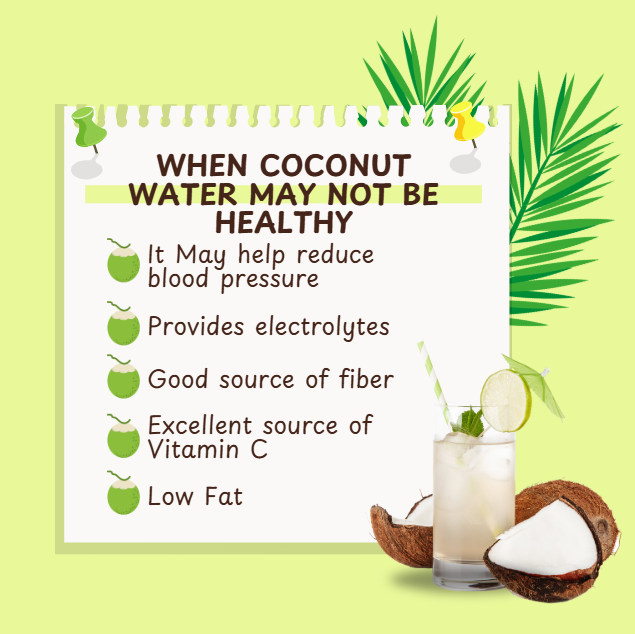
Risks & Side Effects: When Coconut Water Is Not Healthy
This is the most critical part of this guide. For some individuals, coconut water can be dangerous.
1. The Potassium Risk (Hyperkalemia)
The main risk of coconut water is its extremely high potassium content.
Your kidneys are responsible for filtering excess potassium from your blood. If your kidneys aren’t working well, or if you flood your body with more potassium than they can handle, it can build up in your blood. This condition is called hyperkalemia (high potassium) and it is a medical emergency that can cause:
- Irregular heart rhythms (arrhythmias)
- Muscle weakness
- In severe cases, cardiac arrest
Who is at risk?
- People with Chronic Kidney Disease (CKD): This is the #1 risk group. The National Kidney Foundation (NKF) lists coconut water as a high-potassium food that should be limited or avoided by patients with kidney disease.
- People on Certain Medications: Some common blood pressure medications (like ACE inhibitors, ARBs, and potassium-sparing diuretics like Spironolactone) can raise potassium levels. Adding high-potassium coconut water on top of this can be dangerous.
2. Added Sugars
This risk is about label-reading. Many popular brands sell “pineapple” or “chocolate” flavored coconut water. These often contain 20-30 grams of sugar per serving, making them no healthier than a soda.
3. GI Upset
In large amounts, coconut water can cause bloating, gas, and diarrhea. It contains FODMAPs (fermentable carbohydrates) that can trigger symptoms in people with Irritable Bowel Syndrome (IBS).
When to Call a Clinician
While rare in healthy individuals, excessive potassium intake can be serious. If you have known kidney disease, are on potassium-affecting medications, or have consumed large amounts of coconut water and experience any of the following, seek medical attention:
- Heart palpitations or a “fluttering” feeling
- A slow or irregular pulse
- Sudden muscle weakness or “heavy” limbs
- Tingling or numbness in your hands or feet
Daily Use in Special Situations
Coconut Water in Pregnancy
Is coconut water healthy during pregnancy? It is generally considered safe, with two key rules:
- It MUST be pasteurized. Unpasteurized (raw) juices can carry bacteria (like Listeria) that are very dangerous during pregnancy. The FDA warns against all unpasteurized juices.
- Moderation. The American College of Obstetricians and Gynecologists (ACOG) recommends 8-12 cups of water per day during pregnancy. Coconut water can be a part of that, but be mindful of the calories and sugar, especially if you are at risk for gestational diabetes.
Coconut Water and Diabetes
The American Diabetes Association (ADA) lists water and zero-calorie drinks as the best choices. Unsweetened coconut water is okay in moderation, but it is not a “free” drink.
- An 8 oz serving has ~10-15g of carbohydrates, which you must count toward your daily total.
- Always choose unsweetened.
- Test your blood sugar to see how it affects you personally.
Coconut Water for Kidneys/Liver
- Kidneys: As stated by the National Kidney Foundation (NKF), AVOID coconut water if you have CKD or are on a potassium-restricted diet.
- Liver: There are no specific, evidence-based benefits of coconut water for liver health.
Label Literacy: How to Buy Healthy Coconut Water
The grocery aisle is confusing. Here’s what to look for on the label.
- Check the Ingredients: The list should say “100% Coconut Water.” If you see “Added Sugar,” “Cane Sugar,” or “Fructose,” put it back.
- “Unsweetened” vs. “No Sugar Added”: “Unsweetened” is the best claim. “No Sugar Added” is also good, but “flavored” versions may still be high in natural sugar from other fruit purees.
- Check for “Pasteurized”: This means it has been heat-treated for safety. It’s the standard for boxed/bottled beverages in the U.S.
- Check the Sodium: A “healthy” choice should be low in sodium (under 140 mg). Most unsweetened brands are ~40-60 mg. Some “sports” versions can be 250 mg or more.
Comparison: Coconut Water vs Sports Drink vs Water
How does coconut water stack up against other hydration options?
TABLE 2: Hydration Drink Comparison (per 8 oz)
| Drink | Calories | Sugar | Sodium | Potassium | Best For… |
| Water | 0 | 0 g | 0 mg | 0 mg | All-purpose daily hydration |
| Unsweetened Coconut Water | ~50 | ~9 g | ~50 mg | ~500 mg | Light hydration, potassium boost |
| Sports Drink (e.g., Gatorade) | ~60 | ~14 g | ~160 mg | ~50 mg | Intense exercise (>60 min |
Frequently Asked Questions (FAQs)
Is coconut water healthy for you/to drink?
Yes, for most healthy people, a moderate amount (4-8 oz) of unsweetened coconut water is a healthy choice. It’s a low-calorie way to get electrolytes, especially potassium.
Is coconut water okay to drink daily?
For a healthy person (with no kidney issues), one 4-8 oz glass of unsweetened coconut water per day is generally fine. However, plain water should still be your main beverage.
Is there a lot of sugar in coconut water?
Unsweetened coconut water has ~6-12 grams of natural sugar per 8 oz serving. This is about half the sugar of an equal amount of orange juice. Flavored versions, however, can have as much sugar as a soda.
Is coconut water super hydrating?
No. It is hydrating because it is 95% water, but clinical studies show it is not superior to plain water or a sports drink for rehydration after light exercise.
What organ is coconut water good for?
This is a common question. While it’s not a “medicine” for any organ, the potassium in coconut water is a mineral that supports heart health and normal muscle and nerve function. However, it can be very bad for the kidneys in people who already have kidney disease.
What happens if I drink coconut water every day?
If you are healthy and drink a moderate amount (4-8 oz) of unsweetened coconut water, you will likely just add a good source of potassium to your diet. If you drink large amounts of sugary coconut water, you may gain weight. If you have undiagnosed kidney disease, you could dangerously raise your potassium levels.
References
- U.S. Department of Agriculture (USDA), FoodData Central. (2019). Nuts, coconut water (liquid from coconuts).
- Kalman, D. S., Feldman, S., Krieger, D. R., & Bloomer, R. J. (2012). Comparison of coconut water and a carbohydrate-electrolyte sport drink on measures of hydration and physical performance in exercise-trained men. Journal of the International Society of Sports Nutrition, 9(1), 1.
- Centers for Disease Control and Prevention (CDC). (2022). Get the Facts: Healthy Drinks.
- National Kidney Foundation (NKF). (2020). Potassium and Your CKD Diet.
- American Diabetes Association (ADA). (2023). What Can I Drink?
- The American College of Obstetricians and Gynecologists (ACOG). (2020). Nutrition During Pregnancy (FAQ).
- U.S. Food & Drug Administration (FDA). (2018). The Dangers of Raw Milk: Unpasteurized Milk Can Get You Sick. (Note: This guidance applies to all unpasteurized juices, including coconut water.)
- Saat, M., Singh, R., Sirisinghe, R. G., & Nawawi, M. (2002). Rehydration after exercise with fresh young coconut water, carbohydrate-electrolyte beverage and plain water. Journal of physiological anthropology and applied human science, 21(2), 93-100.