If you’re logging meals, counting carbs or just curious, you want real numbers, not vague “superfood” claims. This guide lays out pumpkin nutrition facts straight from USDA data: calories, carbs, fiber, sugar, protein, vitamins and minerals for raw, cooked and canned pumpkin, plus pumpkin pie mix and pumpkin seeds.
You’ll also learn why canned pumpkin looks so different from fresh on paper, how to read the vitamin A numbers, and which nutrients matter most for specific diets.
Key Takeaways
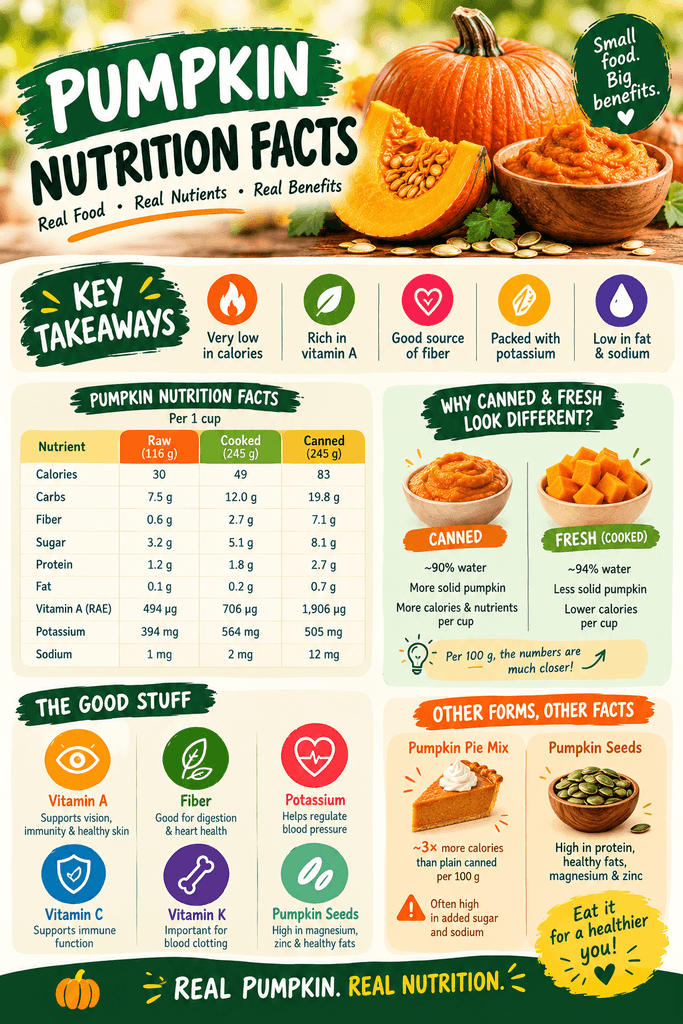
- One cup of cooked, mashed pumpkin has about 49 calories, 12 g carbs, 2.7 g fiber and 706 µg vitamin A (78% of the Daily Value).
- One cup of plain canned pumpkin has about 83 calories, 20 g carbs, 7 g fiber and 1,906 µg vitamin A (over 200% DV), because it holds less water.
- Pumpkin is about 90–94% water, very low in fat and naturally low in sodium.
- Pumpkin pie mix has roughly three times the calories of plain canned pumpkin per 100 g, plus added sodium.
- Canned pumpkin provides a notable amount of vitamin K, which matters if you take warfarin.
- Pumpkin seeds have a completely different profile: high in calories, protein, healthy fats and magnesium.
Pumpkin Nutrition Facts at a Glance
Here are the headline numbers for the three most common forms of pumpkin, per one-cup serving. Values come from USDA FoodData Central records for raw pumpkin, cooked, boiled pumpkin and canned pumpkin without salt.
| Per 1 cup | Raw, cubed (116 g) | Cooked, mashed (245 g) | Canned, no salt (245 g) |
| Calories | 30 | 49 | 83 |
| Carbohydrate | 7.5 g | 12.0 g | 19.8 g |
| Fiber | 0.6 g | 2.7 g | 7.1 g |
| Total sugars | 3.2 g | 5.1 g | 8.1 g |
| Protein | 1.2 g | 1.8 g | 2.7 g |
| Fat | 0.1 g | 0.2 g | 0.7 g |
| Vitamin A (RAE) | 494 µg | 706 µg | 1,906 µg |
| Vitamin C | 10.4 mg | 11.5 mg | 10.3 mg |
| Potassium | 394 mg | 564 mg | 505 mg |
| Sodium | 1 mg | 2 mg | 12 mg |
These numbers are for plain pumpkin with nothing added. Butter, sugar, cream or salt changes them quickly.
For the bigger picture on whether these nutrients add up to a healthy food, see our companion article, is pumpkin healthy.
Pumpkin Calories: Why Canned and Fresh Look So Different
The most common question about pumpkin nutrition facts is why a cup of canned pumpkin has nearly twice the calories of a cup of cooked fresh pumpkin. The answer is water.
According to USDA data, boiled fresh pumpkin is about 94% water, while canned pumpkin is about 90% water. Canned pumpkin is cooked down and packed densely, so a cup holds more actual pumpkin solids. That means more calories, but also more fiber, vitamin A and iron in the same cup.
Per 100 grams, the numbers are much closer:
| Per 100 g | Raw | Cooked | Canned |
| Calories | 26 | 20 | 34 |
| Water | 91.6 g | 93.7 g | 90.0 g |
| Carbs | 6.5 g | 4.9 g | 8.1 g |
| Fiber | 0.5 g | 1.1 g | 2.9 g |
Either way, pumpkin is a very low-calorie food. Even canned pumpkin has fewer calories per cup than a medium banana. If you use pumpkin for its volume and fiber, our article on whether a high-fiber diet is good for weight loss explains how fiber affects fullness.
Pumpkin Carbs, Fiber, and Sugar
Total and Net Carbs
Pumpkin is a moderate-carb vegetable. Here’s the breakdown per cup, with net carbs calculated as total carbs minus fiber:
| Per 1 cup | Total carbs | Fiber | Net carbs | Sugars |
| Raw | 7.5 g | 0.6 g | 6.9 g | 3.2 g |
| Cooked | 12.0 g | 2.7 g | 9.3 g | 5.1 g |
| Canned | 19.8 g | 7.1 g | 12.7 g | 8.1 g |
For people on very low-carb or keto diets, a full cup of canned pumpkin may use a big share of a daily carb limit. Smaller portions, like ¼ cup stirred into yogurt or a sauce, fit more easily. For people counting carbs for diabetes, our list of pumpkin recipes for diabetics shows how to portion and pair pumpkin.
Fiber
Canned pumpkin is a standout source of fiber at about 7 grams per cup, 25% of the FDA’s 28-gram Daily Value. The Harvard T.H. Chan School of Public Health notes that most people eat far less fiber than recommended. Fiber is linked with better digestion and lower risk of heart disease and type 2 diabetes.
Sugar
Pumpkin’s sugars are naturally occurring. A cup of plain canned pumpkin has about 8 grams, which is less than a medium apple. The large amounts of sugar in pumpkin desserts and drinks are added during preparation, not from the pumpkin.
Pumpkin Vitamin A and Carotenoids, Explained
Vitamin A is pumpkin’s headline nutrient, but the numbers can be confusing.
What “RAE” Means
Pumpkin doesn’t contain preformed vitamin A. It contains carotenoids that your body converts into vitamin A. The NIH Office of Dietary Supplements explains that vitamin A is reported in micrograms of retinol activity equivalents (RAE) to account for this. It takes about 12 µg of dietary beta-carotene, or 24 µg of alpha-carotene, to make 1 µg RAE.
Carotenoids in Pumpkin
USDA data shows pumpkin is unusual because it’s rich in both beta-carotene and alpha-carotene, plus lutein and zeaxanthin:
| Per 1 cup | Beta-carotene | Alpha-carotene | Lutein + zeaxanthin | Vitamin A (RAE) | % DV |
| Raw | 3,596 µg | 4,659 µg | 1,740 µg | 494 µg | 55% |
| Cooked | 5,135 µg | 6,652 µg | 2,484 µg | 706 µg | 78% |
| Canned | 17,003 µg | 11,748 µg | — | 1,906 µg | 212% |
% DV is based on the FDA Daily Value of 900 µg RAE. The USDA record lists no lutein value for canned pumpkin.
Lutein and zeaxanthin don’t convert into vitamin A, but they’re carotenoids that collect in the eye. Pumpkin is one of the richer orange-vegetable sources.
Getting the Most From It
Carotenoids are fat-soluble. A study in the American Journal of Clinical Nutrition found that people absorbed significantly more carotenoids from vegetables eaten with full-fat dressing than with fat-free or reduced-fat versions. A drizzle of olive oil, a sprinkle of nuts or a spoonful of yogurt with your pumpkin helps.
Pumpkin Vitamins and Minerals: The Full Panel
Beyond vitamin A, pumpkin provides small to moderate amounts of many nutrients. Here’s the full picture per cup, with % Daily Value based on FDA Daily Values:
| Nutrient (1 cup) | Cooked (245 g) | % DV | Canned (245 g) | % DV |
| Vitamin C | 11.5 mg | 13% | 10.3 mg | 11% |
| Vitamin E | 2.0 mg | 13% | 2.6 mg | 17% |
| Vitamin K | 2.0 µg | 2% | 39 µg | 33% |
| Potassium | 564 mg | 12% | 505 mg | 11% |
| Iron | 1.4 mg | 8% | 3.4 mg | 19% |
| Magnesium | 22 mg | 5% | 56 mg | 13% |
| Calcium | 37 mg | 3% | 64 mg | 5% |
| Copper | 0.22 mg | 25% | 0.27 mg | 30% |
| Folate (DFE) | 22 µg | 6% | 29 µg | 7% |
A few numbers are worth calling out:
- Potassium: At 500–560 mg per cup, pumpkin is a useful source. The Office of Dietary Supplements notes that potassium helps offset sodium’s effect on blood pressure, and many adults don’t get enough.
- Iron: Canned pumpkin provides about 3.4 mg of plant (non-heme) iron per cup. The vitamin C in pumpkin helps the body absorb it, according to the Office of Dietary Supplements iron fact sheet.
- Vitamin K: Canned pumpkin has far more vitamin K than fresh, about a third of the Daily Value per cup. That’s relevant for people on blood thinners (see “Who Should Pay Attention” below).
- Copper: Pumpkin is a surprisingly good source of copper, which helps the body make red blood cells and use iron.
Pumpkin Protein and Fat
Pumpkin flesh is not a significant source of protein or fat. A cup of cooked pumpkin has under 2 grams of protein and less than a quarter gram of fat. That’s why pairing pumpkin with a protein source makes a more balanced and filling meal: Greek yogurt, eggs, beans, chicken or cheese, as in this pumpkin mac and cheese.
Pumpkin Puree vs. Pumpkin Pie Mix: Nutrition Compared
They sit side by side on store shelves, but their nutrition facts are very different. Plain canned pumpkin puree is 100% pumpkin. Pumpkin pie mix (or “filling”) is pumpkin with added sweeteners, spices and salt.
According to USDA FoodData Central’s record for canned pumpkin pie mix:
| Per 100 g | Plain canned pumpkin | Pumpkin pie mix |
| Calories | 34 | 104 |
| Carbohydrate | 8.1 g | 26.4 g |
| Sodium | 5 mg | 208 mg |
| Vitamin A (RAE) | 778 µg | 415 µg |
| Potassium | 206 mg | 138 mg |
Pie mix has about three times the calories and over 40 times the sodium of plain pumpkin, and about half the vitamin A. For everyday cooking, buy cans labeled “100% pumpkin.” Save pie mix for recipes written for it, like this pumpkin bread, or make your own homemade pumpkin puree and season it yourself.
Pumpkin Seeds Nutrition Facts
Pumpkin seeds are nutritionally a different food from the flesh. According to USDA data for roasted pumpkin seed kernels without salt, one ounce (about 28 g) provides:
| Per 1 oz (28 g) | Amount | % DV |
| Calories | ~163 | — |
| Protein | 8.4 g | 17% |
| Fat | 13.9 g | 18% |
| Fiber | ~1.8 g | 6% |
| Magnesium | 156 mg | 37% |
| Phosphorus | 333 mg | 27% |
| Zinc | 2.2 mg | 20% |
That’s why a small handful goes a long way. The Office of Dietary Supplements lists pumpkin seeds among the richest food sources of magnesium. For roasting tips and health benefits, read are pumpkin seeds healthy.
How Pumpkin Compares to Other Orange Vegetables
Pumpkin is one of the lowest-calorie orange vegetables. Here’s how it stacks up per cup:
- Butternut squash (baked): about 82 calories, 6.6 g fiber and over 1,100 µg RAE vitamin A. It’s more nutrient-dense than fresh pumpkin and similar to canned. See is butternut squash healthy.
- Sweet potato: higher in calories and carbs, also rich in beta-carotene. Read are sweet potatoes healthy.
- Carrots: very high in beta-carotene and great raw. See are carrots healthy.
For a broader comparison of every squash variety, from acorn to Hubbard, see our winter squash guide.
Who Should Pay Attention to Pumpkin’s Nutrition Numbers
People Taking Warfarin
Vitamin K affects how blood-thinning medicines like warfarin work. The Office of Dietary Supplements advises people on warfarin to keep their vitamin K intake consistent rather than avoiding it. A cup of canned pumpkin provides about a third of the Daily Value, so if you suddenly start eating a lot of it, tell your doctor.
People With Kidney Disease
Pumpkin contains 500–560 mg of potassium per cup. The National Institute of Diabetes and Digestive and Kidney Diseases advises that people with chronic kidney disease may need to limit high-potassium foods. Ask your renal dietitian how much fits your plan.
People Counting Carbs
The carb table above is your guide. Watch portion sizes, especially with canned pumpkin and pumpkin baked goods.
Very High Daily Intake
Eating very large amounts of carotene-rich foods daily can turn the skin a yellow-orange color. An NCBI StatPearls review describes this condition, carotenemia, as harmless and reversible once intake drops. Vitamin A from carotenoids in food doesn’t cause vitamin A toxicity.
Practical Tips for Using Pumpkin Nutrition Facts
- Weigh or measure for tracking. “One cup” of raw cubes (116 g) and “one cup” of puree (245 g) are very different amounts.
- Use the right database entry. In nutrition apps, choose “canned, without salt” for 100% pumpkin, not “pie mix.”
- Check labels. Brands vary slightly. Compare the Nutrition Facts panel to the USDA numbers.
- Count toward vegetables. The USDA’s MyPlate counts pumpkin as a red and orange vegetable, and 1 cup of cooked or canned pumpkin equals 1 cup of vegetables.
- Boost breakfast. Stirring ½ cup of canned pumpkin into oats adds about 3.5 g of fiber and nearly 1,000 µg RAE of vitamin A. Try this pumpkin caramelized banana baked oatmeal.
Myths vs. Facts About Pumpkin Nutrition
Myth: Pumpkin is high in sugar.
Fact: A cup of plain canned pumpkin has about 8 g of natural sugar. The high sugar in pumpkin treats comes from added sweeteners.
Myth: Fresh pumpkin is more nutritious than canned.
Fact: Per cup, plain canned pumpkin has more fiber, vitamin A and iron than boiled fresh pumpkin because it’s more concentrated.
Myth: Pumpkin is a good protein source.
Fact: The flesh has under 3 g of protein per cup. The seeds are the protein-rich part.
Myth: Pumpkin pie mix and pumpkin puree are interchangeable.
Fact: Pie mix has about three times the calories and much more sodium per 100 g.
Myth: Eating a lot of pumpkin can cause vitamin A poisoning.
Fact: Your body converts carotenoids to vitamin A only as needed. Food sources don’t cause vitamin A toxicity, though very high intake can harmlessly tint the skin.
Frequently Asked Questions
How many calories are in a cup of pumpkin?
According to USDA data, one cup of cooked, mashed pumpkin has about 49 calories, and one cup of plain canned pumpkin has about 83. Raw pumpkin cubes have about 30 calories per cup. Canned pumpkin has more calories per cup because it contains less water and more pumpkin solids.
How many carbs are in canned pumpkin?
One cup of plain canned pumpkin contains about 19.8 grams of total carbohydrate, including 7.1 grams of fiber, for roughly 12.7 grams of net carbs. A half-cup serving has about 10 grams of total carbs. Pumpkin pie mix is much higher in carbs because it has added sugar.
How much vitamin A is in pumpkin?
One cup of plain canned pumpkin provides about 1,906 micrograms RAE of vitamin A, more than twice the Daily Value. A cup of cooked fresh pumpkin provides about 706 micrograms, or 78% of the Daily Value. The vitamin A comes from beta-carotene and alpha-carotene.
Is pumpkin keto-friendly?
Pumpkin can fit a keto diet in small portions. A quarter cup of canned pumpkin has about 3 grams of net carbs, while a full cup has nearly 13. Use small amounts in sauces, smoothies or yogurt, and count it toward your daily carb limit.
How much protein is in pumpkin?
Pumpkin flesh is low in protein, with about 1.8 grams per cup cooked and 2.7 grams per cup canned. Pumpkin seeds are much richer, with about 8 grams of protein per ounce. Pair pumpkin dishes with yogurt, eggs, beans or meat for a balanced meal.
What’s the difference between pumpkin puree and pumpkin pie filling?
Pumpkin puree is 100% cooked pumpkin with nothing added. Pumpkin pie filling contains added sugar, spices and salt. Per 100 grams, USDA data shows pie mix has about 104 calories and 208 mg sodium, compared with 34 calories and 5 mg sodium for plain canned pumpkin.
Conclusion
The pumpkin nutrition facts tell a clear story: plain pumpkin is low in calories and fat, moderate in carbs and naturally low in sodium. It’s also an excellent source of vitamin A from beta- and alpha-carotene. Canned pumpkin is the most concentrated form, with about 7 grams of fiber and over 200% of the Daily Value for vitamin A per cup, while fresh cooked pumpkin is lighter and more watery. Choose “100% pumpkin” over pie mix, measure portions if you’re tracking, eat it with a little fat, and keep vitamin K and potassium in mind if you take warfarin or have kidney disease.
Medical disclaimer: This article is for general educational purposes only and is not a substitute for professional medical advice, diagnosis or treatment. If you take medication such as warfarin or have a condition such as diabetes or kidney disease, talk with your doctor or a registered dietitian before making significant changes to your diet.
(3) References
- U.S. Department of Agriculture. “Pumpkin, raw” (FDC ID 168448). FoodData Central, SR Legacy. https://fdc.nal.usda.gov/fdc-app.html#/food-details/168448/nutrients
- U.S. Department of Agriculture. “Pumpkin, cooked, boiled, drained, without salt” (FDC ID 168449). FoodData Central, SR Legacy. https://fdc.nal.usda.gov/fdc-app.html#/food-details/168449/nutrients
- U.S. Department of Agriculture. “Pumpkin, canned, without salt” (FDC ID 168450). FoodData Central, SR Legacy. https://fdc.nal.usda.gov/fdc-app.html#/food-details/168450/nutrients
- U.S. Department of Agriculture. “Pumpkin pie mix, canned” (FDC ID 169273). FoodData Central, SR Legacy. https://fdc.nal.usda.gov/fdc-app.html#/food-details/169273/nutrients
- U.S. Department of Agriculture. “Seeds, pumpkin and squash seed kernels, roasted, without salt” (FDC ID 170557). FoodData Central, SR Legacy. https://fdc.nal.usda.gov/fdc-app.html#/food-details/170557/nutrients
- U.S. Food and Drug Administration. “Daily Value on the Nutrition and Supplement Facts Labels.” https://www.fda.gov/food/nutrition-facts-label/daily-value-nutrition-and-supplement-facts-labels
- NIH Office of Dietary Supplements. “Vitamin A and Carotenoids: Fact Sheet for Health Professionals.” https://ods.od.nih.gov/factsheets/VitaminA-HealthProfessional/
- NIH Office of Dietary Supplements. “Potassium: Fact Sheet for Health Professionals.” https://ods.od.nih.gov/factsheets/Potassium-HealthProfessional/
- NIH Office of Dietary Supplements. “Iron: Fact Sheet for Health Professionals.” https://ods.od.nih.gov/factsheets/Iron-HealthProfessional/
- NIH Office of Dietary Supplements. “Vitamin K: Fact Sheet for Health Professionals.” https://ods.od.nih.gov/factsheets/VitaminK-HealthProfessional/
- NIH Office of Dietary Supplements. “Magnesium: Fact Sheet for Health Professionals.” https://ods.od.nih.gov/factsheets/Magnesium-HealthProfessional/
- Harvard T.H. Chan School of Public Health. “Fiber.” The Nutrition Source. https://nutritionsource.hsph.harvard.edu/carbohydrates/fiber/
- Brown MJ, et al. “Carotenoid bioavailability is higher from salads ingested with full-fat than with fat-reduced salad dressings.” American Journal of Clinical Nutrition. 2004. https://pubmed.ncbi.nlm.nih.gov/15277161/
- National Institute of Diabetes and Digestive and Kidney Diseases. “Eating Right for Chronic Kidney Disease.” https://www.niddk.nih.gov/health-information/kidney-disease/chronic-kidney-disease-ckd/eating-nutrition
- Al Nasser Y, Jamal Z, Albugeaey M. “Carotenemia.” StatPearls, NCBI Bookshelf. https://www.ncbi.nlm.nih.gov/books/NBK534878/
- U.S. Department of Agriculture. “Vegetables.” MyPlate. https://www.myplate.gov/eat-healthy/vegetables