Nuts are one of the most nutrient-dense foods you can eat. A small handful delivers plant protein, fiber, heart-healthy unsaturated fats, vitamin E, magnesium and a range of protective plant compounds. So, are nuts good for you? The evidence says yes. Large clinical trials and decades of population studies link regular nut eating to healthier hearts, better cholesterol and longer lives, with some important caveats about portions, preparation and allergies.
This complete guide to nuts covers what each popular nut contains, how they compare, what the strongest research says, how many nuts to eat a day, and the best ways to eat and store them. It also covers who should be cautious and clears up the biggest myths.
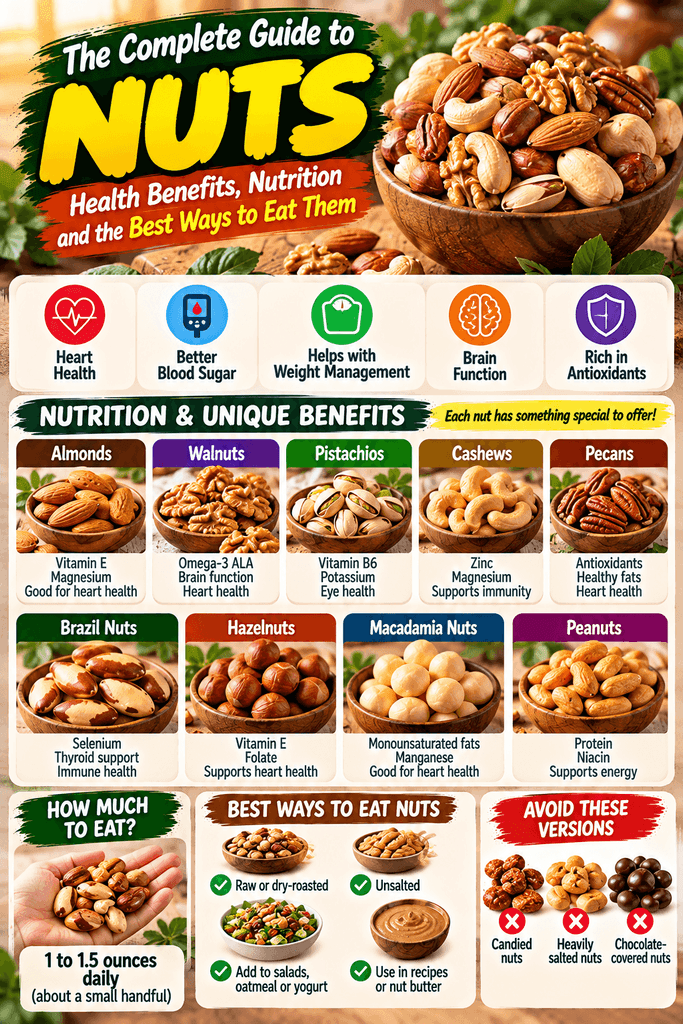
Quick answer: For most healthy adults, the sweet spot is about 1 to 1.5 ounces (28–42 g) of plain, unsalted nuts a day, roughly a small handful, eaten in place of processed snacks rather than on top of them.
Key Takeaways
- Nuts provide unsaturated fats, plant protein, fiber, vitamin E, magnesium and other minerals in a small, portable serving.
- In large studies, regular nut eaters have a lower risk of heart disease, death from heart disease and early death.
- Each nut has a different strength: walnuts lead on omega-3, almonds on vitamin E, Brazil nuts on selenium, cashews on zinc. Variety beats loyalty to one nut.
- Despite their calories, nuts have not been linked to weight gain in trials when they replace other foods.
- People with nut allergies or a history of calcium oxalate kidney stones, and anyone eating Brazil nuts daily, should take specific precautions.
- Plain raw or dry-roasted nuts without added salt or sugar are the best everyday choice.
What Are Nuts, Exactly?
In everyday nutrition, “nuts” usually means tree nuts like almonds, walnuts, cashews, pistachios, pecans, hazelnuts, Brazil nuts and macadamias, plus peanuts. Botanically, peanuts are legumes, related to beans and peas. Nutritionally, though, they behave much like tree nuts, so researchers and dietary guidance usually group them together.
Seeds like pumpkin, sunflower and chia are close nutritional cousins. Nuts generally provide more vitamin E and monounsaturated fat, while seeds can be richer in certain minerals. See our guides on whether chia seeds are healthy and whether pumpkin seeds are healthy.
Much of the benefit of nuts comes from what they replace. According to Harvard’s Nutrition Source, nuts work best when they substitute for less healthy foods rather than being added on top. Swapping chips or cookies for a handful of nuts trades refined starch, sodium and saturated fat for unsaturated fat, fiber and minerals.
Nut Nutrition Facts: How the Most Popular Nuts Compare
The table below shows rounded values per 1 ounce (28 g), based on USDA FoodData Central. Values vary slightly by crop and brand.
| Nut (1 oz / 28 g) | About how many | Calories | Protein | Fiber | Fat | Standout nutrients |
| Almonds | ~23 nuts | ~164 | 6 g | 3.5 g | 14 g | Vitamin E, magnesium, calcium |
| Walnuts | ~14 halves | ~185 | 4 g | 2 g | 18.5 g | Omega-3 ALA, copper |
| Pistachios | ~49 kernels | ~159 | 6 g | 3 g | 13 g | Vitamin B6, potassium, lutein |
| Cashews | ~18 nuts | ~157 | 5 g | 1 g | 12 g | Zinc, magnesium, iron |
| Pecans | ~19 halves | ~196 | 3 g | 3 g | 20 g | Manganese, monounsaturated fat |
| Brazil nuts | ~6 nuts | ~187 | 4 g | 2 g | 19 g | Selenium (exceptionally high) |
| Hazelnuts | ~21 nuts | ~178 | 4 g | 3 g | 17 g | Vitamin E, folate, copper |
| Macadamias | ~11 nuts | ~204 | 2 g | 2.4 g | 21.5 g | Monounsaturated fat, manganese |
| Peanuts | ~28 nuts | ~161 | 7 g | 2.4 g | 14 g | Protein, niacin, folate |
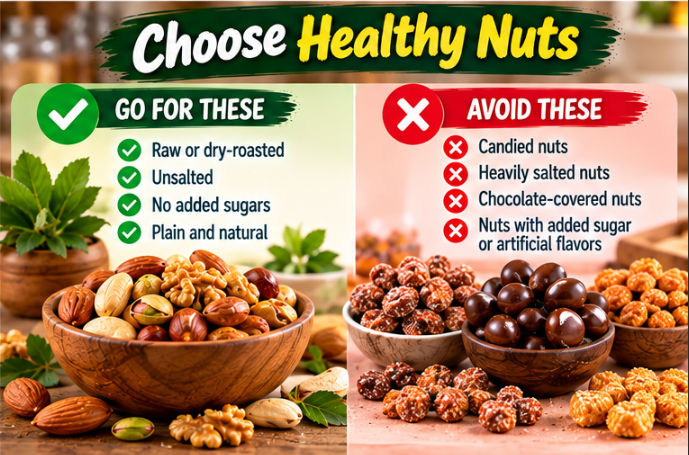
The healthiest and “worst” nuts: All plain nuts are healthy. The worst options aren’t particular nuts but particular preparations: candied, honey-roasted, chocolate-covered and heavily salted. Harvard notes that nuts coated in chocolate, sugar or lots of sodium are “probably not as good.”
Almonds
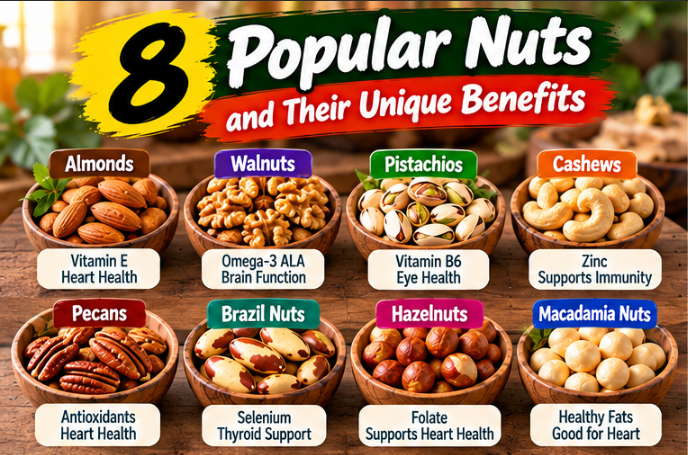
One ounce of dry-roasted almonds provides about 6.8 mg of vitamin E (45% of the Daily Value) and 80 mg of magnesium, according to the NIH Office of Dietary Supplements’ vitamin E and magnesium fact sheets. Almonds are also one of the richest nut sources of fiber and calcium. Learn more in our guide on whether almonds are healthy.
Walnuts
Walnuts are the standout nut source of alpha-linolenic acid (ALA), the plant form of omega-3 fat. One ounce supplies 2.57 g of ALA, more than the daily adequate intake for women (1.1 g) and most of it for men (1.6 g), according to the NIH Office of Dietary Supplements. See whether walnuts are healthy.
Pistachios
Pistachios are among the lowest-calorie nuts, at about 159 per ounce, and among the best tree nuts for protein per calorie. They also provide vitamin B6, potassium and the eye-related carotenoids lutein and zeaxanthin. USDA researchers found that the calories in pistachios have likely been overestimated by about 5%, because some of their fat isn’t absorbed. Buying them in the shell slows you down, which helps with portions.
Cashews
Cashews are creamier and a little higher in carbohydrate than most nuts, and they’re one of the best common-nut sources of zinc (about 1.6 mg per ounce, per USDA data) and magnesium (74 mg per ounce, per the ODS). See whether cashews are healthy and whether cashews are good for cholesterol.
Pecans
Pecans are second only to macadamias in calories, at about 196 per ounce, and are rich in monounsaturated fat and manganese. A few halves go a long way in oatmeal and salads. Read whether pecans are healthy.
Brazil Nuts
Brazil nuts are the richest food source of selenium. According to the NIH Office of Dietary Supplements, one ounce contains about 544 mcg of selenium, nearly 10 times the 55 mcg adult RDA, and a single nut contains 68–91 mcg. One or two nuts a day is plenty (see Risks below).
Hazelnuts and Macadamias
Hazelnuts provide about 4.3 mg of vitamin E per ounce (29% DV), according to the ODS, plus folate and copper. Macadamias are the highest-fat, lowest-protein nut, mostly monounsaturated fat, which makes them popular in low-carb cooking but worth portioning carefully.
Peanuts
Peanuts are legumes, but they earn their place at the nut table. They have the most protein of any nut in the table (about 7 g per ounce) and provide niacin and folate, usually at the lowest price. Many of the large population studies on nuts include peanuts. If peanut butter is your go-to, see whether peanut butter is healthy.
Heart Health Benefits of Nuts
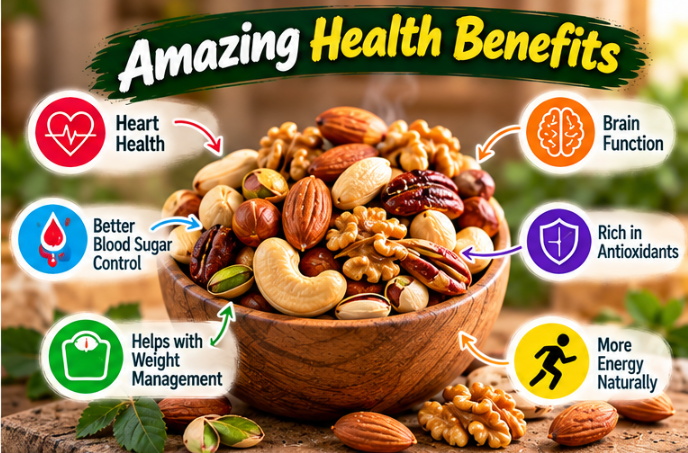
Heart disease is the leading cause of death in the United States, responsible for about 1 in every 5 deaths, according to the CDC. Nuts are among the most-studied foods for heart health.
What the Major Studies Show
Clinical trial: In the PREDIMED trial (New England Journal of Medicine, 2018), about 7,500 Spanish adults at high cardiovascular risk were assigned to a Mediterranean diet with about 30 g of mixed nuts daily, a Mediterranean diet with extra-virgin olive oil, or advice to follow a reduced-fat diet. The nut group had about 28% fewer major cardiovascular events (heart attack, stroke or cardiovascular death) than the reduced-fat group.
Long-term cohorts: An analysis of three Harvard cohorts with more than 210,000 health professionals, published in the Journal of the American College of Cardiology (2017), found that people who ate nuts five or more times a week had a 14% lower risk of cardiovascular disease and a 20% lower risk of coronary heart disease than people who rarely ate nuts.
Meta-analyses:
- A 2019 meta-analysis in Nutrition Reviews of 19 prospective cohort studies found that each additional 28 g of nuts per day was associated with a 13% lower risk of developing cardiovascular disease and a 29% lower risk of dying from it.
- A 2025 meta-analysis in Archives of Cardiovascular Diseases covering 63 prospective cohort studies found that the highest nut consumers, compared with the lowest, had a 19% lower risk of coronary heart disease, 14% lower risk of cardiovascular disease, 26% lower risk of cardiovascular death and 23% lower risk of death from any cause.
These population studies show associations, not proof of cause and effect. Combined with the PREDIMED trial and the cholesterol trials below, though, the evidence is consistent.
How Nuts Help Your Heart
Cholesterol and blood fats: A 2015 meta-analysis of 61 controlled trials (American Journal of Clinical Nutrition, 2,582 participants) found that each 1-ounce daily serving of tree nuts lowered:
- Total cholesterol by about 4.7 mg/dL
- LDL (“bad”) cholesterol by about 4.8 mg/dL
- Apolipoprotein B (a marker of artery-clogging particles) by about 3.7 mg/dL
- Triglycerides by about 2.2 mg/dL
Effects were stronger at intakes of 60 g or more a day and were similar across different types of tree nuts. The analysis found no significant effects on HDL cholesterol, blood pressure or inflammation markers.
Other mechanisms: Nuts are rich in unsaturated fats, which improve cholesterol when they replace saturated fat. They also contain fiber and plant sterols.
FDA health claim: In 2003, the FDA allowed a qualified health claim for nuts: scientific evidence suggests, but does not prove, that eating 1.5 ounces per day of most nuts, as part of a diet low in saturated fat and cholesterol, may reduce the risk of heart disease.
Best nuts for cholesterol: Because the 2015 meta-analysis found similar effects across tree nuts, the best choice is the one you’ll eat consistently in place of less healthy foods. Rotating almonds, walnuts, pistachios and others gives you their different nutrient strengths too.
Blood Sugar and Type 2 Diabetes
Nuts are low in digestible carbohydrate and high in fat, fiber and protein, which slows digestion and helps blunt blood sugar rises when eaten with carbohydrate foods.
A 2014 meta-analysis in PLoS One of 12 randomized trials in 450 people with type 2 diabetes found that eating a median of 56 g of tree nuts a day for about eight weeks modestly but significantly lowered HbA1c (by 0.07 percentage points) and fasting glucose (by 0.15 mmol/L). Effects on fasting insulin and insulin resistance weren’t statistically significant. The authors suggested that nuts help partly by replacing high-glycemic carbohydrates.
Magnesium may also play a role. The NIH Office of Dietary Supplements notes that people with higher magnesium intakes tend to have a lower risk of type 2 diabetes, and that about 48% of Americans get less magnesium than recommended. Almonds and cashews are good sources.
Nuts are not a diabetes treatment. They’re a smart snack swap. If you take insulin or other glucose-lowering medicine, talk with your care team about changes to your diet.
Nuts, Weight, and Appetite
Nuts are calorie-dense, yet in studies people who eat them don’t tend to weigh more. Several factors help explain this:
1. Not all the calories are absorbed. USDA researchers found that a 1-ounce serving of whole almonds provides about 129 calories, versus the 168 calories typically listed on labels, according to a 2012 study in the American Journal of Clinical Nutrition. The tough cell walls of whole nuts trap some fat, which passes through undigested.
2. Nuts are filling. Protein, fiber and fat together help you feel satisfied, so nuts tend to replace other foods rather than add to them.
3. The trial evidence. In a prespecified PREDIMED analysis (Lancet Diabetes & Endocrinology, 2016), people who added about 30 g of nuts a day to a Mediterranean diet for five years gained no more weight than the reduced-fat control group, and had a slightly smaller increase in waist circumference.
Portions still matter. Harvard cautions that nuts should replace other snacks, because adding them without other changes can lead to weight gain. A cup of nuts is roughly 5 ounces, or about 800 calories based on the table above. Pre-portion 1-ounce servings, choose in-shell pistachios for a built-in slowdown, and measure nut butter with a spoon. Our guide to almond butter for weight loss shows how to use nut butters strategically.
Gut Health and Fiber
An ounce of almonds or pistachios provides about 3 grams of fiber. Fiber supports regular digestion and feeds beneficial gut bacteria. Early research suggests nuts may favorably influence the gut microbiome, but this science is still young, so be cautious about bold claims.
What’s well established is the swap effect: replacing low-fiber snacks with nuts raises the fiber in your diet. See whether a high-fiber diet is good for weight loss. If you’re not used to much fiber, increase portions gradually and drink plenty of water to limit gas and bloating.
The Micronutrients Inside Nuts
- Vitamin E is a fat-soluble antioxidant. Almonds (45% DV per ounce) and hazelnuts (29% DV) are the richest nut sources, according to the ODS.
- Magnesium supports muscle and nerve function, blood sugar control and blood pressure regulation. Nearly half of Americans fall short, per the ODS. Almonds and cashews are top sources.
- Selenium supports thyroid hormone metabolism and antioxidant defenses, according to the ODS. Brazil nuts are the richest food source, in small amounts.
- Zinc supports immune function and wound healing. Cashews are among the best nut sources. The ODS notes that phytates in plant foods like nuts and legumes reduce zinc absorption, and that vegetarians and vegans tend to have lower zinc intakes, so a variety of zinc sources helps.
- Omega-3 ALA: Walnuts are the top nut source, per the ODS.
Nuts also provide copper, manganese, potassium, vitamin B6, folate and niacin in varying amounts. No single nut covers everything, which is why rotating them makes sense.
Who Benefits Most From Eating Nuts?
- Adults over 40, as heart disease risk rises with age and nuts target LDL cholesterol and triglycerides.
- People with high cholesterol, who may see larger effects. The 2015 meta-analysis found bigger apolipoprotein B reductions in people with type 2 diabetes.
- People with type 2 diabetes or prediabetes, for a low-carb, filling snack swap.
- Vegetarians and vegans, for plant protein, zinc and minerals.
- Busy snackers, who need a portable, shelf-stable snack that keeps them full.
- Older adults with chewing difficulties, who can get similar nutrition from smooth nut butters.
Risks, Side Effects, and Who Should Be Cautious
Tree Nut and Peanut Allergy
Tree nuts and peanuts are two of the nine major food allergens identified by the FDA. Reactions range from mild to life-threatening anaphylaxis. Being allergic to one nut doesn’t necessarily mean you’re allergic to all, but cross-contact in processing is common. If you have a diagnosed allergy, follow your allergist’s advice, read every label, and carry prescribed emergency medication.
Kidney Stones and Oxalates
For people who form calcium oxalate kidney stones, the National Institute of Diabetes and Digestive and Kidney Diseases lists “nuts and nut products” and peanuts among high-oxalate foods to limit. NIDDK also notes that getting enough calcium can help block stone-forming substances. Work out portions with your doctor or dietitian rather than cutting nuts out on your own.
Selenium Overload From Brazil Nuts
Brazil nuts contain 68–91 mcg of selenium each, and the adult upper limit is 400 mcg a day, according to the ODS. The ODS also notes that the European Food Safety Authority has proposed a lower limit of 255 mcg. Eating a handful daily can lead to selenosis, whose symptoms include hair loss, brittle or lost nails, garlic-smelling breath, a metallic taste, rashes and nausea. Stick to one or two Brazil nuts a day, and account for any selenium in your supplements.
Calorie Creep and Preparation Traps
Honey-roasted, candied, chocolate-covered and heavily salted nuts can turn a healthy food into a treat. Harvard advises choosing nuts without heavy coatings of sugar or salt.
Digestive Sensitivity
Large portions can cause bloating, especially if you’re not used to fiber. Smaller servings and gradual increases usually help.
How Many Nuts Should You Eat a Day?
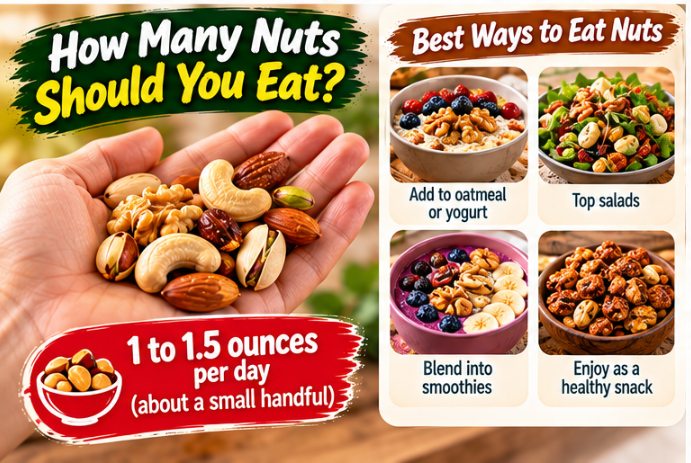
Eating nuts every day is fine, and daily intake is what most studies measured. For most adults, 1 to 1.5 ounces (28–42 g) a day is the evidence-based target:
- The large cohort and meta-analysis findings are expressed per 1-ounce (28 g) serving.
- PREDIMED used about 30 g a day.
- The FDA qualified health claim uses 1.5 ounces a day.
Use the “About how many” column in the nutrition table above as a guide, and remember that nut sizes vary, so a kitchen scale beats counting. Pre-portion a week of 1-ounce servings into small containers. If you’re trying to lose weight, start at 1 ounce and make nuts a replacement for other snacks. For Brazil nuts, cap intake at 1–2 nuts a day.
The Best Ways to Eat Nuts
| Form | Best for | Pros | Watch out for |
| Raw | Snacking, salads | Minimally processed | Firmer texture |
| Dry-roasted, unsalted | Crunchy snacking | No added oil | Salted versions add sodium |
| Oil-roasted | Occasional treat | Extra crisp | Added fat and calories |
| Soaked | Blending, softer texture | Milder taste | Needs refrigeration |
| Nut butter | Toast, oatmeal, smoothies | Easy to eat | Easy to over-scoop; check for added sugar and oil |
| Nut flour | Gluten-free or low-carb baking | Moist results | Calorie-dense |
| Nut milk | Coffee, cereal | Light, lactose-free | Much less protein than whole nuts |
Raw vs. roasted: Both plain raw and plain roasted nuts are healthy choices, according to Harvard. The bigger issue is added salt, sugar and coatings. To season your own, our cinnamon-sugar roasted mixed nuts are a starting point. Go light on the sugar and let spices do the work.
Soaked nuts: Soaking softens nuts and may slightly reduce phytates, which can bind minerals like zinc. The core nutrition (protein, fiber, vitamin E, magnesium and healthy fats) is there either way. Choose the form you’ll eat consistently.
Nut butters, flours and milks: Choose nut butters whose ingredient list reads “nuts” (and maybe salt). Almond flour works well in gluten-free baking. See whether almond flour is healthy. Most commercial nut milks contain little protein compared with whole nuts.
How to Store Nuts So They Stay Fresh
Because nuts are rich in unsaturated fats, they can go rancid. Kansas State University Research and Extension advises that the fats and oils in nuts “can quickly spoil,” and recommends:
- The freezer is best. Refrigeration is also acceptable.
- Seal tightly in solid containers or heavy resealable bags.
- Freezer life: up to one year if tightly sealed, though using them within six months is preferred.
More tips:
- Buy from busy stores for fresher stock.
- Buy raw or unsalted and season at home.
- Portion bulk bags right away into 1-ounce servings and freeze the extras.
- Smell before eating. Bitter, stale or paint-like odors mean the nuts are rancid. Throw them out.
Easy Ways to Add Nuts to Your Meals
- Stir chopped almonds or walnuts into oatmeal or yogurt.
- Add pistachios or cashews to salads, like this cherry arugula quinoa salad with almonds.
- Make grab-and-go snacks like these no-bake blueberry almond oat bars or this berry cherry almond granola.
- Toss walnuts into grain salads like this date and walnut wheat berry salad.
- Try this basil walnut pesto in place of the usual pine nut version.
- Build your own trail mix with raw nuts, seeds and a few raisins.
- Pair nuts with fruit, vegetables, whole grains or yogurt. An apple with an ounce of almonds is a satisfying, balanced snack.
Nuts and Special Diets
- Keto and low-carb: Pecans, macadamias, Brazil nuts and walnuts are the lowest in net carbs, based on USDA data. Cashews and pistachios are higher. See whether keto is a healthy diet.
- Vegan and vegetarian: Nuts help supply protein, zinc and calories. Rotate varieties.
- Mediterranean: Nuts are a core part of the Mediterranean pattern tested in PREDIMED.
- Gluten-free: Plain nuts are naturally gluten-free. Check flavored mixes and processing statements.
Myths vs. Facts About Nuts
Myth: Nuts make you gain weight.
Fact: In PREDIMED, adding about 30 g of nuts daily for five years caused no extra weight gain compared with the control diet, and whole almonds deliver fewer usable calories than labels suggest. Portions still matter.
Myth: All nuts are the same.
Fact: Walnuts lead on omega-3, almonds on vitamin E, Brazil nuts on selenium, cashews on zinc and peanuts on protein.
Myth: Roasted nuts are unhealthy.
Fact: Plain roasted nuts are a healthy choice. Added salt, sugar and candy coatings are the real problem.
Myth: You must soak nuts to get the benefits.
Fact: Soaking changes texture and may slightly reduce phytates, but the core nutrition is there either way.
Myth: Nut butter is just as good as whole nuts.
Fact: It can be, but it’s easier to overeat, and some brands add sugar and oils. Check labels and measure.
Myth: Peanuts don’t count because they’re legumes.
Fact: Nutritionally, peanuts are similar to tree nuts and are included in many of the large studies.
Frequently Asked Questions
How many nuts should you eat a day?
About 1 to 1.5 ounces (28–42 g), roughly a small handful. That matches the amounts used in major studies and the FDA’s qualified heart-health claim. In real terms, that’s about 23 almonds or 14 walnut halves. Measure rather than eating from the bag.
Which nut is the healthiest?
There’s no single winner. Each nut has different strengths: walnuts for omega-3, almonds for vitamin E, Brazil nuts for selenium, cashews for zinc and peanuts for protein. Rotating several types through the week gives you the widest range of nutrients.
Are nuts good for weight loss?
They can be, when they replace other snacks. Nuts are filling, and some of their calories aren’t absorbed: USDA research found whole almonds deliver about 129 calories per ounce rather than 168. In a five-year trial, adding nuts didn’t cause extra weight gain. Portions remain key.
Do nuts lower cholesterol?
Yes, modestly. A meta-analysis of 61 trials found that each daily ounce of tree nuts lowered LDL cholesterol by about 4.8 mg/dL, with stronger effects at about 2 ounces or more a day. Effects were similar across nut types and work best alongside a heart-healthy diet.
Are nuts good for people with diabetes?
Generally, yes. Nuts are low in digestible carbohydrate, and a meta-analysis of 12 trials found that about 2 ounces a day modestly lowered HbA1c and fasting glucose in people with type 2 diabetes. Choose plain, unsalted nuts and count their calories. Discuss diet changes with your care team.
Can you eat too many Brazil nuts?
Yes. Each Brazil nut contains 68–91 mcg of selenium, and the adult upper limit is 400 mcg a day. Eating them by the handful regularly can cause selenium toxicity, with symptoms like hair loss and brittle nails. One or two a day is plenty.
The Bottom Line: A Handful a Day
The evidence on nuts is among the strongest in nutrition science. A major clinical trial, large long-term cohort studies, and meta-analyses of dozens of studies all link regular nut eating to better cholesterol, a lower risk of heart disease and a lower risk of early death, without weight gain when nuts replace other foods. This complete guide to nuts comes down to a simple habit: about 1 to 1.5 ounces of plain, unsalted nuts a day, rotated across types, eaten in place of processed snacks. Keep Brazil nuts to one or two a day, and check with your doctor if you have nut allergies or kidney stones.
Medical disclaimer: This guide is for general informational purposes only and is not a substitute for professional medical advice, diagnosis or treatment. Consult your doctor or a registered dietitian about food allergies, kidney stones, diabetes management or any medical condition before making significant dietary changes.
References
- U.S. Department of Agriculture, Agricultural Research Service. FoodData Central. https://fdc.nal.usda.gov/
- Harvard T.H. Chan School of Public Health. “Nuts for the Heart.” The Nutrition Source. https://nutritionsource.hsph.harvard.edu/food-features/nuts-for-the-heart/
- Centers for Disease Control and Prevention. “About Heart Disease.” https://www.cdc.gov/heart-disease/about/index.html
- Estruch R, Ros E, Salas-Salvadó J, et al. “Primary Prevention of Cardiovascular Disease with a Mediterranean Diet Supplemented with Extra-Virgin Olive Oil or Nuts.” New England Journal of Medicine. 2018;378:e34. https://pubmed.ncbi.nlm.nih.gov/29897866/
- Guasch-Ferré M, Liu X, Malik VS, et al. “Nut Consumption and Risk of Cardiovascular Disease.” Journal of the American College of Cardiology. 2017. https://www.jacc.org/doi/10.1016/j.jacc.2017.09.035
- Becerra-Tomás N, Paz-Graniel I, Kendall CWC, et al. “Nut consumption and incidence of cardiovascular diseases and cardiovascular disease mortality: a meta-analysis of prospective cohort studies.” Nutrition Reviews. 2019;77(10):691–709. https://pubmed.ncbi.nlm.nih.gov/31361320/
- Liu M, Wang M, Fu X, et al. “Nut consumption and risk of cardiovascular disease events and all-cause mortality: a systematic review and dose–response meta-analysis of prospective cohort studies.” Archives of Cardiovascular Diseases. 2025. https://doi.org/10.1016/j.acvd.2025.08.010
- Del Gobbo LC, Falk MC, Feldman R, Lewis K, Mozaffarian D. “Effects of tree nuts on blood lipids, apolipoproteins, and blood pressure: systematic review, meta-analysis, and dose-response of 61 controlled intervention trials.” American Journal of Clinical Nutrition. 2015. https://pubmed.ncbi.nlm.nih.gov/26561616/
- Viguiliouk E, Kendall CWC, Blanco Mejia S, et al. “Effect of Tree Nuts on Glycemic Control in Diabetes: A Systematic Review and Meta-Analysis of Randomized Controlled Dietary Trials.” PLoS One. 2014. https://pubmed.ncbi.nlm.nih.gov/25076495/
- Novotny JA, Gebauer SK, Baer DJ. “Discrepancy between the Atwater factor predicted and empirically measured energy values of almonds in human diets.” American Journal of Clinical Nutrition. 2012. Summarized by USDA Agricultural Research Service: https://agresearchmag.ars.usda.gov/2013/sep/calories
- Estruch R, Martínez-González MA, Corella D, et al. “Effect of a high-fat Mediterranean diet on bodyweight and waist circumference: a prespecified secondary outcomes analysis of the PREDIMED randomised controlled trial.” Lancet Diabetes & Endocrinology. 2016. https://library.fabresearch.org/viewItem.php?id=10338
- U.S. Food and Drug Administration. “Qualified Health Claims: Letters of Enforcement Discretion” (Nuts and Coronary Heart Disease, 2003). https://www.fda.gov/food/nutrition-food-labeling-and-critical-foods/qualified-health-claims-letters-enforcement-discretion
- NIH Office of Dietary Supplements. “Vitamin E: Fact Sheet for Health Professionals.” https://ods.od.nih.gov/factsheets/VitaminE-HealthProfessional/
- NIH Office of Dietary Supplements. “Magnesium: Fact Sheet for Health Professionals.” https://ods.od.nih.gov/factsheets/Magnesium-HealthProfessional/
- NIH Office of Dietary Supplements. “Selenium: Fact Sheet for Health Professionals.” https://ods.od.nih.gov/factsheets/Selenium-HealthProfessional/
- NIH Office of Dietary Supplements. “Zinc: Fact Sheet for Health Professionals.” https://ods.od.nih.gov/factsheets/Zinc-HealthProfessional/
- NIH Office of Dietary Supplements. “Omega-3 Fatty Acids: Fact Sheet for Health Professionals.” https://ods.od.nih.gov/factsheets/Omega3FattyAcids-HealthProfessional/
- U.S. Food and Drug Administration. “Food Allergies.” https://www.fda.gov/food/food-labeling-nutrition/food-allergies
- National Institute of Diabetes and Digestive and Kidney Diseases. “Eating, Diet, & Nutrition for Kidney Stones.” https://www.niddk.nih.gov/health-information/urologic-diseases/kidney-stones/eating-diet-nutrition
- Upham W. “Horticulture: Nut Storage.” Kansas State University Research and Extension. 2022. https://www.ksre.k-state.edu/news/stories/2022/12/horticulture-nut-storage.html