



Have you ever opened a medical bill and felt your heart drop? You are certainly not alone.
Most people find navigating the medical system more stressful than the actual illness. In fact, Americans’ challenges with health care have become a defining feature of modern life in the United States. We spend more than any other nation. However, our outcomes often lag behind our peers. Why is there such a massive disconnect?
What is the biggest problem with US healthcare today? Many of my patients feel the system is a maze designed to confuse them.
What do Americans think about their healthcare? For many, it feels like a looming financial shadow. Recent sentiment on platforms like Reddit shows a growing frustration.
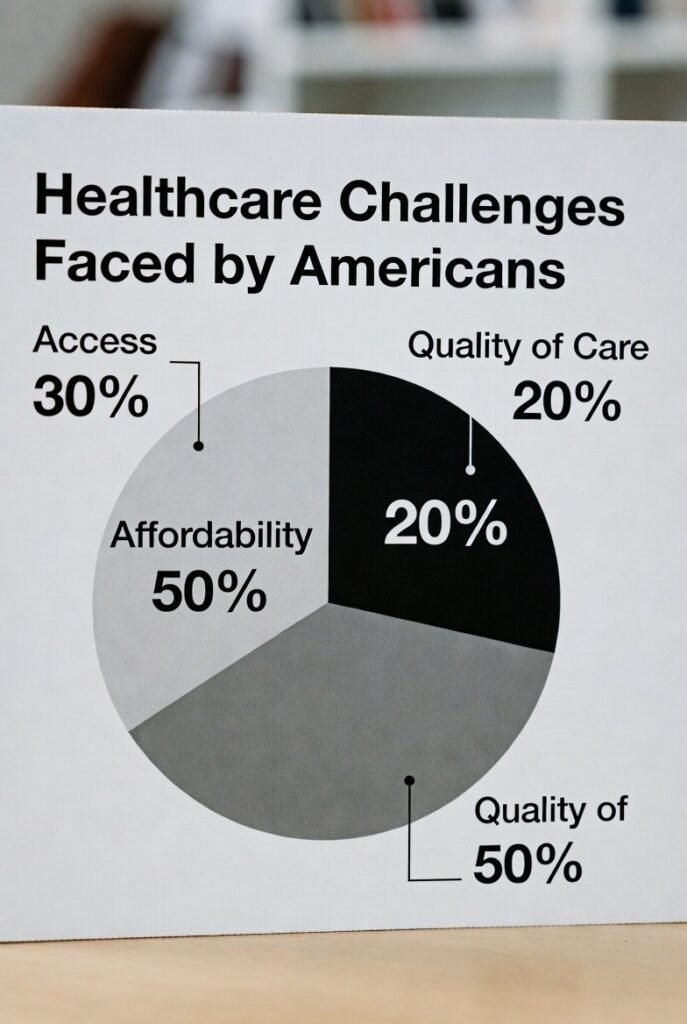
People are tired of “surprise” bills and long wait times. This american healthcare crisis review aims to peel back the layers of these issues. Furthermore, we will look at health care issues today through a clinical and systemic lens.
We need to understand why high spending does not always equal high quality.
Articles about healthcare in America often focus on the politics. In contrast, this review focuses on the patient experience and real-world costs.
By the end, you will have a clearer picture of the major problems in the U.S. healthcare system and how to navigate them.
What Are the Biggest Problems in U.S. Healthcare?
To fix a problem, we must first name it. The American system is a complex web of private and public entities.
This fragmentation is a primary driver of frustration. It creates a “pay-to-play” atmosphere that leaves many behind. First of all, let’s look at the core systemic failures.
What Is the Biggest Problem With American Healthcare?
If you ask ten experts, “what is the biggest problem in American healthcare?” you might get ten different answers. However, most agree that what is the main health problem in the United States is the lack of price transparency.
Patients are essentially consumers who cannot see the price tag before they “buy” a service. This lack of clarity creates a massive administrative burden.
Furthermore, the what is the #1 public health problem in the US today is arguably the rising rate of chronic diseases coupled with high care costs.
We are a nation that is “sicker and poorer” because of how we fund medicine. The system is reactive rather than proactive.
We spend billions on late-stage treatments. Meanwhile, we underfund the basic primary care that prevents those issues. This creates a cycle of high-cost, low-value care.
Major Challenges in Healthcare Today
When we analyze the 7 challenges in healthcare, a clear pattern emerges. These are not just inconveniences.
They are structural barriers to wellness. What are the major challenges facing healthcare today? Let’s break them down:
- Rising Costs: Medical inflation consistently outpaces general inflation and wage growth.
- Insurance Complexity: Policies are often written in “legalese” that prevents patients from knowing their rights.
- Access Barriers: Even with insurance, finding a doctor who is “in-network” and taking new patients is hard.
- Provider Shortages: We are facing a massive burnout crisis among doctors and nurses.
- Administrative Waste: Almost 25% of US healthcare spending goes to billing and paperwork.
- Inequality: Your zip code often determines your life expectancy more than your genetic code.
- Poor Care Continuity: Patients often feel like they are starting over with every new specialist.
These points represent what are the three biggest issues in healthcare today: cost, complexity, and inequity. Because the system is so fragmented, information often gets lost between providers. This leads to redundant testing and medical errors.
The Healthcare Affordability Crisis
Affordability is the most urgent of all Americans’ challenges with health care costs. Even those with “good” jobs find themselves one accident away from ruin.
This healthcare affordability crisis review examines the financial reality of being a patient in 2026.
Americans’ Challenges With Health Care Costs
The effects of rising healthcare costs ripple through every part of the economy.
Families must choose between groceries and prescriptions. In fact, many Americans skip necessary care because they fear the bill.
This leads to more expensive emergency room visits later. As a result, the total cost to the system actually goes up. It is a classic case of being “penny wise and pound foolish” at a national level.
What’s Driving High Healthcare Costs?
Who is to blame for high healthcare costs? The answer is complex. It is a mix of hospital pricing, pharmaceutical costs, and insurance overhead.
The healthcare inflation impact is felt most by the middle class. They often make too much for subsidies but not enough to easily pay high premiums.
- Hospital Pricing: In the US, hospitals can charge different prices for the same procedure based on the insurer.
- Drug Prices: Americans pay significantly more for the same brand-name drugs than people in Europe or Canada.
- Administrative Waste: The sheer number of insurance plans requires an army of billing specialists.
- High medical costs america review: Research shows that we don’t use more care than other countries. We simply pay more for the care we do use.
Out-of-Pocket Costs & Medical Debt
The rise of out of pocket healthcare costs review has led to a surge in medical debt. Even with insurance, high deductibles can reach $8,000 or more.
This has fueled the healthcare debt america review, where millions of people are hounded by collectors for life-saving care.
Consequently, medical bankruptcy america review remains a uniquely American phenomenon. In most developed nations, the idea of going bankrupt over a broken leg is unheard of.
KFF Insights on Healthcare Costs
Data from the Kaiser Family Foundation (KFF) provides a sobering look at americans’ challenges with health care costs kff. Their research shows that roughly half of U.S. adults say it is difficult to afford health care costs.
Furthermore, kff Americans’ challenges with health care costs reports indicate that about 4 in 10 adults have delayed or gone without care in the last year due to cost.
These statistics highlight a system that is failing its most basic mission: keeping people healthy without ruining them financially.
Health Insurance Problems & Coverage Gaps
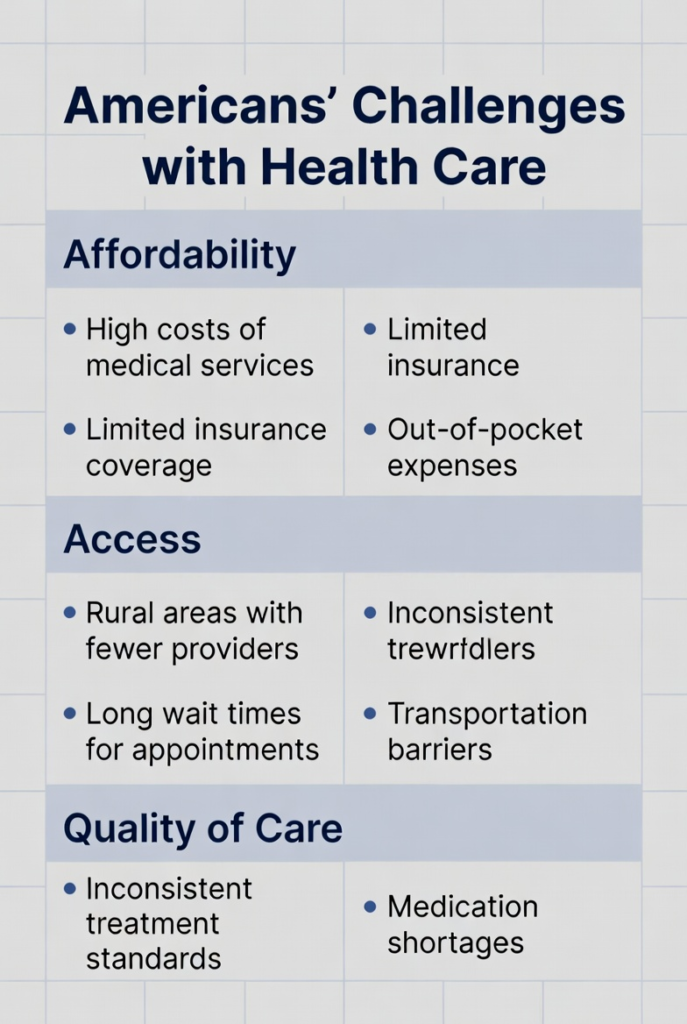
Many people believe that having insurance means you are protected. Unfortunately, this is not always true. Health insurance problems and solutions are now a major part of the clinical conversation.
Insurance Denial Problems and Solutions
The insurance denial problems review shows a troubling trend. More claims are being denied for “medical necessity” by algorithms rather than doctors.
This leads to healthcare coverage denials review, where patients are left to appeal complex decisions while they are sick.
To fight this, you must keep meticulous records. Always ask for a “peer-to-peer” review if a claim is denied.
Coverage Gaps & Hidden Costs
We also see significant health insurance coverage gaps review. This is especially true for mental health and dental care.
Furthermore, prescription coverage gaps review often leave seniors in the “donut hole” of costs.
Another issue is insurance network restrictions review. You might go to an in-network hospital but be treated by an out-of-network anesthesiologist. This “surprise billing” is a major stressor.
High-Deductible Plans & Premium Increases
The trend of high deductible health plans review was supposed to lower premiums. However, insurance premium increases review have continued anyway.
Now, patients have high premiums and high deductibles. The copay healthcare costs review also shows that even small fees can add up for those with chronic conditions.
Access to Healthcare in the United States
Access is about more than just having an insurance card. It is about whether that card actually opens doors to a clinic.
Unfortunately, americans’ challenges with health care often involve long wait times and “medical deserts.” Many people have insurance but no way to use it effectively.
Access to Healthcare in the United States (Statistics & Reality)
When we look at access to healthcare in the United States statistics, the picture is quite grim.
According to the Commonwealth Fund, the U.S. ranks last among high-income countries in terms of access.
This is despite spending double the amount of money. Furthermore, healthcare access issues usa review data shows that millions live in areas with no primary care doctors.
About 25 million Americans still lack any health insurance at all.
This creates a massive ripple effect in our emergency rooms. Consequently, the uninsured often wait until a minor issue becomes a life-threatening crisis. This is a primary driver of the American healthcare crisis review we see in the news today.
Populations Facing the Greatest Barriers
It is important to ask: who is being left behind? The uninsured americans healthcare review shows that Hispanic and Black communities face higher rates of being uninsured.
Also, healthcare for low income families review reveals that many “working poor” families earn too much for Medicaid but too little for private plans.
Geography also plays a massive role in your health outcomes. For instance, rural healthcare challenges review highlight the closing of small-town hospitals.
Patients in these areas may have to drive two hours for a simple scan. In contrast, urban healthcare inequality review shows that even in big cities, low-income neighborhoods often have fewer specialists. This “zip code lottery” is a major failing of our current system.
Provider Shortages & Delayed Care
We are currently in the middle of a massive healthcare provider shortages review. Experts predict a shortage of up to 124,000 physicians by 2034.
Most noteworthy is the primary care shortages review. Many young doctors choose high-paying specialties to pay off medical school debt.
As a result, we see a surge in delayed medical care review. If you have to wait six months for a screening, your disease may progress. This delay is not just an inconvenience. It is a clinical risk that leads to poorer survival rates for conditions like cancer or heart disease.
Quality of Care, System Failures & Patient Experience
Is the care we get worth the high price tag? Most data suggests that US healthcare is a “high cost, variable quality” model.
This section explores why the us healthcare system review often yields such disappointing results for patients.
Healthcare Quality & System Failures
When we discuss healthcare quality concerns review, we must look at medical errors.
Surprisingly, medical errors are a leading cause of death in the US. This is often due to healthcare system failures review rather than individual mistakes.
The lack of continuity of care issues review is a major culprit. When your primary doctor, your surgeon, and your physical therapist don’t talk to each other, things fall through the cracks.
This fragmentation leads to “polypharmacy,” where patients take conflicting medications. It also leads to redundant tests that drive up costs without improving health.
Patient Experience & Navigation Challenges
The american healthcare patient experience review is often described as “frustrating” and “overwhelming.” Many patients feel like a number in a giant machine.
Furthermore, healthcare navigation difficulties review are a common complaint. Trying to figure out which doctor is in-network feels like a full-time job.
We also have to talk about the healthcare paperwork burden review. Doctors spend more time on computers than with patients.
Likewise, patients spend hours on the phone with insurance companies. This administrative waste does nothing to heal the sick. It only serves to increase the burnout of both the patient and the provider.
Billing Errors, Transparency & Fraud
One of the most stressful americans’ challenges with health care is the “mystery bill.” Research shows that up to 80% of medical bills contain errors. The medical billing errors review highlights everything from duplicate charges to incorrect codes.
While there is a push for hospital pricing transparency review, many facilities still hide their true costs. This makes it impossible for patients to shop around. Finally, healthcare fraud concerns review cost the system billions of dollars every year. These costs are eventually passed down to the consumer in the form of higher premiums.
Mental Health, Seniors & Chronic Care
Some groups are hit harder by system failures than others. This is especially true for those with long-term needs.
Mental Healthcare Access
The mental healthcare access review is perhaps the most heartbreaking part of the US system. We have a “parity” law that says mental health should be covered like physical health.
However, in practice, this rarely happens. Many therapists do not accept insurance because the reimbursement rates are too low. Consequently, mental health care becomes a luxury for those who can pay cash.
Seniors, Medicare & Medicaid Limitations
Our aging population faces unique senior healthcare challenges review. While Medicare is a lifesaver, it has gaps.
The medicare limitations review shows that it often doesn’t cover long-term nursing home care or hearing aids.
Meanwhile, medicaid access problems review are growing as states “unwind” their pandemic-era coverage.
Many seniors find themselves in a “coverage gap” where they cannot afford the care they need to stay in their homes. This leads to premature institutionalization, which is more expensive for everyone.
Chronic Illness Cost Burden
Finally, we must look at the chronic illness care costs review.
Conditions like diabetes or autoimmune diseases require lifelong management.
The cumulative cost of specialized drugs and frequent visits can be crushing. These patients are the ones most likely to face “financial toxicity,” where the cost of the cure is as damaging as the disease.
Are There Real Solutions?
When traditional systems fail, innovation often takes their place. We are currently seeing a shift toward decentralized and direct-to-consumer medical models. While none are a “magic bullet,” they offer vital relief for americans’ challenges with health care in 2026.
Healthcare Alternatives Gaining Attention
The most significant trend is the rise of the direct primary care review (DPC). In this model, you pay a flat monthly fee (usually $60–$150) directly to your doctor.
This bypasses the insurance middleman entirely.
- Benefits: You get unlimited visits, 30-minute appointments, and wholesale prices on labs.
- Direct Primary Care Review: Patients report much higher satisfaction because they actually have time to talk to their physician.
Another option is the subscription healthcare model review. Similar to DPC, these often include 24/7 telehealth.
Furthermore, health sharing ministries review have become a popular alternative for those with religious affiliations.
However, beware: health shares are not insurance and do not guarantee payment for pre-existing conditions. They are medical cost-sharing communities, not regulated financial contracts.
Cost Control & Assistance Options
If you are stuck in a high-cost plan, look for “wraparound” help. Supplemental health insurance review can cover the “gap” in your deductible if you have a major accident.
Additionally, patient financial assistance programs review (PAPs) are a hidden gem.
Many drug manufacturers offer these to provide life-saving medications for free or at a deep discount if you meet income requirements.
To avoid being overcharged, use healthcare cost comparison tools review. Websites like Healthcare Bluebook or GoodRx allow you to see the “fair price” before you arrive at the pharmacy or imaging center.
Navigating the System More Safely
Knowledge is your best defense. An american healthcare survival guide review would always emphasize knowing your patient healthcare rights review. Under the “No Surprises Act,” you have the right to a good-faith estimate for non-emergency care. If you feel a hospital has treated you unfairly, healthcare consumer protection review agencies at the state level can help you file a formal dispute.
Future Outlook & What Americans Can Expect
Looking ahead to the rest of 2026 and 2027, the healthcare affordability trends review show a mixed bag.
On one hand, medical inflation is projected to stay at 7-9% due to high drug costs and labor shortages. On the other hand, AI is finally beginning to reduce the healthcare paperwork burden review for doctors, which could eventually lower administrative costs.
Healthcare Affordability Outlook
The healthcare affordability outlook review suggests that more employers will move toward Individual Coverage Health Reimbursement Arrangements (ICHRAs).
This gives you a bucket of tax-free money to buy your own plan, rather than being stuck with whatever the company chooses.
According to healthcare affordability research review from KFF, this could lead to more personalized care but also requires higher health literacy from the consumer.
Final Takeaway
When we see healthcare affordability explained review, the core message is clear: the system is broken, but you are not helpless.
By moving toward DPC, using assistance programs, and exercising your rights, you can mitigate the worst of the american healthcare crisis.
The healthcare affordability consumer review sentiment remains cautious, but empowered.
Ultimately, healthcare affordability facts review show that the best way to save money is to stay healthy through preventive care—even if you have to pay for that prevention out of pocket today to avoid a massive hospital bill tomorrow.
FAQ: Navigating the American Healthcare Crisis
1. What is the biggest problem with US healthcare in 2026? The “biggest problem” is a tie between high out-of-pocket costs and the extreme complexity of insurance navigation.
2. Is Direct Primary Care (DPC) actually insurance? No. DPC is a service agreement. You still need a high-deductible insurance plan for catastrophic events like surgery or cancer.
3. How can I find out the cost of a surgery before I have it? Ask the hospital for a “Good Faith Estimate.” You can also use online transparency tools to compare the hospital’s “cash price” vs. “insurance price.”
4. What should I do if my insurance denies a life-saving claim? Request an external independent review. Your insurance company must comply with the decision of an outside medical expert.
5. Are health sharing ministries safe? They are risky. They do not have to follow the ACA rules, meaning they can deny coverage for pre-existing conditions or mental health.
6. Can I negotiate a medical bill? Yes. Ask for an itemized bill and look for errors. Many hospitals will offer a 20-40% discount if you offer to pay the balance in a lump sum.
7. Why are US drug prices so much higher than in Canada? The US does not use centralized price negotiations for most private plans, allowing manufacturers to set higher market rates.
8. What is a “Medical Desert”? It is an area, usually rural or low-income urban, where there are no specialists or hospitals within a 30-mile radius.
9. Does the “No Surprises Act” cover everything? It covers emergency room visits and out-of-network providers at in-network facilities. It does not cover ground ambulances in some states.
10. Is healthcare debt the same as credit card debt? In many states, medical debt is treated differently and may have more protections against wage garnishment, but it still ruins credit scores.
11. Can I use an HSA for Direct Primary Care? As of 2026, many rules have been updated to allow DPC fees to be paid via HSA/FSA funds, but check your specific plan first.
12. How do I find Patient Assistance Programs (PAPs)? Visit NeedyMeds.org or the specific website of the pharmaceutical company that makes your medication.
Final Verdict
The US healthcare system review confirms that while we have the best technology in the world, our delivery system is in crisis. For the average American, healthcare is a top financial stressor.
However, by adopting a “consumer-first” mindset—shopping for prices, using DPC for routine care, and staying informed on legal protections—you can protect both your health and your wallet.