
Have you noticed how people in their 20s and 30s are increasingly managing health issues once associated with much older generations?
Specialized diets, daily medications, wearable health trackers, and regular visits to specialists like endocrinologists or rheumatologists have become surprisingly common among young adults.
This shift raises an important question: are we exaggerating the problem, or is there truly a rise in chronic illnesses in young adults in the US? Unfortunately, the evidence points to a very real and troubling trend.
Chronic illness in young adults is no longer a rare exception—it is becoming a defining public health issue.
Medically, a chronic illness is typically defined as a condition that lasts one year or longer, requires ongoing medical care, or limits daily activities.
For young adults, this includes autoimmune diseases, metabolic disorders, cardiovascular risk conditions, gastrointestinal diseases, and chronic mental health-related illnesses.
This goes far beyond occasional stress or temporary burnout. What we are witnessing is a growing health crisis among young adults in America that affects quality of life, productivity, and long-term health outcomes.
Data from the CDC and NIH shows a sharp increase in chronic illness rates in young adults across the United States.

Even more concerning is the rise in multi-morbidity—when an individual lives with two or more chronic conditions simultaneously.
Age groups once considered the healthiest are now experiencing combinations of issues such as insulin resistance, chronic inflammation, autoimmune dysfunction, anxiety disorders, and hormonal imbalances.
This pattern reflects a fundamental shift in how chronic diseases develop and progress in modern lifestyles.
Understanding chronic illness explained for young adults requires looking beyond genetics alone. Environmental stressors, ultra-processed diets, sedentary behavior, sleep deprivation, digital overload, and constant psychological stress all play interconnected roles.
These factors accumulate silently over time, often showing symptoms only after significant damage has already occurred.
In this guide, we’ll explore why chronic illnesses are increasing in young adults, examine the latest statistics, uncover the root causes, and—most importantly—discuss practical strategies to help protect your long-term health and well-being before these conditions become lifelong burdens.
Chronic Illness Statistics Among Young Adults in the US
The numbers emerging from major public health institutions paint a sobering picture of America’s changing health profile.
For much of the 20th century, chronic disease was largely associated with aging—conditions that appeared after decades of wear and tear.
Today, that assumption no longer holds. Young adults chronic illness statistics in the USA now show that nearly one in three Americans between the ages of 18 and 34 lives with at least one chronic condition.
This dramatic shift represents more than a medical concern; it signals a growing social, economic, and public health challenge.
According to CDC chronic disease statistics, rates of traditionally “adult-onset” conditions such as hypertension, prediabetes, and type 2 diabetes have increased sharply among younger populations over the past two decades.
In some age cohorts, these conditions have nearly doubled since the early 2000s. Importantly, this trend cannot be explained by improved screening alone.
NIH research on chronic illness in young adults suggests that underlying biological markers—such as insulin resistance, systemic inflammation, and immune dysregulation—are appearing earlier in life than ever before.
When examining chronic disease statistics in the United States overall, researchers often reference a historic “U-shaped” curve of illness: high disease burden in childhood, lower rates during young adulthood, and a sharp increase later in life.
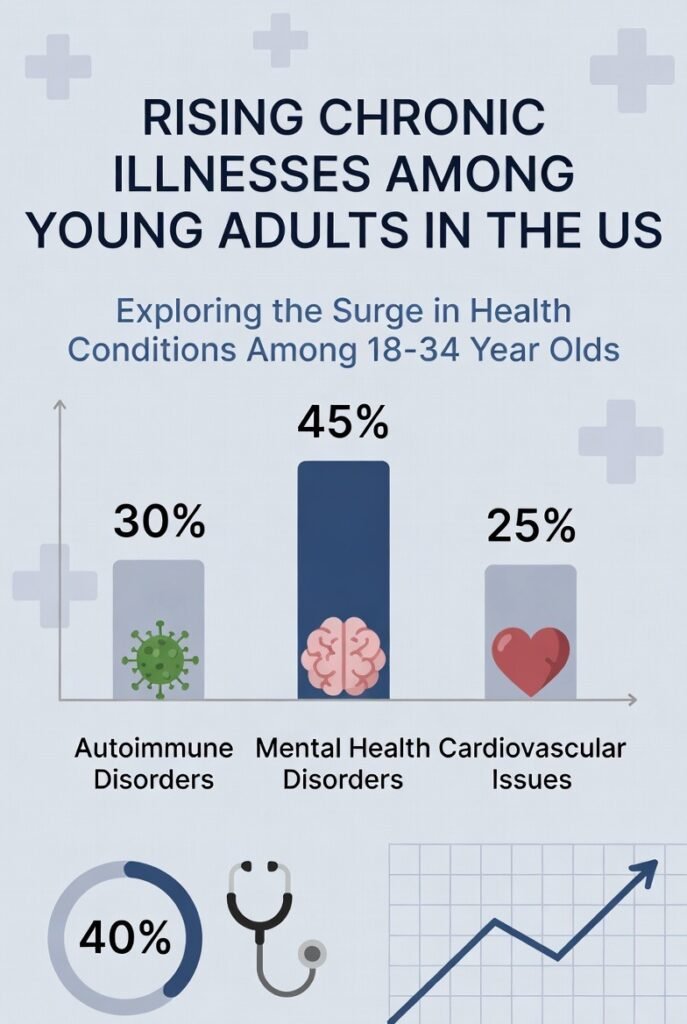
That curve is now flattening. The traditional health advantage of being young is shrinking, meaning the age gap between peak health and chronic disease onset is rapidly closing.
This shift places enormous strain on the healthcare system, as individuals require decades of ongoing treatment rather than short-term intervention later in life.
Chronic Illness Prevalence by Age in the USA
Breaking the data down by age reveals just how quickly chronic illness is advancing through early adulthood. Chronic illness prevalence by age in the USA shows a clear progression that begins earlier than many people expect. Adolescents still experience high rates of asthma, allergies, and mental health conditions, but the transition into the 20s now brings a surge in metabolic and inflammatory issues.
For individuals in their early to mid-20s, diagnoses such as insulin resistance, irritable bowel syndrome (IBS), autoimmune conditions, and chronic fatigue are becoming increasingly common.
These are often labeled “lifestyle-adjacent” illnesses because they are closely linked to diet quality, sleep patterns, physical inactivity, and chronic stress exposure.
By the time Americans reach their 30s, the percentage of young adults with chronic illness climbs even higher.
Many people ask, is chronic illness common in young adults? The data clearly says yes. Current estimates suggest that approximately 27% of people in their 20s manage a long-term health condition, and that number rises significantly in the 30–39 age range.
Compared to the late 1990s, this represents a historically unprecedented increase in early-life disease burden.
US vs Global Trends: How America Compares
Is this rise in chronic illness unique to the United States? When examining chronic disease statistics worldwide, it becomes clear that many developed nations are experiencing similar trends—but the US consistently ranks among the worst.
Chronic disease rates by country show that while modernization, urbanization, and sedentary lifestyles affect global health, the American experience is more severe and accelerated.
Recent analyses, including features on chronic disease on the rise highlighted by National Geographic, point to shared global risk factors such as environmental toxins, reduced physical activity, and chronic stress.
However, the US faces unique challenges. The widespread consumption of ultra-processed foods, often referred to as the Standard American Diet (SAD), plays a central role.
High sugar intake, refined carbohydrates, industrial seed oils, and chemical additives contribute directly to metabolic dysfunction and chronic inflammation.
Compared to Western Europe, young adults in the US tend to develop metabolic and cardiovascular risk markers five to ten years earlier.
Limited access to preventive healthcare, higher medical costs, and fragmented health education further worsen outcomes.
Together, these factors explain why the chronic illness crisis among young adults is not only real—but advancing faster in the United States than in many other parts of the world.
Why Gen Z and Millennials Are Experiencing a Health Decline
It is easy to blame “lazy habits,” but that is a lazy explanation. If you wonder why Gen Z is getting sicker, you have to look at the world they were born into.
This generation is the first to be “digital natives,” but they are also the first to grow up in a completely hyper-processed food environment.
The millennial health decline chronic illness trend is equally concerning. Blue Cross Blue Shield reported that millennials are seeing a faster decline in health than Gen X did at the same age.
This US chronic illness epidemic young adults is driven by a “perfect storm” of economic stress, poor nutrition, and environmental triggers that previous generations simply didn’t face as intensely.
Chronic Disease Trends US 2025 and Beyond
Looking forward, chronic illness trends US young adults 2025 suggest that the burden will only increase.
We are seeing a “compounding effect” where childhood obesity leads to early-onset heart issues.
The future of chronic disease in young Americans depends heavily on our ability to pivot toward preventive care.
The long-term health outlook young adults US is currently on a trajectory toward shorter lifespans than our parents.
This is a historic first. We must address the chronic disease trends in millennials and Gen Z now to avoid a total collapse of productivity and quality of life.
The chronic illness epidemic USA youth is not a future threat; it is our current reality.
Most Common Chronic Diseases in Young Adults in the US
What exactly are we catching? The most common chronic diseases in young adults are shifting away from infectious diseases toward systemic, “slow-burning” conditions. These most common diseases in young adults often fly under the radar because they don’t always cause immediate, visible distress.
Autoimmune and Inflammatory Disorders
There is a massive wave of rising autoimmune diseases in young adults US. Conditions like Lupus, Rheumatoid Arthritis, and Celiac disease are appearing in much younger patients. Doctors believe long-term inflammation young adults face from diet and stress is a primary trigger. This immune dysfunction young Americans experience is often the result of a “leaky” gut and a hyper-reactive immune system.
Metabolic & Cardiovascular Conditions
Perhaps the most shocking trend is the rise of type 2 diabetes in young adults America. We used to call this “adult-onset” diabetes, but that name is now obsolete. Similarly, hypertension in young adults US is becoming a common diagnosis during routine checkups.
Heart disease in young adults statistics USA show that strokes and heart attacks are no longer “old man” problems. Much of this stems from metabolic syndrome young adults US, a cluster of conditions like high blood sugar and excess body fat that increases your risk for everything from heart failure to cancer.
Digestive & Hormonal Disorders
The gut health crisis young adults US is reaching a breaking point.
We see record numbers of IBS and gut disorders young adults US face, often linked to the microbiome’s destruction. Hormonally, thyroid disorders young adults America are rampant, particularly among women.
The PCOS prevalence young women USA is another major factor, impacting fertility and metabolic health. These hormonal imbalance chronic illness young adults issues create a cycle of weight gain and fatigue that is incredibly hard to break without clinical intervention.
Mental Health–Linked Chronic Illness
We cannot ignore the link between the mind and body. Anxiety depression chronic illness young adults is a two-way street.
Chronic physical pain leads to depression, while chronic cortisol spikes from anxiety lead to physical systemic damage. Mental health and chronic illness data US show that those with a mental health diagnosis are significantly more likely to develop a physical chronic condition within ten years.
Causes of Chronic Illness in Young Adults
Why is this happening now? The causes of chronic illness in young adults are multi-faceted. When people ask why chronic illness is increasing in young adults, they often want a single villain. In reality, it is a combination of lifestyle, environment, and biology.
Lifestyle-Driven Causes
The poor diet and chronic disease young Americans connection is undeniable. Our food system is flooded with inflammatory seed oils and refined sugars.
This processed food chronic illness risk USA is the foundation of the problem. Pair this with a sedentary lifestyle chronic illness US youth—where most of our day is spent behind a screen—and you have a recipe for disaster.
Obesity linked chronic illness young adults face is the physical manifestation of these habits.
Stress, Sleep & Digital Overload
We are the most stressed generation in history. Stress related chronic illness in young adults is driven by high cortisol levels that never get a chance to reset.
Furthermore, sleep deprivation chronic disease young adults is a silent killer. Without deep sleep, the body cannot repair cellular damage.
The social media stress chronic illness young adults experience is a new phenomenon. The constant “fight or flight” mode triggered by digital notifications keeps the body in a state of high alert.
This chronic illness and digital age connection is something we are only beginning to study, but the preliminary data is frightening.
Environmental & Biological Factors
We are swimming in a sea of chemicals. Environmental toxins chronic illness young adults encounter—from microplastics to “forever chemicals” (PFAS) in our water—act as endocrine disruptors.
When asking what chronic disease is on the rise, we have to look at how these toxins trigger genetic predispositions that might have stayed dormant in our ancestors.
Chronic Illness Symptoms Young Adults Ignore
One reason the rising chronic illnesses in young adults in the US is so dangerous is that the symptoms are often dismissed.
Most silent chronic diseases in young adults start with “vague” issues.
You might think you’re just tired from work, but early warning signs of chronic illness are often staring us in the face.
Commonly ignored symptoms include:
- Persistent Fatigue: Not just “I need coffee,” but a bone-deep exhaustion.
- Brain Fog: Difficulty concentrating or remembering simple tasks.
- Joint Pain: Aches that aren’t related to a specific injury.
- Digestive Distress: Regular bloating, gas, or “random” stomach aches.
Chronic fatigue syndrome young adults often starts this way, and if ignored, it can lead to total physical disability.
How to Prevent Chronic Illness in Young Adults: Building Health Before Disease Begins
The good news is that rising chronic illness in young adults is not inevitable.
While genetics play a role, the majority of modern chronic diseases are driven by lifestyle, environment, and long-term habits.
Learning how to prevent chronic illness in young adults starts with one essential mindset shift: radical self-responsibility.
Prevention is no longer something to think about in your 40s or 50s—it must begin now, while your body still has a high capacity to heal and adapt.
Lifestyle Changes That Work
Small, consistent lifestyle changes to prevent chronic illness create powerful results over time.
Think of health as compound interest—the earlier you invest, the greater the return. One of the most effective strategies is adopting an anti-inflammatory lifestyle young adults can sustain, not a short-term diet or extreme fitness plan.
Movement is foundational. Regular physical activity improves insulin sensitivity, lowers inflammation, supports cardiovascular health, and enhances mental resilience. This doesn’t require extreme workouts. Daily walking, resistance training two to three times per week, and mobility work can dramatically reduce chronic disease risk.
Nutrition is equally critical. The best diet for preventing chronic disease in young adults emphasizes whole, minimally processed foods.
Research consistently supports Mediterranean-style and Paleo-inspired eating patterns because they are rich in fiber, antioxidants, omega-3 fats, and high-quality protein.
These diets help stabilize blood sugar, support gut health, and reduce chronic inflammation—key drivers of autoimmune and metabolic conditions. Eliminating ultra-processed foods, excess sugar, and industrial seed oils alone can significantly lower disease risk.
Sleep is another often-overlooked pillar. Chronic sleep deprivation disrupts hormones, increases inflammation, and weakens immune function. Young adults should prioritize 7–9 hours of consistent, high-quality sleep as a non-negotiable health practice.
Stress, Gut & Immune Health
Effective stress management for chronic illness prevention is not optional—it is medically necessary. Chronic psychological stress elevates cortisol, which over time contributes to insulin resistance, immune suppression, and systemic inflammation.
Practices such as mindfulness meditation, breathwork, journaling, therapy, and regular exposure to nature have been shown to lower stress hormones and improve long-term health outcomes.
Gut health plays a central role in prevention. Focusing on gut health and chronic disease prevention means supporting a diverse microbiome through fiber-rich foods, fermented foods like yogurt, kefir, kimchi, and sauerkraut, and minimizing unnecessary antibiotic use.
A healthy gut directly influences immune balance, inflammation control, and even mental health.
Strengthening immune system support for young adults in the US also involves adequate micronutrient intake, sunlight exposure, proper sleep, and managing stress. A resilient immune system is better equipped to prevent autoimmune dysfunction and chronic inflammatory conditions before they take hold.
Supplements & Natural Support
While nutrition should always come first, targeted supplements for chronic illness prevention can fill common gaps. Vitamin D supports immune regulation and inflammation control, yet deficiency is widespread. Omega-3 fatty acids help counter chronic inflammation and support heart and brain health. Magnesium plays a critical role in energy production, stress regulation, muscle function, and sleep quality—areas where many young adults struggle.
Exploring natural ways to manage chronic illness early—before symptoms escalate—can often reduce or delay the need for aggressive pharmaceutical interventions later in life. When combined with consistent lifestyle habits, these strategies create a powerful defense against the growing chronic illness epidemic among young adults.
Why Young Adults Are Falling Through the Cracks
Our healthcare system isn’t built for us. There is a massive problem with misdiagnosed chronic illness young adults face because doctors often assume young people are “fine.” This leads to a delayed diagnosis chronic disease young adults which allows the condition to worsen.
Primary care gaps young adults US are wide, as many in their 20s don’t even have a regular doctor. Combined with insurance challenges young adults chronic disease patients face—like high deductibles—many simply avoid the doctor until it’s an emergency.
This lack of chronic disease awareness young Americans have, paired with health education gaps young adults America, creates a cycle of neglect.
How Chronic Illness Is Affecting Young Adult Lives
This isn’t just a medical issue; it’s a life issue. Chronic illness affecting career young adults is a major hurdle, leading to lower work productivity young adults and more disability claims young adults chronic illness.
The healthcare costs chronic illness young Americans pay out of pocket can lead to lifelong debt.
Beyond the money, the quality of life chronic illness young adults experience is significantly lower, often leading to social isolation chronic illness young adults.
Even student health chronic illness young adults is suffering, with a college students chronic illness rise affecting graduation rates.
Public Health Solutions for the Rising Chronic Illness Crisis
We need a systemic shift. This public health crisis young adults America cannot be solved by individuals alone. The chronic disease burden on US healthcare will become unsustainable without better chronic illness prevention strategies US.
Public health solutions for chronic illness rise must include:
- Policy Changes: Taxing ultra-processed foods and subsidizing fresh produce.
- Early Screening: Lowering the age for routine metabolic and autoimmune blood panels.
- Education: Teaching “Health Literacy” in high schools and colleges.
Frequently Asked Questions
Why are young adults getting chronic illnesses?
A combination of ultra-processed diets, high environmental toxin exposure, chronic digital stress, and sedentary behavior is triggering early-onset disease.
Are chronic illnesses increasing in the US?
Yes, data from the CDC shows a steady rise in chronic conditions among people under 35 over the last two decades.
What chronic diseases affect young adults most?
Autoimmune disorders, Type 2 diabetes, hypertension, and clinical anxiety/depression are the most prevalent.
Can stress cause chronic illness long term?
Absolutely. Chronic stress keeps cortisol high, which causes systemic inflammation and eventually damages organs and the immune system.
Are chronic illnesses preventable in young adults?
Many are. While genetics play a role, lifestyle interventions like diet, sleep, and stress management can prevent or reverse many chronic conditions.
Final Verdict
The rising chronic illnesses in young adults in the US is a flashing red light for our society. We are seeing a generation that is “biologically older” than their years.
However, awareness is the first step toward a cure. By prioritizing early screening, demanding better food quality, and managing our digital stress, we can turn the tide.
Don’t wait for a crisis to start caring for your health—your future self will thank you for the work you do today.
References
- CDC: Trends in Multiple Chronic Conditions (2025)
- Journal of Clinical Investigation: Autoimmune Disease Prevalence (2024)
- Current Opinion in Immunology: The Autoimmunity Urgent Call (2023)
- Frontiers in Public Health: Projections of Chronic Disease Burden (2023)
- CDC: Chronic Disease and Geographic Disparities (2024)