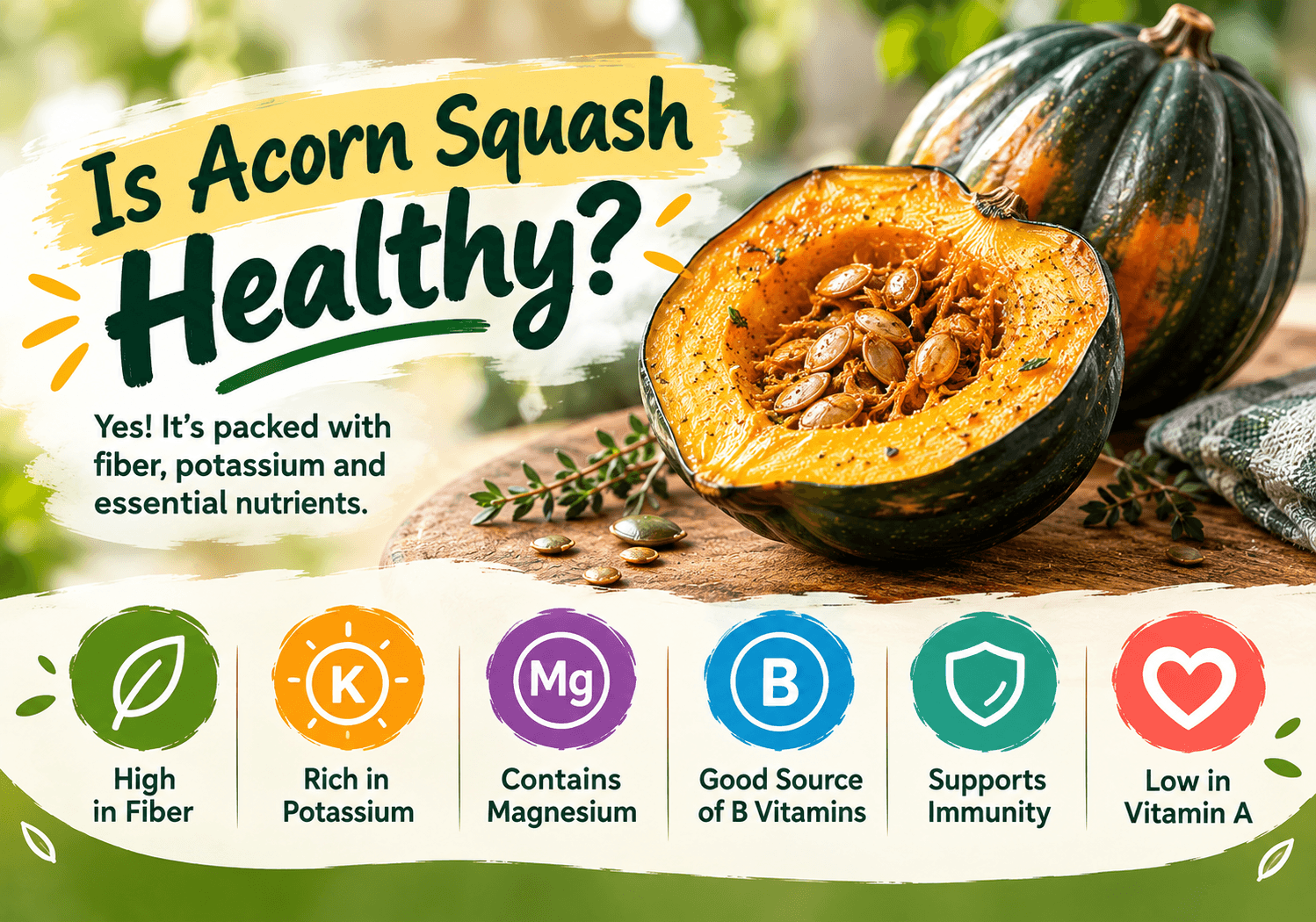
Acorn squash is the little ridged, dark-green squash that shows up every fall, usually halved and roasted with butter and brown sugar. It looks like a cousin of butternut squash and pumpkin, so many people assume it has the same nutrition. It doesn’t, and that’s what makes the question interesting. So, is acorn squash healthy? Yes. It’s one of the highest-fiber vegetables you can eat and a strong source of potassium, magnesium and several B vitamins. It’s just not the vitamin A source its orange-fleshed relatives are.
This guide breaks down acorn squash nutrition using USDA data, explains each benefit, flags who should watch portions, and shows you how to cook it, including whether you can eat the skin.
Key Takeaways
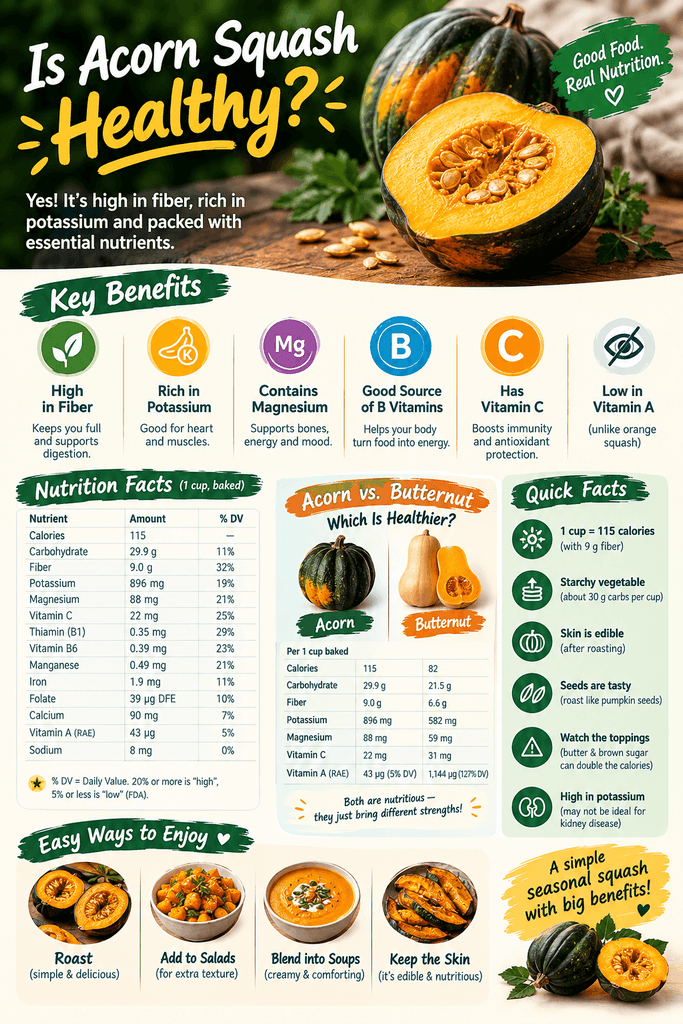
- One cup of baked acorn squash has about 115 calories, 9 g fiber and 896 mg potassium, along with good amounts of magnesium, thiamin, vitamin B6 and vitamin C.
- Acorn squash is low in vitamin A (about 5% of the Daily Value per cup). If you want beta-carotene, butternut squash or pumpkin is the better pick.
- At about 30 g carbohydrate per cup, acorn squash is a starchy vegetable. People managing blood sugar should count it like a grain or potato.
- The skin is edible after roasting, and the seeds can be roasted like pumpkin seeds.
- Watch the toppings: butter and brown sugar can quickly double the calories.
- People with kidney disease may need to limit acorn squash because of its high potassium.
What Is Acorn Squash?
Acorn squash (Cucurbita pepo) is a winter squash, harvested when mature with a hard rind and firm flesh, so it stores for weeks. It’s in the same species as zucchini, spaghetti squash, delicata and small pie pumpkins. Butternut squash belongs to a different species.
It’s named for its acorn-like shape: round, with deep ribs and a pointed end. Most acorn squash is dark green, sometimes with an orange patch where it rested on the ground. Golden and white varieties also exist. Inside, the flesh is pale yellow to light orange, mildly sweet and nutty, and slightly fibrous.
To see how acorn squash fits among butternut, kabocha, Hubbard and the rest, read our complete winter squash guide.
Acorn Squash Nutrition Facts
According to USDA FoodData Central’s record for baked acorn squash without salt, one cup of cubes (205 g) provides:
| Nutrient (1 cup, baked) | Amount | % Daily Value |
| Calories | 115 | — |
| Carbohydrate | 29.9 g | 11% |
| Fiber | 9.0 g | 32% |
| Protein | 2.3 g | — |
| Fat | 0.3 g | 0% |
| Potassium | 896 mg | 19% |
| Magnesium | 88 mg | 21% |
| Thiamin (B1) | 0.35 mg | 29% |
| Vitamin B6 | 0.39 mg | 23% |
| Vitamin C | 22 mg | 25% |
| Manganese | 0.49 mg | 21% |
| Iron | 1.9 mg | 11% |
| Folate | 39 µg DFE | 10% |
| Calcium | 90 mg | 7% |
| Vitamin A (RAE) | 43 µg | 5% |
| Sodium | 8 mg | 0% |
% DV is based on FDA Daily Values. The FDA considers 20% DV or more per serving “high” and 5% or less “low.”
Using that rule, one cup of acorn squash is high in fiber, magnesium, thiamin, vitamin B6, vitamin C and manganese. It’s close to high in potassium, and low in vitamin A, fat and sodium.
Acorn Squash vs Butternut Squash: Which Is Healthier?
This is the comparison most people want. Here are the two side by side, per one cup baked, using USDA data for acorn and baked butternut squash:
| Per 1 cup baked (205 g) | Acorn | Butternut |
| Calories | 115 | 82 |
| Carbohydrate | 29.9 g | 21.5 g |
| Fiber | 9.0 g | 6.6 g |
| Potassium | 896 mg | 582 mg |
| Magnesium | 88 mg | 59 mg |
| Vitamin C | 22 mg | 31 mg |
| Vitamin A (RAE) | 43 µg (5% DV) | 1,144 µg (127% DV) |
Neither is “healthier” overall. They’re good at different things:
- Choose acorn for more fiber, potassium and magnesium.
- Choose butternut for vitamin A, fewer calories and fewer carbs.
Rotating both, along with other orange vegetables, covers more nutritional ground than picking one. For the full butternut picture, see is butternut squash healthy. If vitamin A is your priority, our pumpkin nutrition facts show how much pumpkin provides.
Health Benefits of Acorn Squash
The benefits below come from acorn squash’s nutrient profile and from broader research on fiber and vegetable intake. No single food prevents disease, but acorn squash packs several under-consumed nutrients into one serving.
1. Exceptionally High in Fiber
Nine grams of fiber per cup puts acorn squash among the highest-fiber vegetables. That’s about a third of the 28-gram Daily Value. The Harvard T.H. Chan School of Public Health notes that fiber helps regulate blood sugar, supports regular digestion and is associated with lower risk of heart disease and type 2 diabetes. Yet most people eat far less than recommended.
Mayo Clinic adds that fiber helps you feel full longer, which is one reason high-fiber foods are useful for weight management. Learn more in our article on whether a high-fiber diet is good for weight loss.
2. Rich in Potassium for Blood Pressure Support
At nearly 900 mg per cup, acorn squash has more potassium than a medium banana. According to the NIH Office of Dietary Supplements, potassium helps counter the effect of sodium on blood pressure, and higher intakes are associated with lower blood pressure and stroke risk. Many adults don’t reach the recommended 2,600 mg (women) to 3,400 mg (men) a day.
3. A Good Source of Magnesium
Magnesium is involved in more than 300 enzyme reactions, including muscle and nerve function, blood sugar control and blood pressure regulation, according to the Office of Dietary Supplements. The same source notes that many Americans consume less magnesium than recommended. One cup of acorn squash provides about a fifth of the Daily Value.
4. Supplies B Vitamins for Energy Metabolism
Acorn squash is a surprisingly good source of thiamin (vitamin B1) and vitamin B6. The Office of Dietary Supplements thiamin fact sheet explains that thiamin helps the body turn food into energy. Vitamin B6 is involved in protein metabolism, brain development and immune function. One cup provides roughly a quarter of the Daily Value for each.
5. Adds Vitamin C
With 22 mg per cup, acorn squash supplies about a quarter of the Daily Value for vitamin C. The Office of Dietary Supplements notes that vitamin C is needed to make collagen and support immune function, and that it improves absorption of the plant-based iron that acorn squash also contains.
6. Part of a Vegetable-Rich Eating Pattern
A large 2017 meta-analysis in the International Journal of Epidemiology found that higher fruit and vegetable intake was associated with lower risk of cardiovascular disease, cancer and early death, with benefits up to about 800 grams a day. The USDA’s MyPlate includes acorn squash among the red and orange vegetables it encourages people to eat each week.
Who Benefits Most From Acorn Squash?
- People who need more fiber. Few vegetables match 9 g per cup.
- People trying to eat more potassium and magnesium, especially if they eat few fruits, vegetables, beans or nuts.
- Anyone replacing refined starches. Swapping white rice, white bread or regular pasta for acorn squash adds fiber and minerals.
- Plant-forward eaters looking for a filling, nutrient-dense base for meals.
- Seasonal cooks. Acorn squash is affordable in fall and winter and keeps for weeks.
Is Acorn Squash Good for People With Diabetes?
Acorn squash can fit a diabetes-friendly diet, but it’s a starchy vegetable. One cup has about 30 g of total carbohydrate, or about 21 g of net carbs after subtracting fiber. That’s similar to a small baked potato or ⅔ cup of cooked rice.
What works in its favor is the 9 grams of fiber, which Harvard notes helps slow the rise in blood sugar after meals. Practical tips:
- Count acorn squash as your starch for the meal, not as a free vegetable.
- Stick to about ½ to 1 cup and pair it with protein and healthy fat.
- Skip the brown sugar and maple glaze, or use a small drizzle.
- If you want a lower-carb squash, spaghetti squash has far fewer carbs per cup. See is spaghetti squash healthy.
Risks and Who Should Be Cautious
Kidney Disease
Acorn squash is high in potassium. The National Institute of Diabetes and Digestive and Kidney Diseases advises that people with chronic kidney disease may need to limit high-potassium foods, because damaged kidneys may not remove extra potassium well. Ask your renal dietitian whether, and how much, acorn squash fits your plan.
Low-Carb and Keto Diets
With about 21 g of net carbs per cup, acorn squash is hard to fit into strict keto plans. Small portions may work on moderate low-carb diets.
Calorie-Heavy Toppings
The classic preparation, with butter and brown sugar in each half, can add a lot of calories and added sugar. Try olive oil, herbs, cinnamon or a small amount of maple syrup instead. Our article on whether maple syrup is healthy explains how to use it sparingly.
Bitter Squash
Like all squash, acorn squash can rarely contain high levels of bitter compounds called cucurbitacins, which can cause stomach upset. If your squash tastes unusually bitter, don’t eat it. Throw it away.
Cutting Injuries
Acorn squash’s ribs and hard rind make it awkward to cut. See the safe-cutting steps below.
How Much Acorn Squash Should You Eat?
There’s no set limit. A typical serving is ½ to 1 cup of cooked squash, about a quarter to half of a medium squash. MyPlate counts 1 cup of cooked acorn squash as 1 cup of vegetables toward the 2–4 cups a day most adults need. If you have diabetes, kidney disease or follow a low-carb diet, adjust portions with your healthcare team.
How to Cook Acorn Squash
How to Cut It Safely
- Wash and dry the squash. Place it on a cutting board on top of a damp towel to keep it from sliding.
- To soften a very hard squash, pierce it a few times with a knife and microwave it for 2–3 minutes.
- Set it stem-side up and insert a heavy chef’s knife next to the stem. Rock the knife down through one side, then turn the squash and repeat.
- Scoop out the seeds and stringy pulp with a sturdy spoon. Keep the seeds for roasting.
Roasted Halves (the Classic)
Brush the cut sides with olive oil and season with salt, pepper or cinnamon. Roast cut-side down at 400°F (200°C) for 35–45 minutes, until a fork slides in easily. Flip, add toppings and roast 5 more minutes if you like.
Roasted Slices or Wedges
Cut the halves into ¾-inch slices along the ribs. Toss with oil and spices and roast at 425°F (220°C) for 20–30 minutes, turning once. The skin becomes tender enough to eat.
Stuffed Acorn Squash
Acorn squash halves make natural bowls. Roast them until almost tender, then fill with a cooked grain mixture and roast another 10–15 minutes. Good fillings:
- Wild rice with cranberries and walnuts. Our fruited wild rice salad works as a ready-made stuffing.
- Lean turkey or chicken sausage with apples and onions. See is turkey sausage healthy.
- Quinoa, black beans and corn, with a little cheese on top.
For another hearty grain pairing, try this winter squash wheat berry risotto, which works well with acorn squash.
Microwave Method
For a fast weeknight side, place halves cut-side down in a microwave-safe dish with ¼ inch of water. Cover and microwave on high for 8–12 minutes, until tender.
Can You Eat Acorn Squash Skin?
Yes. Acorn squash skin is edible and softens when roasted, especially in thinner slices. Some people find it chewy in large halves, so eating it is a matter of preference. Scrub the squash well before cooking if you plan to eat the skin.
Don’t Toss the Seeds
Acorn squash seeds can be cleaned, tossed with oil and salt, and roasted at 300–325°F until golden, just like pumpkin seeds. For their nutrition profile, read are pumpkin seeds healthy.
Practical Tips: Buying and Storing Acorn Squash
- Choose squash that feels heavy for its size, with a dull, dark-green rind and no soft spots or cracks. A little orange on the skin is normal, but a mostly orange squash may be overripe and drier.
- Store whole acorn squash in a cool, dry, well-ventilated place, not the refrigerator. It keeps for several weeks but doesn’t last as long as butternut.
- Refrigerate cut squash, wrapped, and use it within a few days.
- Freeze cooked squash by mashing or cubing it and packing it into freezer containers.
Acorn Squash Myths vs. Facts
Myth: All orange-fleshed squash is high in vitamin A.
Fact: Acorn squash has only about 5% of the Daily Value for vitamin A per cup, compared with over 100% in butternut squash.
Myth: Acorn squash is a low-carb vegetable.
Fact: At about 30 g of carbohydrate per cup, it’s a starchy vegetable, comparable to potatoes or rice.
Myth: You have to peel acorn squash.
Fact: The skin is edible once roasted. Peeling is optional.
Myth: Acorn squash is just a vehicle for butter and sugar.
Fact: With 9 g fiber, nearly 900 mg potassium and high levels of magnesium, B vitamins and vitamin C per cup, acorn squash is nutrient-dense on its own.
Myth: Sweet potatoes are always more nutritious.
Fact: Sweet potatoes beat acorn squash on vitamin A, but acorn squash competes well on fiber and potassium. Compare them in are sweet potatoes healthy.
How Acorn Squash Fits a Healthy Lifestyle
Think of acorn squash as a whole-food starch: it fills the same role on your plate as rice, pasta or potatoes, but with much more fiber and a wide spread of minerals and B vitamins. Build a balanced plate with roasted or stuffed acorn squash, a lean protein, and a green vegetable or salad. Season it with herbs, spices and a little olive oil rather than heavy butter and sugar, and pair it with orange vegetables like butternut, carrots or pumpkin to cover vitamin A.
Frequently Asked Questions
How many calories are in acorn squash?
According to USDA data, one cup of baked acorn squash cubes has about 115 calories. A medium acorn squash yields roughly 2 to 3 cups of cooked flesh. Butter, brown sugar and maple syrup toppings can add 100 calories or more per serving, so season lightly.
Is acorn squash good for weight loss?
Acorn squash can support weight management because its 9 grams of fiber per cup helps you feel full. It’s not especially low in calories for a vegetable, though, at about 115 per cup. Use it in place of refined starches, keep toppings light, and pair it with protein.
Is acorn squash high in carbs?
Yes, compared with most vegetables. One cup of baked acorn squash has about 30 grams of total carbohydrate and 9 grams of fiber, for roughly 21 grams of net carbs. It’s best counted as a starchy vegetable, like potatoes or corn, in a carb-controlled meal plan.
Can you eat the skin of acorn squash?
Yes. Acorn squash skin is safe to eat and softens when roasted, especially when the squash is cut into thin slices or wedges. In large roasted halves the skin can stay chewy, so many people scoop out the flesh instead. Scrub the squash well before cooking.
Which is healthier, acorn or butternut squash?
Both are healthy, with different strengths. Acorn squash has more fiber, potassium and magnesium. Butternut squash has far more vitamin A and fewer calories and carbs per cup. Eating both, along with other vegetables, gives you a broader range of nutrients.
Does acorn squash have vitamin A?
Only a small amount. One cup of baked acorn squash provides about 43 micrograms RAE of vitamin A, roughly 5% of the Daily Value. For beta-carotene and vitamin A, butternut squash, pumpkin, sweet potatoes and carrots are much richer choices.
Conclusion
So, is acorn squash healthy? Yes. It’s a nutrient-dense, high-fiber starchy vegetable with 9 grams of fiber, nearly 900 mg of potassium, and high levels of magnesium, thiamin, vitamin B6 and vitamin C per cup. It isn’t a vitamin A powerhouse like butternut or pumpkin, and its 30 grams of carbs per cup mean people with diabetes should count it like a starch. Roast it with olive oil and spices or stuff it with grains and lean protein, go light on butter and sugar, and check with your doctor about potassium if you have kidney disease.
Medical disclaimer: This article is for general educational purposes only and is not a substitute for professional medical advice, diagnosis or treatment. If you have a health condition such as diabetes or kidney disease, talk with your doctor or a registered dietitian before making significant changes to your diet.
(3) References
- U.S. Department of Agriculture. “Squash, winter, acorn, cooked, baked, without salt” (FDC ID 169293). FoodData Central, SR Legacy. https://fdc.nal.usda.gov/fdc-app.html#/food-details/169293/nutrients
- U.S. Department of Agriculture. “Squash, winter, butternut, cooked, baked, without salt” (FDC ID 169296). FoodData Central, SR Legacy. https://fdc.nal.usda.gov/fdc-app.html#/food-details/169296/nutrients
- U.S. Food and Drug Administration. “Daily Value on the Nutrition and Supplement Facts Labels.” https://www.fda.gov/food/nutrition-facts-label/daily-value-nutrition-and-supplement-facts-labels
- Harvard T.H. Chan School of Public Health. “Fiber.” The Nutrition Source. https://nutritionsource.hsph.harvard.edu/carbohydrates/fiber/
- Mayo Clinic Staff. “Dietary fiber: Essential for a healthy diet.” Mayo Clinic. https://www.mayoclinic.org/healthy-lifestyle/nutrition-and-healthy-eating/in-depth/fiber/art-20043983
- NIH Office of Dietary Supplements. “Potassium: Fact Sheet for Health Professionals.” https://ods.od.nih.gov/factsheets/Potassium-HealthProfessional/
- NIH Office of Dietary Supplements. “Magnesium: Fact Sheet for Health Professionals.” https://ods.od.nih.gov/factsheets/Magnesium-HealthProfessional/
- NIH Office of Dietary Supplements. “Thiamin: Fact Sheet for Health Professionals.” https://ods.od.nih.gov/factsheets/Thiamin-HealthProfessional/
- NIH Office of Dietary Supplements. “Vitamin B6: Fact Sheet for Health Professionals.” https://ods.od.nih.gov/factsheets/VitaminB6-HealthProfessional/
- NIH Office of Dietary Supplements. “Vitamin C: Fact Sheet for Health Professionals.” https://ods.od.nih.gov/factsheets/VitaminC-HealthProfessional/
- Aune D, et al. “Fruit and vegetable intake and the risk of cardiovascular disease, total cancer and all-cause mortality—a systematic review and dose-response meta-analysis of prospective studies.” International Journal of Epidemiology. 2017. https://pubmed.ncbi.nlm.nih.gov/28338764/
- U.S. Department of Agriculture. “Vegetables.” MyPlate. https://www.myplate.gov/eat-healthy/vegetables
- National Institute of Diabetes and Digestive and Kidney Diseases. “Eating Right for Chronic Kidney Disease.” https://www.niddk.nih.gov/health-information/kidney-disease/chronic-kidney-disease-ckd/eating-nutrition