Walk down the snack aisle and you’ll find nuts in every style: raw, dry-roasted, oil-roasted, salted, smoked, and honey-roasted. Roasting gives nuts their deep flavor and satisfying crunch. But does the heat destroy their nutrients, and what about the honey-glazed kind? So, are roasted nuts healthy?
For the most part, yes. Plain roasted nuts keep nearly all the nutrition of raw nuts, and the research behind nuts’ heart and weight benefits often used roasted nuts. What matters more is how they’re roasted and what’s added: oil, salt, honey, or sugar. This guide compares raw, dry-roasted, oil-roasted, and honey-roasted nuts. It also explains what roasting does to nutrients, covers the safety questions, and shows how to roast nuts at home the healthy way.
Key Takeaways
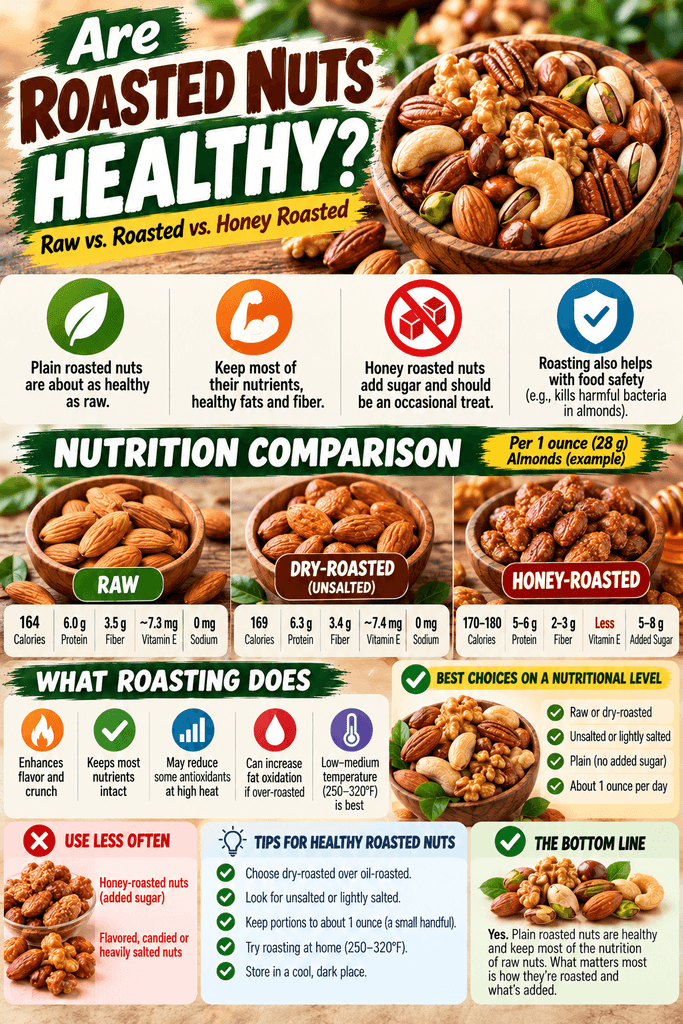
- Plain dry-roasted nuts are about as healthy as raw. USDA data show nearly identical calories, protein, fiber, and vitamin E per ounce.
- High-temperature roasting can reduce some antioxidants and vitamin E and increase fat oxidation. Low-to-medium temperatures (about 120–160°C, or 250–320°F) protect nutrients best.
- Honey-roasted nuts add sugar, often several grams per ounce, and frequently salt. Treat them as an occasional snack.
- Lightly salted roasted nuts are modest in sodium. Salted dry-roasted peanuts have about 115 mg per ounce (5% of the Daily Value).
- Roasting helps with safety. U.S. almonds must be treated to kill Salmonella, and roasting is one approved method.
- Best choice: raw or dry-roasted, unsalted or lightly salted, in about 1-ounce portions.
Are Roasted Nuts Healthy? The Short Answer
Yes. Plain roasted nuts are a healthy food. Roasting mainly removes water and develops flavor through browning, a process called the Maillard reaction. Protein, fiber, minerals, and most of the healthy fats stay intact.
Much of the research on nuts and health used roasted nuts. For example, a randomized trial in the European Journal of Clinical Nutrition gave adults 1.5 ounces of dry-roasted, lightly salted almonds daily for four weeks. They reduced hunger without causing weight gain. Our guides on whether nuts are good for your heart and whether nuts are fattening cover those benefits in detail.
The real question isn’t “raw or roasted?” It’s whether the nuts have extra oil, salt, sugar, or honey, and whether they were roasted at very high heat.
Raw vs. Roasted: What Changes in the Nutrition?
USDA data for almonds show how little dry roasting changes the basics. Per 1 ounce:
| Almonds (1 oz) | Calories | Protein | Fiber | Vitamin E | Sodium |
| Raw | 164 | 6.0 g | 3.5 g | ~7.3 mg | 0 mg |
| Dry-roasted, unsalted | 169 | 6.3 g | 3.4 g | ~7.4 mg | 0 mg |
The small differences come mostly from water loss: roasted nuts weigh a little less, so an ounce holds slightly more nut. Commercial dry roasting barely changed the vitamin E in USDA’s almond data.
There’s one interesting twist. The USDA Agricultural Research Service found that labels overstated the calories in whole raw almonds by about 25%, but in chopped roasted almonds by only about 17%. Roasting and chopping break down more cell walls, so your body absorbs a bit more of the fat. The difference is small, but roasted nuts deliver slightly more usable calories than raw.
What Roasting Does to Nuts’ Healthy Compounds
Vitamin E and antioxidants: depends on the heat
A study in Food Chemistry roasted hazelnuts, almonds, macadamias, pistachios, and walnuts at different times and temperatures. It found:
- Fatty acid composition didn’t change with roasting.
- Vitamin E forms (tocopherols) fell after roasting, by roughly 38% (alpha), 40% (beta), and 70% (gamma).
- Antioxidant capacity dropped significantly in hazelnuts, macadamias, and walnuts.
- Malondialdehyde, a marker of fat oxidation, rose with higher temperatures, about 17-fold in walnuts.
The authors concluded that roasting at low to medium temperatures (120–160°C) gave the best taste along with a healthier composition. The study was supported by the California Walnut Commission.
Other research is more reassuring. A 2025 study in Molecules found that peanuts, hazelnuts, and walnuts had higher measured polyphenols and antioxidant activity after roasting. Faster microwave methods preserved healthy fatty acids best.
Bottom line: gentle roasting keeps most of the goodness. Very hot or very long roasting costs more vitamin E and antioxidants, especially in walnuts, whose omega-3 fats are fragile.
Walnuts and other omega-3-rich nuts
Walnuts are rich in ALA, a plant omega-3 fat that oxidizes more easily under heat. If you buy walnuts for their omega-3s, raw or lightly toasted walnuts are the better choice. See whether walnuts are healthy.
Acrylamide: a small concern, mostly in almonds
Acrylamide is a compound that can form in plant foods cooked at high temperatures. The FDA explains that it forms during frying, roasting, and baking, and that high doses caused cancer in animal studies. It is found mainly in potato products, grain products, and coffee.
In nuts, the main source is almonds:
- In the Food Chemistry study, significant acrylamide formed only in almonds roasted at higher temperatures.
- A Journal of Agricultural and Food Chemistry study found that roasting temperature and an amino acid called asparagine drive acrylamide formation in almonds. Roasted hazelnuts contained very little.
The FDA does not advise people to stop eating roasted foods. It recommends an overall healthy eating pattern. Choosing lighter-colored, gently roasted almonds over very dark ones, and eating a variety of nuts, keeps your exposure low.
Dry-Roasted vs. Oil-Roasted Nuts
| Type | How it’s made | Health notes |
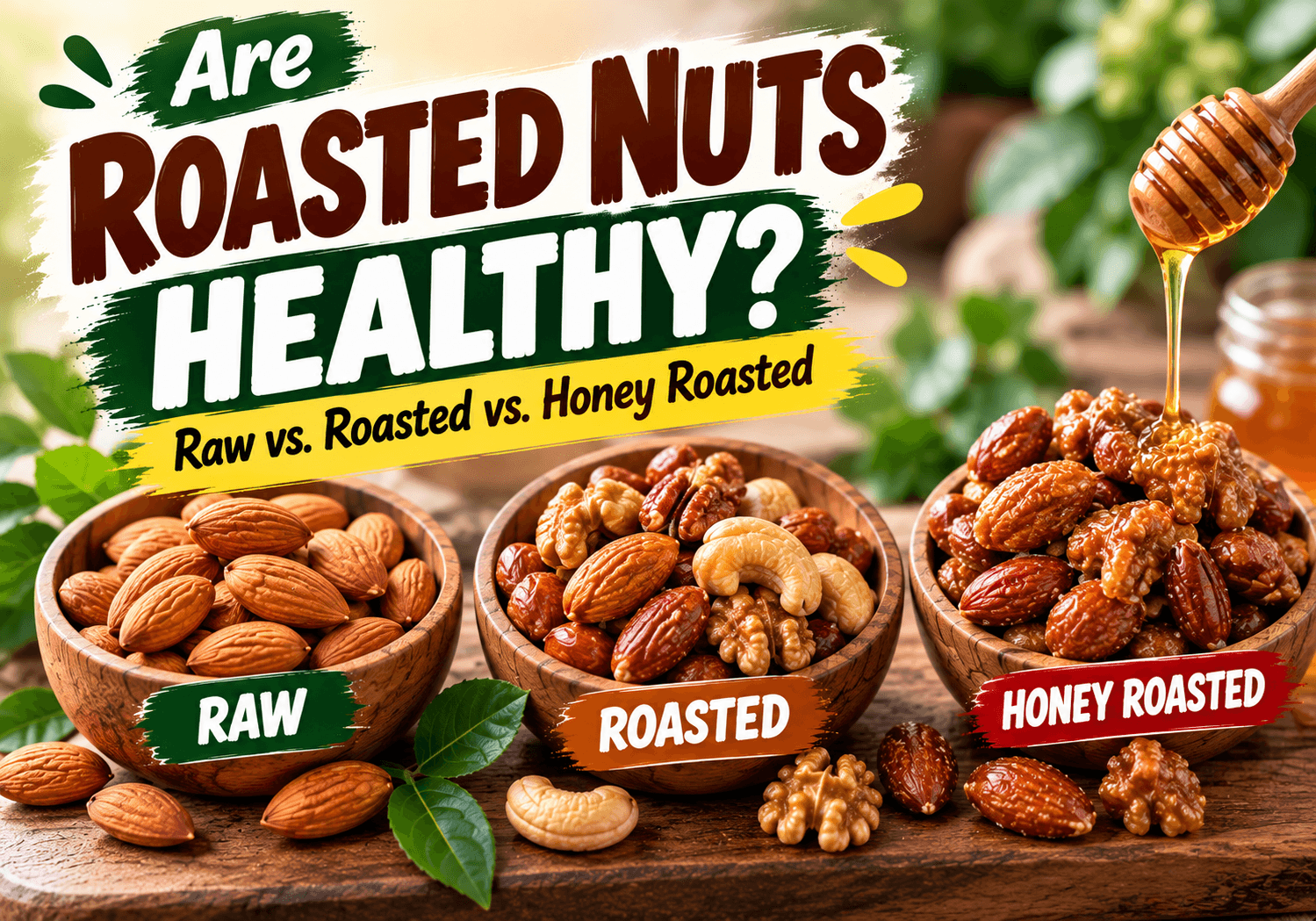
| Dry-roasted | Heated with no added oil | Nutritionally close to raw. The best roasted choice. |
| Oil-roasted | Cooked in or tossed with oil | Slightly more fat and calories. Quality depends on the oil used. |
| Roasted & salted | Either method, plus salt | Adds sodium. Lightly salted is modest. |
| Honey-roasted | Coated with honey and/or sugar, then roasted | Adds sugar and often salt. Best as a treat. |
Check the ingredient list. A good roasted nut product lists only the nut, or the nut and salt. If you see oils, sugar, honey, corn syrup, or flavorings, you’re buying a snack food, not just nuts.
Are Salted Roasted Nuts Bad for You?
Not necessarily. USDA data show that salted dry-roasted peanuts contain about 115 mg of sodium per ounce. That’s about 5% of the Daily Value, less than many people expect. Some brands, seasoned varieties, and “extra salty” mixes contain considerably more.
The FDA notes that most Americans eat too much sodium, which raises the risk of high blood pressure. To keep salt in check:
- Choose unsalted or lightly salted nuts.
- Compare the sodium on labels per 1-ounce serving.
- If you have high blood pressure or heart disease, go unsalted.
- Mix half salted and half unsalted nuts to cut sodium without losing flavor.
Are Honey-Roasted Nuts Healthy?
Honey-roasted nuts are a treat, not a health food. They’re still nuts underneath, so they keep the protein, fiber, and unsaturated fats. The coating, though, adds sugar, usually a mix of honey, sugar, and sometimes corn syrup, plus salt.
How much sugar does the coating add? Here’s an example based on a typical homemade recipe and USDA values:
- 2 cups of almonds (about 10 ounces)
- 2 tablespoons of honey, about 34 g of sugar
- 1 tablespoon of granulated sugar, about 12.5 g of sugar
That’s roughly 4–5 grams of added sugar per ounce. Many commercial products contain a similar amount or more, so check the label for “Added Sugars.”
The FDA’s Daily Value for added sugars is 50 grams. One ounce of honey-roasted nuts might use 8–10% of it. That’s fine occasionally. The problem is that sweet, salty coatings make nuts much easier to overeat. Three handfuls can mean 500 calories and 15 grams of added sugar.
Honey isn’t meaningfully healthier than sugar in these amounts. Our guides on whether honey is heart healthy and whether honey is good for weight loss explain why.
Who should limit honey-roasted nuts
- People managing diabetes or prediabetes, because of the added sugar
- People with high blood pressure, because many contain added salt
- Anyone trying to lose weight, because they’re easy to overeat
- Young children, because of the choking risk from whole nuts and the added sugar
Are Raw Nuts Safer or Healthier Than Roasted?
“Raw” sounds more natural, but roasting brings a real food-safety benefit. Nuts are grown outdoors and can pick up bacteria.
After Salmonella outbreaks were linked to raw almonds in 2001 and 2004, the USDA Agricultural Marketing Service required California almonds to be treated to achieve at least a 4-log (99.99%) reduction in Salmonella, starting with the 2007–08 crop. Roasting is one of the approved treatments. That means most “raw” almonds sold in U.S. stores have been pasteurized by steam or other methods, and they’re safe.
Cashews are a special case. “Raw” cashews in stores have already been heat-treated, because the shell contains an irritating oil related to poison ivy. Our guide to whether cashews are healthy explains this.
Bottom line: both raw and plain roasted nuts are healthy choices. Pick the one you enjoy and will eat in sensible portions.
Who Benefits Most From Choosing the Right Roasted Nuts
- People with high blood pressure: unsalted dry-roasted nuts give you crunch without the sodium.
- People with diabetes: plain roasted nuts instead of honey-roasted avoid added sugar.
- Weight watchers: plain nuts are more satisfying and easier to portion than sweet, salty ones.
- Walnut lovers seeking omega-3s: raw or lightly toasted walnuts protect their fragile fats.
- Picky eaters: roasting improves flavor and texture, which can help you eat nuts more often.
How to Roast Nuts at Home (the Healthy Way)
Home roasting gives you full control over temperature, oil, salt, and sugar.
Oven method
- Preheat the oven to 300–325°F (150–160°C). Gentle heat preserves nutrients and limits acrylamide in almonds, consistent with the 120–160°C range in the Food Chemistry study.
- Spread the nuts in a single layer on a rimmed baking sheet. Use no oil, or a light mist if you want seasonings to stick.
- Roast for 8–15 minutes, stirring halfway. Smaller nuts like pine nuts need less time, and larger nuts like almonds need more.
- Pull them when lightly golden and fragrant. They keep cooking a bit as they cool, and darker means more nutrient loss.
- Cool completely before storing.
Skillet method
Toast nuts in a dry pan over medium-low heat for 3–6 minutes, stirring often. This works well for small batches, salads, and pine nuts.
Healthy flavor ideas
- Cinnamon and a pinch of salt, no sugar
- Smoked paprika and garlic powder
- Rosemary and black pepper
- Curry powder or chili-lime seasoning
- For a sweet treat, use a small amount of maple syrup with lots of spice, like our cinnamon sugar roasted mixed nuts, and keep portions small.
The same method works for seeds. See how to roast pumpkin seeds.
Storage
Roasted nuts go rancid faster than raw ones. Store them in airtight containers, in the fridge for a few weeks or the freezer for longer. If nuts smell like paint or old oil, throw them out.
Myths vs. Facts
| Myth | Fact |
| Roasting destroys all the nutrients in nuts. | Protein, fiber, minerals, and fat composition stay largely intact. Some vitamin E and antioxidants drop at high heat. |
| Raw nuts are always safer. | Roasting kills bacteria. U.S. almonds must be treated to reduce Salmonella. |
| Salted nuts are loaded with sodium. | Lightly salted dry-roasted peanuts have about 115 mg per ounce. Check labels for heavily seasoned varieties. |
| Honey-roasted nuts are healthy because honey is natural. | Honey is still added sugar, and these nuts are easy to overeat. |
| Oil-roasted nuts are deep-fried junk food. | They have slightly more fat and calories. Dry-roasted is better, but oil-roasted isn’t a disaster. |
| Dark roasted almonds are healthier because they’re crunchier. | Darker roasting means more acrylamide and nutrient loss. Lighter is better. |
How Roasted Nuts Fit a Healthy Lifestyle
Plain roasted nuts belong in a healthy diet:
- Snack: 1 ounce of dry-roasted, lightly salted almonds or pistachios with an apple
- Salads: toasted walnuts or pecans instead of croutons
- Breakfast: roasted chopped nuts on oatmeal or yogurt
- Dinner: roasted cashews or peanuts in a vegetable stir-fry
Rotate nuts for variety. Almonds bring fiber and vitamin E, and peanuts bring the most protein, as our guide on whether nuts are high in protein shows. Walnuts bring omega-3s. For an overview of every nut, see our complete guide to nuts.
Frequently Asked Questions
Are raw nuts healthier than roasted nuts?
Only slightly, if at all. Plain dry-roasted nuts have nearly the same calories, protein, fiber, and minerals as raw nuts. High-temperature roasting can reduce some vitamin E and antioxidants, especially in walnuts. Roasting also kills bacteria. Choose whichever you enjoy, as long as it’s plain or lightly salted.
Does roasting nuts destroy nutrients?
Roasting doesn’t change protein, fiber, minerals, or fatty acid composition much. Vitamin E and some antioxidants can drop, and fat oxidation rises, mainly at high temperatures. Roasting at low to medium heat, about 250–320°F (120–160°C), keeps most of the nutrients and still gives great flavor.
Are honey-roasted nuts healthy?
Honey-roasted nuts are best as an occasional treat. The coating adds roughly 4–5 grams or more of added sugar per ounce, often along with salt. They still contain nut protein and healthy fats, but they’re easy to overeat. Plain or lightly salted roasted nuts are the healthier everyday choice.
Are dry-roasted peanuts healthy?
Yes. Dry-roasted peanuts provide about 7 grams of protein per ounce, plus fiber, healthy fats, and minerals. Lightly salted versions contain about 115 mg of sodium per ounce. Choose unsalted if you watch your sodium, and stick to about one ounce, roughly 28 peanuts.
Is it safe to eat raw nuts?
Store-bought raw nuts in the U.S. are generally safe. California almonds must be treated to reduce Salmonella, and “raw” cashews have already been heat-treated. Never eat cashews straight from the shell. Buy from reputable sellers and store nuts in a cool, dry place to prevent spoilage.
What temperature should I roast nuts at?
Roast at about 300–325°F (150–160°C) for 8–15 minutes, stirring halfway, until lightly golden. Gentler heat preserves vitamin E and antioxidants and limits acrylamide in almonds. Watch closely, because nuts can go from golden to burnt in a minute or two.
Conclusion
So, are roasted nuts healthy? Plain roasted nuts are, and they’re nearly as nutritious as raw ones. Choose dry-roasted, unsalted or lightly salted nuts, roasted at moderate temperatures, and enjoy them in about 1-ounce portions.
Honey-roasted, candied, and heavily salted nuts are a different story. Their added sugar and sodium turn a health food into a treat. Enjoy them occasionally, and make plain roasted or raw nuts your everyday choice.
Medical disclaimer: This article is for general information only and isn’t a substitute for professional medical or nutrition advice. If you have high blood pressure, diabetes, a nut allergy, or other health conditions, talk with your doctor or a registered dietitian about the best choices for you.
3. References
- Tan SY, Mattes RD. Appetitive, dietary and health effects of almonds consumed with meals or as snacks: a randomized, controlled trial. European Journal of Clinical Nutrition. 2013;67(11):1205–1214. https://pmc.ncbi.nlm.nih.gov/articles/PMC3898316/
- USDA FoodData Central. Nuts, almonds (FDC 170567). https://fdc.nal.usda.gov/fdc-app.html#/food-details/170567/nutrients
- USDA FoodData Central. Nuts, almonds, dry roasted, without salt added (SR Legacy). https://fdc.nal.usda.gov/
- USDA FoodData Central. Peanuts, all types, dry-roasted, with salt (FDC 174262). https://fdc.nal.usda.gov/fdc-app.html#/food-details/174262/nutrients
- USDA FoodData Central. Honey (FDC 169640). https://fdc.nal.usda.gov/fdc-app.html#/food-details/169640/nutrients
- U.S. Department of Agriculture, Agricultural Research Service. Calories in nuts (Baer DJ, Novotny JA). AgResearch Magazine, March 2018. https://agresearchmag.ars.usda.gov/2018/mar/calories
- Schlörmann W, Birringer M, Böhm V, et al. Influence of roasting conditions on health-related compounds in different nuts. Food Chemistry. 2015;180:77–85. https://doi.org/10.1016/j.foodchem.2015.02.017
- Kulik K, Waszkiewicz-Robak B. The effect of roasting on the health-promoting components of nuts determined on the basis of fatty acids, polyphenol compounds, and antioxidant capacity. Molecules. 2025;30(23):4594. https://pmc.ncbi.nlm.nih.gov/articles/PMC12693215/
- Amrein TM, Lukac H, Andres L, Perren R, Escher F, Amadò R. Acrylamide in roasted almonds and hazelnuts. Journal of Agricultural and Food Chemistry. 2005;53(20):7819–7825. https://doi.org/10.1021/jf051132k
- U.S. Food and Drug Administration. Acrylamide Questions and Answers. Updated 2024. https://www.fda.gov/food/chemical-contaminants-food/acrylamide-questions-and-answers
- U.S. Department of Agriculture, Agricultural Marketing Service. Almonds Grown in California; Outgoing Quality Control Requirements (proposed rule). Federal Register. December 6, 2006. https://govinfo.gov/content/pkg/FR-2006-12-06/pdf/06-9543.pdf
- U.S. Food and Drug Administration. Sodium in Your Diet. https://www.fda.gov/food/nutrition-education-resources-materials/sodium-your-diet
- U.S. Food and Drug Administration. Daily Value on the Nutrition and Supplement Facts Labels. https://www.fda.gov/food/nutrition-facts-label/daily-value-nutrition-and-supplement-facts-labels