Nuts are one of the most calorie-dense foods in the grocery store. A small handful can carry 160 to 200 calories, so it’s natural to ask, are nuts fattening? If you’re trying to lose weight, should you avoid them?
Decades of research point the other way. People who eat nuts regularly tend to gain less weight over time, and controlled trials show that adding nuts to a diet doesn’t cause weight gain. This guide explains why. It covers which nuts have the fewest calories, which are best for weight loss, how many to eat, and the few ways nuts really can work against you.
Key Takeaways
- Nuts are calorie-dense but not fattening in normal portions. A review of 86 randomized trials found no meaningful weight gain from eating nuts, and large cohorts link nut intake to a lower risk of overweight and obesity.
- You absorb fewer calories than the label says. USDA studies measured about 129 calories per ounce for almonds (vs. about 168 on the label) and 146 for walnuts (vs. 185).
- Nuts are filling. Protein, fiber, and fat reduce hunger, so people naturally eat less of other foods.
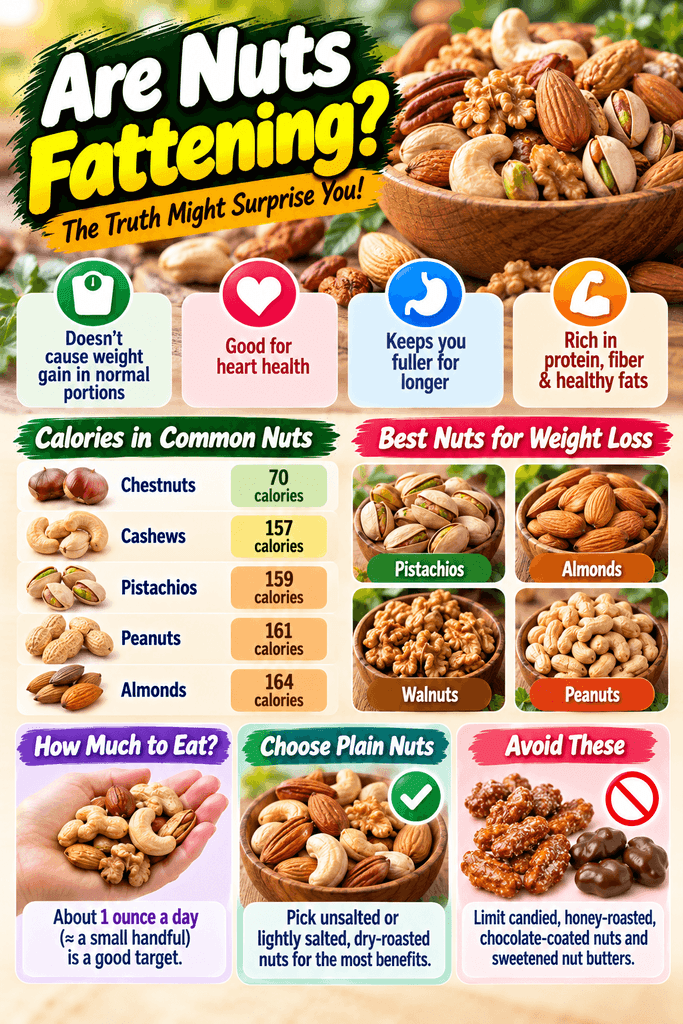
- The nuts with the fewest calories are chestnuts (about 70 per ounce), then cashews, pistachios, peanuts, and almonds (about 157–164).
- Best picks for weight loss: pistachios, almonds, walnuts, and peanuts, kept to about 1 ounce a day, plain or dry-roasted.
- Nuts become fattening when portions are large or when they come candied, honey-roasted, chocolate-coated, or as sweetened spreads.
Are Nuts Fattening? The Short Answer
No, not when eaten in sensible amounts. Nuts are high in calories by weight, but “high in calories” and “fattening” aren’t the same thing. Whether a food leads to weight gain depends on how many of its calories your body absorbs, how full it keeps you, and what it replaces in your diet. On all three counts, nuts do surprisingly well.
The largest analysis to date, a systematic review and meta-analysis in Obesity Reviews, pooled data from more than 569,000 people in prospective cohorts and 86 randomized trials:
- Cohorts: people who ate more nuts had a 7% lower risk of overweight or obesity.
- Trials: adding nuts didn’t raise body weight. The average change was +0.09 kg, which isn’t a meaningful difference.
The authors concluded that the concern that nuts cause weight gain “appears unwarranted.” Our complete guide to nuts covers their wider health benefits.
Nut Calories Compared: Which Nuts Have the Least Calories?
Here’s how common nuts compare per 1-ounce (28 g) serving, using label-style values from USDA FoodData Central. Kernel counts are approximate and vary with size.
| Nut (1 oz) | Calories | Protein | Fiber | Approx. pieces per oz |
|---|---|---|---|---|
| Chestnuts, roasted | ~70 | 0.9 g | 1.4 g | 3–4 |
| Cashews, raw | 157 | 5.2 g | 0.9 g | ~18 |
| Pistachios, raw | 159 | 5.7 g | 3.0 g | ~49 |
| Peanuts, raw | 161 | 7.3 g | 2.4 g | ~28 |
| Almonds, raw | 164 | 6.0 g | 3.5 g | ~23 |
| Hazelnuts | 178 | 4.2 g | 2.7 g | ~21 |
| Walnuts | 185 | 4.3 g | 1.9 g | ~14 halves |
| Brazil nuts | 187 | 4.1 g | 2.1 g | ~6 |
| Pine nuts | 191 | 3.9 g | 1.1 g | ~160 |
| Pecans | 196 | 2.6 g | 2.7 g | ~19 halves |
| Macadamia nuts | 204 | 2.2 g | 2.4 g | ~10–12 |
Which nuts have the least calories?
- Chestnuts are in a class of their own. They’re starchy and low in fat, at about 70 calories per ounce. Our guide on whether chestnuts are healthy explains why they behave more like a grain than a nut.
- Among true high-fat nuts, cashews, pistachios, peanuts, and almonds are the lowest, at about 157–164 calories.
- Pecans and macadamias are the highest, at about 200 calories.
Pistachios give you the most pieces per ounce. You get about 49 kernels for roughly the same calories as 23 almonds or 10 macadamias. That’s useful if you like to snack on something you can keep picking at.
Why Nuts Don’t Act Like Other High-Calorie Foods
1. You absorb fewer calories than the label says
Nutrition labels estimate calories with formulas (the Atwater factors) developed over a century ago. USDA researchers David Baer and Janet Novotny tested these against what people actually absorb. They found that labels overstate the calories in several nuts. As the USDA Agricultural Research Service reported:
- Almonds: about 129 calories absorbed per 28 g serving, compared with roughly 168–170 on the label
- Walnuts: 146 calories, compared with 185
- Pistachios: 154 calories, compared with 162
The almond results were first published in the American Journal of Clinical Nutrition. A later study in Nutrients found the same pattern for cashews.
The reason is structural. Much of a nut’s fat is locked inside tough plant cell walls that chewing doesn’t fully break open. That fat passes through your gut without being absorbed. ARS also found that processing matters: whole raw almonds were overestimated more than chopped roasted almonds, because chopping and roasting break more cells open.
2. Nuts are filling, so you eat less of other foods
Protein, fiber, and fat all slow digestion and keep you full. In a randomized trial in the European Journal of Clinical Nutrition, 137 adults ate 1.5 ounces of almonds a day, about 250 extra calories, for four weeks. They didn’t gain weight. Their hunger dropped, especially when they ate the almonds as a snack. Participants naturally made up for most of the almond calories by eating less elsewhere, a process called energy compensation.
3. They often replace less healthy snacks
When people add nuts to their diet, they usually eat fewer chips, crackers, sweets, or refined carbs. That swap improves overall diet quality without adding net calories. Snacks that are high in fiber and protein tend to support weight control. Our guide on whether a high-fiber diet is good for weight loss explains why.
What the Research Says About Nuts and Body Weight
Randomized trials: no weight gain
Across dozens of controlled trials, adding nuts doesn’t raise body weight, BMI, or waist size. The Obesity Reviews meta-analysis rated this evidence as high certainty. Its dose-response analysis even suggested that higher nut intake was linked to small reductions in body weight and body fat.
An earlier meta-analysis of 33 clinical trials in the American Journal of Clinical Nutrition reached the same conclusion: diets enriched with nuts didn’t increase body weight, BMI, or waist circumference.
Long-term studies: nut eaters gain less weight
Most adults gain a little weight each year. A study in BMJ Nutrition, Prevention & Health followed 144,885 U.S. health professionals for 20–24 years. Every half-serving-per-day increase in nuts (about 14 g) was linked to less weight gain over each 4-year period:
| Increase of ½ serving/day | Weight change per 4 years |
|---|---|
| All nuts | −0.19 kg |
| Walnuts | −0.37 kg |
| Other tree nuts | −0.36 kg |
| Peanuts | −0.15 kg |
The same study found that each extra half-serving of walnuts was linked to a 15% lower risk of obesity. For other tree nuts the figure was 11%. Swapping half a serving of nuts for red meat, processed meat, French fries, desserts, or potato chips was also linked to less weight gain. These are observational findings, so they show an association, not proof of cause. Still, they consistently point the same way as the trials.
Are Nuts Good for Weight Loss?
Nuts aren’t a fat burner. No single food is. But they can make a calorie-controlled diet easier to stick to, which is what matters most for weight loss. Here’s how they help:
- Appetite control: a measured portion between meals can take the edge off hunger before dinner.
- Better diet quality: nuts add magnesium, vitamin E, fiber, and unsaturated fats that low-calorie diets often lack.
- Satisfaction: crunchy, rich foods make a diet feel less restrictive, which helps you stay with it.
- Heart health while you lose weight: nuts help keep LDL cholesterol in check, a useful bonus during a diet.
Weight loss still depends on your overall calorie balance. If you add nuts on top of everything you already eat, you’ll make slower progress. If you use them to replace processed snacks, they work in your favor. For the mental side of sticking with a plan, see our guide to the psychology of weight loss.
Which Nuts Are Best for Weight Loss?
All plain nuts can fit a weight-loss diet. These have the strongest case:
1. Pistachios: the most nuts per calorie
At about 49 kernels per ounce and roughly 159 calories, pistachios let you snack longer for the same calories. USDA measured slightly fewer absorbed calories than the label states. Buying them in the shell slows you down, and the empty shells are a visual reminder of how much you’ve eaten. Learn more in our guide to whether pistachios are healthy.
2. Almonds: high fiber, fewest absorbed calories
Almonds have the most fiber of the common nuts (3.5 g per ounce) and plenty of protein. In USDA’s absorption study they delivered about 129 absorbed calories per ounce, the biggest gap from the label. The almond snacking trial above also showed that they reduce hunger. See whether almonds are healthy for their full profile.
3. Walnuts: strongest link to less weight gain
In the long-term cohort study, walnuts had the strongest association with less weight gain and lower obesity risk. They’re also the richest nut source of plant omega-3 fat (ALA). Our guide on whether walnuts are healthy covers the details.
4. Peanuts: the most protein for the money
Peanuts are technically legumes. They have the most protein of the group (about 7 g per ounce) and are inexpensive. Choose unsalted or lightly salted dry-roasted peanuts, and read our guide to whether peanuts are healthy.
5. Chestnuts: the lowest-calorie option
With about 70 calories per ounce, roasted chestnuts are the best choice if you want a larger, warm portion. They’re higher in carbs, though, so they don’t suit low-carb diets.
Good, but watch portions: cashews, pecans, macadamias, and Brazil nuts
Cashews are low in calories but also low in fiber, so they’re easy to overeat. Pecans and macadamias are the most calorie-dense. Enjoy them in smaller portions or mix them with lower-calorie nuts. Brazil nuts are a special case: their very high selenium content means only one or two a day.
When Nuts Can Become Fattening
Nuts can contribute to weight gain under certain conditions:
- Large, unmeasured portions. Eating straight from a big bag can easily add up to 3–4 ounces, or 500 to 800 calories.
- Candied, honey-roasted, and chocolate-coated nuts. These add sugar and often extra fat. A chocolate-covered nut is dessert, not a diet snack.
- Heavily salted or seasoned nuts. Salt makes them easier to overeat, and the FDA notes that most Americans already eat too much sodium.
- Nut butters with added sugar and oil. Spreads are easy to overpour. A tablespoon is a smaller amount than most people use. Choose ones with only nuts (and maybe salt) on the ingredient list. Our guide to almond butter for weight loss covers portion tricks.
- Trail mixes and granolas. Dried fruit, candy, and sweetened clusters can double the calories. If you love granola, see whether granola is good for weight loss.
A safety note: if you have a peanut or tree nut allergy, avoid the nuts that affect you, whatever their weight-loss benefits.
How Many Nuts a Day for Weight Loss?
For most adults, 1 ounce (28 g) a day is a practical target. That’s a small handful, or about ¼ cup. Most trials and health guidance use this serving, and it fits within almost any calorie budget.
Here’s what 1 ounce looks like:
- 49 pistachios
- 23 almonds
- 18 cashews
- 14 walnut halves
- 28 peanuts
- 2 tablespoons of nut butter, which is about 190 calories, so measure it
If your calorie budget is tight, cut to ½ ounce and pair the nuts with a piece of fruit or raw vegetables for extra volume.
Practical Tips for Eating Nuts Without Gaining Weight
- Pre-portion. Divide a large bag into 1-ounce containers as soon as you get home.
- Choose in-shell nuts. Shelling pistachios or peanuts slows you down.
- Pick plain or dry-roasted. Skip candied, honey-roasted, and heavily salted versions.
- Pair with volume. Combine nuts with an apple, berries, or veggies for a filling snack under 250 calories.
- Use nuts as an ingredient. A tablespoon of chopped walnuts on oatmeal or salad adds crunch for about 50 calories.
- Swap, don’t stack. Replace chips, cookies, or crackers with nuts instead of adding nuts on top.
- Snack, don’t graze. The almond trial found the biggest hunger benefits when nuts were a planned snack.
Myths vs. Facts
| Myth | Fact |
|---|---|
| Nuts are fattening because they’re high in fat. | Trials show nuts don’t cause weight gain, and long-term nut eaters gain less weight. |
| Calorie labels on nuts are exact. | USDA studies show you absorb fewer calories than labels state for almonds, walnuts, pistachios, and cashews. |
| You should avoid nuts when dieting. | A measured portion can reduce hunger and improve diet quality while you lose weight. |
| All nuts are equal for weight loss. | Pistachios, almonds, walnuts, and peanuts have the strongest support. Candied nuts and sweetened spreads are a different story. |
| Roasted nuts are much more fattening than raw. | Dry-roasted nuts have similar calories. Oil-roasting adds a little, and sugar coatings add a lot. |
| Eating nuts at night causes weight gain. | Total daily calories matter more than timing. A planned portion fits any time of day. |
How Nuts Fit a Healthy Weight-Loss Lifestyle
Nuts work best as part of an overall pattern built on vegetables, fruit, whole grains, legumes, and lean protein, combined with regular physical activity and enough sleep. Some simple ways to fit them in:
- Breakfast: stir 1 tablespoon of chopped nuts into Greek yogurt or oatmeal.
- Lunch: toss toasted almonds or walnuts into a salad in place of croutons.
- Snack: an ounce of in-shell pistachios with a piece of fruit.
- Dinner: use crushed nuts as a crust for fish or chicken instead of breadcrumbs.
Small habits like these add up. Our guide on whether your metabolism matters explains how food choices, muscle, and activity work together.
Frequently Asked Questions
Do nuts make you gain belly fat?
No research shows that nuts specifically increase belly fat. Randomized trials find no increase in waist circumference when people eat nuts, and long-term studies link nut intake to less weight gain. Belly fat is driven by total calories, overall diet quality, activity, sleep, and genetics, not by a moderate daily handful of nuts.
Which nut has the fewest calories?
Roasted chestnuts have the fewest, about 70 calories per ounce, because they’re starchy and low in fat. Among typical high-fat nuts, cashews, pistachios, peanuts, and almonds are lowest at about 157–164 calories per ounce. Pecans and macadamias are highest at around 200 calories.
Is it OK to eat nuts every day while losing weight?
Yes. Eating about 1 ounce of plain nuts daily fits well within most weight-loss plans. Nuts can curb hunger and improve diet quality. The key is to measure your portion and use nuts in place of less nutritious snacks rather than adding them on top of your usual diet.
Are pistachios good for weight loss?
Pistachios are one of the best nuts for weight loss. You get about 49 kernels per ounce for roughly 159 calories, more pieces than any other common nut. Shelling them slows your eating, and USDA research found you absorb slightly fewer calories than the label states. Stick to about one ounce.
Are roasted nuts fattening?
Dry-roasted nuts have nearly the same calories as raw ones, so they aren’t meaningfully more fattening. Oil-roasted nuts add a few calories. Honey-roasted, candied, or chocolate-coated nuts add sugar and calories and are easy to overeat. Choose plain, dry-roasted, unsalted or lightly salted nuts.
How many almonds a day should I eat to lose weight?
About 1 ounce, roughly 23 almonds, is a sensible daily amount. A trial using 1.5 ounces a day found no weight gain and less hunger, especially when the almonds were eaten as a snack. Count them into your calorie budget and use them to replace processed snacks.
Conclusion
So, are nuts fattening? Not when you eat them sensibly. Strong research shows that nuts don’t cause weight gain, and people who eat them regularly tend to gain less weight over the years. Your body absorbs fewer of their calories than labels suggest, and their protein, fiber, and fat keep you full.
For weight loss, choose plain pistachios, almonds, walnuts, or peanuts. Reach for chestnuts when you want the fewest calories. Keep to about an ounce a day, and use nuts to replace less nutritious snacks rather than adding them on top.
Medical disclaimer: This article is for general information only and isn’t a substitute for professional medical or nutrition advice. If you have a medical condition, food allergy, or specific weight-loss goals, talk with your doctor or a registered dietitian.
3. References
- Nishi SK, Viguiliouk E, Blanco Mejia S, et al. Are fatty nuts a weighty concern? A systematic review and meta-analysis and dose–response meta-regression of prospective cohorts and randomized controlled trials. Obesity Reviews. 2021;22(11):e13330. https://pmc.ncbi.nlm.nih.gov/articles/PMC9285885/
- Liu X, Li Y, Guasch-Ferré M, et al. Changes in nut consumption influence long-term weight change in US men and women. BMJ Nutrition, Prevention & Health. 2019;2(2):90–99. https://nutrition.bmj.com/content/2/2/90.abstract
- U.S. Department of Agriculture, Agricultural Research Service. Calories in nuts: new measurements (Baer DJ, Novotny JA). AgResearch Magazine, March 2018. https://agresearchmag.ars.usda.gov/2018/mar/calories
- Novotny JA, Gebauer SK, Baer DJ. Discrepancy between the Atwater factor predicted and empirically measured energy values of almonds in human diets. American Journal of Clinical Nutrition. 2012;96(2):296–301. https://pubmed.ncbi.nlm.nih.gov/22760558/
- Baer DJ, Novotny JA. Metabolizable energy from cashew nuts is less than that predicted by Atwater factors. Nutrients. 2019;11(1):33. https://pmc.ncbi.nlm.nih.gov/articles/PMC6356908/
- Tan SY, Mattes RD. Appetitive, dietary and health effects of almonds consumed with meals or as snacks: a randomized, controlled trial. European Journal of Clinical Nutrition. 2013;67(11):1205–1214. https://pmc.ncbi.nlm.nih.gov/articles/PMC3898316/
- Flores-Mateo G, Rojas-Rueda D, Basora J, Ros E, Salas-Salvadó J. Nut intake and adiposity: meta-analysis of clinical trials. American Journal of Clinical Nutrition. 2013;97(6):1346–1355. https://pubmed.ncbi.nlm.nih.gov/23595878/
- USDA FoodData Central. Nuts, almonds (FDC 170567). https://fdc.nal.usda.gov/fdc-app.html#/food-details/170567/nutrients
- USDA FoodData Central. Nuts, pistachio nuts, raw (FDC 170184). https://fdc.nal.usda.gov/fdc-app.html#/food-details/170184/nutrients
- USDA FoodData Central. Nuts, cashew nuts, raw (FDC 170162). https://fdc.nal.usda.gov/fdc-app.html#/food-details/170162/nutrients
- USDA FoodData Central. Nuts, pecans (FDC 170182). https://fdc.nal.usda.gov/fdc-app.html#/food-details/170182/nutrients
- USDA FoodData Central. Nuts, macadamia nuts, raw (FDC 170178). https://fdc.nal.usda.gov/fdc-app.html#/food-details/170178/nutrients
- USDA FoodData Central. Nuts, chestnuts, European, roasted (FDC 170190). https://fdc.nal.usda.gov/fdc-app.html#/food-details/170190/nutrients
- U.S. Food and Drug Administration. Sodium in Your Diet. https://www.fda.gov/food/nutrition-education-resources-materials/sodium-your-diet