Heart disease remains the leading cause of death for adults in the U.S. and much of the world, and what you eat every day plays a large part in your risk. Among everyday foods, few have stronger research behind them than nuts. So, are nuts good for your heart?
The evidence says yes. Large studies following hundreds of thousands of people link regular nut eating to lower rates of heart disease. Controlled trials show that nuts lower LDL (“bad”) cholesterol, and a major randomized trial found fewer heart attacks and strokes in people eating a nut-rich Mediterranean diet. This guide covers what the research shows, how nuts protect your heart, which nuts are best, how many to eat, and which nut products to skip.
Key Takeaways
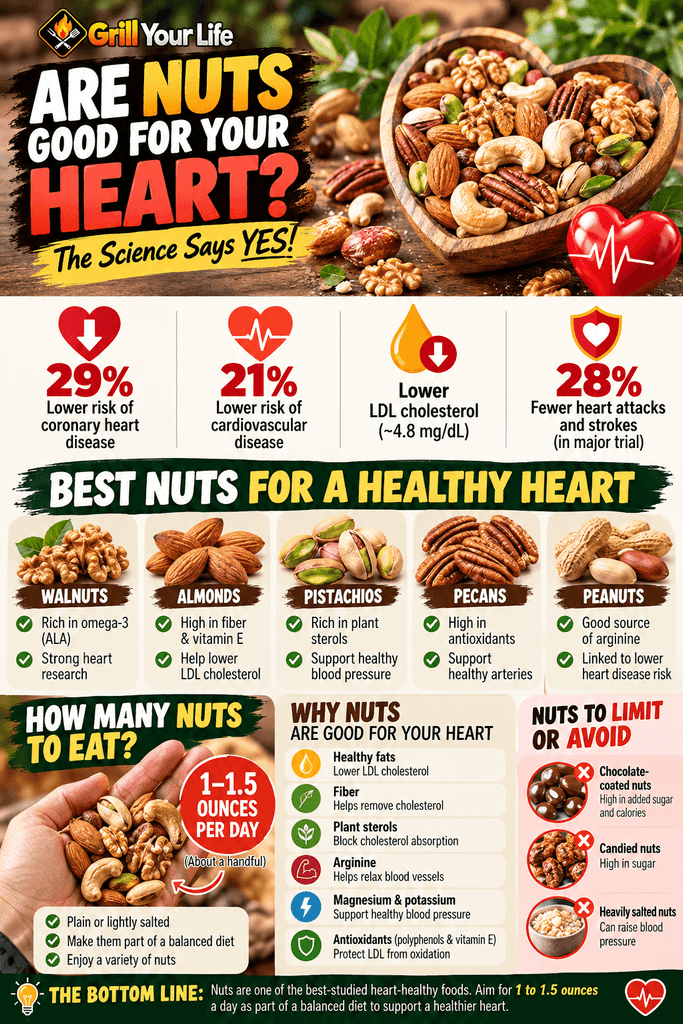
- Regular nut eaters have less heart disease. In a 2016 meta-analysis, each daily 28 g (1 oz) serving of nuts was linked to a 29% lower risk of coronary heart disease and a 21% lower risk of cardiovascular disease.
- Nuts lower LDL cholesterol. Across 61 trials, each daily ounce of tree nuts lowered LDL by about 4.8 mg/dL.
- A major trial supports cause and effect. In PREDIMED, a Mediterranean diet with a daily 30 g of mixed nuts cut major cardiovascular events by about 28% compared with a control diet.
- Walnuts, almonds, pistachios, and peanuts have the strongest heart research.
- Aim for about 1 to 1.5 ounces a day, plain or lightly salted. Skip candied, chocolate-coated, and heavily salted versions.
Are Nuts Good for Your Heart? The Short Answer
Yes. Nuts are one of the best-studied heart-healthy foods. The FDA allowed nut makers to use a qualified health claim in 2003, followed by specific claims for walnuts (2004) and macadamia nuts (2017). The 2003 claim says that “scientific evidence suggests but does not prove” that eating 1.5 ounces of most nuts a day, as part of a diet low in saturated fat and cholesterol, may reduce the risk of heart disease.
Since then, the evidence has grown much stronger. The answer has three parts, each covered below:
- Population studies: nut eaters have less heart disease.
- Clinical trials: nuts improve cholesterol and other risk factors.
- A large outcome trial: a nut-rich diet led to fewer heart attacks and strokes.
For an overview of nut nutrition, see our complete guide to nuts.
What Nuts Bring to Your Heart: The Nutrition Profile
Nuts pack several heart-friendly nutrients into a small serving:
| Nutrient | Why it matters for your heart | Richest nut sources |
| Unsaturated fats | Replacing saturated fat with them lowers LDL cholesterol | Most nuts; macadamias, pecans, and hazelnuts are richest in monounsaturated fat |
| Alpha-linolenic acid (ALA) | Plant omega-3 linked to lower heart risk | Walnuts, by far |
| Fiber | Binds cholesterol in the gut | Almonds, pistachios, pecans |
| Plant sterols | Block cholesterol absorption | Pistachios, almonds |
| Arginine | Building block of nitric oxide, which relaxes blood vessels | Peanuts, almonds, walnuts |
| Magnesium and potassium | Support healthy blood pressure and heart rhythm | Almonds, cashews, Brazil nuts |
| Polyphenols and vitamin E | Antioxidants that may protect LDL from oxidation | Walnuts, pecans (polyphenols); almonds, hazelnuts (vitamin E) |
A review in Nutrients describes nuts as “complex whole foods” whose benefits likely come from this combination of nutrients working together, not from any single compound.
What the Research Says
Population studies: fewer heart attacks among nut eaters
- Dose-response meta-analysis. A 2016 analysis in BMC Medicine pooled 20 prospective studies. For each 28 g/day of nuts, it found:
- 29% lower risk of coronary heart disease
- 21% lower risk of cardiovascular disease
- 22% lower risk of death from all causes
- The link with stroke wasn’t statistically significant. If the associations are causal, the authors estimated that about 4.4 million premature deaths in 2013 were attributable to nut intake below 20 g a day.
- U.S. cohorts. A Journal of the American College of Cardiology study followed about 210,000 health professionals for up to 32 years. As the American College of Cardiology summarized, compared with people who rarely ate nuts:
- Eating nuts five or more times a week was linked to a 14% lower risk of cardiovascular disease and a 20% lower risk of coronary heart disease.
- Walnuts once or more a week were linked to a 19% lower risk of cardiovascular disease.
- Peanuts and other tree nuts twice or more a week were linked to 13–15% lower risk.
Observational studies can’t fully separate nuts from other healthy habits. That’s why the clinical trials below matter.
Clinical trials: lower LDL cholesterol
LDL cholesterol is a direct cause of plaque buildup in the arteries. A meta-analysis of 61 controlled trials in the American Journal of Clinical Nutrition found that each daily serving (1 oz) of tree nuts lowered:
- Total cholesterol by about 4.7 mg/dL
- LDL cholesterol by about 4.8 mg/dL
- Apolipoprotein B, a marker of the number of harmful particles, by about 3.7 mg/dL
- Triglycerides by about 2.2 mg/dL
Effects were stronger at intakes of 60 g a day or more.
Walnuts have the longest trial. In the two-year Walnuts and Healthy Aging (WAHA) study in Circulation , 628 older adults who ate walnuts daily lowered LDL by an average of 4.3 mg/dL. They also had 4.3% fewer total LDL particles and 6.1% fewer small LDL particles, the type most linked to plaque.
Blood pressure
Results here are more modest. A meta-analysis of 21 trials in the American Journal of Clinical Nutrition concluded that nuts can lower blood pressure, especially systolic pressure (the top number). Pistachios had the strongest effect. The 61-trial lipid analysis, by contrast, found no significant overall blood pressure change. Overall, nuts may help a little, but they aren’t a substitute for blood pressure treatment.
The PREDIMED trial: fewer heart attacks and strokes
The strongest evidence comes from PREDIMED, a large randomized trial in Spain. Its 2018 re-analysis in the New England Journal of Medicine included 7,447 adults at high cardiovascular risk. They were assigned to one of three diets:
- A Mediterranean diet with extra-virgin olive oil
- A Mediterranean diet with 30 g of mixed nuts a day (15 g walnuts, 7.5 g almonds, 7.5 g hazelnuts)
- A control diet with advice to reduce dietary fat
After about five years, the nut group had roughly 28% fewer major cardiovascular events (heart attack, stroke, or cardiovascular death) than the control group.
PREDIMED tested a whole diet, not nuts alone. Still, it’s rare to see a food-based trial show fewer actual heart attacks and strokes, not just better lab numbers.
How Nuts Protect Your Heart
Researchers point to several mechanisms working together:
- Lowering LDL cholesterol. Unsaturated fats replace saturated fat. Fiber and plant sterols reduce cholesterol absorption. The result is fewer cholesterol-carrying particles that can lodge in artery walls.
- Improving blood vessel function. Arginine helps your body make nitric oxide, which relaxes blood vessels. Polyphenols and the ALA in walnuts may also support the inner lining of blood vessels (the endothelium).
- Calming inflammation and oxidation. Antioxidants like vitamin E and polyphenols may help protect LDL from oxidation, a step in plaque formation.
- Supporting healthy weight and blood sugar. Nuts are filling and don’t cause weight gain in normal portions. Our article on whether nuts are fattening covers that research. Better weight and blood sugar control both reduce heart strain.
- Replacing less healthy foods. Nuts often push out chips, processed meats, and sweets. This swap explains part of their benefit.
The Best Nuts for Heart Health
All plain nuts are a good choice, but some have stronger heart research:
Walnuts: the omega-3 leader
Walnuts are the only common nut rich in ALA, the plant form of omega-3. They have their own FDA qualified health claim, the strongest cohort link (19% lower cardiovascular risk with weekly intake), and the two-year WAHA trial. If you pick one nut for your heart, walnuts are the strongest choice. See whether walnuts are healthy.
Almonds: fiber, vitamin E, and LDL lowering
Almonds are rich in vitamin E, fiber, and monounsaturated fat. They were part of the PREDIMED nut mix and have been tested in many cholesterol-lowering trials. Learn more about whether almonds are healthy.
Pistachios: blood pressure and plant sterols
Pistachios had the strongest blood pressure effect in the 21-trial meta-analysis and are among the nuts richest in plant sterols. They’re also one of the lower-calorie nuts. Read whether pistachios are healthy.
Peanuts: an affordable heart-healthy choice
Peanuts are technically legumes, but they behave like nuts nutritionally. In the U.S. cohort study, eating peanuts twice a week or more was linked to a 13% lower cardiovascular risk. Peanuts are a budget-friendly way to get similar benefits. See whether peanuts are healthy.
Also heart-friendly: hazelnuts, pecans, macadamias, and cashews
- Hazelnuts were part of PREDIMED.
- Macadamia nuts have their own FDA qualified health claim (2017), based on their monounsaturated fat. See whether macadamia nuts are healthy.
- Cashews have mixed cholesterol results but may modestly lower blood pressure. See our review of whether cashews are good for cholesterol.
Special cases
- Brazil nuts are heart-friendly, but they’re so high in selenium that one or two a day is enough. Our guide on how many Brazil nuts a day explains the upper limit.
- Coconut isn’t a heart-healthy “nut” in the same sense. It’s high in saturated fat. See whether coconut is healthy.
Who Benefits Most
- Adults with high LDL cholesterol who want diet changes to support, not replace, their treatment.
- People at higher heart risk, such as those with diabetes, high blood pressure, overweight, or a family history of heart disease. PREDIMED studied people like this.
- Older adults. The WAHA trial showed LDL benefits in people aged 63–79.
- Vegetarians and vegans, who get heart-healthy fat and protein from nuts in place of meat.
- Anyone replacing processed snacks. Swapping chips or cookies for nuts improves heart risk factors without adding calories.
Risks and Who Should Be Careful
Nuts are safe and beneficial for most people, but a few cautions apply.
Nut allergies
Peanuts and tree nuts are major food allergens that the FDA requires on labels. If you’re allergic, the heart benefits don’t outweigh the risk. Avoid the nuts that affect you and talk with an allergist.
Salt, sugar, and coatings
Heavily salted nuts can work against the blood pressure benefit, and the FDA notes that most Americans already eat too much sodium. Candied, honey-roasted, and chocolate-covered nuts add sugar. Choose unsalted or lightly salted, dry-roasted or raw nuts.
Calories
At 160–200 calories per ounce, nuts are calorie-dense. Measured portions don’t cause weight gain, but eating from a large bag can add hundreds of calories.
Brazil nuts and selenium
Eating several Brazil nuts every day can push selenium above the safe upper limit. Keep it to one or two.
Nuts are not a treatment
If you’ve been prescribed a statin or blood pressure medicine, keep taking it. Nuts support heart health as part of an overall diet, but they don’t replace medication. Talk with your doctor before making changes to your treatment.
How Many Nuts a Day for Heart Health?
The research points to a consistent range:
| Amount | What it looks like | Evidence |
| 1 oz (28 g) a day | ~23 almonds, ~14 walnut halves, ~49 pistachios | Linked to 29% lower coronary heart disease risk (BMC Medicine) |
| 1.5 oz (42 g) a day | A generous handful | Amount in the FDA qualified health claim |
| 30 g a day of mixed nuts | About 1 oz | PREDIMED nut arm |
| 5 or more servings a week | Most days of the week | Linked to 14% lower cardiovascular risk (U.S. cohorts) |
For most adults, 1 to 1.5 ounces a day, eaten in place of less healthy foods, is a sensible heart-healthy target.
Practical Tips for Heart-Healthy Nut Eating
- Choose plain. Raw or dry-roasted, unsalted or lightly salted.
- Mix it up. Rotate walnuts, almonds, pistachios, and peanuts for a broader range of nutrients, as PREDIMED’s mixed nuts did.
- Swap, don’t add. Replace chips, crackers, processed meats, or sweets with nuts.
- Use nuts as a garnish. Add them to oatmeal, salads, stir-fries, and vegetables.
- Pick better nut butters. Choose spreads with just nuts (and maybe salt) on the label. Skip added sugar and hydrogenated oils.
- Pair nuts with other heart-healthy foods. Nuts work best alongside vegetables, fruit, whole grains, legumes, and fish. If you eat fish rarely, our guide on whether fish oil lowers cholesterol covers the omega-3 options.
- Store them well. Unsaturated fats can go rancid. Keep nuts in airtight containers, and refrigerate or freeze them for long storage.
Myths vs. Facts
| Myth | Fact |
| Nuts are high in fat, so they’re bad for your heart. | Most nut fat is unsaturated and lowers LDL when it replaces saturated fat. |
| Only walnuts are heart-healthy. | Walnuts lead, but almonds, pistachios, peanuts, hazelnuts, and others also show benefits. |
| Nuts can unclog arteries. | Nuts help lower LDL and heart risk over time. No food removes existing plaque. |
| Peanuts don’t count because they’re legumes. | Peanut eaters show lower cardiovascular risk in large studies. |
| Salted nuts are just as good. | Extra sodium can undercut blood pressure benefits. Choose unsalted or lightly salted. |
| Eating nuts means I can stop my statin. | Nuts support heart health. Never stop prescribed medication without your doctor. |
How Nuts Fit a Heart-Healthy Lifestyle
Nuts are one piece of the picture, not the whole thing. The heart benefits seen in PREDIMED came from a full Mediterranean-style pattern: plenty of vegetables, fruits, legumes, whole grains, olive oil, and fish, and limited processed meat and sweets. Add regular physical activity, not smoking, enough sleep, and managing blood pressure, cholesterol, and blood sugar, and nuts become part of a strategy with real impact.
Cutting back on foods that raise heart risk matters just as much. Our guide on whether fried food is bad for heart health covers one common culprit.
Frequently Asked Questions
What is the best nut for your heart?
Walnuts have the strongest heart evidence. They’re rich in plant omega-3 (ALA), carry an FDA qualified health claim, and lowered LDL in a two-year trial. Almonds, pistachios, and peanuts are also excellent choices. Eating a mix of plain nuts is a smart approach, as the PREDIMED trial did.
Do nuts lower cholesterol?
Yes. Across 61 controlled trials, eating about one ounce of tree nuts daily lowered LDL cholesterol by roughly 4.8 mg/dL, along with total cholesterol and apolipoprotein B. Larger amounts produced bigger effects. Nuts work best when they replace foods high in saturated fat, not when added on top of them.
How many nuts a day for heart health?
About 1 to 1.5 ounces (28–42 g) a day, roughly a small handful, matches the research. That’s about 23 almonds, 14 walnut halves, or 49 pistachios. The FDA’s qualified health claim uses 1.5 ounces, and the PREDIMED trial used 30 grams of mixed nuts daily.
Are salted nuts bad for your heart?
Lightly salted nuts are fine for most people, but heavily salted nuts can add a lot of sodium, which raises blood pressure. If you have high blood pressure or heart disease, choose unsalted nuts. Always skip candied, honey-roasted, and chocolate-coated nuts, which add sugar and calories.
Is peanut butter good for your heart?
Natural peanut butter made from just peanuts (and maybe salt) can be part of a heart-healthy diet. It provides unsaturated fat and protein. Choose brands without added sugar or hydrogenated oils, and keep portions to about two tablespoons. Studies show the strongest benefits for whole peanuts and tree nuts.
Can nuts unclog arteries?
No food can clear existing plaque from your arteries. Nuts can lower LDL cholesterol and are linked to fewer heart attacks over time, which may help slow plaque buildup. Treating clogged arteries requires medical care, so follow your doctor’s advice and use nuts as part of an overall heart-healthy diet.
Conclusion
So, are nuts good for your heart? Yes, and the evidence is among the strongest for any single food. Regular nut eaters have less heart disease, trials show nuts lower LDL cholesterol, and the PREDIMED trial found fewer heart attacks and strokes with a nut-rich diet.
Choose plain walnuts, almonds, pistachios, or peanuts, eat about 1 to 1.5 ounces a day, and use them to replace processed snacks and meats. Combined with an overall healthy lifestyle, that daily handful is a simple, enjoyable step for your heart.
Medical disclaimer: This article is for general information only and isn’t a substitute for professional medical advice. If you have heart disease, high cholesterol, high blood pressure, or a nut allergy, talk with your doctor or a registered dietitian before changing your diet, and never stop prescribed medication without medical guidance.
3. References
- U.S. Food and Drug Administration. Qualified Health Claims: Letters of Enforcement Discretion (Nuts and Coronary Heart Disease, July 14, 2003; Walnuts, March 9, 2004; Macadamia Nuts, July 24, 2017). https://www.fda.gov/food/food-labeling-nutrition/qualified-health-claims-letters-enforcement-discretion
- Aune D, Keum N, Giovannucci E, et al. Nut consumption and risk of cardiovascular disease, total cancer, all-cause and cause-specific mortality: a systematic review and dose-response meta-analysis of prospective studies. BMC Medicine. 2016;14:207. https://eprints.whiterose.ac.uk/106563/
- Guasch-Ferré M, Liu X, Malik VS, et al. Nut consumption and risk of cardiovascular disease. Journal of the American College of Cardiology. 2017;70(20):2519–2532. https://doi.org/10.1016/j.jacc.2017.10.019
- American College of Cardiology. Nut Consumption Associated With Lower Risk of CVD. 2017. https://www.acc.org/latest-in-cardiology/articles/2017/11/13/18/05/nut-consumption-associated-with-lower-risk-of-cvd
- Del Gobbo LC, Falk MC, Feldman R, Lewis K, Mozaffarian D. Effects of tree nuts on blood lipids, apolipoproteins, and blood pressure: systematic review, meta-analysis, and dose-response of 61 controlled intervention trials. American Journal of Clinical Nutrition. 2015;102(6):1347–1356. https://pubmed.ncbi.nlm.nih.gov/26561616/
- Rajaram S, Cofán M, Sala-Vila A, et al. Effects of walnut consumption for 2 years on lipoprotein subclasses among healthy elders: findings from the WAHA randomized controlled trial. Circulation. 2021;144. https://doi.org/10.1161/CIRCULATIONAHA.121.054051
- Mohammadifard N, Salehi-Abargouei A, Salas-Salvadó J, Guasch-Ferré M, Humphries K, Sarrafzadegan N. The effect of tree nut, peanut, and soy nut consumption on blood pressure: a systematic review and meta-analysis of randomized controlled clinical trials. American Journal of Clinical Nutrition. 2015;101(5):966–982. https://doi.org/10.3945/ajcn.114.091595
- Estruch R, Ros E, Salas-Salvadó J, et al. Primary prevention of cardiovascular disease with a Mediterranean diet supplemented with extra-virgin olive oil or nuts. New England Journal of Medicine. 2018;378(25):e34. https://pubmed.ncbi.nlm.nih.gov/29897866/
- Ros E. Health benefits of nut consumption. Nutrients. 2010;2(7):652–682. https://pmc.ncbi.nlm.nih.gov/articles/PMC3257681/
- U.S. Food and Drug Administration. Food Allergies. https://www.fda.gov/food/food-labeling-nutrition/food-allergies
- U.S. Food and Drug Administration. Sodium in Your Diet. https://www.fda.gov/food/nutrition-education-resources-materials/sodium-your-diet
- U.S. Food and Drug Administration. FDA Completes Review of Qualified Health Claim Petition for Macadamia Nuts and the Risk of Coronary Heart Disease. July 24, 2017. https://www.fda.gov/Food/NewsEvents/ConstituentUpdates/ucm568052.htm