Almonds are one of the most popular snack nuts, while hazelnuts are famous for their rich, toasty flavor in spreads and baked goods. Both are healthy tree nuts, but they bring different strengths to your plate. So in the almonds vs hazelnuts matchup, which one deserves a spot in your pantry?
In this guide, you’ll get a side-by-side nutrition comparison based on USDA data, see what research says about each nut and cholesterol, and learn who may benefit most from each. You’ll also find risks to know, smart portion sizes, and easy ways to enjoy both.
Key Takeaways
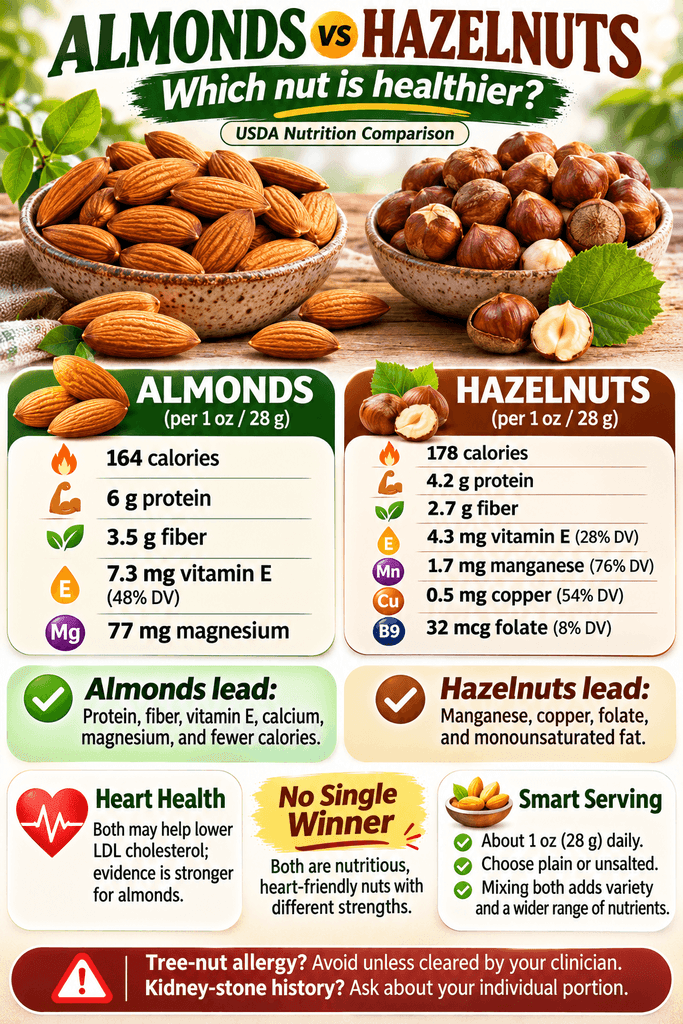
- Almonds have more protein, fiber, vitamin E, calcium, and magnesium per ounce than hazelnuts.
- Hazelnuts have more manganese, copper, and folate, and more heart-healthy monounsaturated fat.
- Almonds have fewer calories, about 164 per ounce versus about 178 for hazelnuts.
- Both may lower LDL cholesterol. Meta-analyses found benefits for each, though the hazelnut evidence is much smaller.
- Hazelnuts are a leading cause of nut allergy in Europe, often linked to birch pollen allergy.
- About 1 ounce a day of either nut, plain and unsalted, fits a healthy diet.
Almonds vs Hazelnuts: What Are They?
Almonds and hazelnuts are both tree nuts. Almonds are often eaten whole, sliced, or as almond butter and almond flour. Hazelnuts, also called filberts, are popular roasted, chopped into desserts, or ground into spreads.
Both belong to a food group that supports heart health. Harvard’s Nutrition Source reports that eating about one ounce of nuts five or more times per week is linked to lower cardiovascular risk. For a wider view, see our complete guide to nuts.
Why Compare Almonds vs Hazelnuts?
These two nuts are often swapped in recipes, nut mixes, and flours. But their nutrient profiles differ in ways that matter if you’re focused on fiber, vitamin E, minerals, or calories. Knowing the differences helps you pick the right nut for your goals.
Almonds vs Hazelnuts: Nutrition Facts Compared
To compare almonds vs hazelnuts fairly, here’s how 1 ounce (28 grams) of each stacks up, based on USDA FoodData Central data for almonds and hazelnuts.
| Nutrient (per 1 oz, raw) | Almonds | Hazelnuts | Winner |
|---|---|---|---|
| Calories | 164 | 178 | Almonds (lower) |
| Protein | 6.0 g | 4.2 g | Almonds |
| Total fat | 14.2 g | 17.2 g | Almonds (lower) |
| Monounsaturated fat | 9.0 g | 13.0 g | Hazelnuts |
| Polyunsaturated fat | 3.5 g | 2.2 g | Almonds |
| Saturated fat | 1.1 g | 1.3 g | About equal |
| Carbohydrates | 6.1 g | 4.7 g | Hazelnuts (lower) |
| Fiber | 3.5 g | 2.7 g | Almonds |
| Sugars | 1.2 g | 1.2 g | Tie |
| Vitamin E | 7.3 mg (48% DV) | 4.3 mg (28% DV) | Almonds |
| Calcium | 76 mg (6% DV) | 32 mg (2% DV) | Almonds |
| Magnesium | 77 mg (18% DV) | 46 mg (11% DV) | Almonds |
| Manganese | 0.6 mg (27% DV) | 1.7 mg (76% DV) | Hazelnuts |
| Copper | 0.3 mg (32% DV) | 0.5 mg (54% DV) | Hazelnuts |
| Folate | 12 mcg (3% DV) | 32 mcg (8% DV) | Hazelnuts |
| Iron | 1.1 mg (6% DV) | 1.3 mg (7% DV) | About equal |
| Riboflavin (B2) | 0.3 mg (25% DV) | 0.03 mg (2% DV) | Almonds |
| Vitamin K | 0 mcg | 4.0 mcg (3% DV) | Hazelnuts |
Per-ounce values are calculated from USDA’s per-100-gram data and rounded. %DV is based on FDA Daily Values for adults.
What the Numbers Show
Almonds win more categories, especially protein, fiber, vitamin E, calcium, magnesium, and riboflavin, and they have fewer calories. Hazelnuts stand out for manganese, copper, folate, and monounsaturated fat, and they’re slightly lower in carbs.
So the almonds vs hazelnuts question really comes down to your nutrition goals. If you want more fiber and vitamin E, almonds lead. If you want more manganese or folate, hazelnuts are the better pick.
Fiber per Calorie
Because nuts are calorie-dense, it helps to compare fiber per 100 calories. Almonds give about 2.2 grams of fiber per 100 calories, while hazelnuts give about 1.5 grams. That means almonds deliver more fiber for the same calories. See our full ranking of nuts with the most fiber.
Almonds vs Hazelnuts for Heart Health and Cholesterol
In the almonds vs hazelnuts debate, both nuts have research suggesting they may help lower LDL (“bad”) cholesterol, but the amount of evidence differs a lot.
Almonds and Cholesterol
Almonds have a large body of research. A 2025 meta-analysis in Nutrients pooled 36 publications of randomized controlled trials with 2,485 participants. Eating almonds significantly lowered LDL cholesterol and total cholesterol compared with control diets, with no meaningful change in HDL (“good”) cholesterol.
Hazelnuts and Cholesterol
Hazelnut research is smaller but encouraging. A 2016 meta-analysis in Nutrients reviewed nine studies with 425 participants who ate 29 to 69 grams of hazelnuts a day for 4 to 12 weeks. Hazelnut-enriched diets were linked to lower LDL cholesterol, with a trend toward lower total cholesterol.
HDL cholesterol, triglycerides, and body mass index stayed largely unchanged. The authors noted that only three randomized studies could be pooled, and two of them came from the same research group, so they called for larger, longer trials.
What This Means for You
When comparing almonds vs hazelnuts for cholesterol, almonds have much stronger evidence, but both appear helpful as part of a heart-healthy diet. Hazelnuts’ higher monounsaturated fat and almonds’ higher fiber may each play a role. Mayo Clinic notes that soluble fiber may help lower total blood cholesterol by lowering LDL cholesterol. Learn more in our guide to nuts and heart health.
Almonds vs Hazelnuts: Vitamins and Minerals
When you look at almonds vs hazelnuts for micronutrients, each nut is a strong source of different vitamins and minerals. Here’s what they do in your body.
Vitamin E: Almonds Lead
Both nuts are rich in vitamin E, but almonds have more. Dry-roasted almonds provide 6.8 mg per ounce, or 45% of the Daily Value, while dry-roasted hazelnuts provide 4.3 mg, or 29%. Adults need 15 mg a day.
Vitamin E is an antioxidant that helps protect cells from damage caused by free radicals. Eating both nuts is an easy way to boost your intake from food.
Manganese: Hazelnuts Shine
Hazelnuts are especially rich in manganese, and this is where they win the almonds vs hazelnuts comparison most clearly. Dry-roasted hazelnuts provide 1.6 mg per ounce, or 70% of the Daily Value. Manganese helps your body metabolize amino acids, cholesterol, glucose, and carbohydrates and supports bone formation and immune function.
Magnesium and Calcium: Almonds Win
Almonds offer more magnesium and calcium. Dry-roasted almonds provide 80 mg of magnesium per ounce, and magnesium helps run more than 300 enzyme systems, including those involved in blood pressure and blood sugar control. Almonds also have more than twice the calcium of hazelnuts, based on USDA data.
That’s useful because the NIH reports that 48% of Americans get less magnesium from food than they need.
Copper and Folate: Hazelnuts Have More
Hazelnuts provide about 0.5 mg of copper per ounce, roughly 70% more than almonds, based on USDA data. Copper is a cofactor for several enzymes involved in energy production and iron metabolism.
Hazelnuts also have about 2.5 times the folate of almonds. Folate helps your body make DNA and other genetic material, and adults need 400 mcg DFE a day. Nuts contribute only a small share, though, so leafy greens, beans, and fortified foods remain the main sources.
Almonds vs Hazelnuts for Protein, Fat, and Carbs
Almonds are the better protein source, with about 6 grams per ounce versus about 4 grams in hazelnuts. If you’re looking to add plant protein, almonds have a clear edge. Learn more about whether nuts are high in protein.
Hazelnuts are higher in total fat, about 17 grams per ounce, but most of it is monounsaturated fat, about 13 grams per ounce based on USDA data. Almonds have less total fat but more polyunsaturated fat. Saturated fat is low and similar in both. See whether nuts are high in fat.
Hazelnuts are slightly lower in carbohydrates, at about 4.7 grams per ounce versus 6.1 grams for almonds. Both are low in sugar, at about 1.2 grams per ounce. If you’re watching blood sugar, both can fit. Our guide to the best nuts for diabetics explains more.
Almonds vs Hazelnuts for Weight Management
Hazelnuts have about 14 more calories per ounce than almonds, mainly because of their higher fat content. That’s a small difference, but it can add up if you eat large handfuls.
Almonds may also provide fewer calories than labels suggest. USDA researchers found that almonds provide about 129 calories per serving instead of the 168 to 170 calories predicted by standard calculations. We didn’t find a similar USDA study for hazelnuts, so it’s unclear whether the same effect applies.
Fiber matters too. Mayo Clinic notes that high-fiber foods tend to be more filling than low-fiber foods. With more fiber and protein, almonds may be slightly more filling.
Still, in the hazelnut meta-analysis, eating hazelnuts didn’t change body mass index. For more, see whether nuts are fattening. Overall, almonds vs hazelnuts is a close call for weight, and portion size matters far more than which nut you pick.
Almonds vs Hazelnuts for Brain Health
Both nuts were part of a well-known brain study. In the Spanish PREDIMED trial, older adults at high heart risk who followed a Mediterranean diet with 30 grams of mixed nuts a day, made up of walnuts, almonds, and hazelnuts, had better memory scores than those on a low-fat control diet.
Because the nuts were mixed, the study can’t tell us whether almonds or hazelnuts mattered more. Both are rich in vitamin E, an antioxidant that helps protect cells. Read more about the best nuts for brain health.
Who Benefits Most From Almonds vs Hazelnuts?
Your best pick in the almonds vs hazelnuts choice depends on your goals.
Almonds may be the better choice if you:
- Want to lower LDL cholesterol, based on strong trial evidence.
- Need more fiber, protein, or vitamin E.
- Want more calcium and magnesium.
- Prefer fewer calories per ounce.
Hazelnuts may be the better choice if you:
- Want more manganese, copper, or folate.
- Prefer more monounsaturated fat.
- Want slightly fewer carbohydrates.
- Enjoy baking or cooking with a rich, toasty flavor.
Women planning pregnancy may appreciate hazelnuts’ extra folate, though food sources don’t replace folic acid supplements. See our guide to the best nuts for women. For a similar comparison, read our almonds vs cashews guide.
Risks and Side Effects: Almonds vs Hazelnuts
Whichever side of the almonds vs hazelnuts debate you land on, both nuts are safe for most people. Keep these points in mind.
Tree nut allergies. Almonds and hazelnuts are both tree nuts, one of the FDA’s nine major food allergens. Severe reactions can cause anaphylaxis, a life-threatening reaction.
Hazelnut and birch pollen allergy. A 2021 review in Medicina describes hazelnuts as the main cause of nut allergy in Europe. Some people with birch pollen allergy get mild itching in the mouth and throat from hazelnuts, while others react to more stable hazelnut proteins that are linked to severe reactions. If hazelnuts make your mouth itch, talk with an allergist.
Kidney stones. If you’ve had calcium oxalate kidney stones, the NIDDK lists nuts and nut products among foods you may want to limit. Ask your doctor or dietitian what’s right for you.
Manganese from supplements. Food sources like hazelnuts are generally fine, but the adult upper limit for manganese is 11 mg a day, so be careful with high-dose supplements.
Calories and added sugar. Nuts average about 185 calories per ounce. Harvard notes that nuts covered in chocolate or with lots of sugar or sodium are probably not as good as plain nuts. That includes many hazelnut spreads and candied almonds.
How Much Should You Eat? Safe Amounts
The portion advice is the same for almonds vs hazelnuts. For most adults, about 1 ounce (28 grams) a day of almonds, hazelnuts, or a mix is a good target. Harvard defines a handful as about 28 grams, or one ounce, and eating that amount five or more times a week is linked to lower heart risk.
The hazelnut trials in the meta-analysis used 29 to 69 grams a day, while PREDIMED used 30 grams of mixed nuts. Larger amounts add more calories, so 1 ounce is a practical everyday amount for most people.
Practical Tips: Enjoying Almonds and Hazelnuts
Here are easy ways to add both nuts to your diet:
- Make a two-nut mix. Combine almonds and hazelnuts for fiber, vitamin E, manganese, and folate in one snack.
- Top breakfast. Sprinkle sliced almonds or chopped hazelnuts on oatmeal or yogurt.
- Bake smarter. Use almond or hazelnut flour in place of some white flour in muffins or pancakes.
- Toast for flavor. Lightly toast hazelnuts to bring out their flavor, then add them to salads.
- Choose plain or dry-roasted. Skip heavily salted, sugared, or chocolate-coated versions. See whether roasted nuts are healthy.
- Read spread labels. Hazelnut spreads can contain a lot of added sugar, so look for options with hazelnuts as the first ingredient and little added sugar.
For more on hazelnuts specifically, see whether hazelnuts are healthy.
Almonds vs Hazelnuts: Quick Scorecard
Here’s a quick almonds vs hazelnuts summary by goal:
| Goal | Better pick | Why |
| Lower LDL cholesterol | Almonds (stronger evidence) | 36 trial publications vs 3 pooled hazelnut trials |
| More fiber | Almonds | About 3.5 g vs 2.7 g per ounce |
| More protein | Almonds | About 6 g vs 4 g per ounce |
| More vitamin E | Almonds | About 48% vs 28% of the Daily Value |
| More manganese | Hazelnuts | About 76% vs 27% of the Daily Value |
| More folate and copper | Hazelnuts | About 2.5 times the folate |
| More monounsaturated fat | Hazelnuts | About 13 g vs 9 g per ounce |
| Fewer calories | Almonds | About 164 vs 178 per ounce |
Nutrient figures are from USDA data for raw almonds and hazelnuts.
Almonds vs Hazelnuts: Myths vs. Facts
| Myth | Fact |
| Hazelnuts are unhealthy because they’re higher in fat. | Most hazelnut fat is monounsaturated, and hazelnut diets were linked to lower LDL cholesterol. |
| Almonds and hazelnuts have the same nutrients. | Hazelnuts have nearly three times the manganese, while almonds have more fiber, protein, and vitamin E. |
| Hazelnut spread counts as eating hazelnuts. | Spreads can add a lot of sugar; Harvard notes sugary nuts are probably not as good as plain ones. |
| Nut allergies are the same everywhere. | Hazelnuts are the main cause of nut allergy in Europe, often tied to birch pollen. |
| You absorb every calorie on the almond label. | USDA found almonds provide fewer calories than predicted. |
How Almonds and Hazelnuts Fit a Healthy Lifestyle
Almonds and hazelnuts work best as part of an overall healthy eating pattern. Use them as a swap for chips, cookies, or candy, alongside vegetables, fruits, whole grains, beans, and lean proteins.
The PREDIMED trial is a good example: both nuts were part of a Mediterranean-style diet rather than being eaten in isolation. In the almonds vs hazelnuts choice, the best answer for many people is to rotate or mix both.
Here’s what a balanced day might look like:
- Breakfast: Oatmeal with sliced almonds and berries.
- Lunch: A green salad topped with toasted hazelnuts.
- Snack: An apple with a few almonds.
- Dinner: Roasted vegetables finished with chopped hazelnuts.
Frequently Asked Questions
Which is healthier, almonds or hazelnuts?
Neither is clearly healthier overall. Almonds have more protein, fiber, vitamin E, calcium, and magnesium, plus stronger cholesterol research. Hazelnuts have more manganese, copper, folate, and monounsaturated fat. Eating both gives you a wider range of nutrients, so the best choice depends on your goals.
Do almonds or hazelnuts have more calories?
Hazelnuts have slightly more calories, about 178 per ounce, compared with about 164 for almonds, based on USDA data. USDA research also suggests the body absorbs fewer calories from almonds than labels show. Sticking to about a 1-ounce portion keeps calories in check with either nut.
Are hazelnuts good for lowering cholesterol?
Research suggests they may help. A 2016 meta-analysis found that hazelnut-enriched diets were linked to lower LDL cholesterol, with HDL and triglycerides largely unchanged. However, the evidence base is small, so almonds, with dozens of trials, are the better-studied choice for cholesterol.
Which nut has more protein, almonds or hazelnuts?
Almonds have more protein, about 6 grams per ounce, compared with about 4 grams in hazelnuts. That makes almonds the better pick if you want extra plant protein. Hazelnuts still add some protein, along with more manganese, copper, and folate than almonds.
Can I eat almonds and hazelnuts every day?
Yes, most people can enjoy them daily in moderation. About 1 ounce a day of almonds, hazelnuts, or a mix is a reasonable target. Choose plain or dry-roasted nuts, avoid sugary spreads, and skip them entirely if you have a tree nut allergy.
Why do hazelnuts make my mouth itch?
Some people with birch pollen allergy react to a hazelnut protein that looks similar to birch pollen, causing mild itching in the mouth or throat. Other hazelnut proteins can cause more severe reactions. If hazelnuts make your mouth itch, stop eating them and talk with an allergist.
Conclusion: Almonds vs Hazelnuts, Which Should You Choose?
In the almonds vs hazelnuts comparison, there’s no single winner. Almonds lead in protein, fiber, vitamin E, calcium, magnesium, and cholesterol research, and they have fewer calories. Hazelnuts lead in manganese, copper, folate, and monounsaturated fat.
For most people, the smartest approach is to enjoy about 1 ounce of plain, unsalted nuts most days, mixing almonds and hazelnuts for a wider range of nutrients. Choose based on your goals, and check with a professional if you have allergies or other health concerns.
Medical disclaimer: This article is for general information only and is not a substitute for professional medical advice, diagnosis, or treatment. If you have a tree nut allergy, birch pollen allergy, kidney stones, or another health condition, talk with your doctor or a registered dietitian before changing your diet.
(3) References
- USDA FoodData Central. Nuts, almonds (FDC ID 170567). https://fdc.nal.usda.gov/fdc-app.html#/food-details/170567/nutrients
- USDA FoodData Central. Nuts, hazelnuts or filberts (FDC ID 170581). https://fdc.nal.usda.gov/fdc-app.html#/food-details/170581/nutrients
- Musa-Veloso K, Gauntlett C, Geronimo K, Vicente I, Ho SPL. Blood lipid levels in response to almond consumption: a systematic review and meta-analysis of randomized controlled trials. Nutrients. 2025;17(17):2791. https://doi.org/10.3390/nu17172791
- Perna S, Giacosa A, Bonitta G, Bologna C, Isu A, Guido D, Rondanelli M. Effects of hazelnut consumption on blood lipids and body weight: a systematic review and Bayesian meta-analysis. Nutrients. 2016;8(12):747. https://doi.org/10.3390/nu8120747
- Valls-Pedret C, Sala-Vila A, Serra-Mir M, et al. Mediterranean diet and age-related cognitive decline: a randomized clinical trial. JAMA Internal Medicine. 2015;175(7):1094–1103. https://doi.org/10.1001/jamainternmed.2015.1668
- USDA Agricultural Research Service. Going Nuts Over Calories. Tellus (originally AgResearch Magazine, March 2018). https://scientificdiscoveries.ars.usda.gov/tellus/stories/articles/going-nuts-over-calories
- Hazelnut Allergy (review). Medicina. 2021 (January). Authors [VERIFY]. https://doaj.org/article/35f9c04c3f774274b169c168542c6b98
- Harvard T.H. Chan School of Public Health, The Nutrition Source. Nuts for the Heart. https://nutritionsource.hsph.harvard.edu/food-features/nuts-for-the-heart/
- Mayo Clinic. Dietary fiber: Essential for a healthy diet. https://www.mayoclinic.org/healthy-lifestyle/nutrition-and-healthy-eating/in-depth/fiber/art-20043983
- NIH Office of Dietary Supplements. Vitamin E: Fact Sheet for Health Professionals. https://ods.od.nih.gov/factsheets/VitaminE-HealthProfessional/
- NIH Office of Dietary Supplements. Manganese: Fact Sheet for Health Professionals. https://ods.od.nih.gov/factsheets/Manganese-HealthProfessional/
- NIH Office of Dietary Supplements. Magnesium: Fact Sheet for Health Professionals. https://ods.od.nih.gov/factsheets/Magnesium-HealthProfessional/
- NIH Office of Dietary Supplements. Copper: Fact Sheet for Health Professionals. https://ods.od.nih.gov/factsheets/Copper-HealthProfessional/
- NIH Office of Dietary Supplements. Folate: Fact Sheet for Health Professionals. https://ods.od.nih.gov/factsheets/Folate-HealthProfessional/
- National Institute of Diabetes and Digestive and Kidney Diseases. Eating, Diet, & Nutrition for Kidney Stones. https://www.niddk.nih.gov/health-information/urologic-diseases/kidney-stones/eating-diet-nutrition
- U.S. Food and Drug Administration. Food Allergies. https://www.fda.gov/food/nutrition-food-labeling-and-critical-foods/food-allergies