Almonds and cashews are two of the most popular nuts in the world. One is crunchy and slightly sweet, and the other is soft and buttery. Both are packed with nutrients, but they’re not the same. So when it comes to almonds vs cashews, which one should you reach for?
In this guide, you’ll see a side-by-side nutrition comparison based on USDA data, what research says about each nut’s effects on cholesterol, blood pressure, and weight, and who might do better with one or the other. You’ll also learn about risks, smart portion sizes, and easy ways to enjoy both.
Key Takeaways
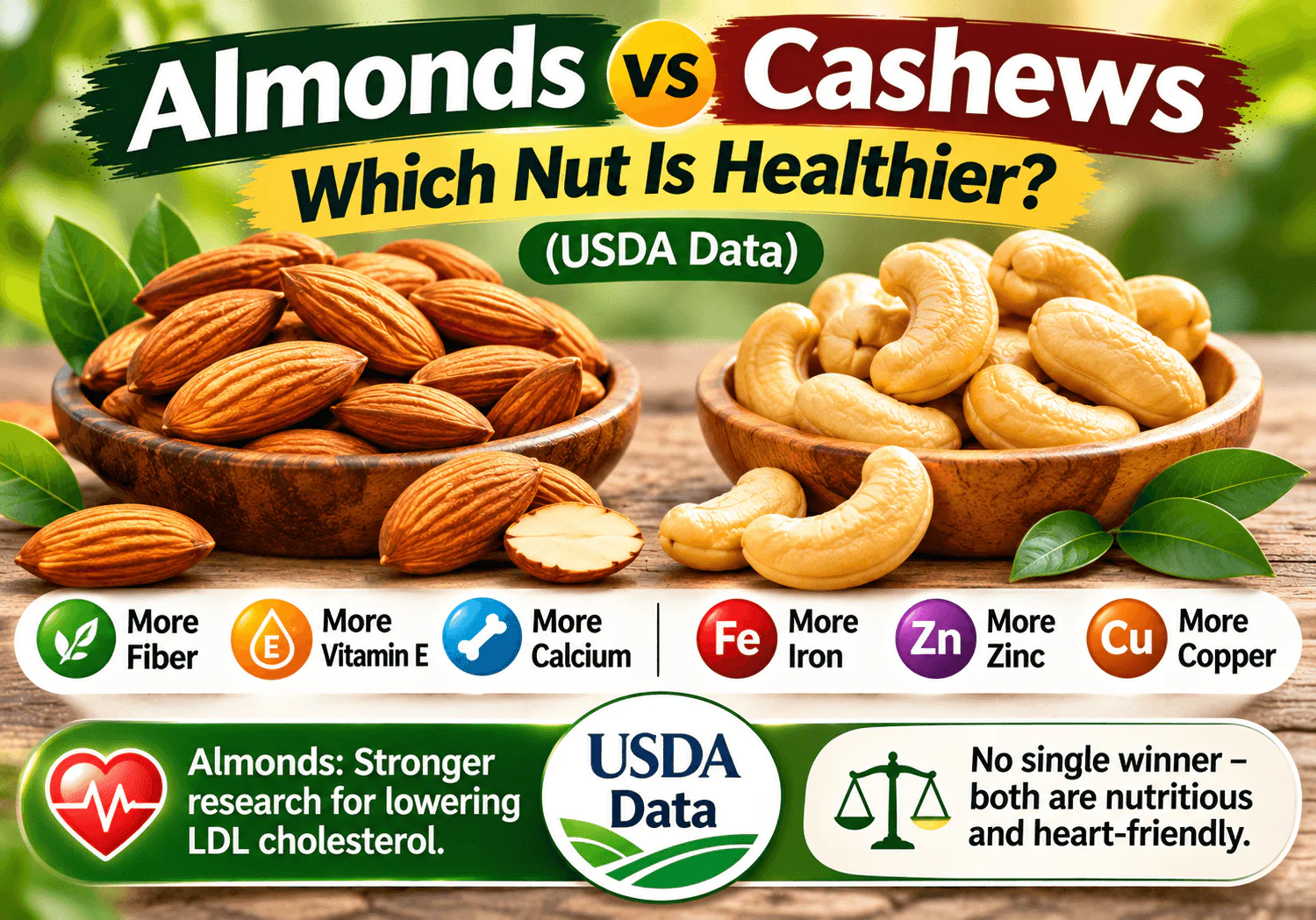
- Almonds have more fiber, vitamin E, and calcium. One ounce gives almost four times the fiber of cashews and about 28 times the vitamin E.
- Cashews have more iron, zinc, and copper. They supply about twice the zinc and copper of almonds per ounce.
- Calories and protein are close. Almonds have about 164 calories and 6 grams of protein per ounce; cashews have about 157 calories and 5 grams.
- Almonds have stronger cholesterol research. A 2025 meta-analysis found almonds lowered LDL cholesterol, while a cashew meta-analysis found no lipid change.
- Both may absorb fewer calories than labels show, according to USDA studies.
- There’s no single winner. About 1 ounce of either, unsalted, fits a healthy diet.
Almonds vs Cashews: What Are They?
Almonds and cashews are both tree nuts, and both are sold raw, roasted, salted, and as nut butters. They look and taste different, and as you’ll see below, their nutrient profiles differ in some important ways too.
Tree nuts are one of the FDA’s nine major food allergens, so anyone with a tree nut allergy should avoid both unless a doctor says otherwise. For a look at how they compare with other nuts, see our complete guide to nuts.
Why the Comparison Matters
Nuts are heart-friendly foods. Harvard’s Nutrition Source reports that eating about one ounce of nuts five or more times per week is linked to lower cardiovascular risk. But each nut has its own nutrient strengths, so knowing the differences helps you choose the best fit for your goals.
Almonds vs Cashews: Nutrition Facts Compared
To settle the almonds vs cashews question with data, here’s how 1 ounce (28 grams) of raw almonds compares with 1 ounce of raw cashews, based on USDA FoodData Central data for almonds and cashews.
| Nutrient (per 1 oz) | Almonds | Cashews | Winner |
| Calories | 164 | 157 | Cashews (slightly) |
| Protein | 6.0 g | 5.2 g | Almonds |
| Total fat | 14.2 g | 12.4 g | Cashews (slightly lower) |
| Saturated fat | 1.1 g | 2.2 g | Almonds |
| Carbohydrates | 6.1 g | 8.6 g | Almonds (lower) |
| Fiber | 3.5 g | 0.9 g | Almonds |
| Sugars | 1.2 g | 1.7 g | Almonds (lower) |
| Vitamin E | 7.3 mg (48% DV) | 0.3 mg (2% DV) | Almonds |
| Calcium | 76 mg (6% DV) | 10 mg (1% DV) | Almonds |
| Magnesium | 77 mg (18% DV) | 83 mg (20% DV) | About equal |
| Iron | 1.1 mg (6% DV) | 1.9 mg (11% DV) | Cashews |
| Zinc | 0.9 mg (8% DV) | 1.6 mg (15% DV) | Cashews |
| Copper | 0.3 mg (32% DV) | 0.6 mg (69% DV) | Cashews |
| Riboflavin (B2) | 0.3 mg (25% DV) | 0.02 mg (1% DV) | Almonds |
| Vitamin K | 0 mcg | 9.7 mcg (8% DV) | Cashews |
Per-ounce values are calculated from USDA’s per-100-gram data and rounded. %DV is based on FDA Daily Values for adults.
What the Numbers Show
Almonds win on fiber, vitamin E, calcium, and riboflavin, and they have half the saturated fat. Cashews win on iron, zinc, copper, and vitamin K, and they’re slightly lower in calories and fat.
Magnesium is close, with both nuts giving about a fifth of the Daily Value. In the almonds vs cashews debate, the “better” nut really depends on which nutrients you need most.
Raw vs. Roasted: Does It Change Almonds vs Cashews?
Roasting changes the numbers a little, but not the overall picture. For example, dry-roasted almonds provide 6.8 mg of vitamin E and 80 mg of magnesium per ounce, close to the raw values in the table. Dry-roasted cashews provide 74 mg of magnesium, a bit less than raw.
Roasting may also affect how many calories you absorb. USDA researchers found that standard calculations overestimated the energy in whole raw almonds by 25%, whole roasted almonds by 19%, and chopped roasted almonds by 17%. So when comparing almonds vs cashews, plain raw or dry-roasted versions of either are good choices. The bigger concern is added salt, sugar, or oil.

Almonds vs Cashews for Heart Health and Cholesterol
Heart health is where the almonds vs cashews research differences are clearest.
Almonds and Cholesterol
Almonds have strong evidence for lowering cholesterol. A 2025 meta-analysis in Nutrients pooled 36 publications of randomized controlled trials with 2,485 participants. Eating almonds significantly lowered LDL (“bad”) cholesterol and total cholesterol compared with control diets.
The review found no meaningful change in HDL (“good”) cholesterol, and the drop in triglycerides wasn’t statistically significant. The authors called for more trials on triglycerides specifically.
Almonds’ fiber may play a part. Mayo Clinic notes that soluble fiber may help lower total blood cholesterol by lowering LDL cholesterol. Almonds also have less saturated fat than cashews.
Cashews and Cholesterol
The cashew research is more limited. A meta-analysis of randomized trials in Complementary Therapies in Medicine, which included 392 participants, found that cashews had no significant effect on cholesterol or triglycerides.
That doesn’t mean cashews are bad for your heart. It means there’s less evidence that they lower cholesterol the way almonds do. Learn more in our guide to nuts and heart health.
Almonds vs Cashews for Blood Pressure
Cashews may have an edge here, though the evidence is limited. The same cashew meta-analysis found that eating cashews lowered systolic blood pressure (the top number) by about 3.4 mmHg on average. It found no significant change in diastolic pressure.
Both nuts are good sources of magnesium. The NIH says magnesium helps run more than 300 enzyme systems, including those involved in blood pressure regulation. Dry-roasted almonds provide 80 mg per ounce and dry-roasted cashews provide 74 mg.
That’s helpful because the NIH reports that 48% of Americans get less magnesium from food than they need.
Almonds vs Cashews for Weight Management
When comparing almonds vs cashews for weight, both nuts are calorie-dense, but research suggests your body may absorb fewer calories from them than labels show.
Almonds Absorb Fewer Calories
USDA researchers found that almonds provide about 129 calories per serving instead of the 168 to 170 calories predicted by standard calculations, about 32% fewer. The form matters too. Whole raw almonds showed the biggest gap, while chopped roasted almonds showed a smaller one.
Cashews Absorb Fewer Calories Too
A similar USDA study published in Nutrients found that a 28-gram serving of cashews provides about 137 calories, which is 16% lower than typical food labels. The study was jointly funded by USDA and a nut industry group, which is worth noting.
What This Means for You
In practice, both nuts may be less fattening than their labels suggest, with almonds showing the larger difference. Almonds also have about four times the fiber, which can help you feel full. Mayo Clinic notes that high-fiber foods tend to be more filling than low-fiber foods. For more, see whether nuts are fattening.
Almonds vs Cashews: Vitamins and Minerals Explained
In the almonds vs cashews matchup, each nut stands out for different micronutrients. Here’s why those nutrients matter.
Vitamin E: Almonds’ Big Advantage
Almonds are one of the best food sources of vitamin E. Dry-roasted almonds provide 6.8 mg per ounce, or 45% of the Daily Value. Vitamin E is an antioxidant that helps protect cells from damage caused by free radicals.
Cashews have very little vitamin E, about 2% of the Daily Value per ounce. If vitamin E is your goal, almonds are the clear choice.
Copper, Zinc, and Iron: Cashews Shine
Cashews are rich in copper. Dry-roasted cashews provide about 0.6 mg per ounce, and adults need 900 mcg (0.9 mg) a day. That’s roughly twice the copper in almonds. Copper is a cofactor for several enzymes involved in energy production and iron metabolism.
Cashews also offer more zinc and iron. Dry-roasted cashews provide 1.6 mg of zinc per ounce, and zinc supports immune function, protein synthesis, and wound healing. Oil-roasted cashews provide about 2 mg of iron per ounce, though plant iron is less easily absorbed than iron from meat.
Fiber: Almonds Win Easily
Almonds have about 3.5 grams of fiber per ounce, compared with less than 1 gram in cashews. That’s a meaningful difference, since Mayo Clinic recommends 21 to 38 grams of fiber a day for adults. See our ranking of nuts with the most fiber.
Almonds vs Cashews for Protein, Fat, and Carbs
Both nuts are good sources of plant protein. Almonds have slightly more, at about 6 grams per ounce versus about 5 grams for cashews. Learn more about whether nuts are high in protein.
Both are high in fat, mostly the unsaturated kind. Almonds have about 9 grams of monounsaturated fat per ounce, while cashews have about 7 grams. Cashews have about twice the saturated fat, at 2.2 grams versus 1.1 grams. See whether nuts are high in fat.
Cashews are higher in carbohydrates, at about 8.6 grams per ounce versus 6.1 grams for almonds. If you’re watching carbs or blood sugar, almonds may be the better fit. Our guide to the best nuts for diabetics covers this in more detail.
Who Benefits Most From Almonds vs Cashews?
Your best pick in the almonds vs cashews choice depends on your health goals.
Almonds may be the better choice if you:
- Want to lower LDL cholesterol, based on strong trial evidence.
- Need more fiber in your diet.
- Want more vitamin E or calcium.
- Are watching carbohydrates or saturated fat.
Cashews may be the better choice if you:
- Need more zinc, copper, or iron. This can matter for vegetarians, who need about 1.8 times as much iron because plant iron is absorbed less well.
- Want a nut that may help lower systolic blood pressure.
- Prefer a softer texture, which can be easier to chew.
- Want slightly fewer calories per ounce.
For tailored advice by group, see our guides to the best nuts for women and the best nuts for men.
Risks and Side Effects: Almonds vs Cashews
Both nuts are safe for most people, but keep these points in mind.
Tree nut allergies. Almonds and cashews are both tree nuts, one of the FDA’s nine major food allergens. Severe reactions can cause anaphylaxis, a life-threatening reaction. If you have a known nut allergy, talk with an allergist before trying either nut.
Kidney stones. If you’ve had calcium oxalate kidney stones, the NIDDK lists nuts and nut products among foods you may want to limit to reduce oxalate in your urine. Ask your doctor or dietitian how much is safe for you.
Calories. Nuts average about 185 calories per ounce. Even if you absorb fewer calories than labels show, large handfuls can add up.
Salted and flavored nuts. Harvard notes that nuts covered in chocolate or with high amounts of sugar or sodium are probably not as good as plain nuts. Roasted, honey-glazed cashews and candied almonds can add a lot of sugar and salt.
Too much zinc from supplements. Cashews won’t push you over the zinc limit, but the adult upper limit is 40 mg a day, so watch high-dose supplements.
How Much Should You Eat? Safe Amounts for Almonds and Cashews
Whether you lean toward almonds or cashews, the portion advice is the same. For most adults, about 1 ounce (28 grams) a day of almonds, cashews, or a mix is a smart target. Harvard defines a handful as about 28 grams, or one ounce, and eating that amount five or more times a week is linked to lower heart risk.
One ounce of cashews is about 18 nuts. For almonds, a small handful that fits in your palm is about right. You don’t have to choose just one, so mixing them gives you the strengths of both.
Practical Tips: Enjoying Almonds and Cashews
Here are easy ways to add both nuts to your day:
- Make a two-nut mix. Combine almonds and cashews for fiber, vitamin E, zinc, and copper in one snack.
- Top breakfast. Add sliced almonds to oatmeal or yogurt for fiber and crunch.
- Cook with cashews. Toss cashews into stir-fries or blend soaked cashews into creamy sauces.
- Choose plain or dry-roasted. Skip heavily salted or sugar-coated versions. See whether roasted nuts are healthy.
- Pre-portion snacks. Pack 1-ounce servings so it’s easy to stop at a handful.
- Use nut butters wisely. Look for almond or cashew butter with no added sugar or oils.
Almonds vs Cashews: Quick Scorecard
If you just want the bottom line, here’s how the almonds vs cashews comparison shakes out across common goals:
| Goal | Better pick | Why |
| Lower LDL cholesterol | Almonds | Strong trial evidence from a 2025 meta-analysis |
| More fiber | Almonds | About 3.5 g vs 0.9 g per ounce |
| More vitamin E | Almonds | About 48% vs 2% of the Daily Value |
| More zinc, copper, iron | Cashews | Roughly twice the zinc and copper |
| Lower systolic blood pressure | Cashews (limited evidence) | About 3.4 mmHg drop in one meta-analysis |
| Fewer calories per ounce | Cashews (slightly) | About 157 vs 164 calories |
| Fewer carbohydrates | Almonds | About 6.1 g vs 8.6 g per ounce |
Nutrient figures are from USDA data for raw almonds and cashews; research findings are described in the sections above.
Seen this way, almonds vs cashews isn’t a contest with one champion. Almonds win more categories, especially for heart and fiber goals, while cashews are the stronger mineral source. Most people can enjoy both.
Almonds vs Cashews: Myths vs. Facts
| Myth | Fact |
| Cashews are unhealthy because they’re higher in fat. | Cashews have slightly less total fat than almonds per ounce, based on USDA data. |
| Almonds and cashews have the same nutrients. | Almonds have about 28 times the vitamin E, while cashews have about twice the zinc and copper. |
| You absorb every calorie on the label. | USDA studies found almonds provide about 32% fewer calories, and cashews 16% fewer, than predicted. |
| Cashews lower cholesterol as well as almonds. | A cashew meta-analysis found no significant effect on cholesterol, unlike almonds. |
| Nuts are bad for weight loss. | A 1-ounce portion fits most diets and is linked to lower heart risk. |
How Almonds and Cashews Fit a Healthy Lifestyle
Almonds and cashews work best as part of an overall healthy eating pattern, not as a magic food. Use them as a swap for chips, cookies, or candy, alongside vegetables, fruits, whole grains, beans, and lean proteins.
Rotating between almonds and cashews, or mixing them, gives you a wider range of nutrients than eating only one. In other words, the smartest answer to almonds vs cashews is often “both.”
Here’s what a balanced day might look like:
- Breakfast: Oatmeal topped with sliced almonds and berries.
- Lunch: A vegetable stir-fry with a small handful of cashews.
- Snack: A piece of fruit with a few almonds.
- Dinner: A grain bowl with a creamy cashew-based sauce.
This spreads both nuts across the day while keeping the total close to 1 ounce. Nuts can also be part of a diet that supports heart and brain health. See our guides to nuts and inflammation and the best nuts for brain health.
Frequently Asked Questions
Which is healthier, almonds or cashews?
Neither is clearly healthier overall. Almonds have more fiber, vitamin E, and calcium, plus stronger research for lowering LDL cholesterol. Cashews have more zinc, copper, and iron and may help lower systolic blood pressure. The best choice depends on your goals, and eating both gives you a wider mix of nutrients.
Are cashews more fattening than almonds?
Not really. Per ounce, cashews have slightly fewer calories and less total fat than almonds, based on USDA data, and both may provide fewer calories than labels show. Almonds have more fiber, which may help you feel full. Sticking to about a 1-ounce portion helps with either nut.
Do almonds or cashews have more protein?
Almonds have slightly more protein, about 6 grams per ounce, compared with about 5 grams in cashews. Both are good plant protein sources for snacks and meals. If protein is your top priority, almonds have a small edge, but the difference is modest, about 1 gram per serving.
Which nut is better for lowering cholesterol?
Almonds have stronger evidence. A 2025 meta-analysis of randomized trials found that almonds significantly lowered LDL and total cholesterol. A meta-analysis of cashew trials found no significant effect on cholesterol or triglycerides. Both nuts can still fit a heart-healthy diet, but almonds are the better-studied choice for cholesterol.
Are almonds or cashews better for people with diabetes?
Almonds may be a slightly better fit because they have more fiber and fewer carbohydrates per ounce, about 6 grams versus 8.6 grams for cashews. Both are low in sugar. People with diabetes should choose plain nuts, keep portions to about 1 ounce, and follow advice from their healthcare team.
Can I eat almonds and cashews together?
Yes. Mixing almonds and cashews is a smart way to get the strengths of both: fiber, vitamin E, and calcium from almonds, plus zinc, copper, and iron from cashews. Keep the combined portion to about 1 ounce a day, and choose unsalted, unsweetened versions for the most health benefit.
Conclusion: Almonds vs Cashews, Which Should You Choose?
In the almonds vs cashews matchup, there’s no single winner. Almonds lead in fiber, vitamin E, calcium, and cholesterol-lowering research. Cashews lead in zinc, copper, and iron, and they may help lower systolic blood pressure.
The best approach for most people is to enjoy about 1 ounce of plain, unsalted nuts most days, and to mix almonds and cashews for a wider range of nutrients. Choose based on your goals, and talk with a professional if you have specific health concerns.
Medical disclaimer: This article is for general information only and is not a substitute for professional medical advice, diagnosis, or treatment. If you have a tree nut allergy, kidney stones, diabetes, or another health condition, talk with your doctor or a registered dietitian before changing your diet.
(3) References
- USDA FoodData Central. Nuts, almonds (FDC ID 170567). https://fdc.nal.usda.gov/fdc-app.html#/food-details/170567/nutrients
- USDA FoodData Central. Nuts, cashew nuts, raw (FDC ID 170162). https://fdc.nal.usda.gov/fdc-app.html#/food-details/170162/nutrients
- Musa-Veloso K, Gauntlett C, Geronimo K, Vicente I, Ho SPL. Blood lipid levels in response to almond consumption: a systematic review and meta-analysis of randomized controlled trials. Nutrients. 2025;17(17):2791. https://doi.org/10.3390/nu17172791
- Jalali M, Karamizadeh M, Ferns G, Zare M, Moosavian SP, Akbarzadeh M. The effects of cashew nut intake on lipid profile and blood pressure: a systematic review and meta-analysis of randomized controlled trials. Complementary Therapies in Medicine. 2020;50:102387. https://sussex.figshare.com/articles/journal_contribution/The_effects_of_cashew_nut_intake_on_lipid_profile_and_blood_pressure_a_systematic_review_and_meta-analysis_of_randomized_controlled_trials/23307119
- Baer DJ, Novotny JA. Metabolizable energy from cashew nuts is less than that predicted by Atwater factors. Nutrients. 2019;11(1):33. https://doi.org/10.3390/nu11010033
- USDA Agricultural Research Service. Going Nuts Over Calories. Tellus (originally AgResearch Magazine, March 2018). https://scientificdiscoveries.ars.usda.gov/tellus/stories/articles/going-nuts-over-calories
- Harvard T.H. Chan School of Public Health, The Nutrition Source. Nuts for the Heart. https://nutritionsource.hsph.harvard.edu/food-features/nuts-for-the-heart/
- Mayo Clinic. Dietary fiber: Essential for a healthy diet. https://www.mayoclinic.org/healthy-lifestyle/nutrition-and-healthy-eating/in-depth/fiber/art-20043983
- NIH Office of Dietary Supplements. Vitamin E: Fact Sheet for Health Professionals. https://ods.od.nih.gov/factsheets/VitaminE-HealthProfessional/
- NIH Office of Dietary Supplements. Magnesium: Fact Sheet for Health Professionals. https://ods.od.nih.gov/factsheets/Magnesium-HealthProfessional/
- NIH Office of Dietary Supplements. Copper: Fact Sheet for Health Professionals. https://ods.od.nih.gov/factsheets/Copper-HealthProfessional/
- NIH Office of Dietary Supplements. Zinc: Fact Sheet for Health Professionals. https://ods.od.nih.gov/factsheets/Zinc-HealthProfessional/
- NIH Office of Dietary Supplements. Iron: Fact Sheet for Health Professionals. https://ods.od.nih.gov/factsheets/Iron-HealthProfessional/
- National Institute of Diabetes and Digestive and Kidney Diseases. Eating, Diet, & Nutrition for Kidney Stones. https://www.niddk.nih.gov/health-information/urologic-diseases/kidney-stones/eating-diet-nutrition
- U.S. Food and Drug Administration. Food Allergies. https://www.fda.gov/food/nutrition-food-labeling-and-critical-foods/food-allergies