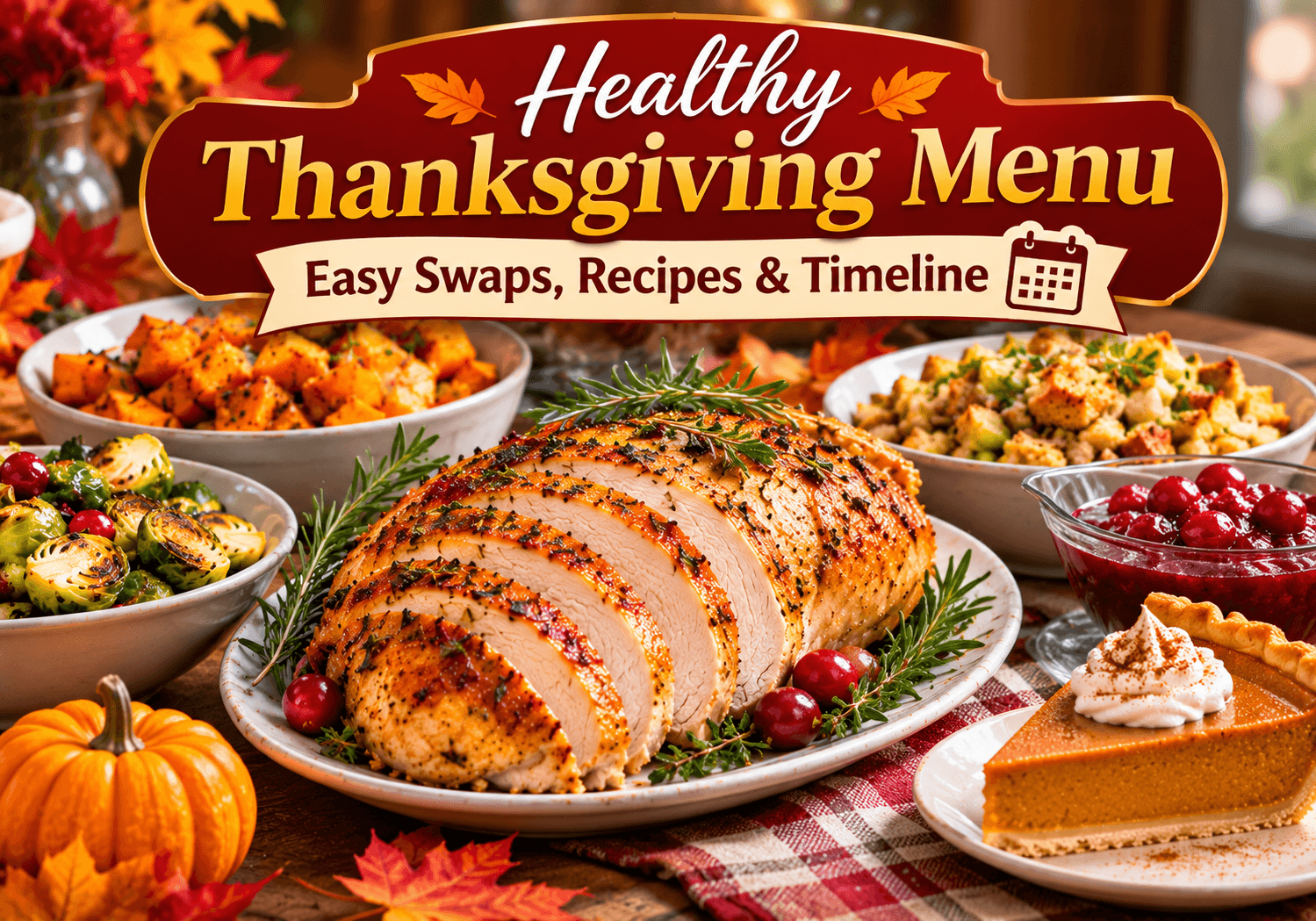
Thanksgiving is about family, gratitude, and food. For many people, it’s also the meal that leaves them stuffed, sleepy, and wishing they’d skipped that third helping. The good news? A healthy Thanksgiving menu doesn’t mean giving up turkey, stuffing, or pie.
In this guide, you’ll find a sample menu, simple swaps for classic dishes, and a week-by-week cooking timeline. You’ll also learn what research says about holiday weight gain, blood sugar, and food safety, so you can enjoy the feast and still feel good the next day.
Key Takeaways
- A healthy Thanksgiving menu is about balance, not restriction. Fill half your plate with vegetables and enjoy small portions of your favorites.
- Small swaps add up. Choosing pumpkin pie over pecan pie saves about 220 calories and 17 grams of sugar per slice.
- Holiday weight gain is small but can stick. An NIH study found people gained about 0.8 pound over the holidays and didn’t lose it.
- A short walk after dinner helps. Light walking lowers blood sugar and insulin compared with sitting.
- Food safety matters. Cook turkey to 165°F and refrigerate leftovers within 2 hours.
- Plan ahead. A simple timeline makes healthy cooking less stressful.
What Makes a Healthy Thanksgiving Menu?
A healthy Thanksgiving menu follows the same principles as healthy eating any other day. It centers on vegetables, fruits, whole grains, and lean protein, with smaller amounts of rich dishes and sweets.
The 2025–2030 Dietary Guidelines for Americans put more emphasis on whole, minimally processed foods. According to Harvard’s summary of the new guidelines, they recommend that no single meal contain more than 10 grams of added sugar. They also keep saturated fat below 10% of daily calories and favor whole, fiber-rich grains over refined ones.
You don’t need to hit every target on a holiday. But these guidelines give you a useful compass when planning a healthy Thanksgiving menu.
The Balanced Thanksgiving Plate
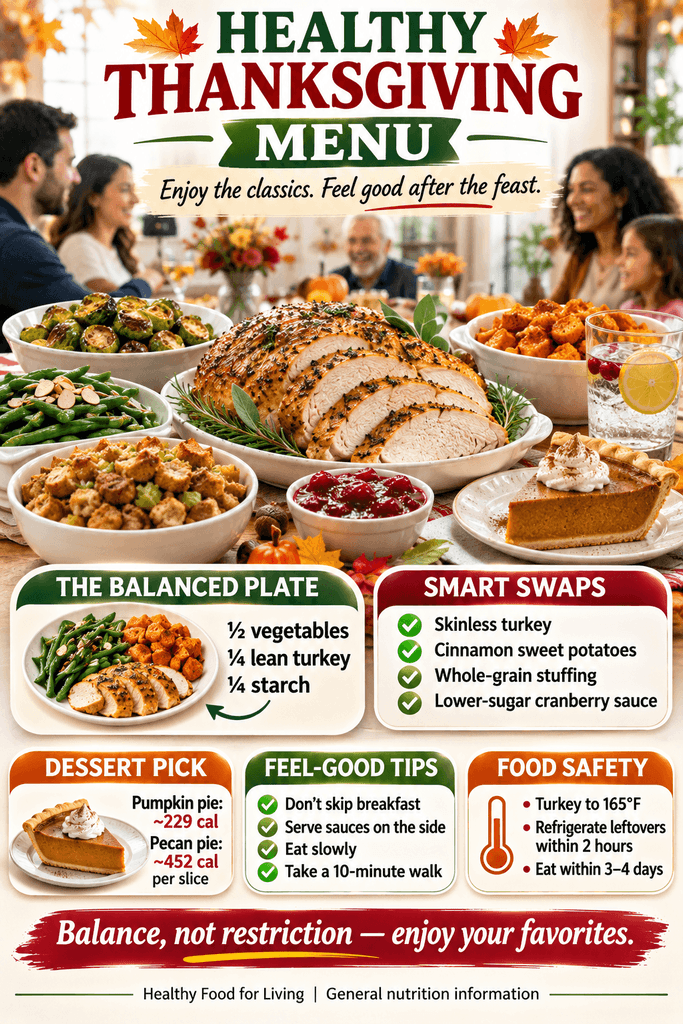
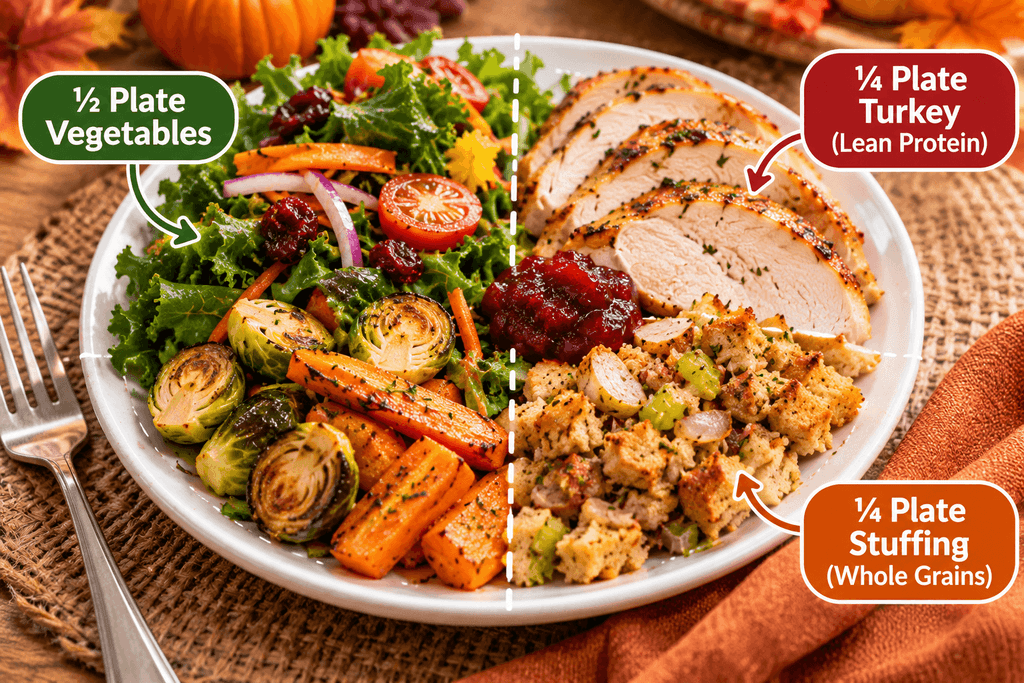
The CDC suggests a simple rule for holiday meals: fill at least half your plate with vegetables. Then use the rest of the plate for:
- One quarter: lean protein, such as skinless turkey breast.
- One quarter: starches, such as stuffing, potatoes, or rolls.
- A small side: cranberry sauce, gravy, or other extras.
MyPlate recommends lean or low-fat protein choices, such as skinless poultry. Turkey breast without the skin fits that description well.
A Sample Healthy Thanksgiving Menu
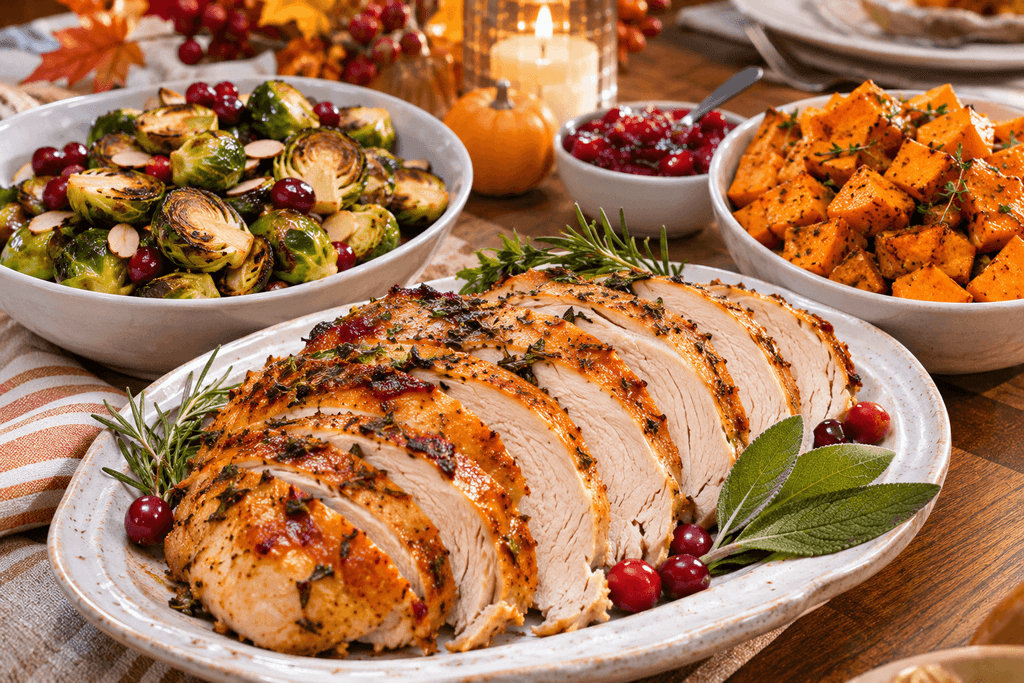
Here’s a complete healthy Thanksgiving menu that keeps the classics but lightens them up. Use it as a template and swap in your family’s favorites.
| Course | Dish | Why It Works |
| Appetizer | Raw vegetable platter with hummus or yogurt dip | Adds fiber and fills you up before the main meal |
| Main | Herb-roasted turkey breast (skin removed before eating) | Lean protein with less saturated fat |
| Vegetable | Roasted Brussels sprouts with olive oil and lemon | High in fiber, low in calories |
| Vegetable | Green beans with toasted almonds (no fried onions) | Crunch and healthy fat without the cream soup |
| Starch | Baked sweet potatoes with cinnamon (no marshmallows) | Rich in vitamin A, less added sugar |
| Starch | Whole-grain bread stuffing with celery, onion, and herbs | More fiber than white bread stuffing |
| Side | Homemade cranberry sauce with less sugar | Keeps the tart flavor with fewer added sugars |
| Sauce | Gravy made from skimmed pan drippings | Lower in fat, served on the side |
| Dessert | Pumpkin pie (one slice) | Fewer calories and less sugar than pecan pie |
| Drinks | Sparkling water with cranberry or citrus | No added sugar, festive look |
This healthy Thanksgiving menu still feels like a holiday. Nothing is “diet food,” and every classic is on the table in some form.
Healthy Thanksgiving Menu Swaps That Keep the Flavor
You don’t have to change everything on your healthy Thanksgiving menu. A few smart swaps can trim calories, added sugar, and sodium without anyone noticing.
Turkey: Choose White Meat, Skip the Skin
Turkey is naturally a lean protein, but the skin adds extra fat. MyPlate measures poultry servings as cooked turkey without skin. Enjoy a slice of crispy skin if you love it, but make skinless breast meat your main serving.
Skip heavily salted injections and pre-brined birds if you’re watching sodium. The FDA notes that over 70% of dietary sodium comes from packaged and prepared foods. Season with herbs, garlic, citrus, and pepper instead.
Sweet Potatoes: Lose the Marshmallows
Sweet potatoes are one of the most nutritious foods on the table. One baked sweet potato provides 1,403 mcg of vitamin A, or 156% of the Daily Value, according to the NIH.
Marshmallow toppings and brown sugar glazes add lots of added sugar. Instead, roast sweet potatoes with a little cinnamon, nutmeg, or a light drizzle of maple syrup. Learn more about whether sweet potatoes are healthy.
Mashed Potatoes: Lighten the Butter and Cream
Mashed potatoes don’t have to be off-limits. Use low-fat milk or broth instead of heavy cream, and add roasted garlic for flavor. You can also mash in some cauliflower to add vegetables. See whether mashed potatoes are healthy.
Stuffing: Go Whole Grain and Add Vegetables
Use whole-grain bread and load the stuffing with celery, onions, mushrooms, and herbs. The new Dietary Guidelines favor whole, fiber-rich grains over refined ones. Learn why whole-grain bread is healthy.
Cranberry Sauce: Make It at Home
Canned sweetened cranberry sauce is high in sugar. USDA data show that one cup contains about 88 grams of sugar, or about 22 grams per quarter cup. Homemade sauce lets you control the sugar while keeping the tart cranberry flavor. See whether cranberries are healthy.
Dessert: Pumpkin Pie Wins
When it comes to pie, pumpkin is the lighter choice. One slice (1/6 of an 8-inch pie) of commercially prepared pumpkin pie has about 229 calories and 15 grams of sugar. The same size slice of pecan pie has about 452 calories and 32 grams of sugar.
Pumpkin pie also provides vitamin A. The NIH lists 488 mcg per piece, or 54% of the Daily Value. Learn more about whether pumpkin is healthy.
Quick Swap Table
| Classic Dish | Healthier Swap | Benefit |
| Dark meat with skin | Skinless white meat | Less fat |
| Sweet potato casserole with marshmallows | Roasted sweet potatoes with cinnamon | Less added sugar |
| Green bean casserole | Green beans with toasted almonds | Less sodium and saturated fat |
| White bread stuffing | Whole-grain stuffing with vegetables | More fiber |
| Canned cranberry sauce | Homemade, lower-sugar sauce | Less added sugar |
| Pecan pie | Pumpkin pie | About half the calories and sugar |
| Sugary cocktails | Sparkling water or a small glass of wine | Fewer calories and less alcohol |
The Health Benefits of a Healthy Thanksgiving Menu
Many Thanksgiving staples are nutritious on their own. It’s usually the toppings, portions, and extras that turn them into heavy dishes.
Vegetables and Fiber Help You Feel Full
Brussels sprouts, green beans, squash, and salads add fiber to your plate. Mayo Clinic explains that high-fiber foods tend to be more filling than low-fiber foods and help control blood sugar. Adults need about 21 to 38 grams of fiber a day.
Roasted squash is another great addition. See whether butternut squash is healthy.
Orange Vegetables Provide Vitamin A
Sweet potatoes, pumpkin, and carrots are rich sources of vitamin A. The NIH lists baked sweet potato, pumpkin pie, and raw carrots among the top food sources, with ½ cup of raw carrots providing 51% of the Daily Value. Vitamin A supports vision, immune function, and cell growth.
Turkey Provides Lean Protein
Skinless turkey breast is a lean protein source, as recommended by MyPlate. Protein helps you feel satisfied and supports muscle health. The new Dietary Guidelines also put more emphasis on protein, recommending 1.2 to 1.6 grams per kilogram of body weight per day for adults.
Thanksgiving Timeline: Plan Your Healthy Thanksgiving Menu Ahead
A good plan makes healthy cooking much easier. Here’s a simple timeline you can follow.
One Week Before
- Finalize your healthy Thanksgiving menu and shopping list.
- Buy a frozen turkey now if you haven’t already.
- Ask guests to bring a vegetable side or salad.
Four to Five Days Before
Start thawing a frozen turkey in the refrigerator. The CDC recommends allowing about 24 hours of thawing for every 4 to 5 pounds of turkey. A 16-pound turkey needs about 3 to 4 days.
Two to Three Days Before
- Make homemade cranberry sauce. It keeps well in the fridge.
- Chop vegetables for stuffing, roasting, and the appetizer platter.
- Toast and cube whole-grain bread for stuffing.
The Day Before
- Bake the pumpkin pie.
- Prepare dips and wash salad greens.
- Set the table and plan oven timing.
Thanksgiving Day
- Roast the turkey and check that it reaches 165°F.
- Roast vegetables while the turkey rests.
- Eat a normal breakfast. The CDC advises people with diabetes not to skip meals to “save up” for a feast.
- Take a family walk after dinner.
After the Meal
Refrigerate leftovers within 2 hours. Plan to use them within 3 to 4 days or freeze them.
Food Safety for Your Healthy Thanksgiving Menu
A healthy Thanksgiving menu also needs to be a safe one. The CDC shares these key steps for preparing your holiday turkey safely:
- Don’t wash raw turkey. Washing it can spread germs to other foods.
- Cook to 165°F. Check the thickest part of the breast, where the thigh meets the body, and where the wing meets the body.
- Cook stuffing separately. Baking it in a casserole dish is safest. Make sure the center reaches 165°F.
- Refrigerate leftovers quickly. Store them at 40°F or colder within 2 hours of cooking.
- Use leftovers within 3 to 4 days. Reheat them to 165°F before eating.
The USDA says frozen leftovers keep their best quality for two to six months. If you have questions on the holiday, the USDA Meat and Poultry Hotline (1-888-674-6854) is open from 8 a.m. to 2 p.m. ET on Thanksgiving Day.
Who Benefits Most From a Healthy Thanksgiving Menu?
Everyone can benefit from a lighter holiday meal, but some people may notice a bigger difference.
People with diabetes. Large, carb-heavy meals can push blood sugar up. The CDC suggests planning carb choices in advance, eating close to your usual meal times, and checking your blood sugar during the festivities. For dessert ideas, see our pumpkin recipes for diabetics.
People watching their weight. Holiday weight gain is smaller than many people think, but it tends to stick. An NIH study found that adults gained about 0.8 pound between Thanksgiving and New Year’s, and most didn’t lose it afterward. People who were already overweight were more likely to gain 5 pounds or more.
People with high blood pressure. Many holiday foods are high in sodium. The FDA’s Daily Value for sodium is less than 2,300 mg per day, while Americans average about 3,400 mg.
People with heart disease. Choosing lean protein and limiting saturated fat from butter, cream, and fatty meats supports heart health. See whether butter is healthy.
Risks and Who Should Be Cautious
Even with a healthy Thanksgiving menu, keep these risks in mind.
Overeating. Very large meals can leave you uncomfortable and sluggish. Eating slowly helps. Harvard’s Nutrition Source notes that slower eating was linked to eating less food in a review of 68 studies, because people felt fuller sooner.
Alcohol. The CDC defines moderate drinking as two drinks or less a day for men and one drink or less for women. It also notes that drinking less is better for your health, and even moderate drinking may have risks. People with diabetes should avoid sugary mixers.
Food allergies. Thanksgiving dishes often contain common allergens such as milk, eggs, wheat, and tree nuts. The FDA lists nine major food allergens that can cause serious reactions. Ask guests about allergies ahead of time and label dishes. If you need gluten-free dessert options, check whether pumpkin pie is gluten-free.
Foodborne illness. Undercooked turkey and leftovers left out too long can cause food poisoning. Follow the food safety steps above.
How Much Should You Eat?
There’s no single calorie target for Thanksgiving. Instead, focus on portions and how you feel.
- Vegetables: Fill at least half your plate.
- Turkey: Take a modest serving of skinless breast meat, about a quarter of your plate.
- Starches: Pick your two favorites and take about half a cup each.
- Dessert: Enjoy one slice of pie, or share a slice and try two kinds.
- Seconds: Wait at least 20 minutes before going back. The CDC says it takes at least 20 minutes for your brain to realize you’re full.
If you don’t want to skip a favorite treat, the CDC suggests asking your host if you can take a treat home for later. Nothing has to be off-limits.
Practical Tips for a Healthier Thanksgiving Day
- Eat a balanced breakfast. Don’t skip meals to save room. Arriving starving makes overeating more likely.
- Start with vegetables. Fill up on the veggie platter and salad first.
- Drink water. Keep a glass of water nearby and alternate it with any alcohol.
- Serve sauces on the side. The CDC suggests leaving sauces, dressings, and toppings on the side so guests can choose how much to use.
- Take a walk after dinner. A 2022 meta-analysis in Sports Medicine found that light walking breaks lowered blood sugar and insulin compared with sitting. The CDC says even 10 minutes after a big meal helps. Learn more about whether exercise lowers blood sugar.
- Prep vegetables ahead. If you’re short on time, see whether you can freeze Brussels sprouts.
Healthy Thanksgiving Menu Myths vs Facts
| Myth | Fact |
| A healthy Thanksgiving menu means skipping your favorites. | The CDC says you can still enjoy holiday treats in moderation. |
| Skipping breakfast saves calories for the feast. | The CDC advises not to skip meals to save up for a big meal. |
| Most people gain 5 to 10 pounds over the holidays. | An NIH study found the average gain was about 0.8 pound. |
| All pies are about the same. | Pecan pie has about twice the calories of pumpkin pie per slice. |
| Washing turkey makes it safer. | Washing raw turkey can spread germs to other foods. |
How a Healthy Thanksgiving Menu Fits a Healthy Lifestyle
One big meal won’t make or break your health. What matters most is your overall eating pattern across weeks and months. Still, the NIH study suggests that holiday weight gain may add up over the years, since most people don’t lose it.
A healthy Thanksgiving menu helps you enjoy the day while staying on track. Your healthy Thanksgiving menu can keep working after the holiday, too. Turn leftovers into healthy meals, such as turkey and vegetable soup, turkey salads, or grain bowls with roasted squash. Get back to your usual routine the next day without guilt.
Staying active through the holiday season also helps. The CDC calls activity a “secret holiday weapon” and suggests inviting family and friends to join you. For more seasonal inspiration, browse our pumpkin recipe roundup.
Frequently Asked Questions
What is a healthy Thanksgiving menu?
A healthy Thanksgiving menu includes lean turkey, plenty of vegetables, whole-grain stuffing, roasted sweet potatoes, homemade cranberry sauce, and a modest dessert like pumpkin pie. It keeps traditional flavors but uses less butter, sugar, and salt. The goal is balance, with vegetables filling about half of your plate.
How can I make Thanksgiving dinner healthier?
Start with simple swaps. Choose skinless white meat turkey, roast vegetables instead of using cream-based casseroles, and make cranberry sauce at home with less sugar. Use whole-grain bread for stuffing and serve gravy on the side. Pick pumpkin pie over pecan pie to save calories and sugar.
How long does it take to thaw a turkey?
In the refrigerator, allow about 24 hours for every 4 to 5 pounds of turkey, according to the CDC. A 16-pound turkey needs about 3 to 4 days. In cold water, allow about 30 minutes per pound and change the water every 30 minutes. Cook it right after thawing.
Which Thanksgiving dessert is healthiest?
Pumpkin pie is usually the lighter choice. A slice of commercially prepared pumpkin pie has about 229 calories and 15 grams of sugar, compared with about 452 calories and 32 grams of sugar in pecan pie. Pumpkin pie also provides vitamin A. Fresh fruit or baked apples are lighter still.
Can people with diabetes enjoy Thanksgiving dinner?
Yes. The CDC suggests eating at your usual times, planning carb choices ahead, and filling half your plate with vegetables. If you want dessert, cut back on other carbs like rolls or potatoes. Check your blood sugar during the day, limit alcohol, and take a short walk after eating.
How long are Thanksgiving leftovers safe to eat?
Refrigerate leftovers within 2 hours of cooking and eat them within 3 to 4 days, according to the CDC. Reheat them to 165°F before eating. If you won’t finish them in time, freeze them. The USDA says frozen leftovers keep their best quality for two to six months.
Conclusion: Build Your Healthy Thanksgiving Menu
A healthy Thanksgiving menu doesn’t require giving up the foods you love. Fill half your plate with vegetables, choose lean turkey, make a few smart swaps, and enjoy one slice of your favorite pie. Plan ahead with a simple timeline, follow food safety rules, and take a walk after the meal.
Above all, focus on the people around the table. One holiday meal is just one meal, and a balanced approach lets you enjoy it without guilt.
Medical disclaimer: This article is for general information only and is not a substitute for professional medical advice, diagnosis, or treatment. If you have diabetes, heart disease, high blood pressure, food allergies, or another health condition, talk with your doctor or a registered dietitian about your holiday eating plan.
3. References
- Harvard T.H. Chan School of Public Health, The Nutrition Source. Dietary Guidelines for Americans 2025–2030: Progress on added sugar, protein hype, saturated fat contradictions. January 9, 2026. https://nutritionsource.hsph.harvard.edu/2026/01/09/dietary-guidelines-for-americans-2025-2030/
- Centers for Disease Control and Prevention. Healthy Eating and the Holidays (Diabetes). 2024. https://www.cdc.gov/diabetes/healthy-eating/5-healthy-eating-tips-holidays.html
- Centers for Disease Control and Prevention. Preparing Your Holiday Turkey Safely. 2024. https://www.cdc.gov/food-safety/foods/holiday-turkey.html
- USDA Food Safety and Inspection Service. Happy Thanksgiving (food safety guidance). https://www.fsis.usda.gov/food-safety/safe-food-handling-and-preparation/poultry/happy-thanksgiving
- USDA MyPlate. Protein Foods. https://www.myplate.gov/eat-healthy/protein-foods
- NIH Office of Dietary Supplements. Vitamin A and Carotenoids: Fact Sheet for Health Professionals. https://ods.od.nih.gov/factsheets/VitaminA-HealthProfessional/
- USDA Agricultural Research Service. Cranberry sauce, canned, sweetened (FDC ID 173961). FoodData Central. https://fdc.nal.usda.gov/fdc-app.html#/food-details/173961/nutrients
- University Hospitals Health & Wellness Library. Nutrition Facts: Pie, pumpkin, commercially prepared, 1 piece (1/6 of 8″ pie). https://www.uhhospitals.org/health-information/health-and-wellness-library/nutrition-facts/article/nutritionfacts-v1/pie-pumpkin-commercially-prepared-1-piece-16-of-8-pie [VERIFY]
- University Hospitals Health & Wellness Library. Nutrition Facts: Pie, pecan, commercially prepared, 1 piece (1/6 of 8″ pie). https://www.uhhospitals.org/health-information/health-and-wellness-library/article/nutritionfacts-v1/pie-pecan-commercially-prepared-1-piece-16-of-8-pie [VERIFY]
- National Institute of Child Health and Human Development (NIH). Holiday Weight Gain Slight, But May Last a Lifetime. March 22, 2000 (on Yanovski JA et al., New England Journal of Medicine, 2000). https://www.nichd.nih.gov/newsroom/releases/holidayweightgain
- U.S. Food and Drug Administration. Sodium in Your Diet. 2024. https://www.fda.gov/food/nutrition-education-resources-materials/sodium-your-diet
- U.S. Food and Drug Administration. Food Allergies. https://www.fda.gov/food/nutrition-food-labeling-and-critical-foods/food-allergies
- Centers for Disease Control and Prevention. About Moderate Alcohol Use. January 14, 2025. https://www.cdc.gov/alcohol/about-alcohol-use/moderate-alcohol-use.html
- Buffey AJ, Herring MP, Langley CK, Donnelly AE, Carson BP. The acute effects of interrupting prolonged sitting time in adults with standing and light-intensity walking on biomarkers of cardiometabolic health in adults: a systematic review and meta-analysis. Sports Medicine. 2022. https://doi.org/10.1007/s40279-022-01649-4
- Harvard T.H. Chan School of Public Health, The Nutrition Source. Mindful Eating. https://nutritionsource.hsph.harvard.edu/mindful-eating/
- Mayo Clinic. Dietary fiber: Essential for a healthy diet. https://www.mayoclinic.org/healthy-lifestyle/nutrition-and-healthy-eating/in-depth/fiber/art-20043983