Almonds and pistachios are two of the most popular snack nuts in the world. They look similar on a nutrition label, fit easily into lunch boxes, and both have a “heart-healthy” reputation. So when it comes to almonds vs pistachios, does one really come out ahead?
The short answer: they each win in different areas. This guide gives you a side-by-side nutrition comparison based on USDA data, plus what research says about heart health, blood sugar, and weight loss. You’ll also learn about downsides, how much to eat, and simple ways to enjoy both.
Key Takeaways
- Calories and protein are close. One ounce has about 164 calories and 6 grams of protein for almonds, and about 159 calories and 5.7 grams for pistachios.
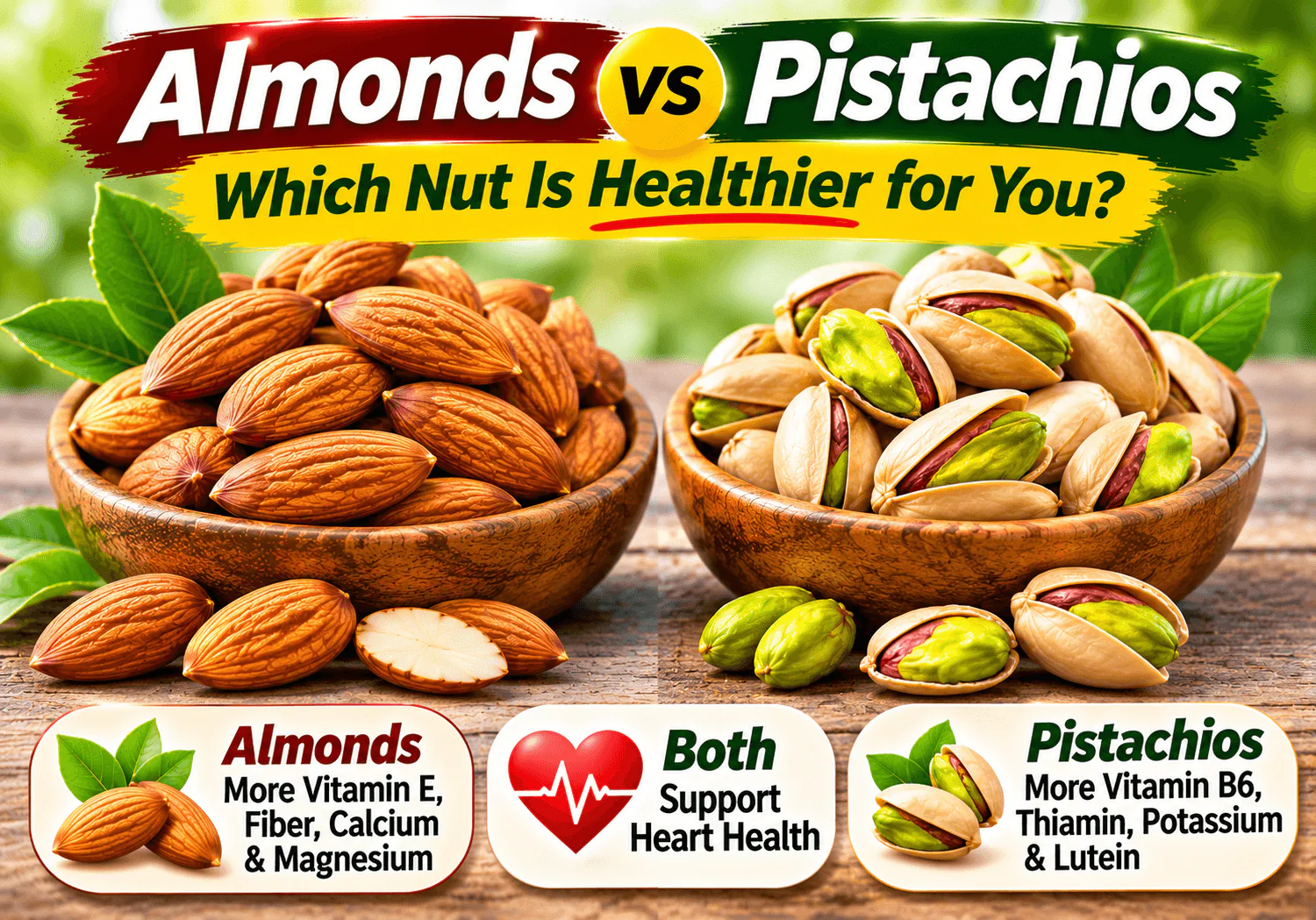
- Almonds lead in vitamin E, magnesium, calcium, and fiber. They have about nine times the vitamin E of pistachios.
- Pistachios lead in vitamin B6, thiamin, potassium, and lutein, an antioxidant found in the eye.
- Both support heart health. Almond trials show lower LDL cholesterol, while pistachio trials show lower blood pressure and better cholesterol ratios.
- Pistachios have good blood sugar research. A meta-analysis found they lowered fasting blood sugar and insulin.
- In-shell pistachios may help you eat less, since cracking shells slows you down.
Almonds vs Pistachios: The Basics
Almonds and pistachios are both tree nuts. Almonds come from the almond tree, while pistachios grow in clusters and are often sold in their partly open shells. Pistachios are smaller, so you get more kernels in each ounce.
Both are good sources of healthy unsaturated fats, plant protein, and fiber. Both are also listed among tree nuts, one of the FDA’s nine major food allergens. Beyond that, the almonds vs pistachios vitamin and mineral profiles differ quite a bit.
Almonds vs Pistachios: Nutrition Facts Compared
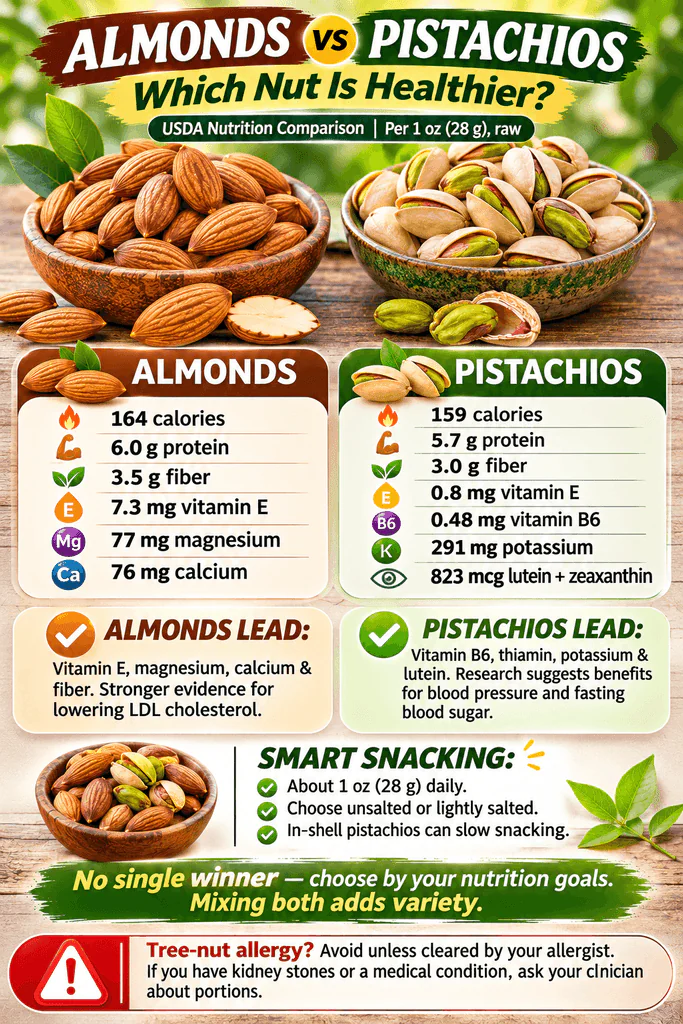
Here’s how 1 ounce (28 grams) of raw almonds compares with 1 ounce of raw pistachios, based on USDA Food Data Central data for almonds and pistachios.
| Nutrient (per 1 oz, raw) | Almonds | Pistachios | Winner |
| Calories | 164 | 159 | Pistachios (slightly lower) |
| Protein | 6.0 g | 5.7 g | About equal |
| Total fat | 14.2 g | 12.8 g | Pistachios (lower) |
| Monounsaturated fat | 9.0 g | 6.6 g | Almonds |
| Polyunsaturated fat | 3.5 g | 4.1 g | Pistachios |
| Saturated fat | 1.1 g | 1.7 g | Almonds (lower) |
| Carbohydrates | 6.1 g | 7.7 g | Almonds (lower) |
| Fiber | 3.5 g (13% DV) | 3.0 g (11% DV) | Almonds |
| Sugars | 1.2 g | 2.2 g | Almonds (lower) |
| Vitamin E | 7.3 mg (48% DV) | 0.8 mg (5% DV) | Almonds |
| Magnesium | 77 mg (18% DV) | 34 mg (8% DV) | Almonds |
| Calcium | 76 mg (6% DV) | 30 mg (2% DV) | Almonds |
| Riboflavin (B2) | 0.3 mg (25% DV) | 0.05 mg (3% DV) | Almonds |
| Manganese | 0.6 mg (27% DV) | 0.3 mg (15% DV) | Almonds |
| Vitamin B6 | 0.04 mg (2% DV) | 0.48 mg (28% DV) | Pistachios |
| Thiamin (B1) | 0.06 mg (5% DV) | 0.25 mg (21% DV) | Pistachios |
| Potassium | 208 mg (4% DV) | 291 mg (6% DV) | Pistachios |
| Copper | 0.29 mg (32% DV) | 0.37 mg (41% DV) | Pistachios |
| Lutein + zeaxanthin | 0.3 mcg | 823 mcg | Pistachios |
Per-ounce values are calculated from USDA’s per-100-gram data and rounded. %DV is based on FDA Daily Values for adults.
What the Numbers Show
The almonds vs pistachios matchup is close on calories and protein. Pistachios have slightly less fat and fewer calories, while almonds have slightly more fiber and fewer carbs and sugars.
The real differences show up in vitamins and minerals. Almonds are a vitamin E and magnesium powerhouse. Pistachios stand out for vitamin B6, thiamin, potassium, and lutein. Neither nut wins across the board.
Almonds vs Pistachios: Protein Content
Almonds have a tiny protein edge, about 6.0 grams per ounce compared with 5.7 grams for pistachios, based on USDA data. Per 100 calories, they’re almost identical, at about 3.6 grams each.
Protein quality is another story. A 2020 study in the Journal of the Science of Food and Agriculture measured the protein quality of pistachios. Both raw and roasted pistachios had a DIAAS score above 75, which the authors rated as “good” quality protein. The same paper listed earlier protein-quality scores (PDCAAS) of 73 to 81 for pistachios, compared with 57 for almonds.
This study used growing pigs as a model for human digestion and was funded by a USDA grant. In the almonds vs pistachios protein race, both nuts add useful plant protein to your diet. Learn more about whether nuts are high in protein.
Almonds vs Pistachios for Heart Health
Both nuts have strong heart-health research, though they affect different markers.
What Almond Research Shows
A 2025 meta-analysis in Nutrients pooled 36 publications of randomized controlled trials with 2,485 participants. Eating almonds significantly lowered LDL (“bad”) cholesterol and total cholesterol. HDL (“good”) cholesterol didn’t change in a meaningful way.
What Pistachio Research Shows
A 2020 meta-analysis in Complementary Therapies in Medicine combined 11 randomized trials with 506 participants. Eating pistachios significantly lowered systolic blood pressure, by about 3 points on average. It also improved the LDL-to-HDL and total-to-HDL cholesterol ratios.
Pistachios also have more potassium than almonds, about 291 mg per ounce compared with 208 mg. Potassium plays a role in healthy blood pressure.
Which Is Better for Your Heart?
When you compare almonds vs pistachios for heart health, both look helpful. Almonds have stronger evidence for lowering LDL cholesterol, while pistachios have evidence for blood pressure. Harvard’s Nutrition Source reports that eating about one ounce of nuts five or more times per week is linked to lower heart disease risk. See our guide to nuts and heart health.
Almonds vs Pistachios for Blood Sugar and Diabetes
This is where pistachios have some of their best evidence. A 2022 meta-analysis in the British Journal of Nutrition included 8 randomized trials with 535 people. Eating pistachios lowered fasting blood sugar by about 5 mg/dL and lowered fasting insulin.
The authors noted that the trials were small and the results varied a lot from study to study. Still, the overall direction was positive. The researchers reported no outside funding for the review.
Almonds have a different strength: magnesium. One ounce of almonds gives about 18% of the Daily Value, more than twice the amount in pistachios. The NIH explains that magnesium helps run more than 300 enzyme systems, including blood glucose control. Almonds also have slightly fewer carbs and sugars.
In the almonds vs pistachios comparison for diabetes, both can fit a healthy meal plan. For more, see our guide to the best nuts for diabetics.
Almonds vs Pistachios for Weight Loss
Calories are close: about 164 per ounce for almonds and 159 for pistachios, based on USDA data. In the almonds vs pistachios weight-loss matchup, both can fit a plan when portions are controlled.
Almonds: Fewer Absorbed Calories
USDA researchers found that almonds provide about 129 calories per serving instead of the 168 to 170 calories predicted by standard calculations. In other words, your body may not absorb all of the calories in whole almonds.
Pistachios: A Built-In Speed Bump
Pistachios in the shell may help you eat less. In a 2011 study in Appetite, 140 college students who ate in-shell pistachios consumed 41% fewer calories than those who ate shelled pistachios. Yet both groups felt equally full and satisfied.
Pistachios have also been tested in a weight-loss program. In a 2020 trial in Nutrients, 100 adults with overweight or obesity followed a 4-month weight-loss plan, and half also ate 1.5 ounces of pistachios a day. Both groups lost about 5% of their body weight. The pistachio group also ate fewer sweets, though American Pistachio Growers funded the study.
Fiber and Fullness
Almonds have slightly more fiber, about 3.5 grams per ounce versus 3.0 grams for pistachios. Mayo Clinic notes that high-fiber foods tend to be more filling than low-fiber foods. For more, see whether nuts are fattening.
Almonds vs Pistachios: Vitamins and Minerals
When you compare almonds vs pistachios for micronutrients, each nut has its own strengths.
Vitamin E: Almonds Win Big
Almonds are one of the best food sources of vitamin E. Dry-roasted almonds provide 6.8 mg per ounce, or 45% of the Daily Value. Raw pistachios provide less than 1 mg of this form of vitamin E. Vitamin E is an antioxidant that helps protect cells from damage caused by free radicals.
Vitamin B6 and Thiamin: Pistachios Win
Pistachios are a rich source of vitamin B6. One ounce gives about 0.48 mg, or 28% of the Daily Value, based on USDA data. Pistachios also supply about 21% of the Daily Value for thiamin, a B vitamin your body uses to turn food into energy.
Lutein and Zeaxanthin: Pistachios Win
Pistachios contain about 823 mcg of lutein and zeaxanthin per ounce, while almonds have almost none. The National Eye Institute describes lutein and zeaxanthin as antioxidants with activity in the retina. The amount in pistachios is much lower than the 10 mg of lutein used in the AREDS2 eye supplement, so pistachios are not a substitute for treatment.
Magnesium and Calcium: Almonds Win
Almonds have more than twice the magnesium and calcium of pistachios. Dry-roasted almonds provide 80 mg of magnesium per ounce. That matters because the NIH reports that 48% of Americans get less magnesium from food than they need.
Fiber: Almonds Edge Ahead
Almonds have about 3.5 grams of fiber per ounce, compared with about 3.0 grams in pistachios. Mayo Clinic recommends 21 to 38 grams of fiber a day for adults. See our ranking of nuts with the most fiber.
Who Benefits Most From Almonds vs Pistachios?
In the almonds vs pistachios decision, your best pick depends on your goals.
Almonds may be the better choice if you:
- Want to lower LDL cholesterol, based on strong trial evidence.
- Need more vitamin E, magnesium, calcium, or fiber.
- Want slightly fewer carbs and sugars.
- Like nut butters, almond flour, or almond milk in your cooking.
Pistachios may be the better choice if you:
- Want to support healthy blood pressure or fasting blood sugar.
- Need more vitamin B6, thiamin, or potassium.
- Want a snack that slows you down, thanks to the shells.
- Want more lutein and zeaxanthin in your diet.
For more on each, see whether almonds are healthy and whether pistachios are healthy.
Is There Any Downside to Eating Pistachios or Almonds?
Whichever side of the almonds vs pistachios question you land on, keep these risks in mind.
Tree nut allergy. Almonds and pistachios are both tree nuts. Tree nut allergies can cause anaphylaxis, a life-threatening reaction. If you’re allergic to one tree nut, talk with an allergist before trying others.
Salt. Pistachios are often sold roasted and salted. Harvard notes that nuts with lots of sugar or sodium are probably not as good as plain nuts. Choose unsalted or lightly salted versions when you can.
Aflatoxins. The National Cancer Institute explains that aflatoxins are toxins made by certain fungi that can affect crops such as corn, peanuts, and tree nuts. The NCI advises buying major commercial brands and throwing out nuts that look moldy, discolored, or shriveled.
Kidney stones. If you’ve had calcium oxalate kidney stones, the NIDDK lists nuts and nut products among foods you may want to limit. Ask your doctor what’s right for you.
Calories. Both nuts are calorie-dense. Eating large handfuls on top of your usual diet can add up quickly.
How Much Should You Eat Each Day?
For most adults, about 1 ounce (28 grams) a day of almonds, pistachios, or a mix is a reasonable amount. Harvard defines a handful as about 28 grams, or one ounce. Eating that amount five or more times a week is linked to lower heart disease risk.
Because pistachios are smaller, an ounce of pistachios looks like more food than an ounce of almonds. That can make a serving feel more satisfying. The easiest way to learn your portion is to weigh 28 grams once on a kitchen scale. This serving advice is the same on both sides of the almonds vs pistachios debate.
Which Nuts Should You Not Eat Every Day in Large Amounts?
Almonds and pistachios are safe for most people to eat daily in normal portions. Brazil nuts are a different story. The NIH reports that one ounce of Brazil nuts has 544 mcg of selenium, well above the adult upper limit of 400 mcg a day. By comparison, an ounce of pistachios has about 3 mcg.
Almonds vs Pistachios: Raw, Roasted, and Milk
Raw vs roasted. Both nuts are healthy raw or dry-roasted. In the pistachio protein study, roasting slightly lowered how well some amino acids were digested. See whether roasted nuts are healthy.
Pistachio milk vs almond milk. Nut milks are mostly water, so they contain far less protein and fiber than whole nuts. Check labels for added sugar and calcium. Learn more about almond milk and weight loss.
Practical Tips: Enjoying Almonds and Pistachios
- Mix them. Combine almonds and pistachios to get vitamin E, magnesium, B6, and lutein in one snack.
- Buy pistachios in the shell. Cracking shells slows you down and leaves a visual reminder of how much you’ve eaten.
- Choose unsalted. Pick plain or lightly salted nuts over heavily salted or candied ones.
- Pre-portion snacks. Pack 1-ounce servings in small containers.
- Add them to meals. Sprinkle chopped pistachios on yogurt or salads, and add sliced almonds to oatmeal.
- Store them well. Keep nuts in a cool, dry place, and toss any that look moldy or shriveled.
Almonds vs Pistachios: Quick Scorecard
Here’s a quick almonds vs pistachios summary by goal:
| Goal | Better pick | Why |
| Lower LDL cholesterol | Almonds | Strong evidence from 36 trial publications |
| Lower blood pressure | Pistachios | Meta-analysis showed lower systolic pressure |
| Fasting blood sugar | Pistachios | Meta-analysis of 8 trials |
| Vitamin E | Almonds | About 48% vs 5% of the Daily Value |
| Vitamin B6 | Pistachios | About 28% vs 2% of the Daily Value |
| Magnesium | Almonds | About 18% vs 8% of the Daily Value |
| Fiber | Almonds | About 3.5 g vs 3.0 g per ounce |
| Calories | Tie | About 164 vs 159 per ounce |
Nutrient figures are from USDA data for raw almonds and pistachios.
Almonds vs Pistachios: Myths vs. Facts
| Myth | Fact |
| Pistachios are much higher in calories than almonds. | Pistachios have slightly fewer calories, about 159 vs 164 per ounce. |
| Almonds are always the healthiest nut. | Pistachios have more vitamin B6, thiamin, and potassium than almonds. |
| Nuts make blood sugar worse. | A meta-analysis found pistachios lowered fasting blood sugar. |
| Eating nuts always causes weight gain. | In a 4-month trial, people eating pistachios lost as much weight as those who didn’t. |
| All nuts are safe in any amount. | Brazil nuts can push selenium above the upper limit quickly. |
Other Nut Comparisons
The almonds vs pistachios debate isn’t the only nut matchup worth knowing. If you’re wondering how almonds stack up against other popular nuts, read our almonds vs peanuts and almonds vs cashews guides, or see whether walnuts are healthy. Rotating different nuts through your week gives you a wider range of nutrients.
Frequently Asked Questions
Are almonds or pistachios healthier?
Neither is clearly healthier overall. Almonds have more vitamin E, magnesium, calcium, and fiber, plus strong evidence for lowering LDL cholesterol. Pistachios have more vitamin B6, thiamin, potassium, and lutein, with research supporting blood pressure and blood sugar. The best choice depends on your health goals.
Which is better for weight loss, almonds or pistachios?
Both can work when eaten in 1-ounce portions. Pistachios have slightly fewer calories, and eating them in the shell may help you eat less. USDA research suggests the body absorbs fewer calories from whole almonds than labels show. Almonds also have slightly more fiber to help you feel full.
Do almonds or pistachios have more protein?
Almonds have slightly more protein, about 6 grams per ounce compared with about 5.7 grams in pistachios, based on USDA data. The difference is small. A 2020 study rated pistachio protein as good quality, so both nuts are useful sources of plant protein in a balanced diet.
What is the healthiest nut to eat daily?
There’s no single healthiest nut. Almonds, pistachios, walnuts, and other plain nuts all offer healthy fats, fiber, and protein. Harvard links eating about one ounce of nuts five or more times a week with lower heart disease risk. Mixing different nuts gives you the widest range of nutrients.
Is there any downside to eating pistachios?
Pistachios are healthy for most people, but there are a few downsides. They’re often heavily salted, they’re calorie-dense, and they’re a tree nut allergen. Like other nuts, they can carry aflatoxins, so buy trusted brands and throw away any that look moldy, discolored, or shriveled.
Are pistachios or almonds better for diabetes?
Both can fit a diabetes-friendly diet. A meta-analysis of eight trials found pistachios lowered fasting blood sugar and insulin. Almonds have more magnesium, fiber, and fewer carbs per ounce. Choose unsalted versions, keep portions to about one ounce, and follow your healthcare team’s advice.
Conclusion: Almonds vs Pistachios, Which Should You Choose?
In the almonds vs pistachios comparison, there’s no single winner. Almonds lead in vitamin E, magnesium, calcium, fiber, and LDL-lowering research. Pistachios lead in vitamin B6, thiamin, potassium, and lutein, with promising research on blood pressure and blood sugar.
For most people, the smartest approach is to enjoy about 1 ounce of plain, unsalted nuts most days, mixing almonds and pistachios for a wider range of nutrients. If weight control is your goal, in-shell pistachios are an easy way to slow down.
Medical disclaimer: This article is for general information only and is not a substitute for professional medical advice, diagnosis, or treatment. If you have a tree nut allergy, diabetes, high blood pressure, kidney stones, or another health condition, talk with your doctor or a registered dietitian before changing your diet.
3. References
- USDA Agricultural Research Service. Nuts, almonds (FDC ID 170567). FoodData Central. https://fdc.nal.usda.gov/fdc-app.html#/food-details/170567/nutrients
- USDA Agricultural Research Service. Nuts, pistachio nuts, raw (FDC ID 170184). FoodData Central. https://fdc.nal.usda.gov/fdc-app.html#/food-details/170184/nutrients
- Musa-Veloso K, Gauntlett C, Geronimo K, Vicente I, Ho SPL, et al. Almond consumption and blood lipids: a systematic review and meta-analysis of randomized controlled trials. Nutrients. 2025. https://doi.org/10.3390/nu17172791
- Ghanavati M, Rahmani J, Clark C, Hosseinabadi SM, Rahimlou M. Pistachios and cardiometabolic risk factors: a systematic review and meta-analysis of randomized controlled clinical trials. Complementary Therapies in Medicine. 2020;52:102513. https://doi.org/10.1016/j.ctim.2020.102513
- Hadi A, Asbaghi O, Kazemi M, Khadem Haghighian H, Ghaedi E. Effects of pistachios on glycaemic control: a systematic review and meta-analysis of randomised controlled trials. British Journal of Nutrition. 2023;129(10):1693–1702. https://doi.org/10.1017/S0007114522002100
- Rock CL, Zunshine E, Nguyen HT, et al. Effects of pistachio consumption in a behavioral weight loss intervention on weight change, cardiometabolic factors, and dietary intake. Nutrients. 2020;12(7):2155. https://doi.org/10.3390/nu12072155
- Honselman CS, Painter JE, Kennedy-Hagan KJ, et al. In-shell pistachio nuts reduce caloric intake compared to shelled nuts. Appetite. 2011;57. https://doi.org/10.1016/j.appet.2011.02.022
- Bailey HM, Stein HH. Raw and roasted pistachio nuts are good sources of protein based on their digestible indispensable amino acid score. Journal of the Science of Food and Agriculture. 2020;100:3878–3885. https://doi.org/10.1002/jsfa.10429 [VERIFY exact title]
- USDA Agricultural Research Service. Going nuts over calories. https://scientificdiscoveries.ars.usda.gov/tellus/stories/articles/going-nuts-over-calories
- NIH Office of Dietary Supplements. Vitamin E: Fact Sheet for Health Professionals. https://ods.od.nih.gov/factsheets/VitaminE-HealthProfessional/
- NIH Office of Dietary Supplements. Magnesium: Fact Sheet for Health Professionals. https://ods.od.nih.gov/factsheets/Magnesium-HealthProfessional/
- NIH Office of Dietary Supplements. Selenium: Fact Sheet for Health Professionals. https://ods.od.nih.gov/factsheets/Selenium-HealthProfessional/
- National Eye Institute. NIH study confirms benefit of supplements for slowing age-related macular degeneration (June 2, 2022). https://www.nei.nih.gov/about/news-and-events/news/nih-study-confirms-benefit-supplements-slowing-age-related-macular-degeneration
- Harvard T.H. Chan School of Public Health, The Nutrition Source. Nuts for the heart. https://nutritionsource.hsph.harvard.edu/food-features/nuts-for-the-heart/
- Mayo Clinic. Dietary fiber: Essential for a healthy diet. https://www.mayoclinic.org/healthy-lifestyle/nutrition-and-healthy-eating/in-depth/fiber/art-20043983
- U.S. Food and Drug Administration. Food Allergies. https://www.fda.gov/food/nutrition-food-labeling-and-critical-foods/food-allergies
- National Cancer Institute. Aflatoxins. https://www.cancer.gov/about-cancer/causes-prevention/risk/substances/aflatoxins
- NIDDK. Eating, Diet, & Nutrition for Kidney Stones. https://www.niddk.nih.gov/health-information/urologic-diseases/kidney-stones/eating-diet-nutrition