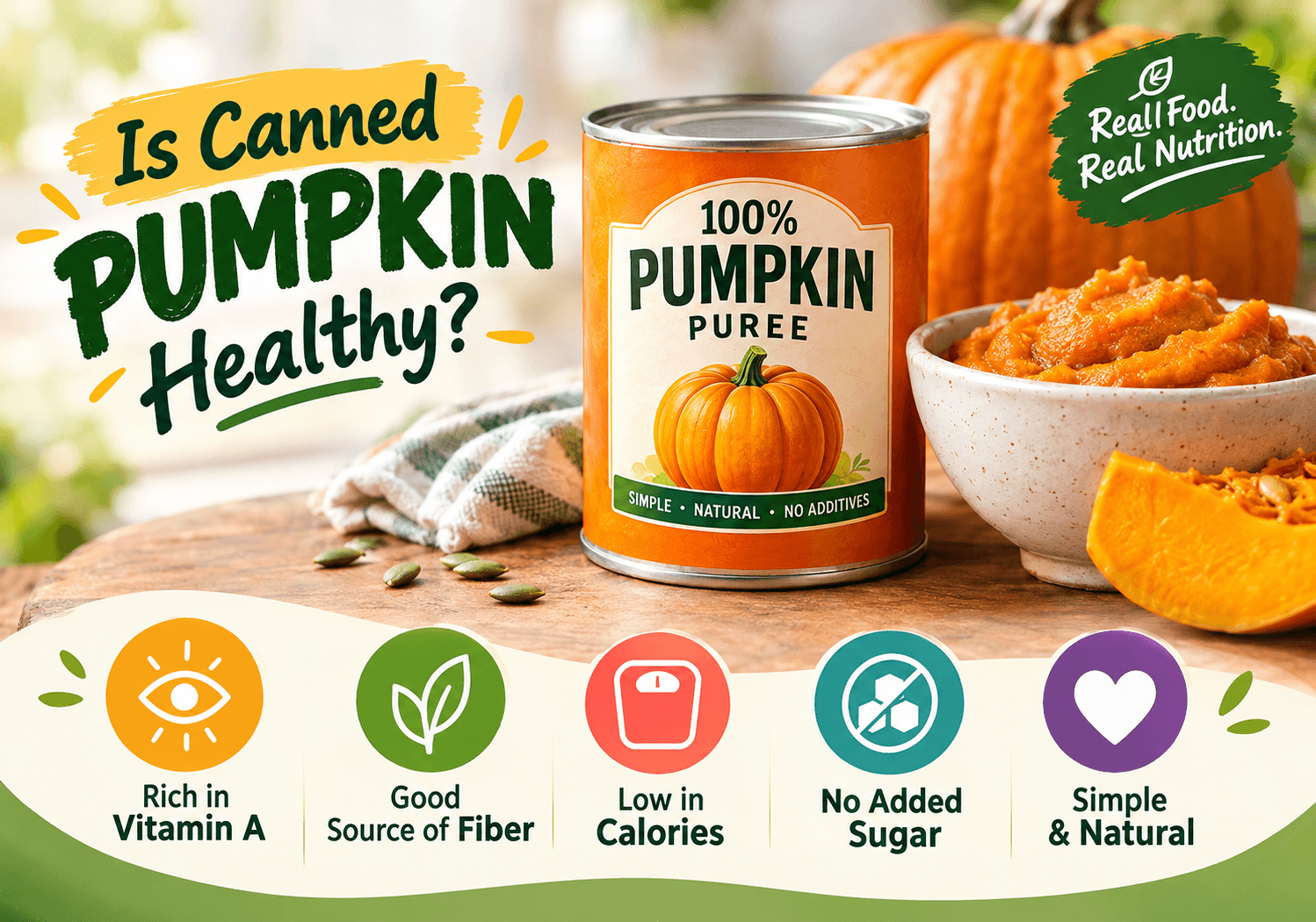
That inexpensive can of pumpkin in your pantry may be one of the most nutritious foods in the store, or a sugary dessert mix in disguise. Two cans can look almost identical on the shelf. So, is canned pumpkin healthy? Plain canned pumpkin is: it’s just cooked, pureed pumpkin, rich in vitamin A and fiber. The catch is knowing which can you’re holding.
This guide explains what’s in canned pumpkin, how it compares to fresh, exactly what to check on the label, and how to store and use it safely.
Key Takeaways
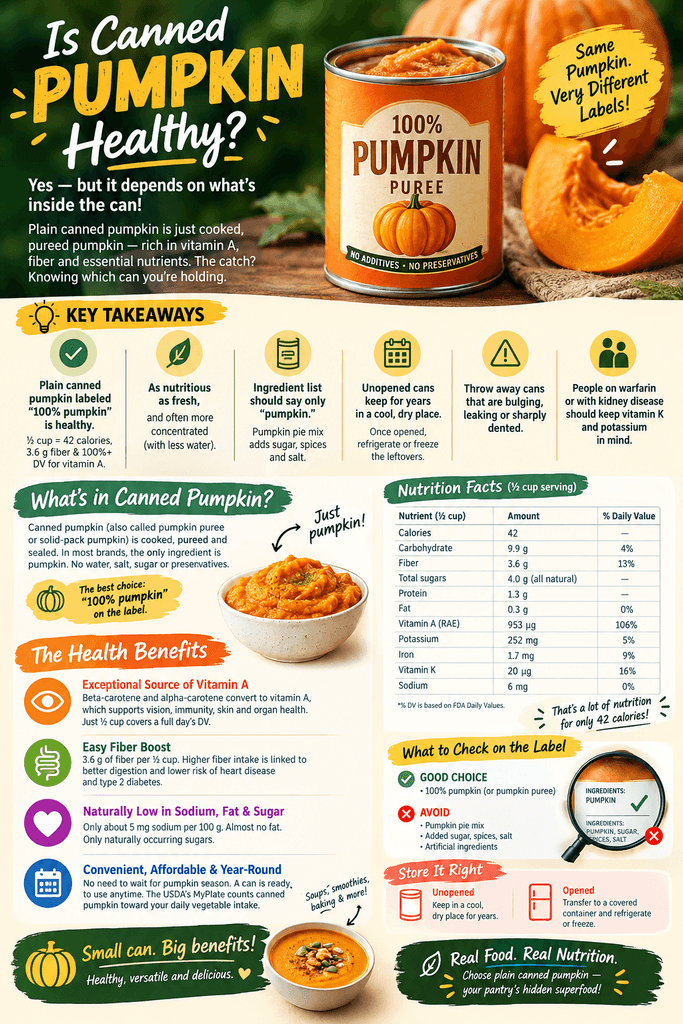
- Plain canned pumpkin labeled “100% pumpkin” is healthy. A ½-cup serving has about 42 calories, 3.6 g fiber and more than 100% of the Daily Value for vitamin A.
- Canned pumpkin is as nutritious as fresh, and often more concentrated, because it contains less water.
- The ingredient list should say only “pumpkin.” Pumpkin pie mix adds sugar, spices and salt.
- Unopened cans keep for years in a cool, dry place. Once opened, move the leftovers to a covered container and refrigerate or freeze them.
- Throw away cans that are bulging, leaking or sharply dented.
- People on warfarin or with kidney disease should keep canned pumpkin’s vitamin K and potassium in mind.
What Is Canned Pumpkin?
Canned pumpkin, also sold as “pumpkin puree” or “solid-pack pumpkin,” is pumpkin that has been cooked, pureed and sealed in a can. In most brands, the only ingredient is pumpkin. Nothing is added: no water, salt, sugar or preservatives.
Pumpkin is a winter squash, and the varieties used for canning are chosen for smooth, dense, sweet flesh rather than the stringy flesh of carving pumpkins. To learn how pumpkin relates to butternut, acorn and other squashes, see our winter squash guide.
Canned Pumpkin Nutrition: What’s in a Serving?
Most canned pumpkin labels list a serving as ½ cup. Based on USDA FoodData Central’s record for canned pumpkin without salt, a ½-cup serving (about 122 g) provides roughly:
| Nutrient (½ cup) | Amount | % Daily Value |
| Calories | 42 | — |
| Carbohydrate | 9.9 g | 4% |
| Fiber | 3.6 g | 13% |
| Total sugars | 4.0 g (all natural) | — |
| Protein | 1.3 g | — |
| Fat | 0.3 g | 0% |
| Vitamin A (RAE) | 953 µg | 106% |
| Potassium | 252 mg | 5% |
| Iron | 1.7 mg | 9% |
| Vitamin K | 20 µg | 16% |
| Sodium | 6 mg | 0% |
% DV is based on FDA Daily Values.
That’s a lot of nutrition for 42 calories. For the full breakdown of raw, cooked and canned pumpkin, including carotenoids and minerals, see our detailed pumpkin nutrition facts.
Is Canned Pumpkin Healthy? The Benefits
Here’s why plain canned pumpkin earns a spot in a healthy pantry.
Exceptional Source of Vitamin A
Canned pumpkin’s orange color comes from beta-carotene and alpha-carotene, which the body converts to vitamin A as needed. According to the NIH Office of Dietary Supplements, vitamin A supports normal vision, immune function and the health of the skin and organs. Just ½ cup of canned pumpkin covers a full day’s Daily Value.
Easy Fiber Boost
With 3.6 grams of fiber per ½ cup, canned pumpkin is one of the simplest ways to add fiber to meals. The Harvard T.H. Chan School of Public Health notes that most people don’t eat enough fiber, and that higher intake is linked with better digestion and lower risk of heart disease and type 2 diabetes.
Naturally Low in Sodium, Fat, and Sugar
Unlike many canned vegetables, plain canned pumpkin is packed without salt, at only about 5 mg of sodium per 100 g. It has almost no fat and only naturally occurring sugars.
Convenient, Affordable, and Available Year-Round
Fresh pie pumpkins are seasonal and take time to roast and puree. A can is ready to use any time of year. The USDA’s MyPlate counts canned vegetables toward your daily vegetable intake and lists pumpkin among the red and orange vegetables.
For a broader look at pumpkin’s health benefits, including the research on vegetable-rich diets, see is pumpkin healthy.
Canned Pumpkin vs. Fresh: Which Is Healthier?
Many people assume fresh is always better. For pumpkin, that’s not the case.
A review of fresh, frozen and canned produce by researchers at the University of California, Davis, published in the Journal of the Science of Food and Agriculture, found that carotenoid levels are “generally similar in comparable fresh and processed products.” Canned products often showed higher carotenoid values, which the authors attributed partly to how results are measured and to better extractability. They also found minimal changes in fiber during processing. They concluded that canned and frozen produce “should not be excluded from recommendations.”
USDA data shows the practical difference. Per cup, plain canned pumpkin has about 7.1 g of fiber and 1,906 µg of vitamin A, while boiled fresh pumpkin has about 2.7 g of fiber and 706 µg of vitamin A. Canned pumpkin holds less water, so you get more pumpkin in every spoonful.
Fresh pumpkin still has its place for roasting and soups. If you’d rather make your own puree, our step-by-step guide shows how to make pumpkin puree. Frozen squash is another good option. See are frozen vegetables healthy.
What to Look for on the Canned Pumpkin Label
This is where a healthy choice is made or missed. Check these five things.
1. The Front of the Can
Look for “100% pure pumpkin,” “pumpkin puree” or “solid-pack pumpkin.” Be wary of “pumpkin pie mix,” “pumpkin pie filling” or “easy pumpkin pie.” These are pre-sweetened and pre-spiced.
2. The Ingredient List
This is the most reliable check. A plain canned pumpkin should list one ingredient: pumpkin. If you see sugar, corn syrup, spices, salt or “natural flavor,” you have pie filling, not puree.
3. Added Sugars
The Nutrition Facts label now shows added sugars separately from total sugars. According to the FDA’s guide to the Nutrition Facts label, added sugars include sugars added during processing, syrups and honey. Plain pumpkin should show 0 g added sugars.
4. Sodium
Plain canned pumpkin is naturally very low in sodium. If a can lists much more than about 10 mg per serving, salt has likely been added. The FDA’s sodium guidance explains label terms: “salt/sodium-free” means under 5 mg per serving, “low sodium” means 140 mg or less, and “no salt added” means no salt was added during processing.
5. % Daily Value and Serving Size
The FDA’s rule of thumb is that 5% DV or less is low and 20% DV or more is high. On a can of plain pumpkin, you should see vitamin A high (often 100% or more) and fiber in the double digits. Remember that the serving size (usually ½ cup) isn’t a recommendation of how much to eat. It’s a standard unit for comparing products.
Quick Label Checklist
| Check | Healthy canned pumpkin | Pumpkin pie mix |
| Ingredients | Pumpkin only | Pumpkin, sugar, spices, salt, flavorings |
| Added sugars | 0 g | Yes |
| Sodium | Very low | Higher |
| Vitamin A | Very high | Lower |
| Best use | Everyday cooking, baking, smoothies | Recipes written for pie mix |
Pumpkin Puree vs. Pumpkin Pie Filling: The Numbers
According to USDA FoodData Central’s record for canned pumpkin pie mix, the difference per 100 grams is large:
| Per 100 g | Plain canned pumpkin | Pumpkin pie mix |
| Calories | 34 | 104 |
| Carbohydrate | 8.1 g | 26.4 g |
| Sodium | 5 mg | 208 mg |
| Vitamin A (RAE) | 778 µg | 415 µg |
Pie mix has about three times the calories, about 40 times the sodium and about half the vitamin A. If a recipe calls for pie mix, like this pumpkin bread, use it. Otherwise, buy plain puree and add your own spices and a smaller amount of sweetener. This maple coconut pumpkin butter is a homemade pie-filling alternative where you control the sugar.
What About BPA in Can Linings?
Some people worry about bisphenol A (BPA), a chemical that has been used in the linings of metal cans. Small amounts can migrate from packaging into food.
The U.S. Food and Drug Administration states that, based on its review of hundreds of studies, “BPA is safe at the current levels occurring in foods” and that it continues to monitor new research. Many manufacturers have moved to cans labeled “BPA-free” or “non-BPA lining.” If you prefer to limit exposure, look for that label, choose pumpkin in cartons or glass, or make your own puree.
Who Should Be Cautious With Canned Pumpkin
People Taking Warfarin
Canned pumpkin contains more vitamin K than fresh, about 16% of the Daily Value per ½ cup. The Office of Dietary Supplements advises people taking warfarin to keep vitamin K intake consistent from day to day. You don’t need to avoid canned pumpkin, but tell your doctor if you start eating a lot more of it.
People With Kidney Disease
Pumpkin is a source of potassium, about 250 mg per ½ cup. The National Institute of Diabetes and Digestive and Kidney Diseases advises that people with chronic kidney disease may need to limit high-potassium foods. Ask your renal dietitian what portion fits your plan.
People Managing Blood Sugar
Plain canned pumpkin has about 10 g of carbohydrate per ½ cup, with 3.6 g of fiber. That fits most diabetes meal plans in reasonable portions, but sweetened pumpkin products are a different story. Our pumpkin recipes for diabetics show balanced ways to use it.
Very High Intake
Eating large amounts of carotene-rich foods every day can give the skin a yellow-orange tint. An NCBI StatPearls review describes this condition, carotenemia, as harmless and reversible.
How to Store Canned Pumpkin Safely
Unopened Cans
Store cans in a cool, dry place, not above the stove or under the sink. According to North Dakota State University Extension, low-acid canned foods like vegetables keep their quality for about two to five years. The “best by” date refers to quality, not safety.
Damaged Cans
Don’t buy or use cans with sharp dents, especially along the seams (NDSU Extension). The CDC warns not to eat food from containers that are leaking, bulging or swollen, look damaged or cracked, spurt liquid or foam when opened, or contain food that’s discolored, moldy or smells bad. Botulism toxin can’t be seen, smelled or tasted, so when in doubt, throw it out.
After Opening
Don’t store leftovers in the open can. Transfer them to a covered container and refrigerate promptly (NDSU Extension), then use them within a few days. For longer storage, freeze leftover pumpkin in measured portions, such as ½ cup in freezer bags or ice cube trays, so it’s ready for recipes.
Homemade Puree
If you make your own puree, freeze it rather than canning it. University of Missouri Extension warns against home-canning mashed or pureed pumpkin, because the puree is too dense for heat to reliably reach the center of the jar.
How Much Canned Pumpkin Should You Eat?
There’s no official limit. A ½-cup serving counts as ½ cup of vegetables toward the 2–4 cups a day MyPlate recommends for most adults. Eating ¼ to 1 cup a day fits easily into a balanced diet for most people. You can eat it straight from the can, since it’s fully cooked, though most people prefer it seasoned or mixed into food.
Easy, Healthy Ways to Use Canned Pumpkin
Carotenoids are fat-soluble. A study in the American Journal of Clinical Nutrition found that people absorbed significantly more carotenoids from vegetables eaten with full-fat dressing than with fat-free or reduced-fat dressing. So pair your pumpkin with a little healthy fat:
- Breakfast: Stir ¼–½ cup into oatmeal, yogurt or smoothies. Try these overnight pumpkin spice oats.
- Pasta night: Blend pumpkin into a creamy sauce like this light pumpkin Alfredo sauce.
- Chili and stews: Pumpkin thickens and adds nutrients. Try this pumpkin sweet potato black bean chili.
- Baking: Replace some of the oil or butter in muffins and quick breads with pumpkin puree.
- Toppings: Finish pumpkin dishes with toasted pepitas for crunch, protein and minerals. See are pumpkin seeds healthy.
Canned Pumpkin Myths vs Facts
Myth: Canned pumpkin isn’t real pumpkin.
Fact: Plain canned pumpkin is cooked pureed pumpkin, typically with no other ingredients. Check the ingredient list to confirm.
Myth: Fresh pumpkin is always more nutritious.
Fact: Research shows carotenoid levels are generally similar in fresh and canned produce. Per cup, canned pumpkin is more concentrated in fiber and vitamin A.
Myth: Canned foods are always high in sodium.
Fact: Plain canned pumpkin is packed without salt and has only about 6 mg sodium per ½ cup.
Myth: Pumpkin puree and pumpkin pie filling are the same.
Fact: Pie filling has added sugar and salt, with about three times the calories per 100 g.
Myth: Canned pumpkin goes bad right after the best-by date.
Fact: “Best by” refers to quality, not safety. Undamaged cans stored properly can last years. Discard any can that’s bulging, leaking or sharply dented.
How Canned Pumpkin Fits a Healthy Lifestyle
Canned pumpkin is a nutrient-rich, low-cost and shelf-stable way to eat more vegetables any time of year. Keep a few cans of 100% pumpkin in your pantry, check the ingredient list every time you buy, and use it in everyday meals, not just fall desserts. Pair it with protein, whole grains and a little healthy fat for balanced meals.
Frequently Asked Questions
Is canned pumpkin as healthy as fresh pumpkin?
Yes. Plain canned pumpkin is as nutritious as fresh and often more concentrated. Research comparing fresh and canned produce found carotenoid levels are generally similar. Per cup, canned pumpkin provides more fiber and vitamin A than boiled fresh pumpkin because it contains less water.
Does canned pumpkin have added sugar?
Plain canned pumpkin labeled “100% pumpkin” has no added sugar, only about 4 grams of natural sugar per half cup. Pumpkin pie mix or filling does contain added sugar. Check the ingredient list and the “Added Sugars” line on the Nutrition Facts label to tell them apart.
How long does canned pumpkin last after opening?
Once opened, move leftover canned pumpkin to a covered container, refrigerate it promptly and use it within a few days. For longer storage, freeze it in measured portions, such as half-cup bags or ice cube trays. Don’t store leftovers in the open can.
Can you eat canned pumpkin straight from the can?
Yes. Canned pumpkin is fully cooked, so it’s safe to eat without heating, as long as the can is undamaged. Most people find it tastes better mixed into oatmeal, yogurt, smoothies or sauces, or seasoned with spices.
Is BPA in canned pumpkin dangerous?
The FDA states that BPA is safe at the current levels found in foods, and it continues to review new research. Many brands now use BPA-free can linings. If you prefer to limit exposure, choose cans labeled BPA-free, cartons or glass jars, or make homemade puree.
How much canned pumpkin can I eat a day?
There’s no official limit. For most people, a quarter cup to one cup a day fits well into a balanced diet. A half cup counts as half a cup of vegetables. People with kidney disease or those taking warfarin should check with their doctor about portions.
Conclusion
So, is canned pumpkin healthy? Yes, as long as it’s plain, 100% pumpkin. A half cup gives you a full day’s vitamin A, nearly 4 grams of fiber and almost no sodium, fat or added sugar, and research suggests canned produce holds its nutrients well compared with fresh. Read the label every time: the ingredient list should say only “pumpkin,” with 0 g added sugars. Store unopened cans somewhere cool and dry, throw away damaged ones, and refrigerate or freeze leftovers in a separate container.
Medical disclaimer: This article is for general educational purposes only and is not a substitute for professional medical advice, diagnosis or treatment. If you take medication such as warfarin or have a condition such as diabetes or kidney disease, talk with your doctor or a registered dietitian before making significant changes to your diet.
(3) References
- U.S. Department of Agriculture. “Pumpkin, canned, without salt” (FDC ID 168450). FoodData Central, SR Legacy. https://fdc.nal.usda.gov/fdc-app.html#/food-details/168450/nutrients
- U.S. Department of Agriculture. “Pumpkin pie mix, canned” (FDC ID 169273). FoodData Central, SR Legacy. https://fdc.nal.usda.gov/fdc-app.html#/food-details/169273/nutrients
- U.S. Food and Drug Administration. “Daily Value on the Nutrition and Supplement Facts Labels.” https://www.fda.gov/food/nutrition-facts-label/daily-value-nutrition-and-supplement-facts-labels
- U.S. Food and Drug Administration. “How to Understand and Use the Nutrition Facts Label.” https://www.fda.gov/food/nutrition-facts-label/how-understand-and-use-nutrition-facts-label
- U.S. Food and Drug Administration. “Sodium in Your Diet.” https://www.fda.gov/food/nutrition-education-resources-materials/sodium-your-diet
- U.S. Food and Drug Administration. “Bisphenol A (BPA): Use in Food Contact Application.” Updated 2023. https://www.fda.gov/food/food-packaging-other-substances-come-contact-food-information-consumers/bisphenol-bpa-use-food-contact-application
- Rickman JC, Bruhn CM, Barrett DM. “Nutritional comparison of fresh, frozen, and canned fruits and vegetables II. Vitamin A and carotenoids, vitamin E, minerals and fiber.” Journal of the Science of Food and Agriculture. 2007. https://ucanr.edu/sites/default/files/2010-06/19188.pdf
- NIH Office of Dietary Supplements. “Vitamin A and Carotenoids: Fact Sheet for Health Professionals.” https://ods.od.nih.gov/factsheets/VitaminA-HealthProfessional/
- NIH Office of Dietary Supplements. “Vitamin K: Fact Sheet for Health Professionals.” https://ods.od.nih.gov/factsheets/VitaminK-HealthProfessional/
- Harvard T.H. Chan School of Public Health. “Fiber.” The Nutrition Source. https://nutritionsource.hsph.harvard.edu/carbohydrates/fiber/
- National Institute of Diabetes and Digestive and Kidney Diseases. “Eating Right for Chronic Kidney Disease.” https://www.niddk.nih.gov/health-information/kidney-disease/chronic-kidney-disease-ckd/eating-nutrition
- Al Nasser Y, Jamal Z, Albugeaey M. “Carotenemia.” StatPearls, NCBI Bookshelf. https://www.ncbi.nlm.nih.gov/books/NBK534878/
- Centers for Disease Control and Prevention. “Home-Canned Foods: Botulism Prevention.” https://www.cdc.gov/botulism/prevention/home-canned-foods.html
- North Dakota State University Extension. “Storing Canned and Packaged Food” (FN1468). 2025. https://www.ndsu.edu/agriculture/sites/default/files/2025-06/FN1468.pdf
- University of Missouri Extension. “Preserving winter squash.” https://extension.missouri.edu/news/preserving-winter-squash
- U.S. Department of Agriculture. “Vegetables.” MyPlate. https://www.myplate.gov/eat-healthy/vegetables
- Brown MJ, et al. “Carotenoid bioavailability is higher from salads ingested with full-fat than with fat-reduced salad dressings.” American Journal of Clinical Nutrition. 2004. https://pubmed.ncbi.nlm.nih.gov/15277161/