Peanuts are America’s favorite “nut”: cheap, crunchy, everywhere, and the main ingredient in a pantry staple. But they’re also one of the most misunderstood foods. They’re technically legumes, they’re sometimes dismissed as junk food at ballgames, and they’re a major allergen. So, are peanuts healthy? Yes, when they’re plain or dry-roasted. Peanuts have more protein than any common tree nut, plenty of heart-healthy fat and fiber, and large studies link eating them regularly to lower rates of heart disease, at a fraction of the price of almonds or walnuts.
This guide covers peanut nutrition, what the research shows, how whole peanuts compare to peanut butter, salted and flavored versions, safety questions about aflatoxin and allergies, and how many to eat.
Key Takeaways
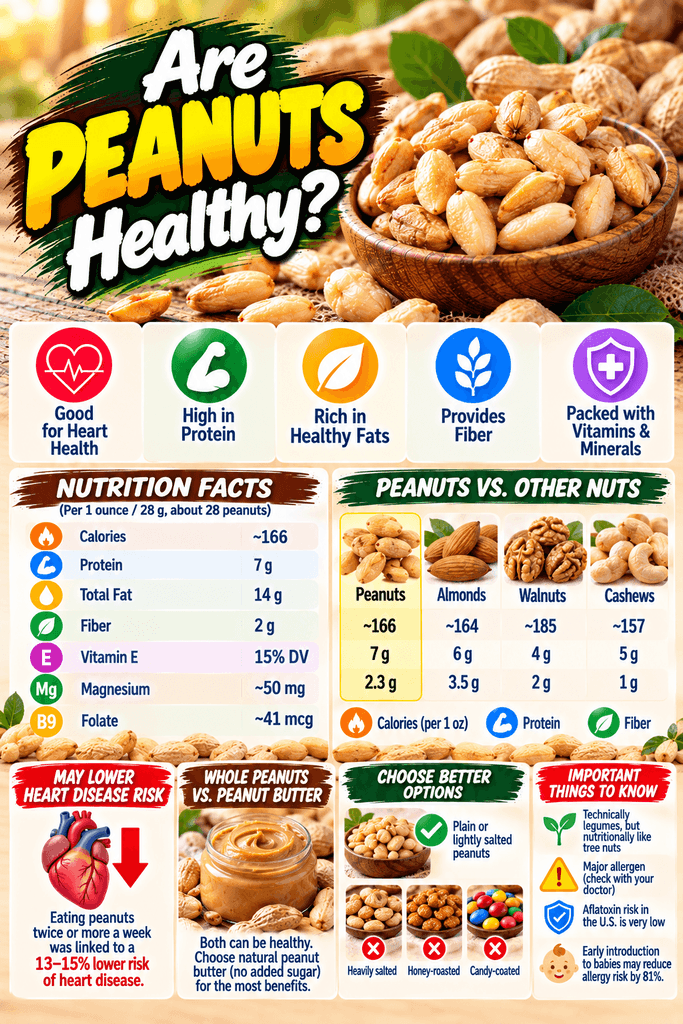
- One ounce of dry-roasted peanuts (about 28 peanuts) has roughly 166 calories, 7 g of protein, 14 g of fat (mostly unsaturated) and 2 g of fiber.
- Peanuts are legumes, but nutritionally they behave like tree nuts, with more protein per ounce than almonds, walnuts or cashews.
- In a study of more than 210,000 adults, eating peanuts twice or more a week was linked to a 13–15% lower risk of cardiovascular disease.
- Choose unsalted or lightly salted, plain peanuts. Heavily salted, honey-roasted and candy-coated versions are a different story.
- Aflatoxin risk in the U.S. is very low thanks to FDA testing.
- Early introduction of peanut foods to babies reduced peanut allergy by 81% in a landmark trial. Follow NIAID guidelines and talk to your pediatrician.
Are Peanuts Nuts or Legumes?
Botanically, peanuts are legumes, members of the bean and pea family. They grow underground in pods, which is why they’re also called groundnuts. Tree nuts like almonds and walnuts grow on trees.
Nutritionally, though, peanuts are much closer to tree nuts than to beans. Like nuts, they’re high in fat and protein and low in carbohydrate. That’s why most nutrition research, including many of the large heart-health studies, groups peanuts with tree nuts. For allergen labeling, the FDA lists peanuts separately from tree nuts as their own major allergen.
For legume cousins with a different profile, see whether chickpeas are healthy and whether black beans are healthy. For how peanuts fit among all nuts, see our complete guide to nuts.
Peanut Nutrition Facts
According to USDA FoodData Central data for dry-roasted peanuts without salt, one ounce (28 g, about 28 peanuts) provides approximately:
| Nutrient (1 oz, dry-roasted, unsalted) | Amount |
| Calories | ~166 |
| Protein | ~6.7 g |
| Total fat | ~14 g |
| Monounsaturated fat | ~7 g |
| Carbohydrate | ~6 g |
| Fiber | ~2.3 g |
| Magnesium | ~50 mg |
| Folate | ~41 mcg |
| Vitamin E | ~2 mg |
| Manganese | ~0.6 mg |
| Sodium | ~2 mg |
Calculated from USDA FoodData Central per-cup values for dry-roasted peanuts without salt (146 g per cup).
What stands out:
- Protein: about 7 g per ounce, the most of any common nut.
- Healthy fats: about half the fat is monounsaturated, the same type found in olive oil.
- Vitamin E: The NIH Office of Dietary Supplements lists 1 ounce of dry-roasted peanuts at 2.2 mg (15% DV).
- Magnesium: The ODS lists ¼ cup of oil-roasted peanuts at 63 mg.
- B vitamins: Peanuts are a good source of folate and niacin.
- Naturally sodium-free: Unsalted peanuts have almost no sodium. Salt is added.
How Peanuts Compare to Tree Nuts
| Nut (1 oz) | Calories | Protein | Fiber | Approx. cost |
| Peanuts | ~166 | ~7 g | ~2.3 g | $ (lowest) |
| Almonds | ~164 | 6 g | 3.5 g | $$ |
| Pistachios | ~159 | 6 g | 3 g | $$$ |
| Cashews | ~157 | 5 g | 1 g | $$ |
| Walnuts | ~185 | 4 g | 2 g | $$ |
Nutrition values from USDA FoodData Central. Cost is a general comparison and varies by region and season.
Peanuts win on protein and price. Almonds have more fiber and vitamin E; see whether almonds are healthy. Rotating peanuts with tree nuts gives you the widest range of nutrients.
Are Peanuts Healthy for Your Heart?
What the Research Shows
The largest study to look at peanuts separately came from three Harvard cohorts with more than 210,000 health professionals, published in the Journal of the American College of Cardiology (2017). According to the American College of Cardiology’s summary, people who ate peanuts two or more times a week had:
- A 13–15% lower risk of cardiovascular disease
- A 15–23% lower risk of coronary heart disease
compared with people who rarely or never ate them. Those are similar to the associations seen for tree nuts.
A 2025 meta-analysis of 63 cohort studies in Archives of Cardiovascular Diseases, covering nuts including peanuts, linked the highest nut intake with a 19% lower risk of coronary heart disease and a 23% lower risk of early death.
These are observational studies, which show associations rather than proof of cause and effect. But they consistently point the same way.
Why Peanuts May Help
- Unsaturated fats help lower LDL cholesterol when they replace saturated fat.
- Fiber and magnesium support healthy blood pressure and blood sugar.
- Plant protein can replace some red and processed meat.
- Swap effect: Replacing chips, cookies or processed snacks with peanuts improves overall diet quality.
Note on peanut oil: Peanut oil has its own profile, without the fiber and protein of whole peanuts. See whether peanut oil is healthy.
Are Peanuts Good for Weight Loss?
Peanuts are calorie-dense, but they’re also among the most filling snacks:
- Protein, fiber and fat together promote fullness.
- Harvard’s Nutrition Source advises using nuts to replace other snacks rather than adding them to your diet.
- In a five-year PREDIMED analysis (Lancet Diabetes & Endocrinology, 2016), adults who added about 30 g of mixed nuts a day to a Mediterranean diet gained no more weight than the control group.
Weight-friendly tips:
- Buy peanuts in the shell. Cracking each one slows you down, and the pile of shells shows how much you’ve eaten.
- Pre-portion 1-ounce servings (about 28 peanuts).
- Pair peanuts with fruit or vegetables instead of eating them by the handful from a jar.
Peanuts vs. Peanut Butter: Which Is Healthier?
Whole peanuts and plain peanut butter are nutritionally similar, since natural peanut butter is just ground peanuts, sometimes with salt. But there are practical differences:
| Whole peanuts | Peanut butter | |
| Ingredients | Just peanuts (plus salt, if salted) | Ranges from “peanuts only” to added sugar, oils and salt |
| Portion control | Easier, especially in-shell | Easy to over-scoop: a spoonful can become three |
| Chewing and satisfaction | More chewing, slower eating | Faster to eat |
| Research | In the Harvard study, peanuts ≥2×/week were linked to lower CVD risk | The same study found no link between peanut butter and stroke risk |
| Best use | Snacks, salads, stir-fries | Toast, oatmeal, smoothies, sauces |
Bottom line: Both can be healthy. Whole peanuts make portion control easier. If you love peanut butter, choose jars where the ingredient list says just “peanuts” (and maybe salt), and measure with a tablespoon.
For more on peanut butter, see:
- Is peanut butter healthy?
- Is peanut butter good for you?
- Is peanut butter toast healthy?
- Is banana and peanut butter healthy?
- Make your own with this homemade peanut butter recipe.
Salted, Honey-Roasted, and Flavored Peanuts
Not all peanuts are equal:
- Raw or dry-roasted, unsalted: The healthiest choice, with almost no sodium.
- Lightly salted: Fine in moderation. Check the label for sodium per serving.
- Heavily salted: Can add significant sodium. The FDA recommends adults limit sodium to less than 2,300 mg a day, and notes that more than 70% of dietary sodium comes from packaged and prepared foods.
- Honey-roasted and candy-coated: Add sugar. Under the 2025–2030 Dietary Guidelines, added sugar should stay under 10 g per meal.
- Oil-roasted: Slightly more fat and calories than dry-roasted.
- Peanut candy and chocolate-covered peanuts: Treats, not health food.
Tip: Mix half unsalted and half salted peanuts to cut sodium without losing flavor.
Are Peanuts Keto-Friendly?
Yes, in moderate portions. Based on USDA data, one ounce of dry-roasted peanuts has about 6 g of total carbohydrate and 2.3 g of fiber, roughly 3.5–4 g of net carbs. That’s more than macadamias or pecans, but still keto-compatible in small amounts. For peanut butter on keto, see is peanut butter keto.
Safety Questions: Aflatoxin, Allergies, and Kidney Stones
Aflatoxin
Aflatoxins are toxins produced by certain molds that can grow on crops like corn, peanuts and tree nuts. According to the National Cancer Institute:
- The FDA tests foods that may contain aflatoxins.
- No outbreak of human illness caused by aflatoxins has been reported in the United States.
- You can lower your exposure further by buying major commercial brands and throwing out any nuts that look moldy, discolored or shriveled.
Peanut Allergy
Peanuts are one of the nine major food allergens identified by the FDA, and peanut allergy can cause life-threatening reactions. If you’re allergic, avoid peanuts and peanut products completely, read every label, and carry prescribed emergency medication.
Good news on prevention: According to the National Institute of Allergy and Infectious Diseases (NIAID), the LEAP study found that introducing peanut-containing foods to infants at high risk of peanut allergy was safe and led to an 81% relative reduction in later peanut allergy. NIAID’s 2017 addendum guidelines recommend:
| Infant risk group | Guidance |
| Severe eczema, egg allergy, or both | Introduce peanut-containing foods as early as 4–6 months. Strongly consider evaluation (blood or skin testing) first. |
| Mild to moderate eczema | Introduce peanut-containing foods around 6 months, usually at home. |
| No eczema or food allergy | Introduce age-appropriate peanut-containing foods according to family preferences. |
Important: Babies and young children should never be given whole peanuts. They’re a choking hazard; the CDC lists whole or chopped nuts among foods to avoid for young children. Use age-appropriate forms, such as smooth peanut butter thinned with water or breast milk, or peanut puffs, and talk to your pediatrician first, especially for high-risk infants.
Kidney Stones
For people who form calcium oxalate kidney stones, the National Institute of Diabetes and Digestive and Kidney Diseases specifically lists peanuts, noting they’re “legumes, not nuts, and are high in oxalate,” among foods to limit. Ask your doctor or dietitian about portions.
How Many Peanuts Should You Eat a Day?
For most adults, about 1 ounce a day (roughly 28 peanuts, about 166 calories) is a sensible portion. That’s in line with the 1-ounce servings used in nut research. The Harvard study linked eating peanuts at least twice a week with lower heart disease risk, so you don’t need to eat them daily to benefit, but daily intake in measured portions is fine for most people.
Is it okay to eat peanuts every day? Yes, for most people without allergies or kidney stone concerns, as long as they’re plain or lightly salted and replace less healthy snacks.
Healthy Ways to Eat Peanuts
- In-shell peanuts as a slow, mindful snack
- Sprinkled on salads and grain bowls for crunch and protein
- In stir-fries with vegetables and tofu or chicken
- In homemade trail mix with raisins and seeds
- Crushed on yogurt or oatmeal
- In peanut sauces made with natural peanut butter, lime and a little soy sauce
- Boiled peanuts, a Southern favorite with a softer, bean-like texture. Watch the salt.
Peanut Myths vs. Facts
Myth: Peanuts are junk food.
Fact: Plain peanuts are a nutrient-dense whole food with protein, fiber, unsaturated fats and vitamins. Heavily salted or candied versions are the problem.
Myth: Peanuts aren’t as healthy as “real” nuts.
Fact: In the Harvard study, peanut intake was linked to lower heart disease risk, similar to tree nuts.
Myth: Peanut butter and peanuts are exactly the same.
Fact: Natural peanut butter is nutritionally similar, but many brands add sugar and oils, and it’s easier to overeat.
Myth: Peanuts are full of dangerous aflatoxin.
Fact: The National Cancer Institute reports no U.S. outbreaks of aflatoxin illness. The FDA tests foods for it.
Myth: Avoiding peanuts in infancy prevents allergy.
Fact: The LEAP study found that early introduction to high-risk infants reduced peanut allergy by 81%. Follow NIAID guidelines with your pediatrician.
Frequently Asked Questions
Are peanuts good for weight loss?
They can be. Peanuts are high in protein and fiber, which help you feel full. Harvard advises using nuts to replace other snacks rather than adding them on top. Buy peanuts in the shell and pre-portion about one ounce, roughly 28 peanuts or 166 calories.
Are salted peanuts bad for you?
Not necessarily, but sodium adds up. The FDA recommends adults keep sodium under 2,300 milligrams a day. Choose unsalted or lightly salted peanuts, check the label, or mix salted and unsalted peanuts. Avoid honey-roasted or candy-coated versions, which add sugar.
Are peanuts healthier than peanut butter?
They’re nutritionally similar if the peanut butter contains only peanuts and maybe salt. Whole peanuts are easier to portion and slower to eat. Many peanut butters add sugar and oils, so read the label and measure with a tablespoon.
Are peanuts good for your heart?
Research suggests so. In a Harvard study of over 210,000 adults, eating peanuts two or more times a week was linked to a 13 to 15 percent lower risk of cardiovascular disease. Choose plain or lightly salted peanuts as part of an overall heart-healthy diet.
Are peanuts high in protein?
Yes. Dry-roasted peanuts have about 7 grams of protein per ounce, more than any common tree nut, including almonds and cashews, according to USDA data. They’re an affordable source of plant protein for snacks and meals.
When can babies eat peanuts?
According to NIAID guidelines, high-risk infants with severe eczema or egg allergy can have peanut-containing foods as early as 4 to 6 months, after evaluation. Others can start around 6 months or as appropriate. Never give whole peanuts to babies, and ask your pediatrician first.
Conclusion
So, are peanuts healthy? Yes. Plain and dry-roasted peanuts are one of the best-value health foods around. They have more protein than any common tree nut, plus heart-healthy fats, fiber, vitamin E, magnesium and B vitamins, and a large Harvard study linked eating them twice or more a week to lower heart disease risk. Choose unsalted or lightly salted versions, keep portions to about an ounce, and pick peanut butter made from just peanuts. Follow NIAID guidelines and talk to your pediatrician about introducing peanut to babies, and if you have a peanut allergy or kidney stone history, follow your doctor’s advice.
Medical disclaimer: This article is for general educational purposes only and is not a substitute for professional medical advice, diagnosis or treatment. If you or your child has a food allergy, eczema, kidney stones or another health condition, talk with your doctor, pediatrician, allergist or a registered dietitian before making changes to your diet.
(3) References
- U.S. Department of Agriculture. “Peanuts, all types, dry-roasted, without salt.” FoodData Central (SR Legacy, NDB 16390). https://fdc.nal.usda.gov/food-search?query=peanuts%20dry-roasted%20without%20salt [VERIFY: swap in the direct FDC record link]
- NIH Office of Dietary Supplements. “Vitamin E: Fact Sheet for Health Professionals.” https://ods.od.nih.gov/factsheets/VitaminE-HealthProfessional/
- NIH Office of Dietary Supplements. “Magnesium: Fact Sheet for Health Professionals.” https://ods.od.nih.gov/factsheets/Magnesium-HealthProfessional/
- Guasch-Ferré M, Liu X, Malik VS, et al. “Nut Consumption and Risk of Cardiovascular Disease.” Journal of the American College of Cardiology. 2017. https://www.jacc.org/doi/10.1016/j.jacc.2017.09.035
- American College of Cardiology. “Nut Consumption Associated With Lower Risk of CVD.” 2017. https://www.acc.org/latest-in-cardiology/articles/2017/11/13/18/05/nut-consumption-associated-with-lower-risk-of-cvd
- Liu M, Wang M, Fu X, et al. “Nut consumption and risk of cardiovascular disease events and all-cause mortality.” Archives of Cardiovascular Diseases. 2025. https://doi.org/10.1016/j.acvd.2025.08.010
- Estruch R, Martínez-González MA, Corella D, et al. “Effect of a high-fat Mediterranean diet on bodyweight and waist circumference.” Lancet Diabetes & Endocrinology. 2016. https://library.fabresearch.org/viewItem.php?id=10338
- Harvard T.H. Chan School of Public Health. “Nuts for the Heart.” The Nutrition Source. https://nutritionsource.hsph.harvard.edu/food-features/nuts-for-the-heart/
- U.S. Food and Drug Administration. “Sodium in Your Diet.” https://www.fda.gov/food/nutrition-education-resources-materials/sodium-your-diet
- Harvard T.H. Chan School of Public Health. “Dietary Guidelines for Americans 2025–2030: Progress on added sugar, protein hype, saturated fat contradictions.” 2026. https://nutritionsource.hsph.harvard.edu/2026/01/09/dietary-guidelines-for-americans-2025-2030-progress-on-added-sugar-protein-hype-saturated-fat-contradictions/
- National Cancer Institute. “Aflatoxins.” https://www.cancer.gov/about-cancer/causes-prevention/risk/substances/aflatoxins
- U.S. Food and Drug Administration. “Food Allergies.” https://www.fda.gov/food/food-labeling-nutrition/food-allergies
- National Institute of Allergy and Infectious Diseases. “Guidelines for Clinicians and Patients for Diagnosis and Management of Food Allergy.” https://www.niaid.nih.gov/diseases-conditions/guidelines-clinicians-and-patients-food-allergy
- National Institute of Allergy and Infectious Diseases. “Addendum Guidelines for the Prevention of Peanut Allergy in the United States: Summary for Clinicians.” 2017. https://www.niaid.nih.gov/sites/default/files/peanut-allergy-prevention-guidelines-clinician-summary.pdf
- Centers for Disease Control and Prevention. “Choking Hazards.” https://www.cdc.gov/infant-toddler-nutrition/foods-and-drinks/choking-hazards.html
- National Institute of Diabetes and Digestive and Kidney Diseases. “Eating, Diet, & Nutrition for Kidney Stones.” https://www.niddk.nih.gov/health-information/urologic-diseases/kidney-stones/eating-diet-nutrition