Every fall, keto dieters face the same question: can I have pumpkin? It’s a vegetable, but it’s sweet, starchy and usually shows up in pies and lattes. So, is pumpkin keto? The answer is yes, in measured portions. Plain pumpkin is moderate in carbs, and a small serving fits within a typical keto carb limit. A full cup, pumpkin pie or a pumpkin spice drink can use up most of your day’s carbs.
This guide explains how net carbs work, gives you the exact carb counts for every form of pumpkin from USDA data, shows how much pumpkin fits a keto day, and shares keto-friendly ways to enjoy it.
Key Takeaways
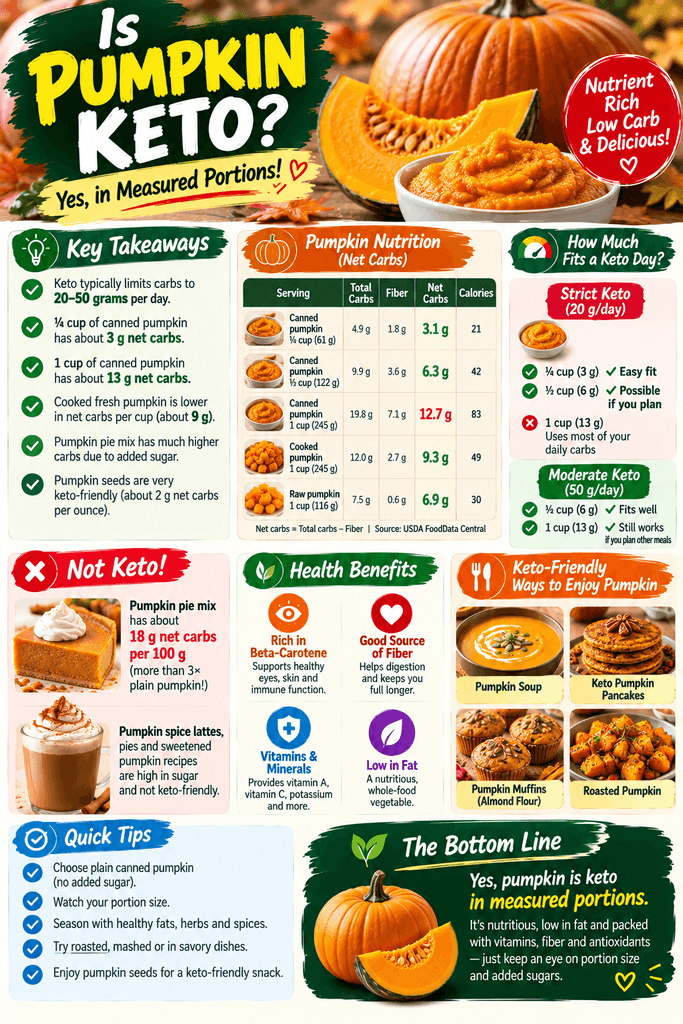
- Keto diets typically limit carbohydrates to 20–50 grams a day.
- ¼ cup of canned pumpkin has about 3 g net carbs, an easy fit for most keto plans.
- 1 cup of canned pumpkin has about 13 g net carbs, which may be half or more of a strict keto day.
- Cooked fresh pumpkin is lower in net carbs per cup (about 9 g) because it holds more water.
- Pumpkin pie mix has about 18 g net carbs per 100 g, more than three times plain canned pumpkin, because of added sugar.
- Pumpkin seeds are very keto-friendly, with roughly 2 g net carbs per ounce.
What Does “Keto” Mean for Carbs?
A ketogenic (keto) diet is a very low-carbohydrate, high-fat eating pattern designed to shift the body into ketosis, a state in which it burns fat and produces ketones for fuel. According to the NCBI StatPearls clinical review of the ketogenic diet, a typical keto diet for weight loss restricts carbohydrates to about 20 to 50 grams a day.
That’s a tight budget. A single medium apple or slice of bread can use up a big share of it. So the real question isn’t just “is pumpkin keto?” It’s “how much pumpkin fits my carb limit?”
For a bigger-picture look at the diet itself, see our article on whether keto is a healthy diet.
Net Carbs Explained
Most keto followers count net carbs rather than total carbs:
Net carbs = Total carbohydrate − Dietary fiber
The logic is that fiber isn’t digested and absorbed the way starches and sugars are, so it has little effect on blood sugar. The FDA’s Nutrition Facts label guide lists Total Carbohydrate, Dietary Fiber, Total Sugars and Added Sugars as separate lines. “Net carbs” isn’t one of them, so you calculate it yourself from the first two.
Because pumpkin has a fair amount of fiber, especially in canned form, its net carbs are noticeably lower than its total carbs.
Is Pumpkin Keto? The Net Carb Numbers
Here are net carbs for every common form of pumpkin, calculated from USDA FoodData Central records for raw pumpkin, cooked pumpkin and canned pumpkin without salt:
| Serving | Total carbs | Fiber | Net carbs | Calories |
| Canned pumpkin, ¼ cup (61 g) | 4.9 g | 1.8 g | 3.1 g | 21 |
| Canned pumpkin, ½ cup (122 g) | 9.9 g | 3.6 g | 6.3 g | 42 |
| Canned pumpkin, 1 cup (245 g) | 19.8 g | 7.1 g | 12.7 g | 83 |
| Cooked, mashed, ½ cup (122 g) | 6.0 g | 1.3 g | 4.7 g | 25 |
| Cooked, mashed, 1 cup (245 g) | 12.0 g | 2.7 g | 9.3 g | 49 |
| Raw cubes, 1 cup (116 g) | 7.5 g | 0.6 g | 6.9 g | 30 |
What this means on keto:
- On a 20 g/day strict plan, ¼ cup of canned pumpkin (3 g net) fits easily. ½ cup (6 g net) is possible if you plan around it. A full cup (13 g net) uses about two-thirds of the day.
- On a 50 g/day moderate plan, ½ to 1 cup fits more comfortably.
Why canned looks higher than fresh: Canned pumpkin has less water than boiled fresh pumpkin, so a cup holds more pumpkin. You get more carbs, but also more fiber and vitamin A. For the full nutrient breakdown, see our pumpkin nutrition facts.
Pumpkin Pie Mix and Pumpkin Spice: Not Keto
The biggest keto trap isn’t pumpkin itself. It’s what’s added to it. According to USDA FoodData Central’s record for canned pumpkin pie mix:
| Per 100 g | Plain canned pumpkin | Pumpkin pie mix |
| Total carbs | 8.1 g | 26.4 g |
| Fiber | 2.9 g | 8.3 g |
| Net carbs | 5.2 g | 18.1 g |
| Calories | 34 | 104 |
Pumpkin pie mix has more than three times the net carbs of plain pumpkin because of added sugar. Traditional pumpkin pie adds a flour crust, which pushes carbs higher still. Pumpkin spice lattes and baked goods are typically sweetened too.
Keto tip: Always buy cans labeled “100% pumpkin.” The ingredient list should say only “pumpkin,” and the Added Sugars line should read 0 g. Our guide on whether canned pumpkin is healthy explains how to read the label.
“Pumpkin spice” itself is just a blend of cinnamon, nutmeg, ginger and cloves, which is essentially carb-free in the small amounts used. The carbs come from the sugar and milk in pumpkin spice drinks.
Pumpkin Seeds: The Most Keto-Friendly Part
If you want pumpkin flavor with almost no carbs, eat the seeds. According to USDA data for roasted pumpkin seed kernels, one ounce (about 28 g) provides roughly:
- About 4 g carbs and 2 g fiber, roughly 2 g net carbs
- 8 g protein
- 14 g fat, mostly unsaturated
- 156 mg magnesium, more than a third of the Daily Value
With 71% of their calories from fat, pumpkin seeds match the keto macronutrient pattern well. They’re calorie-dense, though, at about 160 calories per ounce, so measure your portions. Learn more in are pumpkin seeds healthy.
How Pumpkin Compares to Other Squash on Keto
Pumpkin is actually one of the lower-carb winter squashes. Here are net carbs per cup cooked, from USDA data:
| Per 1 cup cooked | Total carbs | Fiber | Net carbs |
| Pumpkin, boiled | 12.0 g | 2.7 g | 9.3 g |
| Hubbard, baked | 22.1 g | 10.0 g | 12.1 g |
| Butternut, baked | 21.5 g | 6.6 g | 14.9 g |
| Acorn, baked | 29.9 g | 9.0 g | 20.9 g |
Sources: USDA FoodData Central records for Hubbard, butternut and acorn squash.
Acorn and butternut squash are hard to fit into a strict keto day. Spaghetti squash is the lowest-carb winter squash and the most popular keto choice. See is spaghetti squash healthy. For an overview of every variety, visit our winter squash guide.
Why Pumpkin Is Worth Fitting Into a Keto Diet
Keto diets cut out many fruits, whole grains and starchy vegetables, which can leave gaps in fiber and some vitamins. A small serving of pumpkin helps fill them.
Fiber
The StatPearls review lists constipation among the common side effects of a ketogenic diet. A ¼ to ½ cup of canned pumpkin adds 2–4 grams of fiber. The Harvard T.H. Chan School of Public Health notes that fiber supports regular digestion and is linked with better long-term health.
Vitamin A
Just ¼ cup of canned pumpkin provides more than half the Daily Value for vitamin A, from beta-carotene. The NIH Office of Dietary Supplements explains that vitamin A supports vision, immune function, and skin health. Since keto meals are high in fat, the beta-carotene in pumpkin is well absorbed: carotenoids are fat-soluble, and a study in the American Journal of Clinical Nutrition found people absorbed more of them when vegetables were eaten with full-fat dressing.
Potassium
The StatPearls review also notes that micronutrient deficiencies can occur on long-term keto diets. Pumpkin provides potassium, about 250 mg per ½ cup of canned pumpkin, which the Office of Dietary Supplements notes is important for blood pressure regulation.
Who Should Be Cautious
People With Diabetes Taking Medication
The StatPearls review warns that ketogenic diets are contraindicated for people taking SGLT2 inhibitors because of the risk of euglycemic diabetic ketoacidosis. People on insulin or sulfonylureas need close monitoring and careful dose adjustments to avoid low blood sugar. Talk to your doctor before starting keto if you take diabetes medication.
Long-Term Keto Risks
The same review lists possible long-term effects of ketogenic diets, including unhealthy cholesterol changes, fatty liver, kidney stones and reduced bone density. Our article on whether keto is safe covers these concerns in more depth.
Kidney Disease
Pumpkin is a source of potassium, and people with chronic kidney disease may need to limit high-potassium foods, according to the National Institute of Diabetes and Digestive and Kidney Diseases.
How Much Pumpkin Can You Eat on Keto?
There’s no single answer, because carb limits vary. Use this simple guide:
| Your daily net carb limit | Suggested pumpkin portion | Net carbs |
| 20 g (strict) | ¼ cup canned pumpkin | ~3 g |
| 30 g | ¼–½ cup canned pumpkin | 3–6 g |
| 50 g (moderate) | ½–1 cup canned pumpkin | 6–13 g |
Tips for fitting it in:
- Measure, don’t eyeball. ¼ cup and ½ cup look similar but double the carbs.
- Count it in your daily total. Log pumpkin alongside your other vegetables, dairy and nuts.
- Freeze leftovers in ¼-cup portions. Ice cube trays work well, so you’re not tempted to finish the can.
- Pair it with fat and protein. It fits the keto pattern and helps keep meals satisfying.
Keto-Friendly Ways to Eat Pumpkin
- Pumpkin cream cheese mousse: Whip ¼ cup canned pumpkin with cream cheese, cinnamon, nutmeg and a non-nutritive sweetener. See is cream cheese healthy.
- Creamy pumpkin soup: Blend a small amount of pumpkin with broth, coconut milk and spices. Learn more in is coconut milk healthy.
- Keto pumpkin muffins: Use almond flour, eggs and a little pumpkin. Read is almond flour healthy.
- Pumpkin spice “latte”: Stir 1–2 tablespoons of pumpkin and pumpkin spice into coffee with heavy cream. Skip the syrup.
- Roasted pepitas: Toss pumpkin seeds with oil, salt and spices for a crunchy, low-carb snack.
- Savory pumpkin sauce: Simmer a spoonful of pumpkin with cream and Parmesan as a sauce for chicken or roasted cauliflower. Try it over this crispy roasted cauliflower.
Pumpkin and Keto: Myths vs. Facts
Myth: Pumpkin is too high in carbs for keto.
Fact: ¼ cup of canned pumpkin has about 3 g net carbs, which fits most keto plans.
Myth: Canned pumpkin has more sugar than fresh.
Fact: Plain canned pumpkin has no added sugar. It’s just more concentrated than water-heavy boiled pumpkin.
Myth: Pumpkin pie filling is basically the same as pumpkin puree.
Fact: Pie mix has more than three times the net carbs per 100 g because of added sugar.
Myth: All winter squash is equally keto-friendly.
Fact: Pumpkin and spaghetti squash are lower in net carbs. Acorn squash has more than twice pumpkin’s net carbs per cup.
Myth: Pumpkin spice is high in carbs.
Fact: The spice blend is nearly carb-free. The sugar and milk in pumpkin spice drinks are the problem.
How Pumpkin Fits a Healthy Keto (or Low-Carb) Lifestyle
Pumpkin can be one of the more nutritious carbs in a keto diet. In small portions, it adds fiber, vitamin A and potassium, nutrients keto dieters can fall short on, without knocking you out of your carb range. Treat it as a measured ingredient rather than a side dish, choose 100% pumpkin over pie mix, and lean on pumpkin seeds for low-carb crunch. If you follow keto long-term, work with a healthcare provider to monitor your cholesterol, kidney health and nutrient intake.
Frequently Asked Questions
How many net carbs are in pumpkin?
According to USDA data, a quarter cup of canned pumpkin has about 3 grams of net carbs, and a full cup has about 13 grams. A cup of cooked fresh pumpkin has about 9 grams of net carbs, because it contains more water. Pumpkin pie mix is much higher because of added sugar.
Can you eat canned pumpkin on keto?
Yes, in small portions. A quarter cup of plain canned pumpkin has about 3 grams of net carbs, which fits most keto plans. Choose cans labeled 100% pumpkin with 0 grams of added sugar, and avoid pumpkin pie mix, which is sweetened.
How much pumpkin can I eat on keto?
It depends on your daily carb limit. On a strict 20-gram plan, a quarter cup of canned pumpkin is a safe portion. On a moderate 50-gram plan, half a cup to a full cup may fit. Measure portions and count them in your daily total.
Are pumpkin seeds keto-friendly?
Yes. Roasted pumpkin seeds have roughly 2 grams of net carbs per ounce, along with about 8 grams of protein and 14 grams of mostly unsaturated fat. They’re calorie-dense at about 160 calories per ounce, so measure your portion.
Is pumpkin pie keto?
Traditional pumpkin pie isn’t keto. The filling contains added sugar, and the crust is made with wheat flour. Pumpkin pie mix alone has about 18 grams of net carbs per 100 grams. Keto versions use plain pumpkin, a sugar substitute and an almond flour crust.
Is pumpkin lower in carbs than butternut squash?
Yes. According to USDA data, a cup of cooked pumpkin has about 9 grams of net carbs, compared with about 15 grams for baked butternut squash and 21 grams for acorn squash. Pumpkin and spaghetti squash are among the most keto-friendly winter squashes.
Conclusion
So, is pumpkin keto? Yes, if you watch the portion. A quarter cup of plain canned pumpkin has about 3 grams of net carbs, so it fits even a strict 20-gram day, while a full cup uses most of that budget. Skip pumpkin pie mix and sweetened pumpkin drinks, which carry several times the carbs. Lean on pumpkin seeds for a nearly carb-free pumpkin fix. And if you take diabetes medication or have kidney disease, talk to your doctor before starting keto.
Medical disclaimer: This article is for general educational purposes only and is not a substitute for professional medical advice, diagnosis or treatment. Ketogenic diets are not appropriate for everyone. If you have diabetes, kidney disease or another health condition, or take medication, talk with your doctor or a registered dietitian before starting a ketogenic diet.
(3) References
- Daley SF, Masood W, Annamaraju P, Khan Suheb MZ. “The Ketogenic Diet.” StatPearls, NCBI Bookshelf. 2025. https://www.ncbi.nlm.nih.gov/books/NBK499830/
- U.S. Department of Agriculture. “Pumpkin, raw” (FDC ID 168448). FoodData Central. https://fdc.nal.usda.gov/fdc-app.html#/food-details/168448/nutrients
- U.S. Department of Agriculture. “Pumpkin, cooked, boiled, drained, without salt” (FDC ID 168449). FoodData Central. https://fdc.nal.usda.gov/fdc-app.html#/food-details/168449/nutrients
- U.S. Department of Agriculture. “Pumpkin, canned, without salt” (FDC ID 168450). FoodData Central. https://fdc.nal.usda.gov/fdc-app.html#/food-details/168450/nutrients
- U.S. Department of Agriculture. “Pumpkin pie mix, canned” (FDC ID 169273). FoodData Central. https://fdc.nal.usda.gov/fdc-app.html#/food-details/169273/nutrients
- U.S. Department of Agriculture. “Seeds, pumpkin and squash seed kernels, roasted, without salt” (FDC ID 170557). FoodData Central. https://fdc.nal.usda.gov/fdc-app.html#/food-details/170557/nutrients
- U.S. Department of Agriculture. “Squash, winter, hubbard, baked, without salt” (FDC ID 168476). FoodData Central. https://fdc.nal.usda.gov/fdc-app.html#/food-details/168476/nutrients
- U.S. Department of Agriculture. “Squash, winter, butternut, cooked, baked, without salt” (FDC ID 169296). FoodData Central. https://fdc.nal.usda.gov/fdc-app.html#/food-details/169296/nutrients
- U.S. Department of Agriculture. “Squash, winter, acorn, cooked, baked, without salt” (FDC ID 169293). FoodData Central. https://fdc.nal.usda.gov/fdc-app.html#/food-details/169293/nutrients
- U.S. Food and Drug Administration. “How to Understand and Use the Nutrition Facts Label.” https://www.fda.gov/food/nutrition-facts-label/how-understand-and-use-nutrition-facts-label
- Harvard T.H. Chan School of Public Health. “Fiber.” The Nutrition Source. https://nutritionsource.hsph.harvard.edu/carbohydrates/fiber/
- NIH Office of Dietary Supplements. “Vitamin A and Carotenoids: Fact Sheet for Health Professionals.” https://ods.od.nih.gov/factsheets/VitaminA-HealthProfessional/
- NIH Office of Dietary Supplements. “Potassium: Fact Sheet for Health Professionals.” https://ods.od.nih.gov/factsheets/Potassium-HealthProfessional/
- Brown MJ, et al. “Carotenoid bioavailability is higher from salads ingested with full-fat than with fat-reduced salad dressings.” American Journal of Clinical Nutrition. 2004. https://pubmed.ncbi.nlm.nih.gov/15277161/
- National Institute of Diabetes and Digestive and Kidney Diseases. “Eating Right for Chronic Kidney Disease.” https://www.niddk.nih.gov/health-information/kidney-disease/chronic-kidney-disease-ckd/eating-nutrition