Omega-3 fats are among the most talked-about nutrients for heart and brain health. Most people think of salmon and fish oil, but many people also look to plant foods, especially nuts. So, which nuts are highest in omega-3? And can nuts actually help you meet your needs?
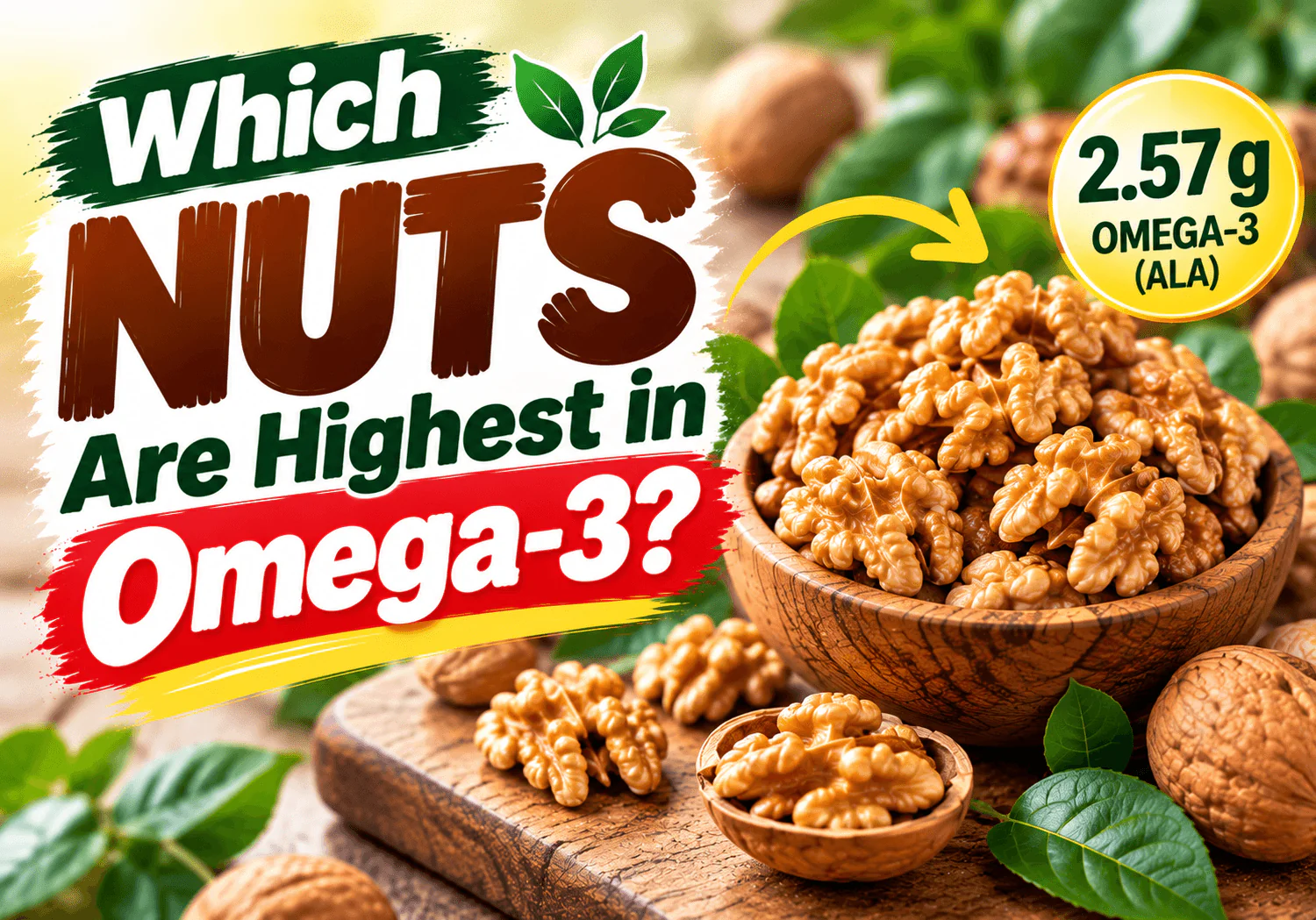
The answer is surprisingly lopsided. One nut, the English walnut, stands far ahead of every other. A single ounce of walnuts gives you more plant omega-3 than adults need in a day. Most other nuts contain almost none. This guide ranks every common nut by omega-3 content using USDA data, compares nuts with seeds and fish, explains what plant omega-3 can and can’t do, and shows how to work omega-3-rich nuts into your diet.
Key Takeaways
- English walnuts are by far the highest omega-3 nut, with about 2.57 g of ALA per ounce. That’s more than the daily Adequate Intake for both men (1.6 g) and women (1.1 g).
- Black walnuts come second (about 0.76 g per ounce), then pecans (about 0.28 g).
- Most other nuts, including almonds, cashews, peanuts, Brazil nuts, and hazelnuts, have almost no omega-3.
- Seeds beat most nuts: chia (5.06 g per ounce), flaxseed (2.35 g per tablespoon), and hemp seeds (about 3 g per 3 tablespoons).
- Nuts provide ALA, a plant omega-3. Your body converts only under 15% of it to EPA and DHA, the omega-3s in fish.
- Higher ALA intake is linked to lower risk of death from heart disease and all causes.
Do Nuts Have Omega-3? The Short Answer
Some do, and some don’t. Nuts contain a plant form of omega-3 called alpha-linolenic acid (ALA). The amount varies enormously:
- English walnuts are an excellent source.
- Black walnuts and pecans provide a modest amount.
- Almonds, cashews, peanuts, Brazil nuts, hazelnuts, macadamias, pistachios, and pine nuts provide very little.
ALA is an essential fat: your body can’t make it, so you must get it from food. According to the NIH Office of Dietary Supplements (ODS), the Adequate Intake for adults aged 19–50 is:
- Men: 1.6 g of ALA a day
- Women: 1.1 g of ALA a day
One ounce of English walnuts covers both.
Which Nuts Are Highest in Omega-3? The Full Ranking
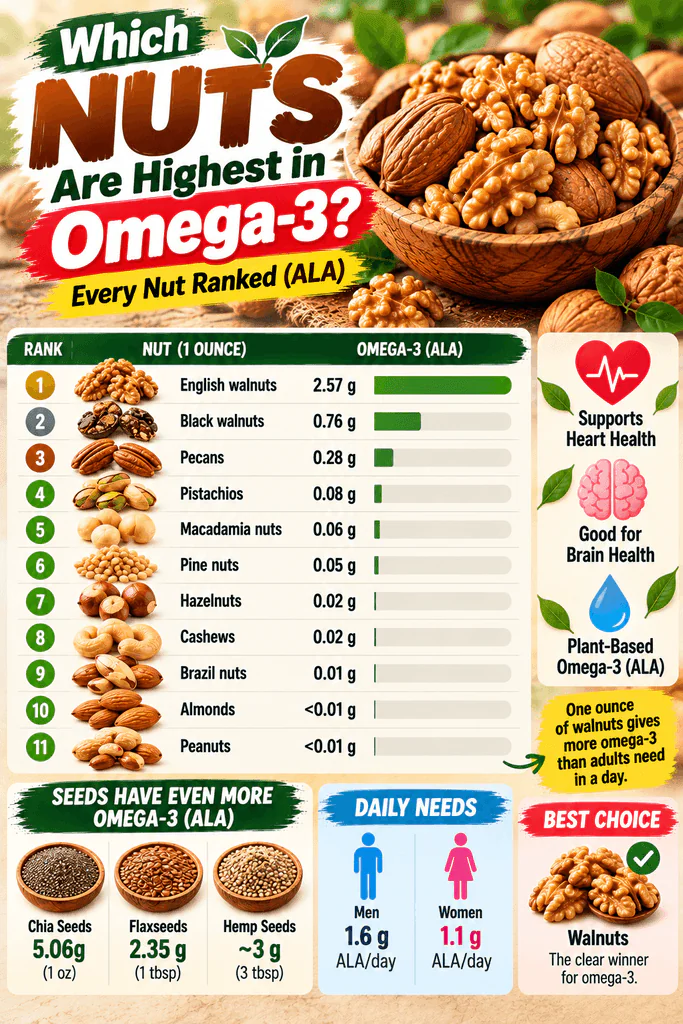
All values are ALA per 1 ounce (28 g), calculated from USDA FoodData Central SR Legacy records.
| Rank | Nut (1 oz) | ALA omega-3 | % of women’s AI (1.1 g) | % of men’s AI (1.6 g) |
| 1 | English walnuts | 2.57 g | 234% | 161% |
| 2 | Black walnuts | 0.76 g | 69% | 48% |
| 3 | Pecans | 0.28 g | 25% | 18% |
| 4 | Pistachios | 0.08 g | 7% | 5% |
| 5 | Macadamia nuts | 0.06 g | 5% | 4% |
| 6 | Pine nuts | 0.05 g | 4% | 3% |
| 7 | Brazil nuts | 0.01 g | 1% | <1% |
| 8 | Hazelnuts | 0.02 g | 2% | 2% |
| 9 | Cashews | 0.02 g | 2% | 1% |
| 10 | Almonds | <0.01 g | <1% | <1% |
| 10 | Peanuts | <0.01 g | <1% | <1% |
What this means:
- Walnuts are in a league of their own. They contain about 9 times more ALA than pecans and over 100 times more than cashews.
- Almonds and peanuts, though excellent foods for other reasons, have essentially no omega-3.
- If omega-3 is your goal, walnuts should be your nut of choice. For their full nutrition profile, see whether walnuts are healthy.
Nuts vs Seeds vs Oils: The Best Plant Sources of Omega-3
Walnuts lead the nuts, but some seeds contain even more ALA. Values come from the ODS omega-3 fact sheet and USDA FoodData Central.
| Food | Serving | ALA omega-3 |
| Flaxseed oil | 1 tbsp | 7.26 g |
| Chia seeds | 1 oz (about 2 tbsp) | 5.06 g |
| Hemp seeds, hulled | 3 tbsp (30 g) | ~3.0 g |
| English walnuts | 1 oz | 2.57 g |
| Flaxseed, whole | 1 tbsp | 2.35 g |
| Canola oil | 1 tbsp | 1.28 g |
| Soybean oil | 1 tbsp | 0.92 g |
| Black walnuts | 1 oz | 0.76 g |
| Pecans | 1 oz | 0.28 g |
Takeaways:
- Chia and flax are the most concentrated plant sources. Grind flaxseed so your body can absorb its nutrients, since whole seeds may pass through undigested.
- Walnuts are the best nut. They also bring protein, fiber, magnesium, and polyphenols. As a handful you can snack on, they’re easy to eat every day.
- Combining sources works well. Walnuts on oatmeal with a tablespoon of ground flax easily provides 4–5 g of ALA.
Pumpkin seeds are excellent for magnesium and protein but are low in omega-3. See whether pumpkin seeds are healthy.
ALA vs. EPA and DHA: What Nuts Can and Can’t Do
There are three main omega-3s:
| Omega-3 | Main sources | Role |
| ALA (alpha-linolenic acid) | Walnuts, flax, chia, hemp, canola and soybean oil | Essential fat. Energy source. Partly converted to EPA/DHA |
| EPA (eicosapentaenoic acid) | Fatty fish, fish oil, algae oil | Heart, inflammation regulation |
| DHA (docosahexaenoic acid) | Fatty fish, fish oil, algae oil | Brain, eyes, nervous system |
Your body can turn ALA into EPA and then DHA, but only to a limited extent. The ODS fact sheet reports conversion rates of less than 15%. It notes that eating EPA and DHA directly from foods or supplements is the only practical way to raise their levels in your body.
What this means for you:
- Walnuts are an excellent source of ALA, but not a replacement for fish if you want EPA and DHA.
- The Dietary Guidelines, cited by the FDA, recommend at least 8 ounces of seafood a week for most adults, and 8–12 ounces of lower-mercury fish for pregnant or breastfeeding people.
- Vegans and vegetarians can get ALA from walnuts, flax, chia, and hemp. If they want EPA and DHA, they can talk with a health professional about algae-based supplements.
For more on fish and supplements, see our guide on whether fish oil lowers cholesterol.
Health Benefits of Plant Omega-3 From Nuts
Lower risk of death from heart disease
The biggest review of ALA, a 2021 meta-analysis in The BMJ, pooled 41 cohort studies with nearly 1.2 million participants. People with the highest ALA intake, compared with the lowest, had:
- 10% lower risk of death from all causes
- 8% lower risk of death from cardiovascular disease
- 11% lower risk of death from coronary heart disease
Each additional 1 gram a day of ALA was linked to a 5% lower risk of death from all causes and from cardiovascular disease. That’s less than half an ounce of walnuts.
The study also found a slightly higher cancer mortality risk with high ALA intake (6%). The authors called for more research, and the finding didn’t apply to all sources. As with all observational research, these are associations, not proof of cause and effect.
Walnuts and heart health
Walnuts have their own body of evidence:
- FDA claim. In 2004, the FDA allowed a qualified health claim for walnuts and heart disease.
- Large cohort. In a study of about 210,000 U.S. adults in the Journal of the American College of Cardiology, eating walnuts once or more a week was linked to a 19% lower risk of cardiovascular disease.
- Two-year trial. In the WAHA trial in Circulation [VERIFY DOI], 628 older adults who ate walnuts daily for two years lowered LDL cholesterol by about 4.3 mg/dL. They also reduced harmful small LDL particles by about 6%.
These benefits likely come from walnuts’ whole package: ALA, other polyunsaturated fats, fiber, and polyphenols. Our guide on whether nuts are good for your heart covers the broader evidence.
Other potential benefits
Research is exploring ALA and walnuts for inflammation, brain aging, and blood vessel function. The evidence there is earlier-stage. It’s reasonable to view walnuts as part of a healthy diet, but not as a treatment for any condition.
Who Benefits Most From Omega-3-Rich Nuts
- Vegetarians and vegans, who don’t eat fish and rely on plant ALA.
- People who rarely eat fish. Walnuts help fill the ALA gap, though they don’t replace EPA and DHA.
- People with high LDL cholesterol or heart disease risk, who benefit from walnuts’ cholesterol-lowering effect.
- People with diabetes, who face higher heart risk. See which nuts are best for diabetics.
- Anyone building a heart-healthy snack routine, since walnuts are easy to add to daily meals.
Risks and Who Should Be Careful
Tree nut allergy
Walnuts and pecans are tree nuts, one of the major food allergens that the FDA requires on labels. If you’re allergic, flax, chia, and hemp seeds are alternatives, with your allergist’s approval.
Calories
Walnuts have about 185 calories per ounce. They don’t cause weight gain in normal portions, but large amounts add up. See whether nuts are fattening.
Rancidity
The polyunsaturated fats that make walnuts valuable also make them prone to going rancid. Rancid nuts taste bitter and smell like paint, and their fats have oxidized. Store walnuts in an airtight container in the fridge or freezer.
High-heat roasting
A Food Chemistry study found that roasting walnuts at higher temperatures increased a marker of fat oxidation about 17-fold and lowered their antioxidant capacity. For maximum omega-3 benefit, choose raw or lightly toasted walnuts. Our guide on whether roasted nuts are healthy explains more.
Omega-3 supplements are different
Omega-3 supplements, mainly fish oil, aren’t the same as eating walnuts. The ODS notes that high-dose supplements (4 g a day) slightly increased atrial fibrillation risk in two large trials. People taking warfarin should have their blood clotting monitored. Talk with your doctor before starting supplements.
How Many Walnuts Do You Need for Omega-3?
| Goal | Amount of English walnuts | ALA |
| Meet women’s AI (1.1 g) | About ½ oz (7 halves) | ~1.3 g |
| Meet men’s AI (1.6 g) | About ⅔ oz (9–10 halves) | ~1.7 g |
| Typical heart-healthy serving | 1 oz (about 14 halves) | 2.57 g |
| WAHA trial amount | 30–60 g a day | ~2.7–5.4 g |
For most people, ½ to 1 ounce of walnuts a day easily meets ALA needs.
Practical Ways to Add Omega-3-Rich Nuts to Your Diet
- Top your breakfast. Sprinkle chopped walnuts and a tablespoon of ground flax over oatmeal or yogurt for about 4–5 g of ALA.
- Upgrade salads. Use walnuts or pecans instead of croutons.
- Make walnut pesto. Swap pine nuts for walnuts, which have about 50 times more ALA.
- Snack smart. A handful of walnuts with an apple or pear makes a filling snack.
- Bake with them. Add walnuts to muffins, banana bread, or energy bites, though high oven heat may oxidize some of the fat.
- Mix your own trail mix. Combine walnuts, pecans, pumpkin seeds, and a few dried berries.
- Use canola or soybean oil for cooking to add a little more ALA.
- Don’t forget fish. Include fatty fish like salmon or sardines twice a week for EPA and DHA, if you eat fish.
Myths vs. Facts
| Myth | Fact |
| All nuts are good sources of omega-3. | Only walnuts are excellent. Black walnuts and pecans are modest, and the rest have almost none. |
| Almonds are high in omega-3. | Almonds contain essentially no omega-3, though they’re rich in vitamin E and fiber. |
| Walnut omega-3 is the same as fish oil. | Walnuts provide ALA. Fish provides EPA and DHA. Your body converts less than 15% of ALA. |
| Eating walnuts means you don’t need fish. | Walnuts cover ALA, but fish (or algae oil) is the practical source of EPA and DHA. |
| Roasting doesn’t affect walnut fats. | High-heat roasting increases fat oxidation in walnuts. Raw or lightly toasted is best. |
| More omega-3 is always better. | Food sources are safe, but high-dose supplements carry some risks. |
How Omega-3 Nuts Fit a Healthy Lifestyle
Think of walnuts as your daily plant omega-3 anchor, part of a varied, mostly whole-food diet. A practical pattern:
- Daily: ½–1 oz of walnuts, plus ground flax or chia a few times a week
- Weekly: fatty fish twice a week, if you eat fish
- Overall: plenty of vegetables, fruits, whole grains, legumes, and healthy oils
Other nuts still matter for their own strengths. Almonds bring fiber and vitamin E, pistachios bring protein and plant sterols, and peanuts lead on protein, as our guide on whether nuts are high in protein shows. For a full overview, see our complete guide to nuts.
Frequently Asked Questions
Which nut has the most omega-3?
English walnuts have by far the most omega-3, about 2.57 grams of ALA per ounce, more than the daily Adequate Intake for adults. Black walnuts come second with about 0.76 grams, and pecans third with about 0.28 grams. Most other nuts, including almonds and cashews, contain almost no omega-3.
Do almonds have omega-3?
Almonds contain essentially no omega-3, less than 0.01 grams per ounce, according to USDA data. They’re still a very healthy nut, rich in vitamin E, fiber, magnesium, and protein. If you want omega-3 from nuts, choose walnuts, or add flax or chia seeds to your diet.
Can you get enough omega-3 from nuts?
You can easily meet the ALA requirement from nuts. Half an ounce to one ounce of walnuts covers adults’ daily Adequate Intake. However, your body converts less than 15% of ALA into EPA and DHA, the omega-3s found in fish. Fish or algae oil is the practical way to get those.
Are walnuts better than fish for omega-3?
Walnuts and fish provide different omega-3s. Walnuts supply ALA, while fatty fish supply EPA and DHA, which your body uses directly. Walnuts are excellent for meeting ALA needs and supporting heart health, but they don’t replace fish for EPA and DHA. Ideally, include both if you eat fish.
Which seeds are highest in omega-3?
Chia seeds are among the highest, at about 5 grams of ALA per ounce. Flaxseed provides about 2.35 grams per tablespoon, and ground flax is best absorbed. Hemp seeds offer about 3 grams per three tablespoons. All are excellent for vegetarians and people with tree nut allergies.
Do roasted walnuts lose their omega-3?
High-temperature roasting can damage walnut fats. One study found a marker of fat oxidation rose about 17-fold in walnuts roasted at higher temperatures. Lightly toasted walnuts are fine, but raw walnuts best preserve their omega-3s. Store walnuts in the fridge or freezer to prevent rancidity.
Conclusion
So, which nuts are highest in omega-3? English walnuts win by a wide margin, at about 2.57 grams of ALA per ounce, more than adults need daily. Black walnuts and pecans follow at much lower levels, and most other nuts contain almost none.
Eat about ½ to 1 ounce of walnuts a day, add ground flax or chia for extra ALA, and keep walnuts fresh in the fridge. Because plant ALA converts poorly to EPA and DHA, fatty fish (or an algae-based supplement for vegans, with medical advice) remains important. Together, these choices support a heart-healthy diet.
Medical disclaimer: This article is for general information only and isn’t a substitute for professional medical or nutrition advice. If you have a nut allergy, heart disease, take blood thinners, or are considering omega-3 supplements, talk with your doctor or a registered dietitian.
3. References
- NIH Office of Dietary Supplements. Omega-3 Fatty Acids: Fact Sheet for Health Professionals. Updated September 2026. https://ods.od.nih.gov/factsheets/Omega3FattyAcids-HealthProfessional/
- USDA FoodData Central. Nuts, walnuts, English (FDC 170187). https://fdc.nal.usda.gov/fdc-app.html#/food-details/170187/nutrients
- USDA FoodData Central. Nuts, walnuts, black, dried (FDC 170186). https://fdc.nal.usda.gov/fdc-app.html#/food-details/170186/nutrients
- USDA FoodData Central. Nuts, pecans (FDC 170182); pistachio nuts, raw (170184); macadamia nuts, raw (170178); pine nuts, dried (170591). https://fdc.nal.usda.gov/
- USDA FoodData Central. Nuts, brazilnuts (170569); hazelnuts (170581); cashew nuts, raw (170162); almonds (170567); peanuts, raw (172430). https://fdc.nal.usda.gov/
- USDA FoodData Central. Seeds, hemp seed, hulled (FDC 170148). https://fdc.nal.usda.gov/fdc-app.html#/food-details/170148/nutrients
- Naghshi S, Aune D, Beyene J, Mobarak S, Asadi M, Sadeghi O. Dietary intake and biomarkers of alpha linolenic acid and risk of all cause, cardiovascular, and cancer mortality: systematic review and dose-response meta-analysis of cohort studies. BMJ. 2021;375:n2213. https://www.bmj.com/content/375/bmj.n2213.long [VERIFY author list]
- U.S. Food and Drug Administration. Qualified Health Claims: Letters of Enforcement Discretion (Walnuts and Coronary Heart Disease, 2004). https://www.fda.gov/food/food-labeling-nutrition/qualified-health-claims-letters-enforcement-discretion
- Guasch-Ferré M, Liu X, Malik VS, et al. Nut consumption and risk of cardiovascular disease. Journal of the American College of Cardiology. 2017;70(20):2519–2532. https://doi.org/10.1016/j.jacc.2017.10.019
- Rajaram S, Cofán M, Sala-Vila A, et al. Effects of walnut consumption for 2 years on lipoprotein subclasses among healthy elders: findings from the WAHA randomized controlled trial. Circulation. 2021;144. https://doi.org/10.1161/CIRCULATIONAHA.121.054051 [VERIFY DOI]
- U.S. Food and Drug Administration. Advice about Eating Fish. https://www.fda.gov/food/consumers/advice-about-eating-fish
- Schlörmann W, Birringer M, Böhm V, et al. Influence of roasting conditions on health-related compounds in different nuts. Food Chemistry. 2015;180:77–85. https://doi.org/10.1016/j.foodchem.2015.02.017
- U.S. Food and Drug Administration. Food Allergies. https://www.fda.gov/food/food-labeling-nutrition/food-allergies