Nuts are often described as a “protein snack.” But if you’ve ever compared a handful of almonds with a chicken breast or a cup of Greek yogurt, you may have wondered whether the label fits. So, are nuts high in protein, or are they mostly fat with a little protein on the side?
The honest answer: nuts are a good source of protein, but not a high-protein food in the way meat, fish, eggs, or beans are. Most nuts give you 4–7 grams of protein per ounce, along with 160–200 calories. Some nuts deliver far more protein than others. This guide ranks every common nut by protein and explains how nut protein compares with animal and other plant sources. It also covers how to use nuts to help meet your daily protein needs.
Key Takeaways
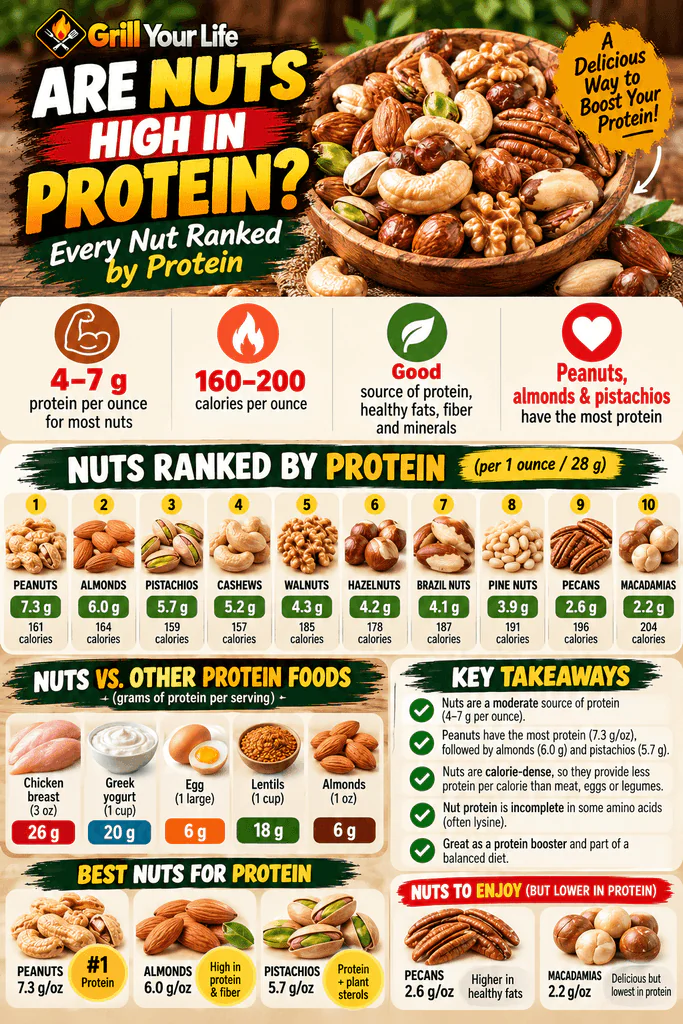
- Nuts are a moderate source of protein. Most provide 4–7 g per ounce (28 g), about the same as one egg.
- Peanuts have the most protein (7.3 g/oz), followed by almonds (6.0 g) and pistachios (5.7 g). Macadamias (2.2 g) and pecans (2.6 g) have the least.
- Nuts are calorie-dense, so per calorie they offer far less protein than lean meat, eggs, or legumes. Most nut calories come from fat.
- Nut protein is incomplete or limited in some amino acids (often lysine). Pistachios score better than most.
- Swapping red meat for nuts as a protein source is linked to lower heart disease risk.
- Use nuts as a protein booster, not your main protein source.
Are Nuts High in Protein? The Short Answer
Nuts contain meaningful protein, but they’re best described as a moderate source rather than a high-protein food.
According to Harvard Health, the RDA for protein is 0.8 grams per kilogram of body weight. That works out to about 0.36 grams per pound, or roughly 50–60 grams a day for many adults. One ounce of nuts typically covers about 10% of that.
The catch is calories. An ounce of nuts has about 160–200 calories, and most of them come from fat. To get 20 grams of protein from almonds, you’d need more than 3 ounces, about 490 calories. The same 20 grams come from about 3 ounces of chicken breast or a cup of Greek yogurt, for far fewer calories.
So nuts are a valuable part of your protein intake. They’re especially useful for plant-based eaters and as a snack that also brings fiber, healthy fats, and minerals. For a broader look at nut nutrition, see our complete guide to nuts.
Which Nuts Are Highest in Protein? The Full Ranking
All values are per 1 ounce (28 g), from USDA FoodData Central SR Legacy records. “Protein per 100 calories” shows how efficiently each nut delivers protein.
| Rank | Nut (1 oz) | Protein | Calories | Protein per 100 kcal |
| 1 | Peanuts, raw | 7.3 g | 161 | 4.5 g |
| 2 | Almonds | 6.0 g | 164 | 3.7 g |
| 3 | Pistachios, raw | 5.7 g | 159 | 3.6 g |
| 4 | Cashews, raw | 5.2 g | 157 | 3.3 g |
| 5 | Walnuts, English | 4.3 g | 185 | 2.3 g |
| 6 | Hazelnuts | 4.2 g | 178 | 2.4 g |
| 7 | Brazil nuts | 4.1 g | 187 | 2.2 g |
| 8 | Pine nuts | 3.9 g | 191 | 2.0 g |
| 9 | Pecans | 2.6 g | 196 | 1.3 g |
| 10 | Macadamia nuts | 2.2 g | 204 | 1.1 g |
| — | Chestnuts, roasted | 0.9 g | ~70 | 1.3 g |
What stands out:
- Peanuts win on both counts: the most protein per ounce and the most per calorie. Botanically they’re legumes, related to beans and lentils, which explains their higher protein.
- Almonds and pistachios are the top tree nuts. They give you roughly 50% more protein per calorie than walnuts or hazelnuts.
- Macadamias and pecans are the “fat nuts.” They’re delicious, but they deliver the least protein per calorie. Choose them for flavor and healthy fats, not protein.
- Chestnuts are starchy, not protein-rich. They behave more like a grain.
Nut Protein vs. Other Protein Foods
How do nuts compare with common protein sources? Values are from USDA FoodData Central.
| Food | Serving | Protein | Protein per 100 kcal |
| Egg, whole | 1 large (50 g) | 6.3 g | 8.8 g |
| Pumpkin seed kernels [VERIFY ID] | 1 oz | ~8.5 g | 5.4 g |
| Peanuts | 1 oz | 7.3 g | 4.5 g |
| Almonds | 1 oz | 6.0 g | 3.7 g |
| Walnuts | 1 oz | 4.3 g | 2.3 g |
Key points:
- Ounce for ounce, peanuts and almonds match or beat an egg. Per calorie, though, the egg delivers about twice as much protein.
- Seeds often beat nuts. Pumpkin seeds provide more protein than any nut. See whether pumpkin seeds are healthy.
- Soy foods are stronger plant protein sources than nuts. Our guide on whether tofu is high in protein covers that option.
The bottom line: nuts are a protein-plus food. You get some protein along with fiber, unsaturated fat, vitamin E, magnesium, and plant compounds that most protein foods don’t offer.
Protein Quality: Are Nuts a Complete Protein?
Protein quality depends on two things: whether a food supplies all nine essential amino acids in useful amounts, and how well you digest them. Most nuts are limited in at least one essential amino acid, often lysine. That doesn’t make nut protein “bad.” It just means nuts work best alongside other protein sources.
Pistachios are a notable exception among nuts. In research from the University of Illinois Stein Nutrition Laboratory, roasted pistachios scored 81 on PDCAAS, an older protein-quality score. Their DIAAS score, a newer and more precise measure, was 83–86 for older children, teens, and adults. That puts pistachios above the 75 threshold the researchers used, and higher than most plant foods. Their limiting amino acids were threonine (by PDCAAS) and lysine (by DIAAS).
You don’t need complete protein at every meal. Eating a variety of protein foods across the day, such as nuts with whole grains, beans, dairy, or soy, fills the gaps. Peanut butter on whole-grain toast is a classic example: the grain and the legume complement each other’s amino acids.
Health Benefits of Getting Protein From Nuts
1. A heart-healthier protein swap
Where your protein comes from matters. A Harvard analysis of 84,136 women in the Nurses’ Health Study, published in Circulation, followed participants for 26 years. Replacing one daily serving of red meat with nuts was linked to a 30% lower risk of coronary heart disease. That was the largest benefit of any swap studied, ahead of fish (24%) and poultry (19%). Our article on whether nuts are good for your heart covers the full evidence.
2. Plant protein and longevity
In a large study in JAMA Internal Medicine, more than 130,000 U.S. adults were followed for up to 32 years. Each 3% of calories from plant protein, including nuts, was associated with about 10% lower all-cause mortality. The link was strongest when plant protein replaced processed red meat. These are observational findings, so they show associations rather than proof.
3. Fullness and weight control
Protein, fiber, and fat together make nuts filling, which helps explain why nut eaters don’t gain extra weight. See our review of whether nuts are fattening.
4. Helpful for plant-based diets
For vegetarians and vegans, nuts and nut butters add protein along with iron, zinc, and magnesium, nutrients that can run low on meat-free diets.
Who Benefits Most From Nut Protein
- Vegetarians and vegans, for whom nuts, seeds, legumes, and soy make up the protein foundation.
- Older adults. The PROT-AGE study group recommends at least 1.0–1.2 g/kg of protein a day for people over 65, more than the general RDA, to help preserve muscle. Nuts are an easy, chew-friendly way to add a few extra grams, especially as nut butters.
- Active people who want a portable snack with protein, fat, and carbs for sustained energy.
- People cutting back on red meat for heart health.
- Busy people who need a shelf-stable, no-prep protein snack.
Risks and Who Should Be Careful
Calories add up quickly
Because nuts are mostly fat, relying on them for large amounts of protein brings a lot of calories. Getting 30 g of protein from almonds alone would cost about 820 calories. Use nuts to supplement your protein, not supply most of it.
Nut allergies
Peanuts and tree nuts are major allergens that the FDA requires on food labels. If you’re allergic, seeds (pumpkin, sunflower, hemp), soy, beans, dairy, eggs, and fish are alternative protein sources. Check with your allergist first.
Kidney disease
People with advanced chronic kidney disease may need to limit total protein. They may also need to watch the phosphorus and potassium in nuts. The PROT-AGE group makes an exception to its higher-protein advice for people with severe kidney disease. Follow your kidney care team’s advice.
Salted and sweetened products
Honey-roasted, candied, and heavily salted nuts add sugar and sodium without adding protein. Choose plain or lightly salted nuts.
“Protein” nut products
Some bars and nut butters marketed as “high-protein” add protein isolates, sugar, or oils. Read the label. Plain nuts and nut butters made only from nuts are usually the better choice.
How to Use Nuts to Boost Your Protein Intake
Here’s roughly how much protein you get from common nut portions:
| Portion | Approx. protein |
| 1 oz peanuts (about 28) | 7 g |
| 1 oz almonds (about 23) | 6 g |
| 1 oz pistachios (about 49) | 6 g |
| 2 tbsp peanut butter | ~7 g [VERIFY with label] |
| 1 cup unsweetened almond milk | ~1 g |
Practical ways to add nut protein
- Pair nuts with another protein. Greek yogurt with almonds, or cottage cheese with walnuts, easily tops 20 g.
- Make peanut butter your go-to spread. It has the most protein of the nut butters. See whether peanut butter is healthy.
- Top grain bowls and salads with a handful of almonds or pistachios for an extra 5–6 g.
- Blend nuts into smoothies. A tablespoon of almond or peanut butter adds protein and creaminess.
- Use nut-based crusts for fish or chicken in place of breadcrumbs.
- Don’t count on nut milks for protein. Most contain only about 1 g per cup. Soy milk or dairy milk provide far more.
If you’re working toward a specific target, our guide to eating 120 grams of protein a day shows how to combine protein foods across meals.
Myths vs. Facts
| Myth | Fact |
| Nuts are a high-protein food like meat. | Nuts are a moderate protein source. Most of their calories come from fat. |
| All nuts have similar protein. | Peanuts have more than three times the protein of macadamias per ounce. |
| Nut protein is useless because it’s incomplete. | Eating varied plant proteins through the day covers the gaps. Pistachios also score well on their own. |
| Peanuts aren’t nuts, so they don’t count. | Peanuts are legumes, which is why they lead in protein. Nutritionally, they work like nuts. |
| Almond milk is a good protein source. | Most almond milk has only about 1 g of protein per cup. |
| You can’t build muscle eating nuts. | Muscle needs enough total protein from varied sources. Nuts can contribute to that. |
How Nut Protein Fits a Healthy Lifestyle
Think of nuts as a nutrient-dense supporting player. Build meals around a main protein, such as fish, poultry, eggs, dairy, beans, lentils, tofu, or tempeh. Then add nuts for extra protein, healthy fats, fiber, and crunch.
About 1 ounce a day fits most diets, brings 4–7 g of protein, and comes with well-documented heart benefits. If you want the most protein per bite, reach for peanuts, almonds, or pistachios. Our guides on whether almonds are healthy, whether pistachios are healthy, and whether peanuts are healthy go deeper on each.
Frequently Asked Questions
Which nut has the most protein?
Peanuts have the most protein, about 7.3 grams per ounce, though they’re technically legumes. Among true tree nuts, almonds lead with about 6 grams per ounce, followed closely by pistachios at 5.7 grams. Macadamia nuts and pecans have the least, at roughly 2 to 2.6 grams per ounce.
Are almonds a good source of protein?
Yes. Almonds provide about 6 grams of protein per ounce, roughly 23 almonds, along with fiber, vitamin E, and magnesium. They’re one of the most protein-efficient tree nuts per calorie. They aren’t a high-protein food like meat or eggs, though, so pair them with other protein sources.
Are nuts a complete protein?
Most nuts are low in at least one essential amino acid, often lysine, so they aren’t complete proteins on their own. Pistachios score better than most, with a protein quality score above 75 for older children and adults. Eating a variety of plant proteins during the day easily covers any gaps.
Do nuts have more protein than eggs?
Per ounce, peanuts and almonds have about the same protein as one large egg (6 grams) or slightly more. Per calorie, eggs provide roughly twice as much, because nuts contain far more fat. Both can be part of a healthy diet. Nuts add fiber and plant compounds that eggs don’t.
Is a handful of nuts enough protein?
A handful, about 1 ounce, provides 4–7 grams of protein. That’s helpful, but not enough as a meal’s main protein source. Most adults need roughly 50–60 grams or more daily. Pair nuts with yogurt, eggs, beans, tofu, or lean meat to reach a satisfying 20–30 grams per meal.
Are seeds higher in protein than nuts?
Often, yes. Pumpkin seeds provide about 8.5 grams of protein per ounce, more than any nut, and hemp seeds are also very protein-rich. Seeds are a great option for people with nut allergies or anyone looking to boost plant protein. They also add minerals like magnesium and zinc.
Conclusion
So, are nuts high in protein? They’re a good, moderate source rather than a high-protein food. Most nuts provide 4–7 grams per ounce. Peanuts, almonds, and pistachios lead the pack, while macadamias and pecans trail.
Because nuts are calorie-dense, use them to boost your protein, not provide most of it. Pair them with yogurt, eggs, beans, tofu, fish, or poultry. Swapping some red meat for nuts also brings well-documented heart benefits. A daily ounce of plain nuts is a smart, satisfying way to add protein along with healthy fats and fiber.
Medical disclaimer: This article is for general information only and isn’t a substitute for professional medical or nutrition advice. If you have kidney disease, food allergies, or specific protein needs, talk with your doctor or a registered dietitian.
3. References
- Harvard Health Publishing. How much protein do you need every day? Updated June 22, 2023. https://www.health.harvard.edu/blog/how-much-protein-do-you-need-every-day-201506188096
- USDA FoodData Central. Peanuts, all types, raw (FDC 172430). https://fdc.nal.usda.gov/fdc-app.html#/food-details/172430/nutrients
- USDA FoodData Central. Nuts, almonds (FDC 170567). https://fdc.nal.usda.gov/fdc-app.html#/food-details/170567/nutrients
- USDA FoodData Central. Nuts, pistachio nuts, raw (FDC 170184). https://fdc.nal.usda.gov/fdc-app.html#/food-details/170184/nutrients
- USDA FoodData Central. Nuts, walnuts, English (FDC 170187). https://fdc.nal.usda.gov/fdc-app.html#/food-details/170187/nutrients
- USDA FoodData Central. Nuts, cashew nuts, raw (FDC 170162); Nuts, pecans (FDC 170182); Nuts, macadamia nuts, raw (FDC 170178); Chestnuts, European, roasted (FDC 170190). https://fdc.nal.usda.gov/
- USDA FoodData Central. Egg, whole, raw, fresh (FDC 171287). https://fdc.nal.usda.gov/fdc-app.html#/food-details/171287/nutrients
- USDA FoodData Central. Seeds, pumpkin and squash seed kernels, dried [VERIFY FDC ID]. https://fdc.nal.usda.gov/
- Bailey HM, Stein HH. Comparing PDCAAS and DIAAS to evaluate protein quality of roasted and raw pistachio nuts. University of Illinois, Stein Monogastric Nutrition Laboratory; presented at Nutrition 2020 Live Online. https://nutrition.ansci.illinois.edu/node/1669
- Bernstein AM, Sun Q, Hu FB, Stampfer MJ, Manson JE, Willett WC. Major dietary protein sources and risk of coronary heart disease in women. Circulation. 2010;122(9):876–883. https://pubmed.ncbi.nlm.nih.gov/20713902/
- Harvard T.H. Chan School of Public Health. Shifting protein sources away from red meats may reduce risk of heart disease in women. 2010. https://www.hsph.harvard.edu/news/press-releases/shifting-protein-heart-disease-risk-women/
- Song M, Fung TT, Hu FB, et al. Association of animal and plant protein intake with all-cause and cause-specific mortality. JAMA Internal Medicine. 2016;176(10):1453–1463. https://doi.org/10.1001/jamainternmed.2016.4182
- Bauer J, Biolo G, Cederholm T, et al. Evidence-based recommendations for optimal dietary protein intake in older people: a position paper from the PROT-AGE Study Group. Journal of the American Medical Directors Association. 2013;14(8):542–559. https://doi.org/10.1016/j.jamda.2013.05.021
- U.S. Food and Drug Administration. Food Allergies. https://www.fda.gov/food/food-labeling-nutrition/food-allergies