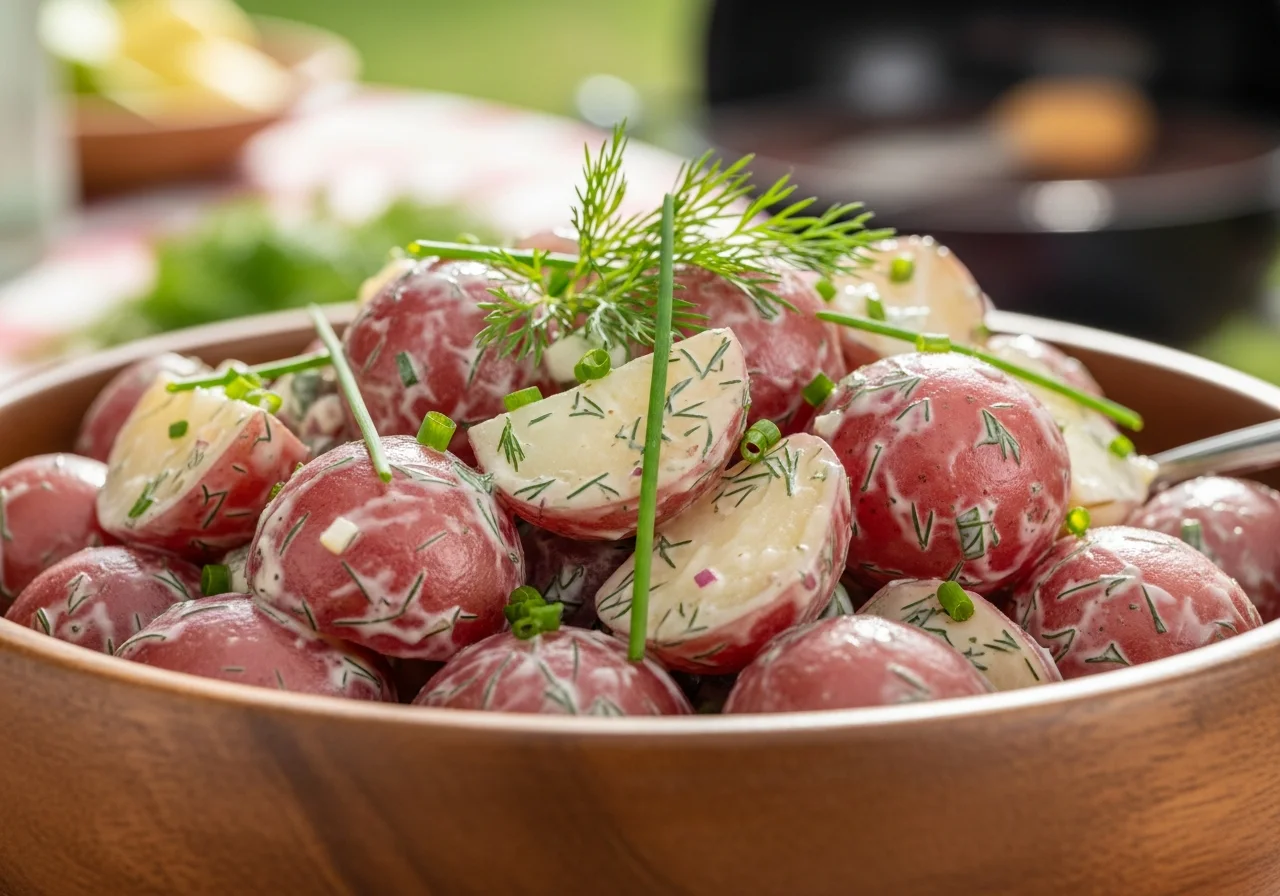
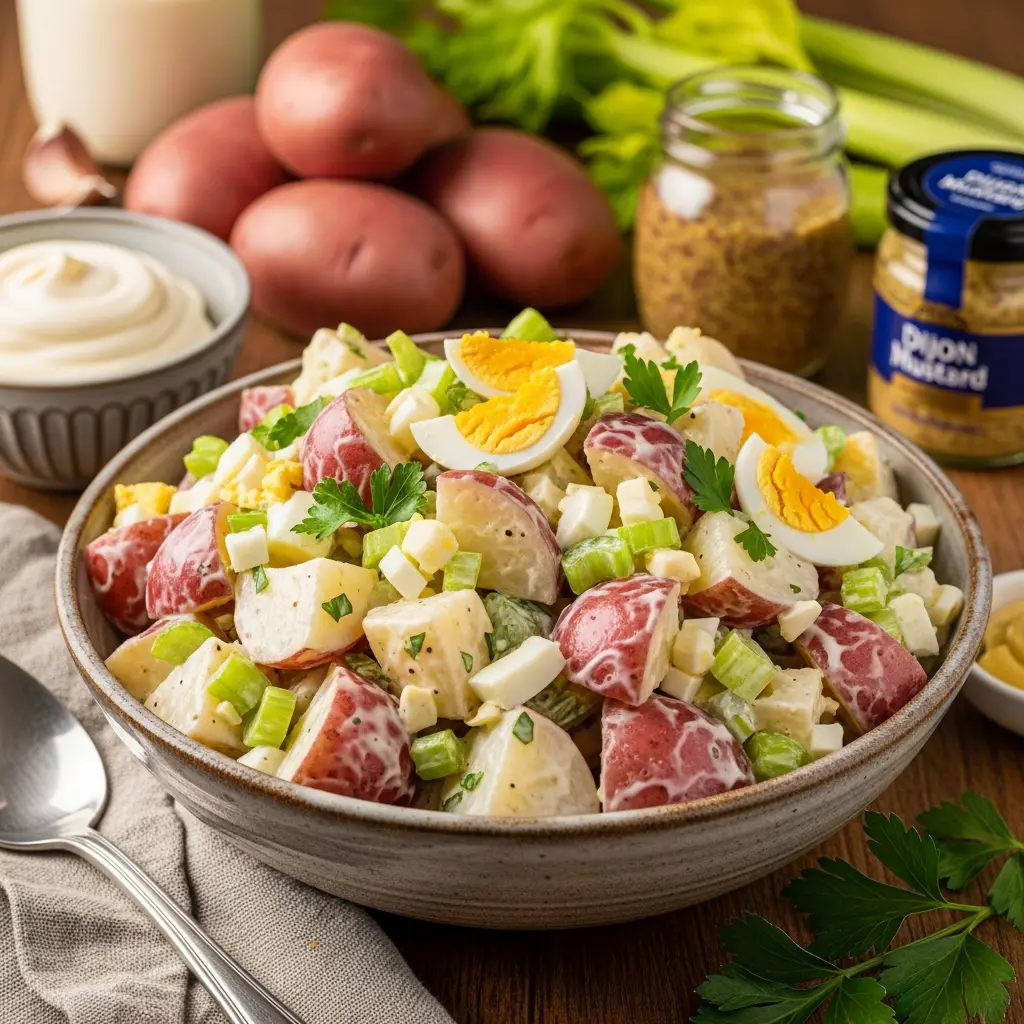
A good red potato salad recipe solves the problem most potato salads have: mushy, bland potatoes swimming in heavy dressing. Red-skinned potatoes keep their shape after boiling, their thin skins add color and texture, and you don’t have to peel a single one.
In this guide, you’ll get a tested red potato salad recipe with a tangy Greek yogurt and mustard dressing, plus the details that make it work: how long to boil the potatoes, why you should dress them while warm, and how long the salad safely keeps. You’ll also learn what the research says about cooled potatoes, vinegar, and blood sugar, and who should adjust the recipe.
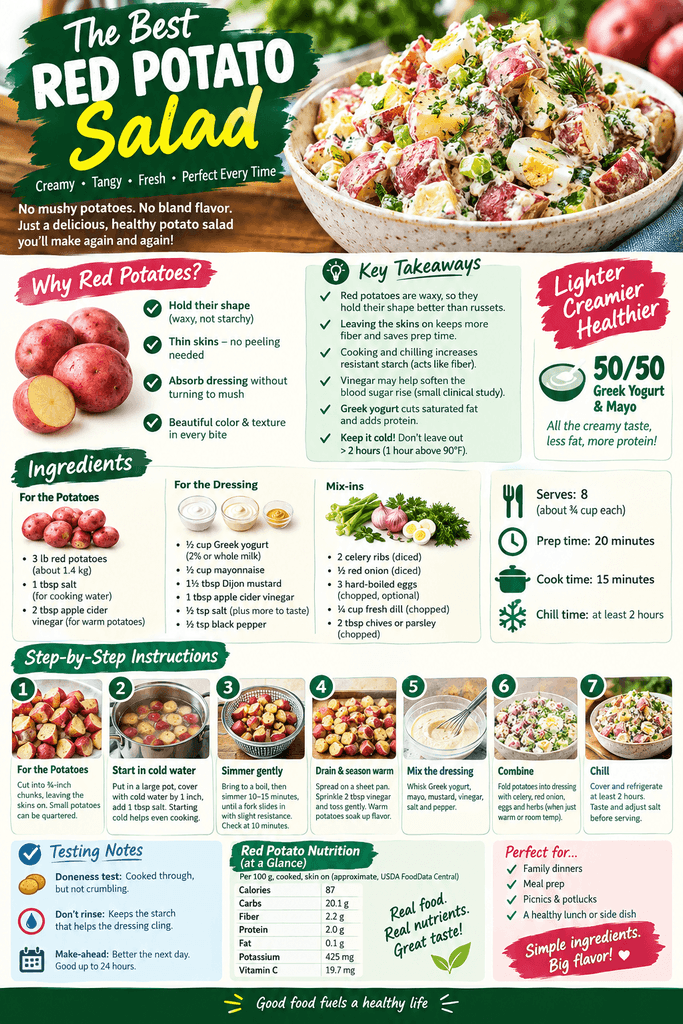
Key Takeaways
- Red potatoes are waxy, so they hold their shape in salad better than starchy russets.
- Leaving the skins on keeps more fiber and saves prep time.
- Cooking and then chilling potatoes increases resistant starch, a type of carbohydrate that acts more like fiber.
- A vinegar-based dressing may help soften the blood sugar rise from a potato meal, according to a small clinical study.
- Swapping half the mayonnaise for Greek yogurt cuts saturated fat and adds protein without losing creaminess.
- Keep potato salad cold, and don’t leave it out longer than two hours (one hour above 90°F).
Why Red Potatoes Make the Best Potato Salad
Potatoes fall roughly into two camps. Starchy potatoes like russets are fluffy and fall apart when boiled, which is great for mashing but not for salad. Waxy potatoes, including red-skinned varieties like Red Bliss and Red Norland, have less starch and more moisture, so the cubes stay firm and distinct.
If you want a deeper breakdown of varieties, our guide to the best potatoes for potato salad compares reds, Yukon Golds, fingerlings, and russets side by side.
Red potatoes have three practical advantages:
- Thin skins. No peeling needed, and the skin holds the potato together.
- Firm texture. They absorb dressing without turning to paste.
- Color. The red skin makes the salad look finished without extra garnish.
The Red Potato Salad Recipe
This version uses a 50/50 blend of Greek yogurt and mayonnaise. You keep the classic creamy taste, but the dressing is lighter and tangier.
Serves: 8 (about ¾ cup each)
Prep time: 20 minutes
Cook time: 15 minutes
Chill time: at least 2 hours
Ingredients
For the potatoes
- 3 lb (about 1.4 kg) small or medium red potatoes, scrubbed
- 1 tablespoon salt (for the cooking water)
- 2 tablespoons apple cider vinegar (for dressing the warm potatoes)
For the dressing
- ½ cup plain Greek yogurt (2% or whole milk)
- ½ cup mayonnaise
- 1½ tablespoons Dijon mustard
- 1 tablespoon apple cider vinegar
- ½ teaspoon salt, plus more to taste
- ½ teaspoon black pepper
Mix-ins
- 2 celery ribs, finely diced
- ½ small red onion, finely diced
- 3 hard-boiled eggs, chopped (optional)
- ¼ cup fresh dill, chopped
- 2 tablespoons fresh chives or parsley, chopped
Instructions
- Cut the potatoes. Cut the potatoes into ¾-inch chunks, leaving the skins on. Small potatoes can simply be quartered. Even sizes cook evenly.
- Start in cold water. Put the potatoes in a large pot, cover with cold water by about an inch, and add 1 tablespoon salt. Starting cold helps the outside and center cook at the same rate.
- Simmer gently. Bring to a boil, then lower to a steady simmer. Cook 10–15 minutes, until a fork slides in with slight resistance. Check at 10 minutes. Overcooking is the most common cause of mushy salad.
- Drain and season warm. Drain well and spread the potatoes on a sheet pan. While they’re still warm, sprinkle 2 tablespoons vinegar over them and toss gently. Warm potatoes soak up flavor; cold ones don’t.
- Mix the dressing. In a large bowl, whisk the Greek yogurt, mayonnaise, mustard, vinegar, salt, and pepper.
- Combine. Once the potatoes are just warm or at room temperature, fold them into the dressing with the celery, red onion, eggs, and herbs.
- Chill. Cover and refrigerate at least 2 hours. Taste before serving and adjust salt, since cold food tastes less salty.
Testing Notes
- Doneness test: Pull one cube out and cut it. You want it cooked through but not crumbling at the edges.
- Don’t rinse. Rinsing cooked potatoes washes off surface starch that helps the dressing cling.
- Make-ahead: The flavor is better the next day. You can make the salad up to 24 hours ahead.
Red Potato Nutrition at a Glance
Red potatoes are a whole food with more to offer than their reputation suggests. The figures below are approximate values for red potatoes cooked with the skin, based on USDA FoodData Central data. [VERIFY: confirm exact values for “Potatoes, red, flesh and skin” before publishing]
| Nutrient (per 100 g, cooked, skin on) | Approximate amount |
| Calories | ~89 kcal |
| Carbohydrates | ~20 g |
| Fiber | ~1.8 g |
| Protein | ~2.3 g |
| Potassium | ~545 mg |
| Vitamin C | ~12 mg |
| Vitamin B6 | ~0.2 mg |
| Fat | under 0.2 g |
The dressing is where most of the calories and fat in potato salad come from, not the potato itself. Our article on whether potatoes are healthy goes deeper into how cooking method changes the picture.
Health Benefits of This Red Potato Salad
A Good Source of Potassium
Potassium helps regulate fluid balance, nerve signals, and muscle contractions, including the heartbeat. The NIH Office of Dietary Supplements sets adequate intake at 3,400 mg per day for adult men and 2,600 mg for adult women, and notes that many Americans fall short.
Higher potassium intake, as part of an overall eating pattern low in sodium, is linked to healthier blood pressure. That’s a core principle of the DASH eating plan from the NHLBI, which emphasizes potassium-rich vegetables.
Vitamin C and Vitamin B6
Potatoes are an underrated source of vitamin C, an antioxidant that supports immune function and collagen production. According to the NIH vitamin C fact sheet, adult men need 90 mg per day and women 75 mg. Some vitamin C is lost during boiling, so keeping the skins on and avoiding overcooking helps.
Potatoes also supply vitamin B6, which the body uses in more than 100 enzyme reactions, mostly related to protein metabolism, per the NIH vitamin B6 fact sheet.
Fiber From the Skin
Much of a potato’s fiber sits in and just under the skin. Fiber supports regular digestion and helps you feel full. Harvard’s Nutrition Source notes that most adults eat far less fiber than recommended, so small additions like skin-on potatoes add up.
Resistant Starch: Why Cold Potato Salad Is Different
Here’s where potato salad has an edge over hot potatoes. When cooked potatoes cool, some of their starch rearranges into a form called resistant starch. It “resists” digestion in the small intestine and travels to the colon, where gut bacteria ferment it, much like fiber.
A study from USDA and University of Minnesota researchers, published in Food Chemistry, measured resistant starch in three varieties, including the red-skinned Red Norland. Chilled potatoes had the most resistant starch, about 4.3 g per 100 g, compared with about 3.1 g in potatoes served hot (Raatz et al., 2016 [VERIFY: replace with direct PubMed link]). Variety made little difference. Temperature did.
Researchers are studying resistant starch for its possible effects on blood sugar, cholesterol, and gut bacteria. A review in Advances in Nutrition found promising early evidence, though much of it comes from animal studies and more human research is needed (Birt et al., 2013 [VERIFY]).
Vinegar May Soften the Blood Sugar Response
Potatoes are known for raising blood sugar quickly. But the way you serve them matters. In a small clinical study of healthy adults, boiled potatoes that were refrigerated for 24 hours and served with a vinaigrette produced a significantly lower glycemic response than freshly boiled potatoes. The glycemic index dropped by about 43%, according to the 2005 study in the European Journal of Clinical Nutrition.
That’s essentially a description of a vinegar-dressed potato salad. It’s one reason this recipe uses vinegar twice: on the warm potatoes and in the dressing. The study was small and done in healthy people, so it’s a helpful hint, not a treatment.
For more on how carbs affect blood glucose, Harvard’s guide to carbohydrates and blood sugar explains glycemic index and glycemic load in plain terms.
Who Benefits Most From This Version
This lighter red potato salad works well for:
- People watching saturated fat. Replacing half the mayo with yogurt lowers saturated fat while keeping the texture.
- Active people. Potatoes provide carbohydrates and potassium, which are useful around exercise.
- Meal preppers. The salad holds well for several days and tastes better on day two.
- Families and picnic hosts. It’s familiar enough for kids but fresher than deli-counter versions.
If you prefer a mayo-free style, a vinegar-and-mustard version like a German-style potato salad or a herby French potato salad leans even harder on the tangy dressing approach.
Risks and Who Should Be Cautious
Blood Sugar and Diabetes
Potatoes are still a starchy food. Large prospective cohort studies have linked higher intake of potatoes, especially French fries, with higher risk of type 2 diabetes (Muraki et al., Diabetes Care, 2016 [VERIFY]). The association was strongest for fried potatoes, and the researchers suggested replacing some potatoes with whole grains.
If you have diabetes or prediabetes, you don’t necessarily need to skip potato salad, but portion size matters. Pair a modest scoop (about ½ cup) with protein and non-starchy vegetables, and talk with your doctor or dietitian about how it fits your plan.
Kidney Disease and Potassium
The same potassium that benefits most people can be a concern for people with advanced kidney disease, whose kidneys may not clear potassium well. The NIH potassium fact sheet notes this risk. If you’ve been told to limit potassium, ask your care team before eating potatoes regularly. Some people use soaking or double-boiling methods to reduce potassium, but only under medical guidance.
Sodium
Salted cooking water, mayonnaise, mustard, and added salt can push sodium up quickly. The FDA recommends adults limit sodium to less than 2,300 mg per day. To keep sodium down, season the cooking water lightly, use the fresh herbs generously, and taste before adding more salt.
Food Safety
Potato salad is a classic picnic food-safety risk because it combines cooked starch, eggs, and dairy, then often sits in the sun. The USDA Food Safety and Inspection Service warns that bacteria multiply fastest between 40°F and 140°F, the “Danger Zone.” Don’t leave potato salad out more than 2 hours, or 1 hour if it’s above 90°F outside.
How Long Red Potato Salad Lasts
Stored in an airtight container in the refrigerator at 40°F or below, homemade potato salad generally keeps 3 to 4 days. The FDA’s guidance on storing food safely recommends keeping your fridge at or below 40°F and using leftovers promptly.
The same rules apply to other mayo- and egg-based salads. Our guide on how long egg salad is good for covers the signs that a creamy salad has gone off.
Don’t freeze potato salad. The potatoes turn watery and grainy, and the dressing separates when thawed.
Healthy Swaps and Variations
Lighter Dressing Options
- All Greek yogurt: Skip the mayo entirely for the lightest version. Add an extra teaspoon of mustard and a pinch of sugar or honey to balance the tang.
- Olive oil vinaigrette: Whisk 3 tablespoons extra-virgin olive oil with 2 tablespoons vinegar and 1 tablespoon Dijon. Olive oil is rich in unsaturated fats, which Harvard’s Nutrition Source associates with better heart health when they replace saturated fats. See our piece on whether extra-virgin olive oil is healthy.
- Avocado mayo or light mayo: Reduces saturated fat compared with regular mayonnaise. Our breakdown of whether mayonnaise is healthy compares common types.
Flavor Variations
- Bacon and chive: Add 4 slices of crisp, crumbled turkey or regular bacon.
- Mediterranean: Swap the dill for parsley and mint, and add olives, cucumber, and crumbled feta.
- Pickle lover’s: Add ¼ cup chopped dill pickles and a splash of pickle brine.
- Asian-inspired: Try the sweeter, mayo-forward style of Japanese potato salad with cucumber and carrot.
About the Eggs
Hard-boiled eggs add protein and richness. For most healthy people, an egg a day fits a balanced diet, according to Harvard’s review of eggs and health. If you’re watching dietary cholesterol on your doctor’s advice, use two eggs and discard one yolk.
Practical Tips for Perfect Red Potato Salad
- Choose similar sizes. Uniform potatoes cook evenly.
- Salt the water. It seasons the potato from the inside. About 1 tablespoon per 3 quarts is enough.
- Dress in two stages. Vinegar on warm potatoes, creamy dressing once they’ve cooled slightly.
- Use fresh herbs. Dill is classic. Chives, parsley, and tarragon all work.
- Make it a day ahead. The dressing seeps in and the resistant starch content rises as the salad chills.
- Add crunch last. Stir in celery and onion close to serving if you want maximum crunch.
For a comparison point, our classic potato salad recipe uses peeled potatoes and a richer dressing, which shows how much the base potato changes the result.
Myths vs. Facts
| Myth | Fact |
| “Potato salad is just empty carbs.” | Red potatoes supply potassium, vitamin C, B6, and fiber, especially with the skin on. |
| “You have to peel potatoes for salad.” | Red potato skins are thin and tender. Leaving them on adds fiber and saves time. |
| “Mayonnaise is what makes potato salad spoil.” | Commercial mayo is acidic. Spoilage usually comes from bacteria growing on any food left in the Danger Zone too long. |
| “Cold potatoes and hot potatoes are nutritionally identical.” | Chilling cooked potatoes increases resistant starch, according to USDA-supported research. |
| “Healthy potato salad can’t taste good.” | A Greek yogurt and mustard dressing with fresh dill is tangy, creamy, and satisfying. |
How Red Potato Salad Fits a Healthy Lifestyle
No single side dish makes or breaks a diet. What matters is the overall pattern. A scoop of this red potato salad next to grilled chicken or fish and a green vegetable makes a balanced plate: protein, healthy fat, fiber-rich carbs, and plenty of produce.
Think of it as a vegetable side that happens to be comforting, not as a free-for-all. Keep portions to about ½ to ¾ cup, load the bowl with herbs and crunchy vegetables, and you get the picnic classic without the heavy feeling afterward. If you’re comparing sides for a cookout, see how it stacks up against coleslaw’s nutrition.
Frequently Asked Questions
Do you peel red potatoes for potato salad?
No. Red potatoes have thin, tender skins that soften during boiling. Leaving them on adds color, texture, and fiber, and it saves prep time. Just scrub them well under running water and trim any green spots or eyes before cutting.
How long do you boil red potatoes for potato salad?
Cut into ¾-inch pieces, red potatoes usually need 10–15 minutes at a gentle simmer after the water boils. Start checking at 10 minutes. They’re ready when a fork goes in with slight resistance. Overcooked potatoes will break apart when you stir in the dressing.
Is red potato salad healthy?
It can be. Red potatoes provide potassium, vitamin C, and fiber. The dressing is the main variable. Using Greek yogurt for half the mayo, adding vinegar, and loading up on vegetables and herbs makes it a reasonable side dish when you keep portions moderate.
How long does red potato salad last in the fridge?
Homemade potato salad stored in an airtight container at 40°F or below generally keeps 3 to 4 days. Discard it if it smells sour, looks slimy, or has been left at room temperature longer than 2 hours. Do not freeze it.
Can you make potato salad the day before?
Yes, and it often tastes better. Chilling overnight lets the potatoes absorb the dressing. Store it covered in the fridge, then stir and taste before serving. You may need a spoonful more yogurt or a pinch of salt.
Why is my potato salad mushy?
The usual causes are overcooking, using starchy potatoes like russets, or stirring too hard. Use waxy red potatoes, simmer gently, test early, and fold the dressing in gently rather than mixing vigorously.
The Bottom Line
This red potato salad recipe keeps everything people love about the picnic classic while making smarter choices along the way: skin-on red potatoes for fiber and structure, a vinegar splash for flavor, and a Greek yogurt and mayo dressing that’s lighter but still creamy. Research suggests that chilling the potatoes and dressing them with vinegar may even soften the blood sugar response compared with eating them hot.
Make it a day ahead, keep it cold, and enjoy a moderate portion alongside protein and vegetables. If you’re exploring other styles, try our Korean potato salad next.
Medical disclaimer: This article is for general educational purposes and is not medical advice. If you have diabetes, kidney disease, or another health condition, talk with your doctor or a registered dietitian before making changes to your diet.
(3) References
- Raatz SK, Idso L, Johnson LK, Jackson MI, Combs GF Jr. Resistant starch analysis of commonly consumed potatoes: content varies by cooking method and service temperature but not by variety. Food Chemistry. 2016. https://pubmed.ncbi.nlm.nih.gov/?term=Raatz+resistant+starch+potatoes+Food+Chemistry+2016 [VERIFY: author list and direct PubMed URL]
- Leeman M, Östman E, Björck I. Vinegar dressing and cold storage of potatoes lowers postprandial glycaemic and insulinaemic responses in healthy subjects. European Journal of Clinical Nutrition. 2005;59(11):1266–1271. https://www.nature.com/articles/1602238
- Birt DF, Boylston T, Hendrich S, et al. Resistant starch: promise for improving human health. Advances in Nutrition. 2013. https://doi.org/10.3945/an.113.004325 [VERIFY]
- Muraki I, Rimm EB, Willett WC, Manson JE, Hu FB, Sun Q. Potato consumption and risk of type 2 diabetes: results from three prospective cohort studies. Diabetes Care. 2016;39(3):376–384. https://doi.org/10.2337/dc15-0547 [VERIFY]
- U.S. Department of Agriculture. FoodData Central. https://fdc.nal.usda.gov/
- NIH Office of Dietary Supplements. Potassium: Fact Sheet for Health Professionals. https://ods.od.nih.gov/factsheets/Potassium-HealthProfessional/
- NIH Office of Dietary Supplements. Vitamin C: Fact Sheet for Health Professionals. https://ods.od.nih.gov/factsheets/VitaminC-HealthProfessional/
- NIH Office of Dietary Supplements. Vitamin B6: Fact Sheet for Health Professionals. https://ods.od.nih.gov/factsheets/VitaminB6-HealthProfessional/
- National Heart, Lung, and Blood Institute. DASH Eating Plan. https://www.nhlbi.nih.gov/education-awareness/healthy-eating/dash-eating-plan
- Harvard T.H. Chan School of Public Health. Fiber. The Nutrition Source. https://www.hsph.harvard.edu/nutritionsource/carbohydrates/fiber/
- Harvard T.H. Chan School of Public Health. Carbohydrates and Blood Sugar. The Nutrition Source. https://www.hsph.harvard.edu/nutritionsource/carbohydrates/carbohydrates-and-blood-sugar/
- Harvard T.H. Chan School of Public Health. Fats and Cholesterol. The Nutrition Source. https://www.hsph.harvard.edu/nutritionsource/what-should-you-eat/fats-and-cholesterol/
- Harvard T.H. Chan School of Public Health. Eggs. The Nutrition Source. https://www.hsph.harvard.edu/nutritionsource/food-features/eggs/
- U.S. Food and Drug Administration. Sodium in Your Diet. https://www.fda.gov/food/nutrition-education-resources-materials/sodium-your-diet
- USDA Food Safety and Inspection Service. “Danger Zone” (40°F–140°F). https://www.fsis.usda.gov/food-safety/safe-food-handling-and-preparation/food-safety-basics/danger-zone-40f-140f
- U.S. Food and Drug Administration. Are You Storing Food Safely? https://www.fda.gov/consumers/consumer-updates/are-you-storing-food-safely