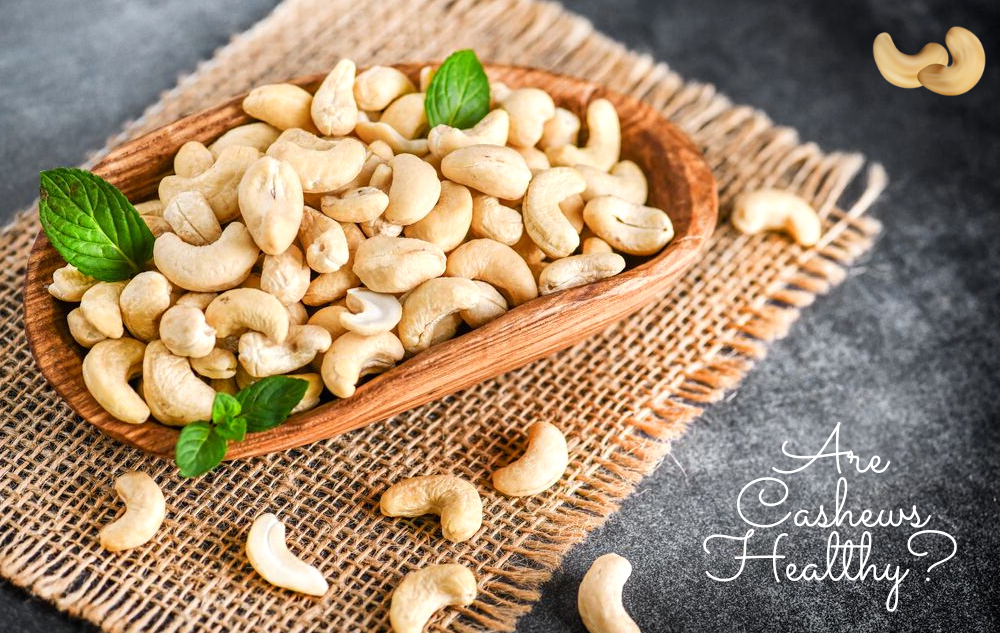
Cashews show up everywhere: roasted in snack mixes, blended into dairy-free sauces, simmered into curries, and spread as cashew butter. They’re creamy, mild, and easy to overeat, which is exactly why so many people ask, are cashews healthy?
The short answer is yes, in sensible portions. Cashews are rich in copper, magnesium, and unsaturated fat. Controlled trials suggest they can fit a heart-healthy diet without causing weight gain. This guide covers what cashews provide and what the research shows (and doesn’t show) about heart health, weight, blood sugar, and men’s health. It also covers who should avoid them and how many to eat each day.
Key Takeaways
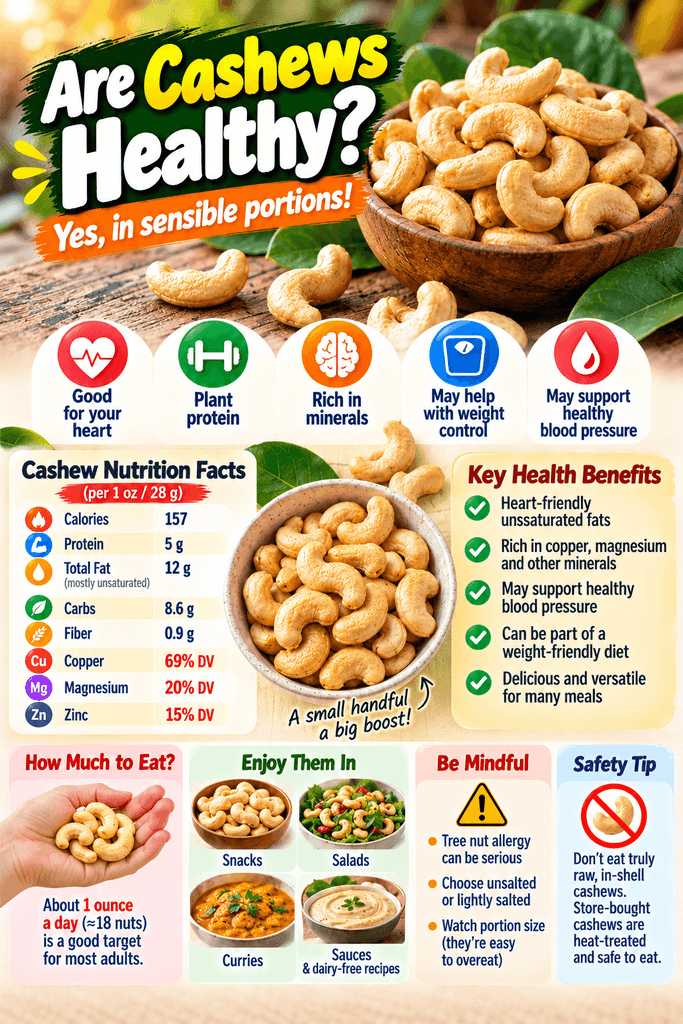
- One ounce of raw cashews (about 18 nuts) has roughly 157 calories, 5 g protein, and 12 g fat, mostly unsaturated. It also provides about 69% of the Daily Value for copper and 20% for magnesium.
- Cashew-specific trials show mixed results for cholesterol. Some find lower LDL or higher HDL, while pooled analyses find no significant lipid change. A modest drop in systolic blood pressure shows up more consistently.
- Your body may absorb fewer calories from cashews than the label suggests.
- Tree nut allergy is the biggest risk. Cashew allergy can be triggered by small amounts and very often comes with pistachio allergy.
- Store-bought “raw” cashews have been heat-treated. Truly raw, in-shell cashews are not safe to crack at home.
- A 1-ounce daily serving, unsalted or lightly salted, is a practical target for most adults.
Are Cashews Healthy? The Short Answer
For most people, yes. Cashews deliver plant protein, unsaturated fats, and several minerals that many diets run short on, all in a food that’s easy to add to meals.
Two things decide whether cashews help or hurt your diet: how many you eat and what form you choose. A handful of dry-roasted cashews is a very different food from a large bag of honey-glazed, oil-roasted ones. Large population studies of nut eaters, summarized in our complete guide to nuts, consistently link regular nut intake to better heart health. Cashews belong in that group, with a few specifics worth knowing.
What Are Cashews?

Cashews grow on the cashew tree (Anacardium occidentale), an evergreen in the Anacardiaceae, or sumac, family. Mango, pistachio, and poison ivy belong to the same family. That family connection explains one of the cashew’s safety quirks, covered below.
Botanically, the cashew isn’t a true nut. It’s the seed of a kidney-shaped fruit that hangs from the bottom of a swollen, fleshy stalk called the cashew apple. The cashew apple itself is juicy and tart. In growing regions it’s eaten fresh or made into juice, jams, and drinks. The seed sits inside a double shell, and a caustic oil fills the layer between the two.
In the kitchen, though, cashews behave like nuts. They’re central to South and Southeast Asian cooking, in curries, rice dishes, and sweets. They’re popular worldwide as a snack, a nut butter, and a creamy base for dairy-free sauces, cheeses, and dairy-free yogurt.
Cashew Nutrition Facts
The values below are for 1 ounce (28 g) of raw cashews, from USDA FoodData Central. Percent Daily Values (DV) use the FDA’s reference amounts.
| Nutrient (per 1 oz) | Amount | % DV |
| Calories | 157 | — |
| Protein | 5.2 g | 10% |
| Total fat | 12.4 g | 16% |
| Monounsaturated fat | 6.7 g | — |
| Polyunsaturated fat | 2.2 g | — |
| Saturated fat | 2.2 g | 11% |
| Carbohydrates | 8.6 g | 3% |
| Fiber | 0.9 g | 3% |
| Copper | 0.62 mg | 69% |
| Magnesium | 83 mg | 20% |
| Manganese | 0.47 mg | 20% |
| Zinc | 1.6 mg | 15% |
| Iron | 1.9 mg | 10% |
| Sodium | 3 mg | 0% |
A few things stand out:
- Copper is the headline nutrient. The NIH Office of Dietary Supplements lists dry-roasted cashews among the top food sources, at 629 mcg (70% DV) per ounce.
- Most of the fat is unsaturated. More than half is monounsaturated, the type also found in olive oil.
- Cashews are lower in fiber and higher in carbs than many nuts. That matters if you’re comparing them with almonds or eating low-carb.
- Raw cashews are naturally almost sodium-free. Any salt comes from processing.
Are Cashews Good for Your Heart?
This is where cashews have the most research, and the results are encouraging but mixed.
What cashew trials show
- LDL cholesterol. In a controlled feeding trial in the American Journal of Clinical Nutrition, summarized by Harvard Health, 51 adults ate 1 to 2 ounces of cashews a day for four weeks. LDL cholesterol fell about 5% compared with a diet that included baked potato chips instead.
- HDL and blood pressure. In a 12-week randomized trial in the Journal of Nutrition, 300 Asian Indian adults with type 2 diabetes ate 30 g of raw cashews daily. Systolic blood pressure dropped about 4.9 mm Hg, compared with 1.7 mm Hg in the control group, and HDL rose slightly. Weight, blood sugar, and LDL didn’t change.
What pooled analyses show
Combined analyses give a more cautious picture:
- A 2020 systematic review in Complementary Medicine Research found no significant overall effect of cashews on total cholesterol, LDL, HDL, or triglycerides.
- A 2020 meta-analysis in Complementary Therapies in Medicine reached the same conclusion on lipids. It did find a small but significant drop in systolic blood pressure, about 3.4 mm Hg.
So cashews don’t reliably lower cholesterol on their own. They do appear to be cholesterol-neutral at worst, which matters for a food often wrongly feared as “fattening.” For a closer look at the cholesterol question, see our deep dive on whether cashews are good for cholesterol.
The bigger picture for nuts
Research on nuts in general is stronger:
- A meta-analysis of 61 trials in the American Journal of Clinical Nutrition found that each daily ounce of tree nuts lowered LDL by about 4.8 mg/dL.
- In a large U.S. cohort analysis in the Journal of the American College of Cardiology, people who ate tree nuts two or more times a week had a 15% lower risk of cardiovascular disease and a 23% lower risk of coronary heart disease.
Tree nuts in that analysis included cashews, but the nut with the most heart research is the walnut. Our guide to whether walnuts are healthy explains why. The likely mechanisms are cashews’ unsaturated fats replacing saturated fat, plus magnesium and plant compounds that support healthy blood vessels.
Are Cashews Good for Weight Loss?
Cashews are calorie-dense, but evidence suggests they don’t cause weight gain when eaten in place of other snacks rather than on top of them. In the 12-week Journal of Nutrition trial, adding 30 g of cashews a day didn’t change body weight.
There’s also a calorie-counting twist. A USDA study published in Nutrients measured how much energy people actually absorb from cashews. Some of the fat stays trapped in the cashew’s cell walls and is never digested. As a result, cashews provided fewer usable calories than standard calculations predict, roughly 16% fewer.
Cashews have one weak spot for appetite control: they’re low in fiber. One ounce has less than 1 gram, so their filling power comes mostly from protein and fat. To make them more satisfying:
- Pair cashews with fruit or vegetables for extra fiber.
- Portion them into a small bowl instead of eating from the bag.
- Use them as an ingredient, such as in a stir-fry or salad, rather than a standalone snack.
If you like spreads, our guide to almond butter for weight loss covers portion strategies that apply to cashew butter too.
Cashews and Blood Sugar
Cashews have more carbohydrates than most nuts, about 8.6 g per ounce. Their fat and protein still slow digestion, so a handful has a modest effect on blood sugar.
In the trial of 300 adults with type 2 diabetes, daily cashews didn’t worsen fasting glucose or HbA1c, the key long-term blood sugar marker. They also brought the blood pressure and HDL benefits described above. The study authors cautioned that benefits may shrink if cashews are salted or roasted in unhealthy fats. If you have diabetes, unsalted cashews in measured portions are a reasonable swap for refined snacks like crackers or chips.
Other Benefits Linked to Cashew Nutrients
These benefits come from the nutrients cashews supply, not from cashew-specific trials. Think of cashews as a contributor, not a treatment.
Copper: blood, energy, and connective tissue
Copper helps enzymes involved in energy production, iron metabolism, connective tissue, and brain chemical (neurotransmitter) synthesis, according to ODS. One ounce of cashews covers most of an adult’s daily copper need of 900 mcg.
Magnesium: muscles, nerves, and bones
At 20% of the DV per ounce, cashews are a solid magnesium source. Magnesium supports muscle and nerve function, blood sugar control, blood pressure regulation, and bone structure.
Zinc: immunity and healing
Cashews provide about 15% of the zinc DV per ounce. The ODS zinc fact sheet notes zinc’s roles in immune function, cell metabolism, and growth. Men need 11 mg a day and women 8 mg.
Plant protein for meat-free diets
With about 5 g of protein per ounce, cashews help vegetarians and vegans add protein, along with the iron and zinc that plant-based diets sometimes lack.
Cashew Nuts Benefits for Male Health: What’s Real
Online claims about cashews boosting testosterone, improving erections, or preventing prostate cancer are common. None of them is supported by cashew-specific human research.
What we can say:
- Zinc matters for men, and cashews provide some. One ounce gives about 1.6 mg toward the 11 mg men need daily. That’s helpful, but cashews won’t correct a true deficiency, and eating more zinc than you need doesn’t raise testosterone.
- Heart and blood vessel health affect sexual health. Diets rich in nuts and unsaturated fats support healthy blood vessels. That’s a reasonable indirect link, not proof that cashews treat erectile problems.
- Nut-rich diets and sperm. Some research on mixed nuts, mainly walnuts, almonds, and hazelnuts, has looked at sperm quality. Cashews weren’t the focus. If fertility is a concern, see our guide on how to know your sperm is healthy, and talk with a doctor.
The honest takeaway: cashews fit a diet that supports men’s health, but they aren’t a fertility or testosterone food.
Are Cashews Bad for You? Risks and Who Should Be Careful
Tree nut allergy
Cashews are a tree nut, one of the major food allergens the FDA requires on labels. Cashew allergy deserves extra respect:
- In a study of tree-nut-allergic young people in Frontiers in Allergy, cashew triggered symptoms at the lowest dose of any nut tested.
- In the same study, all but one person with cashew allergy were also allergic to pistachio.
If you react to pistachios, assume cashews are risky too until an allergist says otherwise. Keep in mind that peanuts are legumes, so a peanut allergy is a separate diagnosis.
Truly raw cashews
Cashews sold as “raw” in stores have already been heat-processed to remove the caustic shell oil. That oil contains compounds related to the allergens in poison ivy. Incomplete processing can cause problems. The CDC documented an outbreak in Pennsylvania in which 54 people developed a poison ivy–like rash after eating poorly processed imported cashew pieces. Never try to crack or roast in-shell cashews at home.
Kidney stones
Cashews contain oxalate. NIDDK advises people with calcium oxalate kidney stones to limit nuts and nut products, along with other high-oxalate foods. If you’ve had this type of stone, ask your doctor or dietitian how many cashews, if any, fit your plan.
Salt, oil, and coatings
Raw cashews contain almost no sodium, but salted, seasoned, and honey-roasted versions can add a lot of it, plus added sugar. The FDA notes that most Americans eat too much sodium. Check labels, and favor unsalted or “lightly salted” options.
Calories
Eating cashews in addition to your usual food, rather than instead of something, adds up quickly. Three ounces is roughly 470 calories.
How Many Cashews a Day?
For most adults, 1 ounce a day (about 18 cashews, or a small handful) is a practical target. That matches the serving size used in most research, including the Journal of Nutrition trial, which used 30 g a day.

Eating cashews every day is fine for most people. Daily nuts are linked to better heart outcomes, and cashew trials lasting up to 12 weeks reported no harm. To get the widest range of nutrients, rotate cashews with other nuts. For example, Brazil nuts are rich in selenium, and walnuts provide plant omega-3s.
Which form of cashews is healthiest?
| Form | How it compares |
| Raw (store-bought) | Heat-treated, safe, no added salt or oil. A great default. |
| Dry-roasted, unsalted | Nearly identical nutrition with a richer flavor. Also a great choice. |
| Oil-roasted, salted | Slightly more fat and much more sodium. Fine occasionally. |
| Honey-roasted or candied | Adds sugar and often salt. Treat as a dessert. |
| Cashew butter | Same nutrition as the nuts if it’s 100% cashews. Watch for added oils, sugar, and salt. |
| Cashew milk | Very low in protein and calories. Choose unsweetened and fortified. |
For a creamy dairy alternative with more protein, compare cashew milk with soy milk.
Easy home roasting: spread store-bought raw cashews on a baking sheet and roast them, without oil, at 350°F for 8–10 minutes, stirring once. Watch closely, because they burn fast.
Myths vs. Facts
| Myth | Fact |
| Cashews are high in cholesterol. | Plant foods contain no cholesterol. Trials show cashews are neutral to slightly beneficial for blood lipids. |
| Cashews are fattening. | In measured portions, trials show no weight gain, and you may absorb fewer calories than the label lists. |
| Cashews are rich in omega-3s and vitamin E. | They contain very little of either. Walnuts (omega-3) and almonds (vitamin E) are better sources. |
| The “fat” in cashews is triglycerides that lower cholesterol. | Cashew fat is mostly monounsaturated. Replacing saturated fat with it supports healthy cholesterol. |
| Store-bought raw cashews are toxic. | They’ve been heat-processed and are safe. Only in-shell, unprocessed cashews are hazardous. |
| Cashews boost testosterone. | No human research shows this. |
How Cashews Fit a Healthy Diet
Cashews work best as an ingredient that replaces less nutritious choices. Try them:
- As a snack swap: 1 ounce of cashews instead of chips or crackers, paired with an apple or carrot sticks.
- In savory meals: toasted in stir-fries, grain bowls, and curries, where a small amount goes a long way.
- As a creamy base: blend soaked cashews into dairy-free sauces and dressings to replace heavy cream.
- In breakfast: chopped over oatmeal or yogurt with fruit.
- In mixed-nut rotations: combine them with almonds, walnuts, and macadamia nuts for variety.
Frequently Asked Questions
What happens if you eat cashews every day?
For most people, a daily ounce of cashews adds copper, magnesium, zinc, and healthy fats without causing weight gain. Trials using about 30 g a day found a modest drop in systolic blood pressure and a small rise in HDL. Problems come mainly from large portions, heavy salting, or a nut allergy.
Are roasted cashews healthy?
Yes. Dry-roasted, unsalted cashews are nutritionally almost identical to raw ones. Oil-roasted versions add a little extra fat, and salted or honey-roasted versions add sodium and sugar. Store-bought “raw” cashews are also heat-treated, so both forms are safe. Choose whichever you enjoy, and keep the salt low.
Are cashews good for diabetics?
Cashews can fit a diabetes-friendly diet in measured portions. In a 12-week trial in adults with type 2 diabetes, 30 g of cashews a day didn’t raise blood sugar or HbA1c and modestly improved blood pressure and HDL. Choose unsalted cashews and count their carbohydrates, about 9 g per ounce.
Are cashews healthier than almonds?
Neither is “best.” Almonds have more fiber, vitamin E, and calcium, plus fewer carbs. Cashews have more copper, iron, and zinc, and a creamier texture for cooking. Both support heart health in reasonable portions. Rotating several nuts gives you a broader mix of nutrients than eating one alone.
Can cashews cause kidney stones?
Cashews contain oxalate, which can contribute to calcium oxalate kidney stones in people prone to them. NIDDK advises limiting nuts if you’ve had this type of stone. People without a stone history don’t need to avoid cashews. If you’ve had stones, ask your doctor which nuts and portions are appropriate.
Is a cashew a nut or a seed?
Botanically, a cashew is a seed. It grows inside a kidney-shaped shell that hangs beneath the cashew apple, a fleshy fruit stalk. In cooking and nutrition, and for allergy labeling, cashews are treated as tree nuts. People with tree nut allergies should treat cashews as a nut.
Conclusion
So, are cashews healthy? Yes, for most people, when you eat about an ounce a day and choose unsalted or lightly salted forms. Cashews are an outstanding source of copper, a good source of magnesium and zinc, and rich in unsaturated fat. Trials suggest they can modestly lower systolic blood pressure without causing weight gain or raising blood sugar. Their effect on cholesterol is neutral to mildly positive rather than dramatic.
Skip cashews if you have a tree nut or pistachio allergy. Ask your doctor first if you’ve had calcium oxalate kidney stones. Otherwise, use cashews to replace chips, crackers, and cream, and mix them with other nuts for the broadest benefits.
Medical disclaimer: This article is for general information only and isn’t a substitute for professional medical advice. Talk with your doctor or a registered dietitian about your individual needs, especially if you have food allergies, kidney stones, diabetes, or heart disease.
3. References
- U.S. Department of Agriculture, Agricultural Research Service. Nuts, cashew nuts, raw (FDC ID 170162, SR Legacy). FoodData Central. https://fdc.nal.usda.gov/fdc-app.html#/food-details/170162/nutrients
- U.S. Food and Drug Administration. Daily Value on the Nutrition and Supplement Facts Labels. https://www.fda.gov/food/nutrition-facts-label/daily-value-nutrition-and-supplement-facts-labels
- NIH Office of Dietary Supplements. Copper: Fact Sheet for Health Professionals. https://ods.od.nih.gov/factsheets/Copper-HealthProfessional/
- NIH Office of Dietary Supplements. Zinc: Fact Sheet for Health Professionals. https://ods.od.nih.gov/factsheets/Zinc-HealthProfessional/
- Harvard Health Publishing. Cashews: A better choice than low-fat chips? Harvard Medical School; 2017 (reporting Mah E, et al. Am J Clin Nutr. 2017). https://www.health.harvard.edu/heart-health/cashews-a-better-choice-than-low-fat-chips
- Mohan V, Gayathri R, Jaacks LM, et al. Cashew nut consumption increases HDL cholesterol and reduces systolic blood pressure in Asian Indians with type 2 diabetes: a 12-week randomized controlled trial. Journal of Nutrition. 2018;148(1):63–69. https://pubmed.ncbi.nlm.nih.gov/29378038/
- Morvaridzadeh M, Sepidarkish M, Farsi F, et al. Effect of cashew nut on lipid profile: a systematic review and meta-analysis. Complementary Medicine Research. 2020;27(5):348–356. https://doi.org/10.1159/000506348
- Jalali M, Karamizadeh M, Ferns GA, Zare M, Moosavian SP, Akbarzadeh M. The effects of cashew nut intake on lipid profile and blood pressure: a systematic review and meta-analysis of randomized controlled trials. Complementary Therapies in Medicine. 2020;50:102387. https://doi.org/10.1016/j.ctim.2020.102387
- Baer DJ, Novotny JA. Metabolizable energy from cashew nuts is less than that predicted by Atwater factors. Nutrients. 2019;11(1):33. https://pmc.ncbi.nlm.nih.gov/articles/PMC6356908/
- Del Gobbo LC, Falk MC, Feldman R, Lewis K, Mozaffarian D. Effects of tree nuts on blood lipids, apolipoproteins, and blood pressure: systematic review, meta-analysis, and dose-response of 61 controlled intervention trials. American Journal of Clinical Nutrition. 2015;102(6):1347–1356. https://pubmed.ncbi.nlm.nih.gov/26561616/
- Guasch-Ferré M, Liu X, Malik VS, et al. Nut consumption and risk of cardiovascular disease. Journal of the American College of Cardiology. 2017;70(20):2519–2532. https://doi.org/10.1016/j.jacc.2017.10.019
- U.S. Food and Drug Administration. Food Allergies. https://www.fda.gov/food/food-labeling-nutrition/food-allergies
- Juel-Berg N, Larsen LF, Küchen T, et al. Patterns of clinical reactivity in a Danish cohort of tree nut allergic children, adolescents, and young adults. Frontiers in Allergy. 2022;3:824660. https://doi.org/10.3389/falgy.2022.824660 Centers for Disease Control and Prevention. Dermatitis associated with cashew nut consumption — Pennsylvania. MMWR. 1983;32(9). https://www.cdc.gov/mmwr/preview/mmwrhtml/00001269.htm
- National Institute of Diabetes and Digestive and Kidney Diseases. Eating, Diet, & Nutrition for Kidney Stones. https://niddk.nih.gov/health-information/urologic-diseases/kidney-stones/eating-diet-nutrition
- U.S. Food and Drug Administration. Sodium in Your Diet. https://www.fda.gov/food/nutrition-education-resources-materials/sodium-your-diet