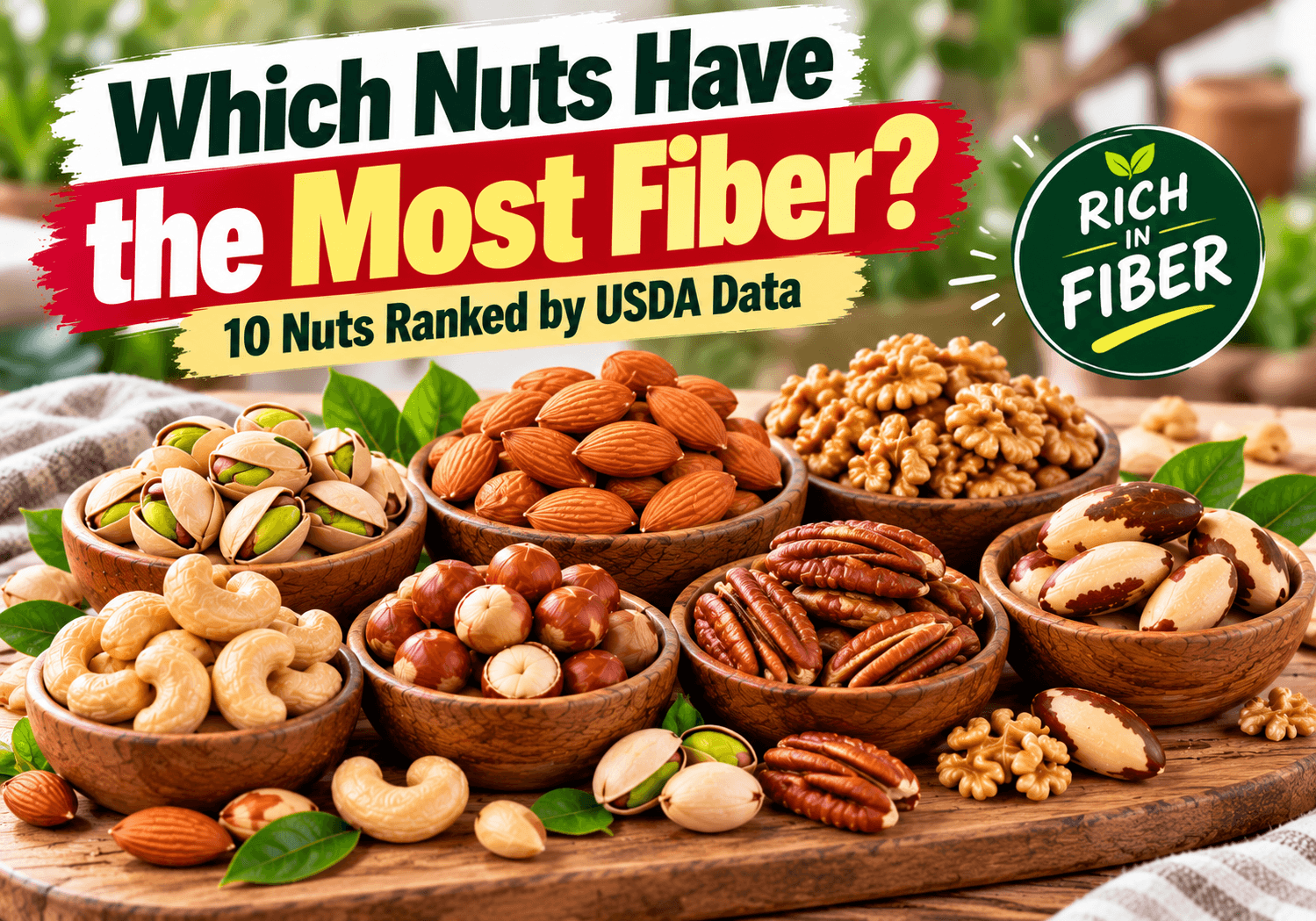
Most people don’t eat enough fiber, and nuts are one of the tastiest ways to close the gap. A small handful can add a few grams of fiber along with healthy fats and protein. But fiber content varies a lot from nut to nut, so it’s worth knowing which nuts have the most fiber before you stock your pantry.
In this guide, you’ll see a ranked list of 10 popular nuts by fiber content, based on USDA data. You’ll also learn what fiber does in your body, who benefits most, how many nuts to eat, and simple ways to make nuts part of a high-fiber diet.
Key Takeaways
- Almonds have the most fiber of common nuts, with about 3.5 grams per ounce.
- Pistachios come second at about 3 grams per ounce, followed by hazelnuts and pecans at about 2.7 grams.
- Cashews and pine nuts have the least, about 1 gram per ounce.
- Most adults need 21 to 38 grams of fiber a day, but the average American gets only about 15 grams.
- Higher fiber intake is linked to a 15% to 30% lower risk of death from all causes and heart disease in large studies.
- About 1 ounce of plain nuts a day is a smart way to add fiber without overdoing calories.
What Is Dietary Fiber, and Why Does It Matter?
Fiber is the part of plant foods your body can’t fully digest. Instead of being absorbed, it moves through your digestive system and helps it work well. According to Mayo Clinic, there are two main types of fiber:
- Soluble fiber dissolves in water and forms a gel-like material. It can help lower cholesterol and blood sugar.
- Insoluble fiber adds bulk and helps material move through your digestive system, which can ease constipation.
Most plant foods, including nuts, contain both types. That’s why eating a variety of fiber-rich foods, rather than relying on one, gives your body a good mix of both kinds. Harvard’s Nutrition Source lists almonds and walnuts as sources of insoluble fiber.
How Much Fiber Do You Need?
Mayo Clinic, citing the National Academy of Medicine, recommends these daily fiber targets:
| Group | Daily fiber target |
| Women 50 or younger | 25 grams |
| Women 51 and older | 21 grams |
| Men 50 or younger | 38 grams |
| Men 51 and older | 30 grams |
Yet most people fall short. Harvard notes that the average American eats only about 15 grams of fiber a day, far below these targets. Nuts are one easy way to help close that gap.
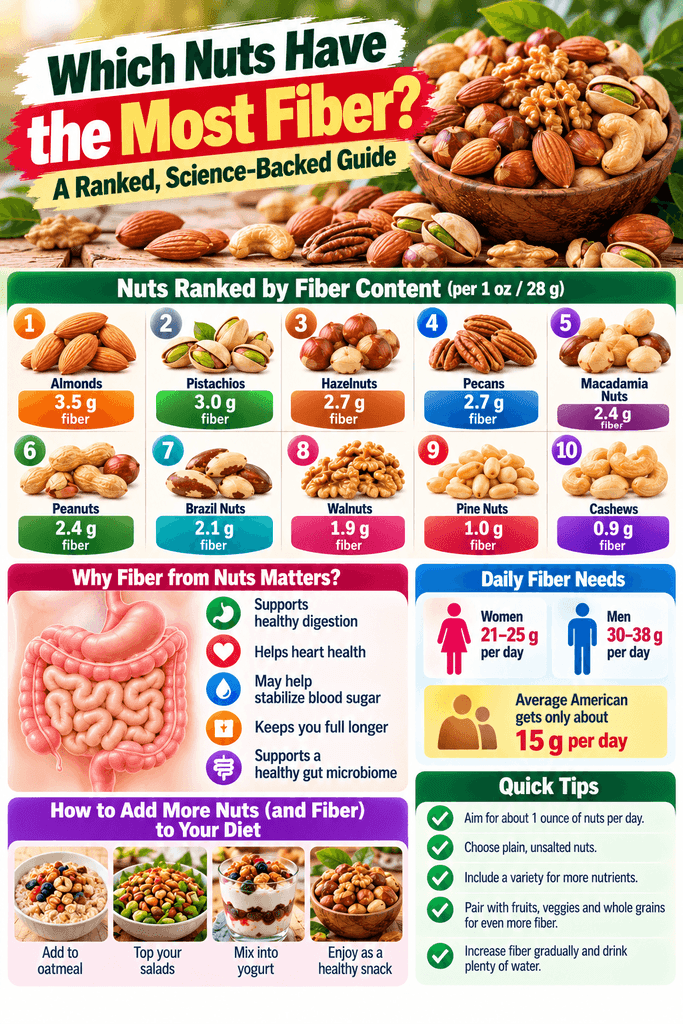
Which Nuts Have the Most Fiber? The Full Ranking
Here’s how 10 popular nuts compare per 1-ounce (28-gram) serving, based on USDA FoodData Central data. We also show fiber per 100 calories, which tells you how much fiber you get for the calories you eat.
| Rank | Nut (raw, 1 oz) | Fiber | Calories | Fiber per 100 calories | Source |
| 1 | Almonds | 3.5 g | 164 | 2.2 g | USDA FDC |
| 2 | Pistachios | 3.0 g | 159 | 1.9 g | USDA FDC |
| 3 | Hazelnuts | 2.7 g | 178 | 1.5 g | USDA FDC |
| 4 | Pecans | 2.7 g | 196 | 1.4 g | USDA FDC |
| 5 | Macadamia nuts | 2.4 g | 204 | 1.2 g | USDA FDC |
| 6 | Peanuts | 2.4 g | 161 | 1.5 g | USDA FDC |
| 7 | Brazil nuts | 2.1 g | 187 | 1.1 g | USDA FDC |
| 8 | Walnuts | 1.9 g | 185 | 1.0 g | USDA FDC |
| 9 | Pine nuts | 1.0 g | 191 | 0.5 g | USDA FDC |
| 10 | Cashews | 0.9 g | 157 | 0.6 g | USDA FDC |
Per-ounce values are calculated from USDA’s per-100-gram data and rounded. Pistachios and almonds are listed raw; roasted values may differ slightly. Peanuts are technically legumes but are usually grouped with nuts.
So, which nuts have the most fiber? Almonds win on both measures: the most fiber per ounce and the most fiber per calorie. Pistachios are a close second, while cashews and pine nuts come last.
Why Fiber per Calorie Matters
Nuts are calorie-dense, so it helps to look at how much fiber you get for every 100 calories. Almonds give you about 2.2 grams, while cashews give you only about 0.6 grams. In other words, you’d need to eat roughly three to four times more calories from cashews to get the same fiber as from almonds.
This matters if you’re watching your weight or trying to raise fiber without adding many calories. Almonds and pistachios are the clear winners on this measure, and they’re the easiest way to get the most fiber from nuts in a single handful.
The Nuts With the Most Fiber in Detail
Here’s a closer look at the nuts with the most fiber and what else they offer.
1. Almonds: The Nut With the Most Fiber
Almonds top the list with about 12.5 grams of fiber per 100 grams, or roughly 3.5 grams per ounce. That’s about 14% of the daily target for a woman 50 or younger.
Almonds also provide about 6 grams of protein, 76 mg of calcium, and 77 mg of magnesium per ounce. That makes them a well-rounded choice beyond fiber alone. Learn more about whether almonds are healthy.
2. Pistachios: Among the Nuts With the Most Fiber per Calorie
Pistachios deliver about 10.6 grams of fiber per 100 grams, or about 3 grams per ounce. They’re also one of the lower-calorie nuts, at about 159 calories per ounce, and they add about 5.7 grams of protein per ounce.
An ounce of pistachios is a generous portion of about 49 nuts, which can make a snack feel more satisfying. See our guide on whether pistachios are healthy.
3. Hazelnuts: One of the Nuts With the Most Fiber for Baking
Hazelnuts have about 9.7 grams of fiber per 100 grams, or about 2.7 grams per ounce. They also offer about 4 grams of protein per ounce.
Hazelnuts work well in baking, on salads, or chopped over yogurt. Our guide on whether hazelnuts are healthy covers their full nutrition profile.
4. Pecans: High in Fiber, Higher in Calories
Pecans contain about 9.6 grams of fiber per 100 grams, also about 2.7 grams per ounce. However, they’re higher in calories, at about 196 per ounce, because of their higher fat content.
That makes pecans a good fiber source, but portion size matters more. Read more about whether pecans are healthy.
5. Macadamia Nuts and Peanuts: Middle of the Pack
Macadamias have about 8.6 grams of fiber per 100 grams, or about 2.4 grams per ounce. They’re the highest in calories on our list, at about 204 per ounce. Learn more about whether macadamia nuts are healthy.
Peanuts match macadamias with about 8.5 grams of fiber per 100 grams, or about 2.4 grams per ounce, but with fewer calories and more protein, about 7 grams per ounce. Read more about whether peanuts are healthy.
Nuts With Less Fiber (But Other Benefits)
Lower fiber doesn’t mean a nut isn’t healthy. These nuts don’t have the most fiber, but they bring other strengths.
Brazil nuts. Brazil nuts have about 7.5 grams of fiber per 100 grams, or about 2.1 grams per ounce. But they’re best eaten in tiny amounts. One Brazil nut contains 68 to 91 micrograms of selenium, and the adult upper limit is 400 micrograms a day. Our guide on how many Brazil nuts to eat explains safe portions.
Walnuts. Walnuts have about 1.9 grams of fiber per ounce, placing them lower on the fiber list. However, they’re a standout source of the plant omega-3 fat ALA, with 2.57 grams per ounce. See whether walnuts are healthy.
Pine nuts and cashews. Pine nuts have about 3.7 grams of fiber per 100 grams, and raw cashews have about 3.3 grams. That’s only about 1 gram per ounce. Cashews still offer protein, about 5 grams per ounce, along with minerals like magnesium and zinc. One ounce is about 18 cashews, so if you love cashews, consider mixing them with almonds or pistachios to raise the fiber in your snack.
Health Benefits of Eating the Nuts With the Most Fiber
Fiber is linked to a wide range of health benefits. Here’s what the research shows and how it may work.
Digestive Health and Regularity
Fiber helps keep you regular. Mayo Clinic explains that fiber increases the weight and size of your stool and softens it, which makes it easier to pass and can ease constipation. A high-fiber diet may also lower the risk of hemorrhoids and small pouches in the colon (diverticular disease).
Women may benefit too. Harvard describes a Nurses’ Health Study of more than 50,000 women in which those eating 25 grams or more of fiber a day had a 13% lower risk of diverticulitis than those eating less than 18 grams.
Nuts have a specific link here. Harvard notes that in a study of more than 47,000 men, eating nuts and popcorn was associated with a lower risk of diverticulitis, an inflammation of those colon pouches.
Heart Health and Cholesterol
Soluble fiber may help lower LDL (“bad”) cholesterol. Mayo Clinic notes that soluble fiber may help lower total blood cholesterol by lowering LDL cholesterol. Harvard adds that a review of 67 controlled trials found a modest cholesterol-lowering effect from soluble fiber.
Nuts bring more than fiber to the table. Harvard reports that eating about one ounce of nuts five or more times per week is linked to lower cardiovascular risk. Learn more in our guide to nuts and heart health.
Blood Sugar Control
Soluble fiber can slow the absorption of sugar, which may help improve blood sugar levels in people with diabetes. Harvard notes that low-fiber diets may raise the risk of type 2 diabetes, though whole grains show the strongest link.
Feeling Full and Managing Weight
High-fiber foods tend to be more filling than low-fiber foods, so you may eat less and stay satisfied longer. Nuts combine fiber with protein and fat, a mix that can make snacks more satisfying. For more, see our guide to high-fiber diets and weight.
Longer Life
A major 2019 review in The Lancet, commissioned by the World Health Organization, found that people who ate the most fiber had a 15% to 30% lower risk of death from all causes and from heart disease, compared with those who ate the least.
The biggest benefits appeared at 25 to 29 grams of fiber a day. The authors also noted that higher intakes may offer even greater benefit for heart disease, type 2 diabetes, and some cancers. These were mostly observational findings, so they show a strong link rather than proof.
Who Benefits Most From the Nuts With the Most Fiber?
Most adults can benefit from adding fiber-rich nuts, but these groups may gain the most:
- People who eat little fiber: With the average American getting only about 15 grams a day, almost everyone has room to add more.
- People with constipation: Fiber softens and adds bulk to stool.
- People watching their cholesterol: Soluble fiber and regular nut eating are both linked to heart benefits.
- People managing blood sugar: Fiber can slow sugar absorption.
- People trying to manage weight: Fiber, protein, and healthy fats make nuts filling.
- Older adults: Fiber targets drop slightly after 50, to 21 grams for women and 30 grams for men, and a daily handful of almonds can help you reach them.
Risks of the Nuts With the Most Fiber and Who Should Be Cautious
Nuts are safe for most people, but keep these points in mind:
Too much fiber, too fast. Adding a lot of fiber quickly can cause gas, bloating, and cramping. Mayo Clinic recommends that you increase fiber gradually over a few weeks and drink plenty of water.
Calories. Nuts average about 185 calories per ounce. If fiber is your goal, almonds and pistachios give you the most fiber for the calories.
Allergies. Tree nuts and peanuts are among the FDA’s nine major food allergens. Severe reactions can cause anaphylaxis, a life-threatening reaction.
Brazil nut overload. Because of their selenium, too many Brazil nuts can cause hair loss, brittle nails, and a garlic odor on the breath. Stick to one or two.
Salted and candied nuts. Harvard notes that nuts covered in chocolate or with lots of sugar or sodium are probably not as good as plain nuts.
How Many of the Nuts With the Most Fiber Should You Eat?
For most adults, about 1 ounce (28 grams) of nuts a day is a good target. Harvard defines a handful as about 28 grams, or one ounce.
One ounce of almonds gives you about 3.5 grams of fiber, which covers 9% to 17% of daily targets depending on your age and sex. That’s a meaningful boost, but nuts alone won’t meet your fiber needs. Mayo Clinic lists whole grains, fruits, vegetables, beans, and nuts and seeds as the best fiber sources, so aim for a mix.
A Sample Day Built Around the Nuts With the Most Fiber
Here’s how nuts can fit into a day:
- Breakfast: Oatmeal topped with 1 ounce of sliced almonds (about 3.5 g fiber from the almonds).
- Snack: An apple with a small handful of pistachios.
- Lunch: A bean and vegetable salad sprinkled with chopped hazelnuts.
- Dinner: Whole-grain pasta with vegetables and a few pine nuts.
Oats are another great fiber source. See whether oatmeal is high in fiber.
Practical Tips for Eating the Nuts With the Most Fiber
- Choose almonds and pistachios first. They have the most fiber per ounce and per calorie.
- Swap low-fiber nuts. Trade some cashews or pine nuts for almonds or pistachios to roughly triple the fiber in your snack.
- Pre-portion snacks. Pack 1-ounce servings so you get the fiber without overdoing calories.
- Mix nuts with other high-fiber foods. Pair them with fruit, oats, or beans.
- Increase slowly. Add nuts and other fiber gradually, and drink plenty of water.
- Pick plain or dry-roasted. Skip heavily salted or candy-coated nuts.
Our complete guide to nuts has more ideas for every type of nut.
Myths vs. Facts: Which Nuts Have the Most Fiber?
| Myth | Fact |
| All nuts have about the same fiber. | Almonds have about 3.5 grams per ounce, nearly four times more than cashews. |
| Walnuts are the highest-fiber nut. | Walnuts have about 1.9 grams per ounce, less than almonds, pistachios, hazelnuts, and pecans. |
| Nuts alone can meet your fiber needs. | Adults need 21 to 38 grams a day; an ounce of almonds gives about 3.5 grams. |
| More fiber is always better, right away. | Adding fiber too fast can cause gas and bloating. Mayo Clinic advises increasing it gradually. |
| High-fiber nuts are too high in calories. | Pistachios and almonds give the most fiber for their calories, and a 1-ounce portion fits most diets. |
How the Nuts With the Most Fiber Fit a Healthy Lifestyle
Nuts are a great fiber booster, but they work best as part of an overall high-fiber eating pattern. The 2019 Lancet review linked the biggest benefits to 25 to 29 grams of fiber a day, an amount that usually comes from a mix of whole grains, fruits, vegetables, beans, nuts, and seeds.
Think of a daily handful of almonds or pistachios, the nuts with the most fiber per serving, as one easy step. Combined with fiber-rich meals and plenty of water, it can help you move closer to your daily fiber goal.
Frequently Asked Questions
Which nut has the most fiber?
Almonds have the most fiber of common nuts, with about 3.5 grams per ounce, based on USDA data. Pistachios come next at about 3 grams per ounce, followed by hazelnuts and pecans at about 2.7 grams. Almonds also give you the most fiber per calorie, making them the top high-fiber choice.
Which nut has the least fiber?
Cashews and pine nuts have the least fiber among popular nuts, with about 1 gram per ounce each. They still provide healthy fats, protein, and minerals. If fiber is your main goal, swap some of them for almonds or pistachios, which have about three times more fiber per serving.
Are nuts a good source of fiber?
Yes, nuts are a good source of fiber, especially almonds, pistachios, hazelnuts, and pecans. One ounce provides about 2 to 3.5 grams. However, adults need 21 to 38 grams a day, so nuts should be combined with whole grains, fruits, vegetables, and beans to meet daily fiber targets.
How much fiber is in a handful of almonds?
A handful of almonds, about 1 ounce or 28 grams, contains about 3.5 grams of fiber, based on USDA data. That covers roughly 9% to 17% of daily fiber targets, depending on age and sex. The same handful also provides about 6 grams of protein and 164 calories.
Do pistachios have more fiber than walnuts?
Yes. Pistachios have about 3 grams of fiber per ounce, while walnuts have about 1.9 grams. Pistachios are also slightly lower in calories. Walnuts, however, are a standout source of plant omega-3 fats, so both nuts can fit into a healthy diet for different reasons.
Can eating too many nuts cause bloating?
Eating a lot of nuts or other high-fiber foods quickly can cause gas, bloating, or cramping. To avoid this, add fiber gradually over a few weeks and drink plenty of water. Sticking to about a 1-ounce portion of nuts a day also helps keep both fiber and calories in check.
Conclusion: Which Nuts Have the Most Fiber?
So, which nuts have the most fiber? Almonds lead the list at about 3.5 grams per ounce, followed by pistachios, hazelnuts, and pecans. Cashews and pine nuts have the least, at about 1 gram per ounce.
Fiber is linked to better digestion, heart health, blood sugar control, and a longer life. A daily handful of almonds or pistachios, paired with other fiber-rich foods and plenty of water, is a simple way to move closer to your daily fiber goal.
Medical disclaimer: This article is for general information only and is not a substitute for professional medical advice, diagnosis, or treatment. If you have a digestive condition, a nut allergy, or other health concerns, talk with your doctor or a registered dietitian before changing your diet.
(3) References
- USDA FoodData Central. Nuts, almonds (FDC ID 170567). https://fdc.nal.usda.gov/fdc-app.html#/food-details/170567/nutrients
- USDA FoodData Central. Nuts, pistachio nuts, raw (FDC ID 170184). https://fdc.nal.usda.gov/fdc-app.html#/food-details/170184/nutrients
- USDA FoodData Central. Nuts, hazelnuts or filberts (FDC ID 170581). https://fdc.nal.usda.gov/fdc-app.html#/food-details/170581/nutrients
- USDA FoodData Central. Nuts, pecans (FDC ID 170182). https://fdc.nal.usda.gov/fdc-app.html#/food-details/170182/nutrients
- USDA FoodData Central. Nuts, macadamia nuts, raw (FDC ID 170178). https://fdc.nal.usda.gov/fdc-app.html#/food-details/170178/nutrients
- USDA FoodData Central. Peanuts, all types, raw (FDC ID 172430). https://fdc.nal.usda.gov/fdc-app.html#/food-details/172430/nutrients
- USDA FoodData Central. Nuts, brazilnuts, dried, unblanched (FDC ID 170569). https://fdc.nal.usda.gov/fdc-app.html#/food-details/170569/nutrients
- USDA FoodData Central. Nuts, walnuts, English (FDC ID 170187). https://fdc.nal.usda.gov/fdc-app.html#/food-details/170187/nutrients
- USDA FoodData Central. Nuts, pine nuts, dried (FDC ID 170591). https://fdc.nal.usda.gov/fdc-app.html#/food-details/170591/nutrients
- USDA FoodData Central. Nuts, cashew nuts, raw (FDC ID 170162). https://fdc.nal.usda.gov/fdc-app.html#/food-details/170162/nutrients
- Mayo Clinic. Dietary fiber: Essential for a healthy diet. https://www.mayoclinic.org/healthy-lifestyle/nutrition-and-healthy-eating/in-depth/fiber/art-20043983
- Harvard T.H. Chan School of Public Health, The Nutrition Source. Fiber. https://nutritionsource.hsph.harvard.edu/carbohydrates/fiber/
- Harvard T.H. Chan School of Public Health, The Nutrition Source. Nuts for the Heart. https://nutritionsource.hsph.harvard.edu/food-features/nuts-for-the-heart/
- Reynolds A, Mann J, Cummings J, Winter N, Mete E, Te Morenga L. Carbohydrate quality and human health: a series of systematic reviews and meta-analyses. The Lancet. 2019;393(10170):434–445. https://doi.org/10.1016/S0140-6736(18)31809-9
- NIH Office of Dietary Supplements. Selenium: Fact Sheet for Health Professionals. https://ods.od.nih.gov/factsheets/Selenium-HealthProfessional/
- NIH Office of Dietary Supplements. Iron: Fact Sheet for Health Professionals (nut serving counts). https://ods.od.nih.gov/factsheets/Iron-HealthProfessional/
- U.S. Food and Drug Administration. Food Allergies. https://www.fda.gov/food/nutrition-food-labeling-and-critical-foods/food-allergies