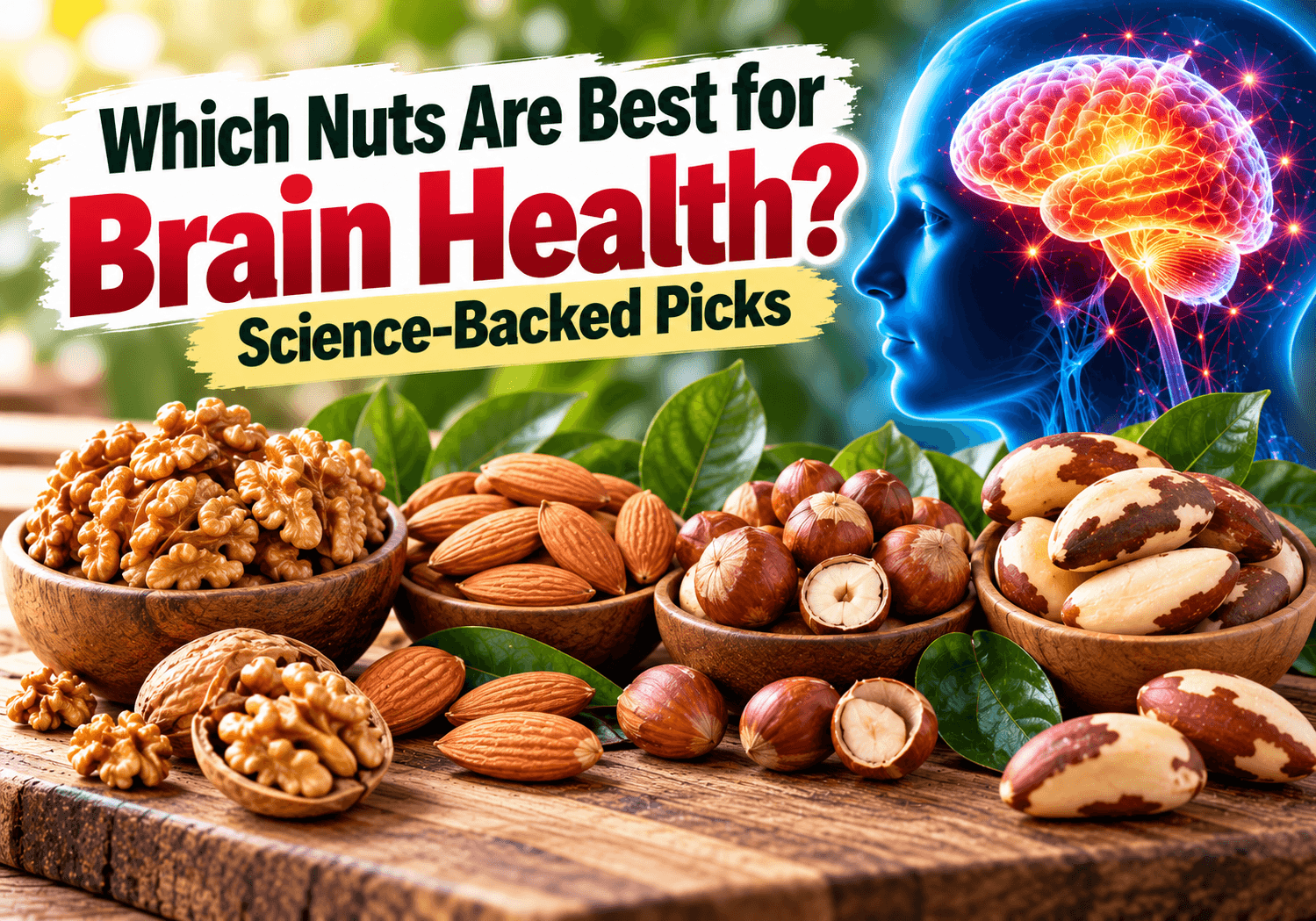
You’ve probably heard that walnuts look like a tiny brain, so they must be good for your mind. It’s a fun idea, but the real story is more interesting. If you’re wondering which nuts are best for brain health, the short answer is walnuts, almonds, hazelnuts, and a small number of Brazil nuts, eaten as part of an overall healthy diet.
In this guide, you’ll learn what makes each nut special, what large studies and clinical trials have found, who may benefit most, and how much to eat. We’ll also clear up a few myths so you know what nuts can, and can’t, do for your memory and thinking.
Key Takeaways
- Walnuts lead the pack. They’re a standout source of ALA, a plant omega-3 fat, and the most studied nut for brain health.
- Almonds and hazelnuts are top vitamin E sources, an antioxidant nutrient that helps protect your cells.
- Brazil nuts are packed with selenium, but one or two is plenty. Too many can be harmful.
- A daily handful may be linked to lower dementia risk. A large UK study tied up to about 30 grams a day to the biggest benefit.
- Clinical trials are mixed. Nuts haven’t been proven to prevent dementia or sharpen memory on their own.
- Plain, unsalted nuts are the smartest choice, about 1 ounce a day as part of a balanced diet.
Why Nuts Matter for Your Brain
Your brain depends on a steady supply of nutrients to build cells, protect them from damage, and keep working well. Nuts offer several of these nutrients in one small, convenient package.
The Harvard T.H. Chan School of Public Health notes that nuts contain healthy fats, protein, vitamin E, folate, potassium, and fiber. Different nuts shine in different areas, which is why the “best” nut depends on the nutrient you’re looking at.
Nuts also support heart health. Harvard reports that eating about one ounce of nuts five or more times per week is linked to lower cardiovascular risk. You can learn more in our guide to nuts and heart health.
The Key Brain-Related Nutrients in Nuts
Here are the main nutrients researchers focus on:
- Alpha-linolenic acid (ALA): A plant-based omega-3 fatty acid, found in especially high amounts in walnuts.
- Vitamin E: An antioxidant vitamin found in almonds, hazelnuts, and peanuts.
- Selenium: A trace mineral that is extremely high in Brazil nuts.
- Healthy fats and fiber: Found in varying amounts across most nuts.
None of these nutrients works like a medicine. Instead, they’re part of the overall eating pattern that research links with healthy aging.
Nutritional Profile of the Best Nuts for Brain Health
Before ranking nuts, it helps to see their key nutrients side by side. The table below uses a standard 1-ounce (about 28-gram) serving, which is roughly a small handful.
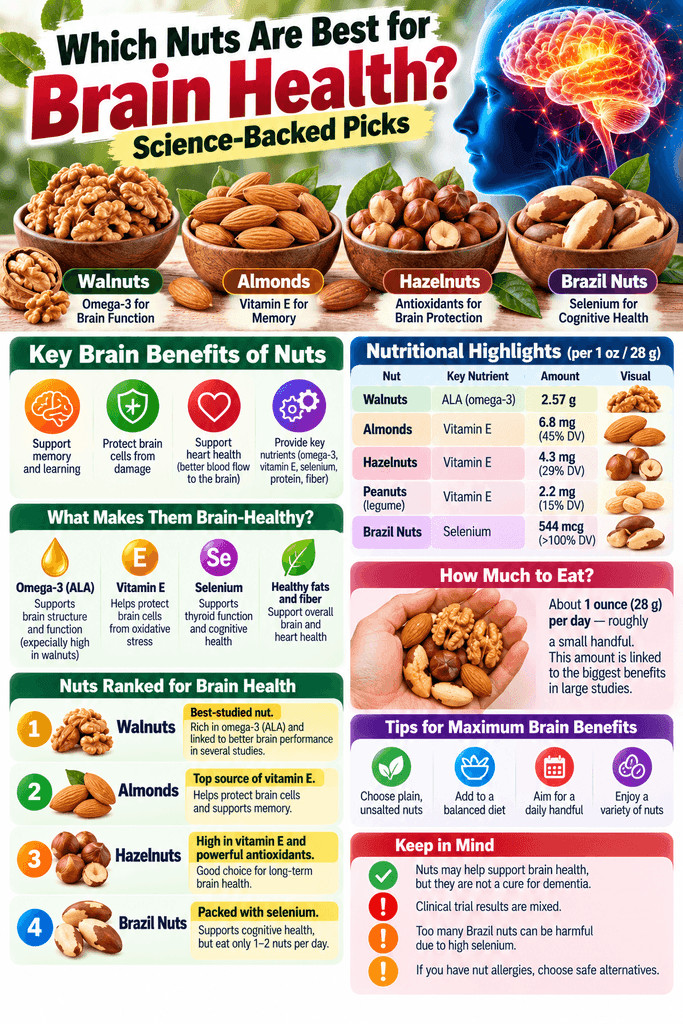
| Nut (1 oz) | Standout brain-related nutrient | Amount per ounce | Source |
| English walnuts | ALA (plant omega-3) | 2.57 g | NIH ODS |
| Almonds (dry roasted) | Vitamin E | 6.8 mg (45% DV) | NIH ODS |
| Hazelnuts (dry roasted) | Vitamin E | 4.3 mg (29% DV) | NIH ODS |
| Peanuts (dry roasted) | Vitamin E | 2.2 mg (15% DV) | NIH ODS |
| Brazil nuts (6–8 nuts) | Selenium | 544 mcg | NIH ODS |
DV = Daily Value. Peanuts are technically legumes, but they’re often grouped with nuts.
A few numbers stand out. One ounce of walnuts provides more ALA than the daily adequate intake for adults, which is 1.6 grams for men and 1.1 grams for women. Meanwhile, one ounce of Brazil nuts delivers more selenium than adults should get in an entire day.
Which Nuts Are Best for Brain Health? Our Ranked List
Based on nutrient content and the available research, here is how the most popular nuts compare for brain support.
1. Walnuts: The Best-Studied Nut for Brain Health
Walnuts earn the top spot for two reasons. First, they’re a standout source of ALA. USDA data show 2.57 grams of ALA and about 185 calories per ounce of English walnuts, along with about 4 grams of protein and 2 grams of fiber.
Second, walnuts have been studied more than any other nut for cognition. A 2021 systematic review in Advances in Nutrition looked at 22 studies with 43,793 participants. Of the six walnut studies it included, five reported a positive link with brain performance.
That doesn’t mean walnuts are a cure-all. The largest walnut trial, discussed below, found no overall effect on thinking skills after two years. For a full nutrient breakdown, see our guide on whether walnuts are healthy.
2. Almonds: Among the Best Nuts for Brain Health and Vitamin E
Almonds are one of the best food sources of vitamin E. One ounce of dry-roasted almonds provides 6.8 mg, or 45% of the Daily Value. Adults need 15 mg of vitamin E a day, so a handful covers almost half.
Vitamin E is an antioxidant that helps protect cells from damage. However, the NIH Office of Dietary Supplements says most research does not support vitamin E supplements for maintaining thinking skills in healthy people. Getting vitamin E from whole foods like almonds is a more balanced approach. Read more about whether almonds are healthy.
3. Hazelnuts: Another of the Best Nuts for Brain Health
Hazelnuts are a close second to almonds for vitamin E, with 4.3 mg per ounce, or 29% of the Daily Value. Like most nuts, they also bring healthy fats and fiber.
Hazelnuts were also part of the nut mix used in the well-known PREDIMED brain study, covered below. If you like variety, they’re an easy way to rotate your vitamin E sources. Our guide on whether hazelnuts are healthy covers their full nutrient profile.
4. Brazil Nuts: Best for Brain Health Only in Small Doses
Brazil nuts are extremely high in selenium. The NIH reports that a single Brazil nut contains 68 to 91 micrograms of selenium, while the recommended amount for adults is just 55 micrograms a day.
That’s both a strength and a risk. The adult upper limit is 400 micrograms per day, so a handful of Brazil nuts can push you over the limit.
Also, clinical trials do not support selenium supplements for reducing cognitive decline. Treat Brazil nuts as an occasional extra, not a daily handful. Our guide to safe Brazil nut portions explains how much is enough.
5. Mixed Nuts and Peanuts: Variety Is Best for Brain Health
You don’t have to pick just one nut. The best-known brain trial with nuts, part of the Spanish PREDIMED study, used a daily mix of 30 grams of mixed nuts, including walnuts, almonds, and hazelnuts.
Peanuts add a little vitamin E, with 2.2 mg per ounce, and are often budget-friendly. Pistachios, pecans, and cashews also fit into a healthy diet, though they’ve been studied less for brain outcomes. Our complete guide to nuts compares them all.
How the Best Nuts for Brain Health May Work
Researchers think nuts may help the brain in several ways. Most of these ideas come from nutrient research, so they explain why nuts are promising rather than proving that they prevent disease.
Omega-3 Fats and Brain Cells
The omega-3 fat DHA is concentrated in the brain and the retina. Walnuts don’t contain DHA directly. Instead, they provide ALA, which your body can convert into EPA and DHA.
The catch is that this conversion is very limited, at less than 15%. So walnuts are a helpful plant source of omega-3s, but they don’t replace fatty fish. To learn more, see our guide to the nuts highest in omega-3, or our comparison of omega-3 and fish oil.
The evidence on omega-3s and the brain is still developing. The NIH says that some, but not all, observational studies link diets high in long-chain omega-3s to a lower risk of cognitive decline.
Antioxidants and Cell Protection
Vitamin E is a fat-soluble antioxidant. It helps protect cells from damage caused by free radicals, unstable molecules that can harm cells over time. This is one reason researchers are interested in vitamin E–rich foods like almonds and hazelnuts.
Heart Health and Blood Flow
Your brain relies on healthy blood flow. Because regular nut eating is linked to lower cardiovascular risk, researchers suspect that some of nuts’ brain benefits may come through better heart and blood vessel health. Nuts’ healthy fats and fiber may also play a role in inflammation, which we explore in our article on whether nuts are inflammatory.
What Research Says About the Best Nuts for Brain Health
Here’s an honest look at the strongest studies, including the ones with disappointing results.
Large Observational Studies: A Daily Handful Is Linked to Lower Dementia Risk
A 2024 UK Biobank study in GeroScience followed 50,386 adults, with an average age of 56.5, for about 7 years. People who ate nuts daily had a 12% lower risk of dementia than those who didn’t eat nuts (hazard ratio 0.88).
The biggest benefit appeared at up to one handful (30 grams) per day, and unsalted nuts were linked to the largest benefits. Still, this type of study shows a link, not cause and effect. People who eat nuts may also have other healthy habits that protect the brain.
Clinical Trials: Mixed but Interesting Results
Randomized trials are the gold standard, and here the picture is more mixed:
- PREDIMED (Spain): In 447 older adults at high cardiovascular risk, a Mediterranean diet with 30 grams of mixed nuts per day improved memory scores compared with a low-fat control diet over about 4 years. However, the nut group didn’t show significant gains in global cognition.
- WAHA walnut trial: In 708 healthy adults aged 63 to 79, eating 30 to 60 grams of walnuts a day for two years produced no overall difference in thinking skills. A subgroup in Barcelona did show a benefit, which the authors called preliminary.
- 2024 meta-analysis: A review of five randomized trials with 928 adults found no significant effect of nuts on cognitive function. The authors noted that the studies were small and very different from one another, and they called for larger, high-quality trials.
The 2021 systematic review reached a similar conclusion. It described the evidence for mixed nuts as inconsistent, mainly because studies used different nuts, doses, and memory tests.
The Bigger Picture: Diet Patterns Matter Most
The MIND diet blends the Mediterranean and DASH diets and includes nuts as one of its brain-healthy food groups. In a three-year trial of 604 older adults with a family history of Alzheimer’s disease, published in the New England Journal of Medicine, both the MIND group and the control group improved, and the difference between them was not significant.
Both groups also followed a mild calorie restriction and lost about 5 kilograms, which may explain some of the improvement. The lesson is that nuts work best as one part of a healthy eating pattern, not as a stand-alone fix.
Who Benefits Most From the Best Nuts for Brain Health?
The research hints that some groups may get more from adding nuts:
- Older adults: Key trials such as PREDIMED and WAHA focused on older adults, when age-related memory changes become more common.
- People at higher risk of cognitive decline: The 2021 systematic review found that studies of higher-risk populations tended to find more favorable results.
- People with heart risk factors: The PREDIMED participants all had high cardiovascular risk, and the nut group’s memory scores improved.
- People who rarely eat fish: Walnuts offer a plant-based omega-3, though they can’t fully replace fish because of the limited ALA conversion.
That said, nuts are a healthy choice for almost everyone without an allergy, at any age.
Risks, Side Effects, and Who Should Be Cautious
Nuts are safe for most people, but a few cautions apply.
Nut allergies. Tree nuts and peanuts are among the nine major food allergens recognized by the FDA. Reactions can range from mild hives to a severe, life-threatening reaction called anaphylaxis. If you have a nut allergy, talk with your doctor before trying any new nut.
Too much selenium from Brazil nuts. Eating too many Brazil nuts can cause selenium toxicity. Common signs include hair loss and brittle nails, along with a garlic odor on the breath, nausea, and fatigue. Stick to one or two Brazil nuts at a time, and not every day.
Calories add up. Nuts are nutrient-dense, but they’re also calorie-dense, averaging about 185 calories per ounce. Large daily portions can lead to weight gain if you don’t adjust elsewhere. See our article on whether nuts are fattening.
Salted, sugared, and chocolate-covered nuts. Harvard experts note that nuts covered in chocolate or with high amounts of sugar or sodium are probably not as good as plain nuts. In the UK Biobank study, unsalted nuts were linked to the biggest brain benefits.
Vitamin E supplements are different from nuts. In one NIH-reviewed trial, people with Alzheimer’s disease who took high-dose vitamin E had more falls. Food sources like almonds don’t come close to those doses, but it’s a good reminder that more isn’t always better.
How Much of the Best Brain Health Nuts Should You Eat?
A good target for most adults is about 1 ounce (28 to 30 grams) of nuts per day. This matches the amount linked to the biggest benefit in the UK Biobank study and the amount used in the PREDIMED trial.
Harvard defines a handful as about 28 grams, or one ounce. For most nuts, that’s a small handful that fits in your palm. Brazil nuts are the exception: 1 ounce is 6 to 8 nuts, but you should eat only 1 or 2 because of their selenium.
Practical Tips for Eating the Best Nuts for Brain Health
Adding nuts to your day is easy. Try these simple ideas:
- Top your breakfast. Sprinkle chopped walnuts on oatmeal or yogurt.
- Pack a pre-portioned snack. Measure a 1-ounce serving into a small container so you don’t overeat.
- Toss them into salads. Toasted almonds or hazelnuts add crunch to greens.
- Choose plain or dry-roasted. Skip heavily salted, sugared, or candy-coated versions. Our guide explains whether roasted nuts are healthy.
- Mix it up. Rotate walnuts, almonds, and hazelnuts during the week to get a wider range of nutrients.
- Keep Brazil nuts as a treat. One or two a few times a week is plenty.
Myths vs. Facts About the Best Nuts for Brain Health
| Myth | Fact |
| Walnuts are good for the brain because they look like one. | Their shape is a coincidence. Walnuts stand out because of their ALA omega-3 content, not their looks. |
| Eating nuts will prevent dementia. | Large studies link nuts to lower dementia risk, but trials haven’t proven that nuts prevent it. |
| Walnut ALA is just as good as fish omega-3s. | The body converts less than 15% of ALA to EPA and DHA. |
| More Brazil nuts means more brain protection. | Too much selenium can be toxic, and selenium supplements haven’t been shown to slow cognitive decline. |
| Vitamin E pills work as well as nuts. | Most research does not support vitamin E supplements for thinking skills in healthy people. |
How the Best Nuts for Brain Health Fit a Healthy Lifestyle
Nuts are a great addition, but they work best alongside other healthy choices. The strongest research points to overall eating patterns, like the Mediterranean and MIND diets, rather than any single food.
A brain-friendly eating pattern may include:
- Plenty of plant foods, such as vegetables, fruits, whole grains, and beans, as in the MIND diet’s brain-healthy food groups.
- Olive oil and nuts, both used in the Mediterranean diet arms of the PREDIMED trial.
- Heart-friendly habits, since nuts’ link to lower cardiovascular risk may be part of how they help the brain.
Think of a daily handful of nuts as one small, easy step in a bigger plan. If you’re also watching blood sugar, protein, or weight, our other nut guides can help you fine-tune your choices.
Frequently Asked Questions
Which nut is best for memory and brain health?
Walnuts have the most research behind them. A systematic review found that five of six walnut studies reported a positive link with brain performance. However, the largest two-year walnut trial found no overall effect on thinking skills, so walnuts are best eaten as part of a healthy diet rather than as a memory treatment.
How many walnuts should I eat a day for brain health?
About 1 ounce, or roughly a small handful, is a reasonable daily amount. That serving provides 2.57 grams of ALA, more than the daily adequate intake for adults. The large UK study linked up to about 30 grams of nuts a day with the greatest reduction in dementia risk.
Are almonds good for your brain?
Almonds are one of the best food sources of vitamin E, an antioxidant that helps protect cells. One ounce provides about 45% of the Daily Value. While vitamin E supplements haven’t been shown to protect thinking skills, getting it from whole foods like almonds fits a brain-healthy diet.
Can eating nuts prevent Alzheimer’s disease?
No food has been proven to prevent Alzheimer’s disease. A large UK study found that daily nut eaters had a 12% lower risk of dementia, but this shows a link, not proof. Clinical trials have shown mixed results, so nuts are best seen as one part of a healthy lifestyle.
Are Brazil nuts good for brain health?
Brazil nuts are very high in selenium, with 68 to 91 micrograms per nut. However, clinical trials don’t support selenium supplements for slowing cognitive decline, and too much selenium can be toxic. One or two Brazil nuts occasionally is a safe way to enjoy them.
Are salted or roasted nuts still healthy for the brain?
Plain, dry-roasted nuts keep most of their nutrients and are a good choice. Heavily salted, sugared, or chocolate-covered nuts are less healthy. In a large UK study, unsalted nuts were linked to the biggest reductions in dementia risk, so plain varieties are the smartest pick.
Conclusion: Which Nuts Are Best for Brain Health?
So, which nuts are best for brain health? Walnuts top the list thanks to their plant omega-3s and the most research. Almonds and hazelnuts follow as excellent vitamin E sources, while Brazil nuts offer selenium in very small amounts.
The research is encouraging but not conclusive. A daily handful of nuts is linked to lower dementia risk, but clinical trials show mixed results. Your best move is to enjoy about 1 ounce of plain, unsalted nuts most days as part of a balanced, plant-forward diet.
Medical disclaimer: This article is for general information only and is not a substitute for professional medical advice, diagnosis, or treatment. If you have concerns about memory, thinking, or a nut allergy, talk with your doctor or a registered dietitian before changing your diet.
(3) References
- Bizzozero-Peroni B, Díaz-Goñi V, Beneit N, et al. Nut consumption is associated with a lower risk of all-cause dementia in adults: a community-based cohort study from the UK Biobank. GeroScience. 2024. https://doi.org/10.1007/s11357-024-01365-z
- Sala-Vila A, Valls-Pedret C, Rajaram S, et al. Effect of a 2-year diet intervention with walnuts on cognitive decline. The Walnuts and Healthy Aging (WAHA) study: a randomized controlled trial. American Journal of Clinical Nutrition. 2020;111(3):590–600. https://doi.org/10.1093/ajcn/nqz328
- Valls-Pedret C, Sala-Vila A, Serra-Mir M, et al. Mediterranean diet and age-related cognitive decline: a randomized clinical trial. JAMA Internal Medicine. 2015;175(7):1094–1103. https://doi.org/10.1001/jamainternmed.2015.1668
- Theodore LE, Kellow NJ, McNeil EA, et al. Nut consumption for cognitive performance: a systematic review. Advances in Nutrition. 2021;12(3):777–792. https://pmc.ncbi.nlm.nih.gov/articles/PMC8166568/
- Moabedi M, Aliakbari M, Erfanian S, Jibril AT, Milajerdi A. The effect of consuming nuts on cognitive function: a systematic review and meta-analysis of randomized clinical trials. Frontiers in Nutrition. 2024;11. https://doi.org/10.3389/fnut.2024.1463801
- Barnes LL, et al. Trial of the MIND diet for prevention of cognitive decline in older persons. New England Journal of Medicine. 2023. https://doi.org/10.1056/NEJMoa2302368
- Rush University Medical Center. MIND diet study shows “short-term” impact on cognition. 2023. https://www.rush.edu/news/mind-diet-study-shows-short-term-impact-cognition
- NIH Office of Dietary Supplements. Omega-3 Fatty Acids: Fact Sheet for Health Professionals. https://ods.od.nih.gov/factsheets/Omega3FattyAcids-HealthProfessional/
- NIH Office of Dietary Supplements. Vitamin E: Fact Sheet for Health Professionals. https://ods.od.nih.gov/factsheets/VitaminE-HealthProfessional/
- NIH Office of Dietary Supplements. Selenium: Fact Sheet for Health Professionals. https://ods.od.nih.gov/factsheets/Selenium-HealthProfessional/
- USDA FoodData Central. Nuts, walnuts, English (FDC ID 170187). https://fdc.nal.usda.gov/fdc-app.html#/food-details/170187/nutrients
- Harvard T.H. Chan School of Public Health, The Nutrition Source. Nuts for the Heart. https://nutritionsource.hsph.harvard.edu/food-features/nuts-for-the-heart/
- U.S. Food and Drug Administration. Food Allergies. https://www.fda.gov/food/nutrition-food-labeling-and-critical-foods/food-allergies