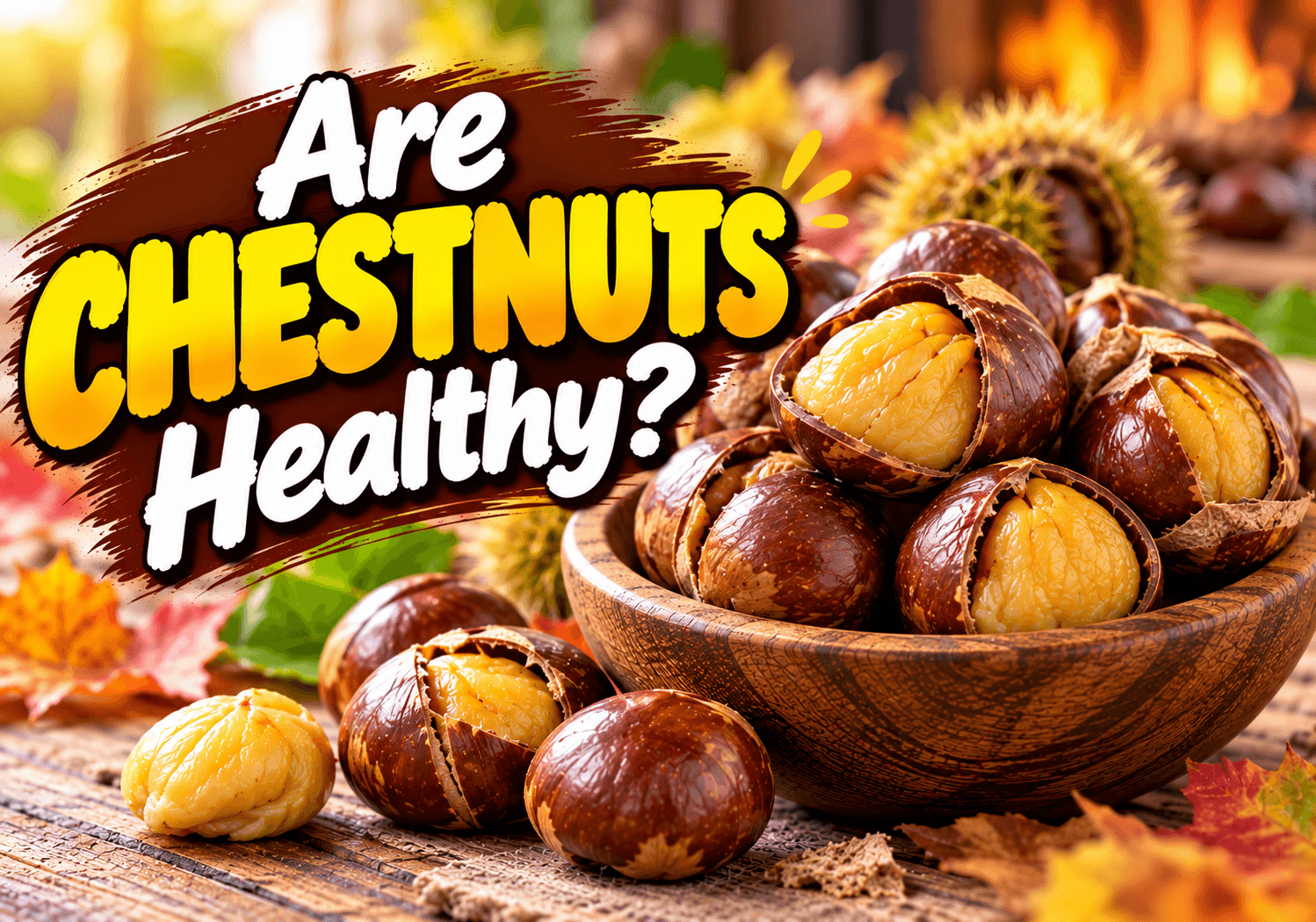
“Chestnuts roasting on an open fire” is a holiday classic for a reason. Warm, sweet and soft, roasted chestnuts are one of the season’s great comfort foods. But chestnuts are nothing like the other nuts in your pantry. They’re low in fat, high in starch, and even contain vitamin C. So, are chestnuts healthy? Yes. They’re a low-fat, low-calorie (for a nut), fiber-containing food that works more like a whole-grain starch than a typical nut. That makes them a smart holiday swap, as long as you know how they differ from other nuts.
This guide covers chestnut nutrition, how chestnuts compare with other nuts and starches, their benefits, the FDA’s 2025 change to their allergen status, how to roast them safely, and one important look-alike to avoid.
Key Takeaways
- One ounce of roasted chestnuts (about 3 nuts) has only about 70 calories and 0.5 g of fat, compared with roughly 160–200 calories for most nuts.
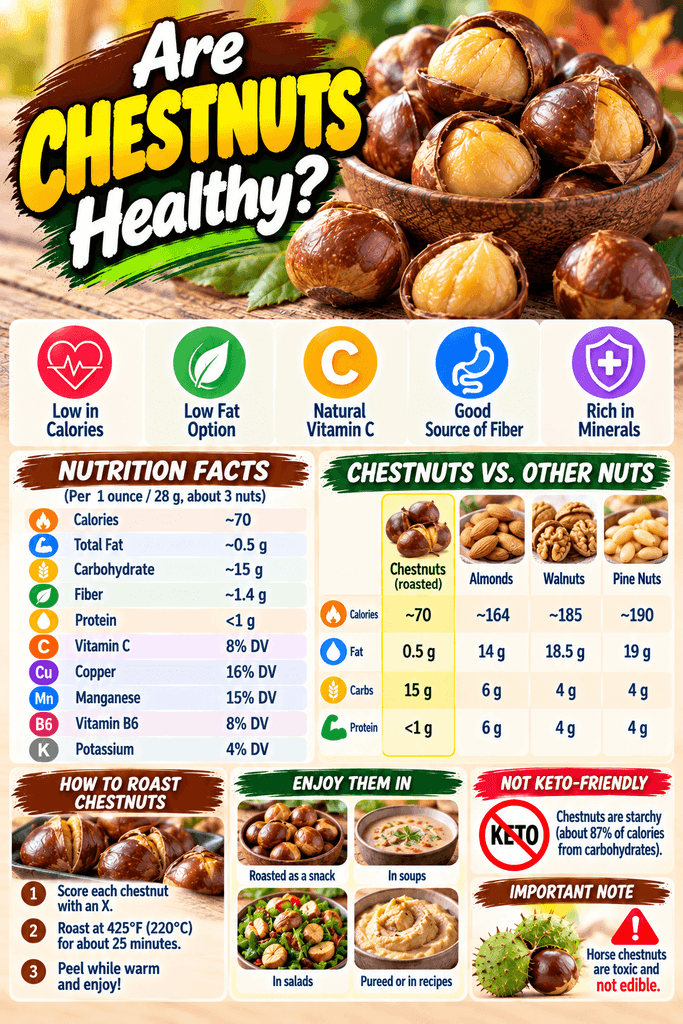
- Chestnuts are starchy: about 87% of their calories come from carbohydrate. They’re not keto-friendly.
- They’re one of the few nuts with vitamin C, plus vitamin B6, copper and manganese.
- In January 2025, the FDA removed chestnut from its list of tree nuts for allergen labeling. People with nut allergies should still check with their allergist.
- Score chestnuts before roasting so they don’t burst. University of Missouri Extension suggests 425°F for about 25 minutes.
- Horse chestnuts are not edible. Their raw seeds are toxic.
What Are Chestnuts?
Chestnuts are the nuts of trees in the genus Castanea. They grow inside spiny husks and have a glossy brown shell. The most common types sold in the U.S. are European chestnuts, along with Chinese and Japanese varieties and a growing number of American-grown hybrids.
Unlike most nuts, chestnuts are soft, starchy and slightly sweet when cooked, more like a sweet potato than an almond. They’re eaten roasted, boiled, steamed, pureed, candied (marrons glacés) or ground into chestnut flour.
Don’t confuse them with:
- Water chestnuts, which are crunchy aquatic vegetables, not nuts.
- Horse chestnuts (buckeyes), which are toxic. More on that below.
For how chestnuts fit with other nuts, see our complete guide to nuts.
Chestnut Nutrition Facts
According to USDA FoodData Central’s record for roasted European chestnuts, one ounce (28 g, about 3 nuts) provides:
| Nutrient (1 oz roasted) | Amount | % Daily Value |
| Calories | ~70 | — |
| Total fat | ~0.5 g | 1% |
| Carbohydrate | ~15 g | 5% |
| Fiber | ~1.4 g | ~5% |
| Protein | <1 g | — |
| Copper | 0.1 mg | 16% |
| Manganese | 0.3 mg | 15% |
| Vitamin C | — | 8% |
| Vitamin B6 | — | 8% |
| Potassium | 170 mg | 4% |
Source: USDA FoodData Central, FDC 170190. % DV is based on FDA Daily Values.
Per cup: A cup of roasted chestnuts (about 143 g) has roughly 350 calories, 76 g of carbohydrate and 7 g of fiber, calculated from the same USDA data. That’s a starchy side-dish portion, not a snack-sized one.
Calorie breakdown: According to USDA data, about 87% of chestnut calories come from carbohydrate, 8% from fat and 5% from protein. That’s essentially the reverse of most nuts, which get 75–90% of their calories from fat.
How Chestnuts Compare to Other Nuts
| Food (1 oz) | Calories | Fat | Carbs | Protein |
| Chestnuts, roasted | ~70 | ~0.5 g | ~15 g | <1 g |
| Almonds | ~164 | 14 g | ~6 g | 6 g |
| Walnuts | ~185 | 18.5 g | ~4 g | 4 g |
| Pine nuts | ~190 | 19 g | ~4 g | 4 g |
| Pecans | ~196 | 20 g | ~4 g | 3 g |
Values from USDA FoodData Central.
Chestnuts have:
- Less than half the calories of most nuts per ounce
- Almost no fat
- Much more carbohydrate
- Very little protein
That means chestnuts don’t provide the healthy fats and protein that make other nuts so filling and heart-friendly. Instead, they’re a lighter, starchy food. See whether almonds are healthy, whether walnuts are healthy and whether pine nuts are healthy for the higher-fat options.
Chestnuts vs. Sweet Potatoes and Other Starches
Because chestnuts are starchy, a fairer comparison is with other starchy sides. Per 100 grams, according to USDA data:
| Food (100 g) | Calories | Carbs | Fiber |
| Chestnuts, roasted | ~245 | ~53 g | ~5 g |
| Sweet potato, baked | ~90 | ~21 g | ~3.3 g |
Chestnuts are denser in calories and carbs than sweet potatoes, because they contain less water. Gram for gram they also have more fiber. In a meal, a small handful of chestnuts can replace part of the potatoes, bread or stuffing rather than being added on top. For comparison, see whether sweet potatoes are healthy and whether potatoes are healthy.
Are Chestnuts Healthy? Key Benefits
1. Low in Fat and Calories (for a Nut)
At about 70 calories and half a gram of fat per ounce, chestnuts are the lightest nut you can eat. If you love snacking on nuts but are watching calories, a few roasted chestnuts satisfy the craving for far fewer calories than almonds or pecans. University of Missouri Extension describes chestnuts as “a healthy, low-fat addition to a meal.”
2. A Source of Fiber
With about 5 g of fiber per 100 g, roughly 7 g in a cup, chestnuts contribute to your daily fiber goal. The Harvard T.H. Chan School of Public Health notes that fiber supports digestion, helps regulate blood sugar, and is linked with lower risk of heart disease and type 2 diabetes.
3. The Nut With Vitamin C
Most nuts contain almost no vitamin C, but chestnuts provide about 8% of the Daily Value per ounce. The NIH Office of Dietary Supplements explains that vitamin C is needed to make collagen, supports immune function, and helps the body absorb iron from plant foods.
4. Copper, Manganese and Vitamin B6
Chestnuts provide copper (16% DV per ounce) and manganese (15% DV), which support red blood cell formation, bone health and antioxidant enzymes. They also supply vitamin B6, which helps with protein metabolism.
5. Naturally Gluten-Free
Chestnuts and pure chestnut flour are naturally gluten-free. NIDDK lists flours made from nuts among gluten-free alternatives for people with celiac disease. Chestnut flour is popular in gluten-free baking, crepes and pasta. Check labels for cross-contact if you have celiac disease. For more holiday gluten-free tips, see whether pumpkin pie is gluten-free.
What Chestnuts Don’t Offer
Being honest: the strong research linking nuts to lower heart disease risk mainly involves higher-fat nuts like walnuts, almonds and pistachios, whose unsaturated fats help lower LDL cholesterol. Chestnuts are nearly fat-free, so you shouldn’t expect the same cholesterol benefits. Enjoy chestnuts as a healthy starch, and keep other nuts in your diet for heart-healthy fats.
Are Chestnuts Good for Weight Loss?
Chestnuts can help as part of a balanced diet:
- Fewer calories per ounce than other nuts, so a few chestnuts make a light snack.
- Fiber helps you feel full.
- Good for swaps: using chestnuts in place of some bread in stuffing, or alongside a smaller portion of potatoes, can lower a meal’s calories while adding fiber.
But they’re calorie-dense compared with most vegetables: a cup has about 350 calories. Treat them as a starch, not a free vegetable.
Are Chestnuts Keto or Low-Carb?
No. With about 15 g of carbohydrate per ounce, and about 76 g per cup, chestnuts are far too starchy for a keto diet. On a low-carb plan, keep them to a few nuts and count them as a carb serving. For low-carb nut options, see whether macadamia nuts are healthy and whether keto is a healthy diet.
People with diabetes can enjoy chestnuts in measured portions as part of their carbohydrate plan, paired with protein and vegetables.
Are Chestnuts Tree Nuts? The FDA’s 2025 Change
In January 2025, the FDA released updated guidance on food allergen labeling. The update removed chestnut (along with coconut, beech nut, butternut, chinquapin, ginkgo nut, hickory nut, pili nut and shea nut) from the list of tree nuts that must be declared as major food allergens on U.S. labels. Almond, Brazil nut, cashew, hazelnut, macadamia, pecan, pine nut, pistachio and walnuts remain on the list, according to the FDA’s Questions and Answers Regarding Food Allergens (Edition 5).
What this means for you:
- Food labels may no longer flag chestnut as a tree nut allergen.
- This is a labeling change, not a guarantee that chestnuts are safe for everyone with a nut allergy. Allergic reactions to chestnuts can still occur.
- If you have a tree nut allergy, ask your allergist whether chestnuts are safe for you, and read ingredient lists carefully, since chestnuts may not appear in the allergen statement.
Tree nuts remain among the major food allergens identified by the FDA.
Warning: Horse Chestnuts Are Not Edible
Every fall, people confuse sweet chestnuts with horse chestnuts (buckeyes), which grow on ornamental trees in many parks and yards. According to the National Center for Complementary and Integrative Health (NIH), the raw seeds, bark, flowers and leaves of horse chestnut are unsafe to eat because they contain a toxic component.
How to tell them apart:
- Edible chestnuts grow in very spiny, bristly husks and usually have a pointed tip or tassel on the nut. Several nuts often sit inside each husk.
- Horse chestnuts grow in thick husks with fewer, blunter spikes, and the nut is round and smooth without a pointed tip.
When in doubt, don’t eat foraged nuts. Buy chestnuts from a grocery store or reputable grower. If someone eats horse chestnuts, contact Poison Control (1-800-222-1222 in the U.S.) or seek medical care.
Can You Eat Raw Chestnuts?
Chestnuts are usually cooked. Raw chestnuts are hard and astringent, and cooking makes them sweet, soft and easier to digest. Roasting, boiling and steaming are the most common methods.
How to Roast Chestnuts Safely
University of Missouri Extension recommends:
- Cure first (optional): Let fresh chestnuts sit at room temperature for 3–5 days to convert some starch to sugar for a sweeter flavor.
- Score the shells: Cut a slit or “X” through the shell on the flat side of each nut. This releases moisture during cooking and prevents the nuts from bursting.
- Roast: Spread on a baking sheet and roast at 425°F for about 25 minutes.
- Peel while warm: Let them cool briefly, then peel away both the outer shell and the thin inner skin while they’re still warm. They’re harder to peel once cold.
Safety tips:
- Never roast unscored chestnuts. Trapped steam can make them burst.
- Use a sharp paring knife or chestnut knife, and hold each nut flat on a cutting board while scoring.
Buying and Storing Chestnuts
Fresh chestnuts are more perishable than other nuts because they contain more water and less fat. According to University of Missouri Extension:
Buying:
- Look for clean, shiny brown shells.
- Check that the tan end of the nut (the hilum) is free of mold.
- Avoid chestnuts stored under misters, which can encourage spoilage.
Storing:
- Refrigerate fresh chestnuts in a ventilated bag and use them within weeks, or keep them near 30°F for one to two months.
- Freeze them in a sealed, non-ventilated bag for longer storage.
- Pre-peeled, vacuum-packed or jarred chestnuts are a convenient shelf-stable option for cooking. Check labels for added sugar or salt.
Healthy Ways to Eat Chestnuts
- Roasted, as a snack: A few warm roasted chestnuts make a light, festive snack.
- In stuffing: Replace part of the bread with chopped roasted chestnuts.
- With roasted vegetables: Toss chopped chestnuts with roasted Brussels sprouts, as in this roasted Brussels sprouts with apples and bacon, or with squash.
- In soups: Pureed chestnut soup is creamy without heavy cream.
- With holiday mains: Serve alongside roasted turkey, like this basic roasted turkey breast.
- Chestnut flour: Use in gluten-free pancakes, crepes or baked goods.
- Seasonal pairings: Chestnuts go beautifully with pumpkin and winter squash. See our guide on how to roast a pumpkin.
Go easy on candied chestnuts (marrons glacés) and sweetened chestnut spreads, which add lots of sugar.
How Many Chestnuts Should You Eat?
As a snack, about 1 ounce (3 roasted chestnuts, about 70 calories) to a small handful is reasonable. As a side dish, about ½ cup (roughly 175 calories and 38 g of carbs, based on USDA data) can replace part of your usual starch. If you’re managing blood sugar, count chestnuts toward your carbohydrate total.
Chestnut Myths vs. Facts
Myth: Chestnuts are high in fat like other nuts.
Fact: Roasted chestnuts have only about 0.5 g of fat per ounce. About 87% of their calories come from carbohydrate.
Myth: Chestnuts are keto-friendly because they’re nuts.
Fact: At about 15 g of carbs per ounce, they’re too starchy for keto.
Myth: Chestnuts give the same heart benefits as walnuts and almonds.
Fact: Those benefits are tied mainly to the unsaturated fats in higher-fat nuts. Chestnuts are healthy, but in a different way.
Myth: Chestnuts are no longer an allergy concern.
Fact: The FDA removed chestnut from its tree nut labeling list, but allergic reactions can still occur. Ask your allergist.
Myth: All chestnuts are edible.
Fact: Horse chestnuts are toxic. Buy chestnuts from trusted sources.
Frequently Asked Questions
Are chestnuts good for weight loss?
They can be, in moderation. Roasted chestnuts have about 70 calories per ounce, far fewer than most nuts, plus some fiber. But they’re starchy, with about 350 calories per cup. Use them as a light snack or in place of part of your usual bread or potatoes.
Are chestnuts high in carbs?
Yes. About 87% of their calories come from carbohydrate. One ounce of roasted chestnuts has about 15 grams of carbs, and a cup has about 76 grams. That makes them more like a starchy vegetable than a typical nut, and too high in carbs for keto diets.
Are chestnuts a tree nut allergen?
In January 2025, the FDA removed chestnut from its list of tree nuts that must be declared on food labels. That’s a labeling change, not a guarantee of safety. Reactions can still happen, so people with nut allergies should ask their allergist before eating chestnuts.
How do you roast chestnuts in the oven?
Cut a slit or X in each shell so steam can escape, then roast at 425°F for about 25 minutes, according to University of Missouri Extension. Let them cool briefly, then peel off the shell and thin inner skin while still warm.
Are horse chestnuts edible?
No. The NIH’s National Center for Complementary and Integrative Health says raw horse chestnut seeds, bark, flowers and leaves are unsafe to eat because they contain a toxic component. Buy edible chestnuts from stores or reputable growers, and don’t eat foraged nuts unless you’re certain.
How should you store fresh chestnuts?
Fresh chestnuts are perishable. Refrigerate them in a ventilated bag and use them within weeks, or keep them near 30°F for one to two months. For longer storage, freeze them in a sealed bag. Check for mold on the tan end before buying.
Conclusion
So, are chestnuts healthy? Yes. Chestnuts are a uniquely light nut, with about 70 calories and half a gram of fat per ounce, plus fiber, vitamin C, vitamin B6, copper and manganese. They’re starchy, not fatty, so think of them as a healthy holiday carbohydrate that can replace part of your stuffing or potatoes, rather than a source of the heart-healthy fats found in walnuts or almonds. Score them before roasting, refrigerate fresh ones, never eat horse chestnuts, and if you have a nut allergy, ask your allergist despite the FDA’s 2025 labeling change.
Medical disclaimer: This article is for general educational purposes only and is not a substitute for professional medical advice, diagnosis or treatment. If you have a nut allergy, diabetes, celiac disease or another health condition, talk with your doctor, allergist or a registered dietitian. If someone may have eaten horse chestnuts, contact Poison Control or seek medical care.
(3) References
- U.S. Department of Agriculture. “Nuts, chestnuts, european, roasted” (FDC ID 170190). FoodData Central. https://fdc.nal.usda.gov/fdc-app.html#/food-details/170190/nutrients
- U.S. Department of Agriculture. “Sweet potato, cooked, baked in skin, flesh, without salt” (FDC ID 168483). FoodData Central. https://fdc.nal.usda.gov/fdc-app.html#/food-details/168483/nutrients
- U.S. Food and Drug Administration. “Daily Value on the Nutrition and Supplement Facts Labels.” https://www.fda.gov/food/nutrition-facts-label/daily-value-nutrition-and-supplement-facts-labels
- Warmund M. “Purchasing and Roasting Chestnuts for the Holidays.” University of Missouri, Integrated Pest Management. 2009. https://ipm.missouri.edu/meg/2009/12/Purchasing-and-Roasting-Chestnuts-for-the-Holidays/
- U.S. Food and Drug Administration. Questions and Answers Regarding Food Allergens, Including the Food Allergen Labeling Requirements of the Federal Food, Drug, and Cosmetic Act (Edition 5): Guidance for Industry. January 2025. Hosted by the University of Nebraska–Lincoln FARRP. https://farrp.unl.edu/sites/unl.edu.ianr.food-science.farrp/files/media/file/FDA%20Final%20Guidance%20Edition%205%20013125.pdf
- U.S. Food and Drug Administration. “Food Allergies.” https://www.fda.gov/food/food-labeling-nutrition/food-allergies
- National Center for Complementary and Integrative Health (NIH). “Horse Chestnut.” https://www.nccih.nih.gov/health/horse-chestnut
- National Institute of Diabetes and Digestive and Kidney Diseases. “Eating, Diet, & Nutrition for Celiac Disease.” https://www.niddk.nih.gov/health-information/digestive-diseases/celiac-disease/eating-diet-nutrition
- Harvard T.H. Chan School of Public Health. “Fiber.” The Nutrition Source. https://nutritionsource.hsph.harvard.edu/carbohydrates/fiber/
- NIH Office of Dietary Supplements. “Vitamin C: Fact Sheet for Health Professionals.” https://ods.od.nih.gov/factsheets/VitaminC-HealthProfessional/