
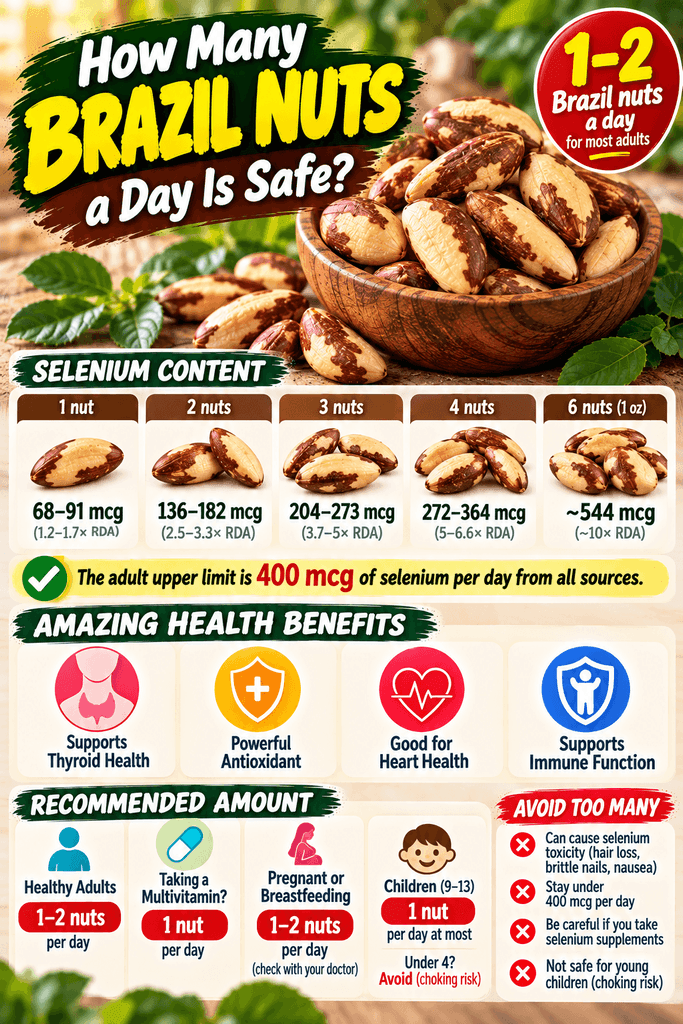
Brazil nuts may be the only food where nutrition experts give you a strict count, not just a portion size. That’s because a single Brazil nut can contain more selenium than you need in a whole day. So how many Brazil nuts a day is safe? For most healthy adults, the answer is one to two. But the right number for you depends on your age, how much selenium you already get from food, and whether you take a multivitamin or supplement.
This guide shows you the math, with daily limits by age group, how much selenium is already in a typical diet, how supplements change the picture, and simple rules for adults, children and pregnant or breastfeeding women.
Key Takeaways
- Most adults: 1–2 Brazil nuts a day. That provides about 68–182 mcg of selenium.
- The adult upper limit is 400 mcg a day from all sources, food plus supplements.
- The average U.S. adult already gets about 94–132 mcg a day from food.
- Six nuts (1 ounce) average about 544 mcg, which is over the adult limit on its own.
- Taking a multivitamin with selenium? Stick to one nut a day.
- Children have much lower limits. One nut can approach the limit for toddlers, and whole nuts are a choking hazard for young kids.
Why Brazil Nuts Need a Daily Limit
Most nuts come with a “handful a day” recommendation. Brazil nuts are different because of their extraordinary selenium content. According to the NIH Office of Dietary Supplements (ODS):
- One ounce of Brazil nuts (6–8 nuts) contains about 544 mcg of selenium.
- A single Brazil nut contains about 68–91 mcg on average.
- The adult Recommended Dietary Allowance (RDA) is just 55 mcg a day.
- The adult tolerable upper intake level (UL) is 400 mcg a day.
So one nut can meet your daily need, and a handful can blow past the safe limit. Selenium is essential for thyroid hormone metabolism, antioxidant defense and immune function, but too much over time causes selenosis: hair loss, brittle nails, garlic-smelling breath, a metallic taste, skin rashes, nausea and nervous system problems, according to the ODS.
For the full picture of Brazil nuts’ benefits, see our main guide: are Brazil nuts healthy.
How Many Brazil Nuts a Day: The Short Answer
| Who | Suggested amount |
| Healthy adults, no selenium supplements | 1–2 nuts a day |
| Adults taking a multivitamin with selenium | 1 nut a day, or 2 on some days |
| Adults taking a selenium-only supplement | Skip daily Brazil nuts. Ask your doctor. |
| Pregnant or breastfeeding women | 1–2 nuts a day, after checking with your provider |
| Teens 14–18 | 1–2 nuts a day |
| Children 9–13 | 1 nut a day at most |
| Children 4–8 | 1 nut occasionally, chopped |
| Children under 4 | Avoid whole or chopped nuts (choking risk) |
The rest of this article explains where these numbers come from.
The Selenium Math: How Much Is in 1, 2, 3 or 6 Nuts?
Using the ODS average of 68–91 mcg per nut:
| Brazil nuts | Selenium | Compared with adult RDA (55 mcg) | Compared with adult UL (400 mcg) |
| 1 nut | 68–91 mcg | 1.2–1.7× | 17–23% |
| 2 nuts | 136–182 mcg | 2.5–3.3× | 34–46% |
| 3 nuts | 204–273 mcg | 3.7–5× | 51–68% |
| 4 nuts | 272–364 mcg | 5–6.6× | 68–91% |
| 6 nuts (1 oz) | ~544 mcg | ~10× | 136% (over) |
On paper, even four nuts stay under the 400 mcg limit. But that ignores the selenium you already get from everything else you eat, which is why the practical limit is lower.
You Already Get Selenium From Food
Selenium is found in many everyday foods. Here’s how much some common foods provide, according to the ODS:
| Food | Serving | Selenium |
| Yellowfin tuna, cooked | 3 oz | 92 mcg |
| Sardines, canned in oil | 3 oz | 45 mcg |
| Shrimp, cooked | 3 oz | 42 mcg |
| Pork chop or beef steak | 3 oz | 37 mcg |
| Turkey, roasted | 3 oz | 26 mcg |
| Chicken, light meat | 3 oz | 22 mcg |
| Cottage cheese, 1% | 1 cup | 20 mcg |
| Egg, hard-boiled | 1 large | 15 mcg |
| Oatmeal, cooked | 1 cup | 13 mcg |
| Brown rice, cooked | 1 cup | 12 mcg |
| Whole-wheat bread | 1 slice | 8 mcg |
What Americans actually eat: According to the ODS, based on national survey data from 2017 to March 2020, people in the U.S. get an average of 108 mcg of selenium a day from foods and beverages. Men average about 132 mcg and women about 94 mcg.
In other words, most adults already exceed the 55 mcg RDA without eating a single Brazil nut. That’s why Brazil nuts are a nice bonus for most people, not a necessity.
Selenium-rich foods are part of a healthy diet. See whether shrimp is healthy, whether chicken is healthy, whether cottage cheese is good for you, whether brown rice is healthy and whether oatmeal is healthy.
Putting It Together: Your Total Daily Selenium
Here’s how Brazil nuts add up on top of a typical diet, using the ODS average intakes and per-nut range:
Typical woman (≈94 mcg from food):
- 1 nut → about 162–185 mcg
- 2 nuts → about 230–276 mcg
- 3 nuts → about 298–367 mcg
Typical man (≈132 mcg from food):
- 1 nut → about 200–223 mcg
- 2 nuts → about 268–314 mcg
- 3 nuts → about 336–405 mcg, which can reach the limit
All of these stay under the 400 mcg U.S. limit except three nuts for a high-intake man. But the ODS notes that the European Food Safety Authority (EFSA) has proposed a lower limit of 255 mcg a day for adults. Under that stricter standard, two nuts plus an average diet can already exceed the limit, especially for men.
Bottom line: One nut a day is comfortably safe for nearly everyone. Two nuts a day is within U.S. limits for most adults. Three or more daily isn’t recommended.
What If You Take a Multivitamin or Supplement?
Supplements change the math. According to the ODS:
- Many multivitamin/mineral supplements contain about 55 mcg of selenium.
- Combination supplements (for example, “thyroid support” or antioxidant formulas) typically contain 50–200 mcg.
- Selenium-only supplements usually contain 100–400 mcg.
| Your situation | Daily selenium before Brazil nuts | Safe Brazil nut habit |
| Food only (average adult) | ~94–132 mcg | 1–2 nuts a day |
| Food + multivitamin (55 mcg) | ~149–187 mcg | 1 nut a day |
| Food + combination supplement (50–200 mcg) | ~144–332 mcg | 0–1 nut; check with your doctor |
| Food + selenium supplement (100–400 mcg) | ~194–532 mcg | Skip daily Brazil nuts |
Check every label. Selenium may be listed as selenomethionine, sodium selenite or sodium selenate. And because supplement labels can be wrong, food is often the more predictable choice: the ODS reports that in 2008, 201 people had severe reactions to a liquid supplement that contained 200 times the labeled amount of selenium.
Do you need a supplement at all? In a 12-week trial in the American Journal of Clinical Nutrition, two Brazil nuts a day raised blood selenium as effectively as a 100 mcg selenium supplement. If your doctor has advised more selenium, ask whether Brazil nuts could replace the pill. Never take both without guidance.
Why “Per Nut” Is Only an Average
Here’s the catch with any Brazil nut calculation: the selenium in each nut can vary enormously.
A 2017 study in Chemosphere found that median selenium levels in Brazil nuts ranged from about 2 mg/kg to 68 mg/kg depending on where in the Amazon they were grown, roughly a 30-fold difference driven by soil selenium and acidity. The researchers estimated a single nut could supply 11% to 288% of daily needs.
Real-world testing shows the same thing. In the New Zealand trial above, two nuts provided only about 53 mcg combined, roughly 26 mcg per nut, far below the ODS average.
What this means for you: You can’t know how much selenium is in the Brazil nuts in your pantry. A cautious habit of one to two nuts a day protects you even if your nuts happen to be at the high end.
How Many Brazil Nuts for Children?
Children have much lower selenium limits than adults. According to the ODS:
| Age | RDA | Upper limit (UL) | What one nut (68–91 mcg) means |
| 1–3 years | 20 mcg | 90 mcg | Up to the full limit. Avoid. |
| 4–8 years | 30 mcg | 150 mcg | About half the limit or more |
| 9–13 years | 40 mcg | 280 mcg | About a quarter to a third of the limit |
| 14–18 years | 55 mcg | 400 mcg | Same as adults |
Practical guidance:
- Under 4: The CDC lists whole or chopped nuts as a choking hazard for young children, and a single high-selenium nut could reach a toddler’s daily limit. Avoid Brazil nuts.
- Ages 4–8: An occasional chopped nut is fine for children without nut allergies. Don’t make it a daily habit.
- Ages 9–13: One nut a day at most.
- Teens: Same as adults.
- Avoid adult supplements with selenium for children unless a doctor prescribes them.
Always check with your pediatrician, especially if your child has a nut allergy or takes a children’s multivitamin.
Pregnancy and Breastfeeding
Selenium needs rise slightly: the ODS sets the RDA at 60 mcg during pregnancy and 70 mcg while breastfeeding. The upper limit stays at 400 mcg.
Most prenatal vitamins contain selenium, so check your label. If yours includes selenium, one Brazil nut a day is a sensible ceiling. The ODS also notes that the American Thyroid Association recommends against selenium supplements for pregnant women with thyroid autoimmunity. Talk with your healthcare provider before adding Brazil nuts or selenium.
Can You Eat Brazil Nuts Every Day?
Yes. Eating one to two Brazil nuts every day is safe for most healthy adults who don’t take high-dose selenium supplements. Daily intake at that level is what the New Zealand trial tested over 12 weeks.
Prefer a weekly approach? Some people eat Brazil nuts a few times a week instead. As a simple rule, about 7–14 nuts per week, spread out rather than eaten all at once, keeps you in the same range as one to two a day. Don’t “save up” and eat a week’s worth in one sitting.
What If You Eat Too Many at Once?
Eating a handful of Brazil nuts once, say 6–10 nuts at a party, isn’t likely to cause problems for a healthy adult. Selenosis is generally linked to chronic excess intake over weeks or months, according to the ODS. Still, if you overdo it, skip Brazil nuts for the next several days and avoid selenium supplements.
Watch for signs of too much selenium if you’ve been eating many nuts regularly or taking supplements:
- Garlic odor on the breath or a metallic taste
- Hair loss
- Brittle, discolored or lost nails
- Skin rashes
- Nausea, diarrhea or fatigue
- Irritability or nervous system symptoms
If you notice these, stop eating Brazil nuts and taking selenium supplements, and see your doctor. A blood test can check your selenium level.
Tips for Building a Safe Brazil Nut Habit
- Count, don’t scoop. Keep Brazil nuts in a separate container, not mixed into a big bag of nuts.
- Make them part of a mixed handful. One Brazil nut plus almonds, walnuts or pistachios gives you selenium plus other nutrients. See whether almonds are healthy, whether walnuts are healthy and whether pistachios are healthy.
- Chop and sprinkle. One chopped Brazil nut over oatmeal or yogurt spreads it further.
- Roast in small amounts. If you make spiced nuts like our cinnamon-sugar roasted mixed nuts, keep Brazil nuts a small share of the batch.
- Read supplement labels every time you buy a new multivitamin.
- Store them cold. Brazil nuts are high in unsaturated fat and can go rancid. Freeze them in a sealed container.
For a complete look at every nut, see our complete guide to nuts.
Myths vs. Facts About Brazil Nut Limits
Myth: You can eat as many Brazil nuts as other nuts.
Fact: About six Brazil nuts average roughly 544 mcg of selenium, over the adult upper limit of 400 mcg.
Myth: More selenium means better thyroid health.
Fact: Selenium supports normal thyroid function, but evidence doesn’t support high selenium intake as a thyroid treatment.
Myth: The 400 mcg limit is just for Brazil nuts.
Fact: It applies to your total selenium from all foods and supplements combined.
Myth: Every Brazil nut has about the same selenium.
Fact: Selenium can vary about 30-fold depending on where the nut was grown.
Myth: Kids can eat Brazil nuts like adults.
Fact: The upper limit for ages 1–3 is just 90 mcg, which one nut can reach, and whole nuts are a choking hazard for young children.
Frequently Asked Questions
Is 2 Brazil nuts a day too much?
For most healthy adults, no. Two nuts provide about 136 to 182 micrograms of selenium. Added to an average diet, that’s still under the U.S. upper limit of 400 mcg. If you also take a multivitamin or selenium supplement, cut back to one nut a day.
Is 3 Brazil nuts a day too much?
Three nuts provide about 204 to 273 micrograms of selenium. With an average diet, that can approach or exceed safe limits, especially under Europe’s stricter 255 mcg guideline. For daily eating, one to two nuts is the safer choice.
Can I eat Brazil nuts if I take a multivitamin?
Yes, but limit yourself to about one nut a day. Many multivitamins contain about 55 micrograms of selenium. Check your label: combination and selenium-only supplements can contain 50 to 400 mcg, and with those, ask your doctor before eating Brazil nuts daily.
How many Brazil nuts can kids eat?
Children have much lower selenium limits: 90 mcg for ages 1–3, 150 mcg for ages 4–8 and 280 mcg for ages 9–13. Avoid nuts for children under 4 because of the choking risk. Older kids can have one nut occasionally. Ask your pediatrician first.
How many Brazil nuts should I eat for my thyroid?
There’s no proven thyroid “dose.” Selenium supports normal thyroid function, but research doesn’t support extra selenium as a treatment for thyroid disease. One to two nuts a day meets your needs safely. If you have a thyroid condition, follow your doctor’s advice.
What happens if you eat 10 Brazil nuts at once?
A one-time handful is unlikely to harm a healthy adult, because selenium toxicity usually comes from long-term excess. Still, 10 nuts average 680 to 910 micrograms of selenium, well above the daily limit. Skip Brazil nuts for several days afterward and avoid selenium supplements.
Conclusion
So, how many Brazil nuts a day is safe? For most healthy adults, one to two. That provides 68–182 mcg of selenium, more than the 55 mcg you need and, alongside a typical diet, under the 400 mcg upper limit. If you take a multivitamin with selenium, stick to one. If you take a selenium-only supplement, skip daily Brazil nuts unless your doctor says otherwise. Children need far less, and toddlers shouldn’t eat whole nuts. Because selenium varies so much from nut to nut, keep the count low and consistent.
Medical disclaimer: This article is for general educational purposes only and is not a substitute for professional medical advice, diagnosis or treatment. If you have a thyroid condition, are pregnant or breastfeeding, take supplements, or are feeding Brazil nuts to children, talk with your doctor, pediatrician or a registered dietitian.
(3) References
- NIH Office of Dietary Supplements. “Selenium: Fact Sheet for Health Professionals.” (RDAs and ULs by age, food sources, U.S. intake data, supplement amounts, EFSA proposed limit, 2008 toxicity incident.) https://ods.od.nih.gov/factsheets/Selenium-HealthProfessional/
- Thomson CD, Chisholm A, McLachlan SK, Campbell JM. “Brazil nuts: an effective way to improve selenium status.” American Journal of Clinical Nutrition. 2008. https://pubmed.ncbi.nlm.nih.gov/18258628/
- Silva Junior EC, Wadt LHO, Silva KE, et al. “Natural variation of selenium in Brazil nuts and soils from the Amazon region.” Chemosphere. 2017;188:650–658. https://doi.org/10.1016/j.chemosphere.2017.08.158
- Centers for Disease Control and Prevention. “Choking Hazards.” Infant and Toddler Nutrition. https://www.cdc.gov/infant-toddler-nutrition/foods-and-drinks/choking-hazards.html
- U.S. Department of Agriculture. “Nuts, brazilnuts, dried, unblanched” (FDC ID 170569). FoodData Central. https://fdc.nal.usda.gov/fdc-app.html#/food-details/170569/nutrients