You grab a bag of orange “yams” for your holiday casserole, but the label also says “sweet potatoes.” So which is it? The sweet potato vs yam mix-up is one of the most common food mysteries in American grocery stores. In fact, most “yams” sold in U.S. supermarkets aren’t yams at all.
This guide explains the real difference between sweet potatoes and yams, why stores mix up the names, and how to tell them apart. You’ll also get a side-by-side nutrition comparison based on USDA data, health benefits, risks, and easy ways to enjoy both.
Key Takeaways
- They’re different plants. Sweet potatoes belong to the morning glory family. True yams are related to lilies and grasses.
- Most U.S. “yams” are sweet potatoes. Soft, orange-fleshed sweet potatoes were labeled “yams” to tell them apart from firmer varieties.
- Sweet potatoes win on vitamin A. They have about 100 times more beta-carotene than yams.
- Yams have more potassium and fewer sugars. Per 100 grams, they have about 670 mg of potassium and less than 1 gram of sugar.
- Sweet potatoes have fewer calories. About 90 calories per 100 grams, compared with about 116 for yams.
- Both are healthy, fiber-rich carbs when baked, boiled, or roasted without heavy toppings.
Sweet Potato vs Yam: Are They the Same Thing?
No. Sweet potatoes and yams are completely different plants. According to the Library of Congress, sweet potatoes (Ipomoea batatas) belong to the morning glory family. True yams belong to the Dioscoreaceae family and are closely related to lilies and grasses.
They aren’t related to regular white potatoes either. That’s a third twist in the sweet potato vs yam story. University of Illinois Extension notes that white potatoes belong to the nightshade family, a separate group from both sweet potatoes and yams.
So when it comes to sweet potato vs yam, you’re comparing two very different vegetables that just happen to look a bit alike.
Are Yams and Sweet Potatoes in the Same Family?
No. Sweet potatoes are dicots in the morning glory family, while yams are monocots in their own yam family. That makes them about as related as a morning glory flower and a lily.
This botanical gap explains most of the sweet potato vs yam differences you’ll notice in the kitchen, from skin texture to sweetness to nutrition.
Why Do Grocery Stores Call Sweet Potatoes Yams?
This is the heart of the sweet potato vs yam confusion. The Library of Congress explains that sweet potatoes come in two main types: “firm” and “soft.” Firm varieties stay firm when cooked, while soft varieties turn soft and moist.
Firm sweet potatoes were grown in the U.S. first. When soft, orange-fleshed varieties arrived, they were called “yams” to set them apart. Illinois Extension notes that enslaved Africans had called them yams because they resembled the yams of Africa.
The USDA Labeling Rule
To reduce the sweet potato vs yam confusion, the USDA requires that a “yam” label be accompanied by “sweet potato.” That’s why you’ll often see both words on the same sign or can.
The Library of Congress adds that true yams are usually found in international markets. So most “yams” in a typical U.S. supermarket are likely sweet potatoes. Even names like “garnet yam” and “jewel yam” refer to softer varieties of sweet potato.
How Do You Tell If You Have a Yam or Sweet Potato?
The easiest way to settle the sweet potato vs yam question at the store is to look at the skin, shape, and size.
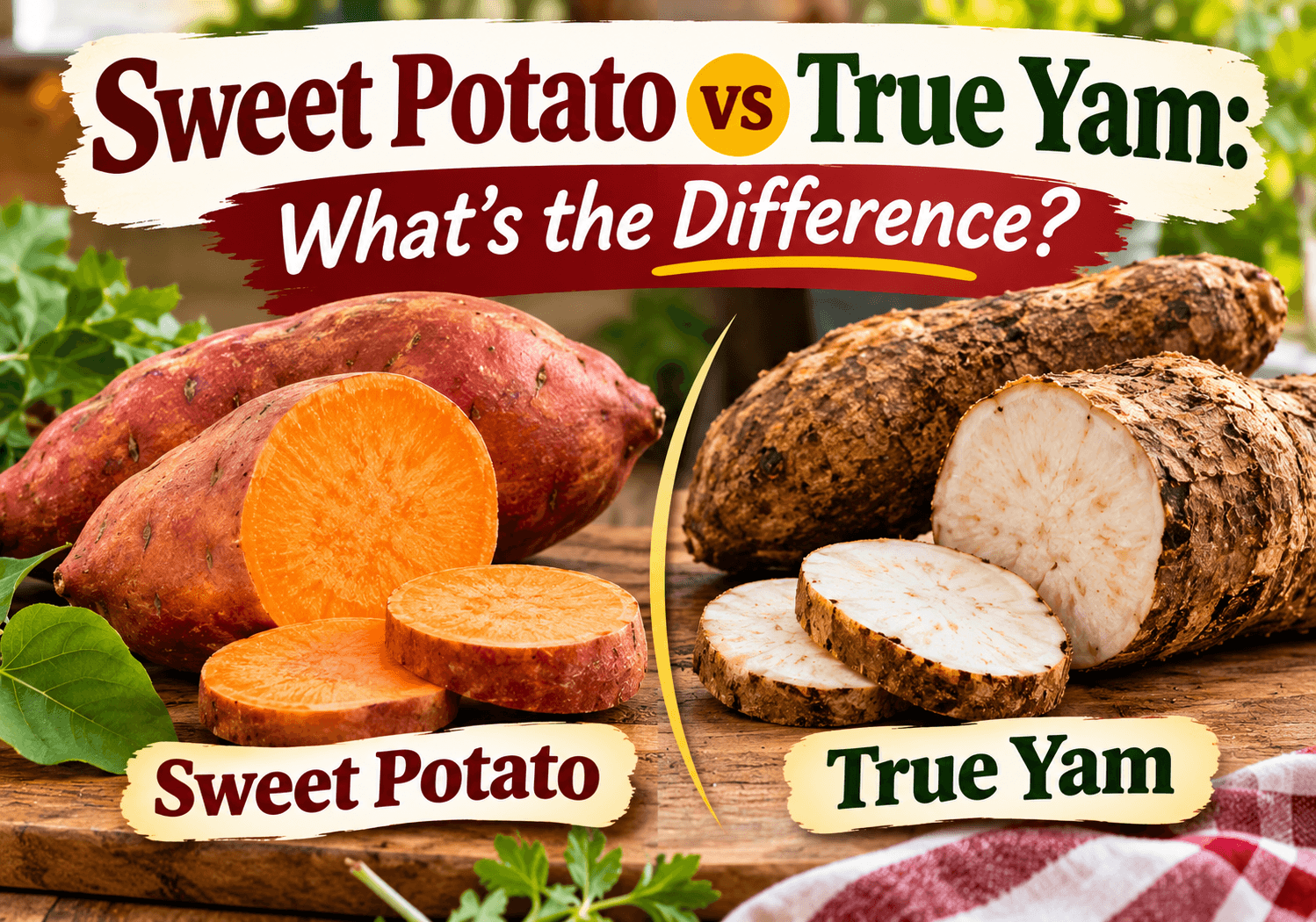
| Feature | Sweet Potato | True Yam |
| Plant family | Morning glory (Convolvulaceae) | Yam family (Dioscoreaceae) |
| Skin | Smooth and thin | Rough, scaly, bark-like |
| Shape | Short and blocky with tapered ends | Long and cylindrical |
| Size | Usually hand-sized | From potato-sized to over 100 pounds |
| Flesh color | White, yellow, orange, or purple | White, yellow, purple, or pink |
| Texture when cooked | Moist and sweet (soft types) or drier (firm types) | Starchier and drier |
| Where to buy in the U.S. | Almost every grocery store | Mostly international markets |
| Origin | Central and South America | Africa and Asia |
Sources: University of Illinois Extension and the Library of Congress.
Quick Tips at the Store
- Check the label. If it says “sweet potato” anywhere, it’s a sweet potato.
- Feel the skin. Smooth, thin skin points to a sweet potato. Rough, hairy, or bark-like skin points to a true yam.
- Look at the size. True yams can be huge. Illinois Extension notes they can grow up to five feet long.
- Consider the store. True yams are most often sold in African, Caribbean, Asian, and Latin markets.
Is a Purple Yam the Same as a Sweet Potato?
Not always, and this is one of the trickiest parts of the sweet potato vs yam puzzle. Ube, the purple yam popular in Filipino desserts, is a true yam called Dioscorea alata, according to the University of Washington’s Miller Library. The library describes it as gently sweet with a touch of smokiness and nuttiness.
However, purple-fleshed sweet potatoes also exist. Illinois Extension notes that sweet potato skin and flesh can be white, yellow, red, purple, or brown. If you’re unsure, check the label or ask the seller for the plant name.
Sweet Potato vs Yam Taste and Texture
What does a yam taste like? True yams are starchier, drier, and much less sweet than the orange sweet potatoes Americans know. The University of Washington’s Miller Library notes that few true yams are sweet, and none are as sweet as the orange vegetable served at holiday feasts.
Soft sweet potatoes turn moist, creamy, and sweet when cooked. That’s why they’re popular in casseroles and pies. True yams, on the other hand, are often boiled and mashed, fried, or roasted, much like regular potatoes, according to Illinois Extension.
Regular potatoes have a milder flavor than either one. See whether a potato is a healthy food.
In the sweet potato vs yam taste test, sweet potatoes win for sweetness. Yams win if you want a starchy, potato-like side.

Sweet Potato vs Yam Nutrition
Here’s how 100 grams of baked sweet potato compares with 100 grams of cooked yam, based on USDA data.
| Nutrient (per 100 g, cooked, no salt) | Sweet Potato (baked in skin) | Yam (boiled or baked) | Winner |
| Calories | 90 | 116 | Sweet potato (lower) |
| Carbohydrates | 20.7 g | 27.6 g | Sweet potato (lower) |
| Fiber | 3.3 g | 3.9 g | Yam |
| Sugars | 8.4 g | 0.5 g | Yam (lower) |
| Protein | 2.0 g | 1.5 g | Sweet potato |
| Fat | 0.2 g | 0.1 g | Tie |
| Potassium | 475 mg (10% DV) | 670 mg (14% DV) | Yam |
| Beta-carotene | 11,509 mcg | 73 mcg | Sweet potato |
| Vitamin A | About 107% DV | About 1% DV | Sweet potato |
| Vitamin C | 19.6 mg (22% DV) | 12.1 mg (13% DV) | Sweet potato |
| Vitamin B6 | 0.29 mg | 0.23 mg | About equal |
| Calcium | 38 mg | 14 mg | Sweet potato |
| Magnesium | 27 mg | 18 mg | Sweet potato |
Calculated from USDA SR Legacy data via University Hospitals for baked sweet potato (1 cup, 200 g) and cooked yam (1 cup cubes, 136 g). %DV is based on FDA Daily Values.
What the Numbers Show
The sweet potato vs yam nutrition matchup has a clear headline: vitamin A. Sweet potatoes are packed with beta-carotene, while yams have almost none. Sweet potatoes also have fewer calories and carbs and a bit more vitamin C, calcium, and magnesium.
Yams have their own strengths. They contain more potassium, slightly more fiber, and almost no natural sugar. Both are low in fat and sodium.
Keep in mind that values shift a little with variety and cooking method. Even so, the sweet potato vs yam vitamin A gap stays huge.
Sweet Potato vs Yam: Which Is Healthier?
In the sweet potato vs yam debate, sweet potatoes come out slightly ahead for most people. Their huge vitamin A content is hard to beat, and they have fewer calories per 100 grams.
That said, yams are also a healthy food. Is yam healthy or unhealthy? Yams are healthy. They’re a good source of potassium, fiber, and vitamin C, and they’re naturally low in fat and sugar.
The best choice depends on your goals. If you want more vitamin A, choose sweet potatoes. If you want more potassium and less sugar, yams are a great pick.
Health Benefits: Sweet Potato vs Yam
Both vegetables bring real nutrition to your plate. Here’s what each one offers in the sweet potato vs yam comparison.
Sweet Potato Benefits
Sweet potatoes are one of the most nutritious vegetables you can eat.
Vitamin A. The NIH lists one whole baked sweet potato as a top vitamin A source, with 1,403 mcg, or 156% of the Daily Value. Vitamin A supports normal vision, the immune system, and cell growth.
Fiber. One cup of baked sweet potato has about 6.6 grams of fiber, based on USDA data. Mayo Clinic notes that fiber helps control blood sugar levels and keeps you feeling full.
Vitamin C and potassium. One cup also provides about 39 mg of vitamin C and 950 mg of potassium. Learn more about whether sweet potatoes are healthy.
Yam Benefits
True yams are a staple food for millions of people. The Library of Congress notes that about 95% of the world’s yam crop is grown in Africa.
Potassium. In the sweet potato vs yam potassium race, yams win. One cup of cooked yam has about 911 mg of potassium, based on USDA data. The NIH sets an adequate intake of 3,400 mg a day for men and 2,600 mg for women. Curious about other potassium sources? See whether Gatorade has potassium.
Fiber. A cup of cooked yam has about 5.3 grams of fiber, which supports digestion and fullness. See whether a high-fiber diet helps weight loss.
Low in sugar. Yams have less than 1 gram of sugar per cup, making them a starchy but not sweet side dish.
Who Should Choose Sweet Potatoes vs Yams?
Your sweet potato vs yam pick depends on your goals and the recipe.
Sweet potatoes may be the better choice if you:
- Want the most vitamin A and beta-carotene.
- Are watching calories or carbs.
- Want a naturally sweet side dish or dessert ingredient.
- Shop at a regular supermarket.
Yams may be the better choice if you:
- Want more potassium per serving.
- Prefer a starchy, less sweet, potato-like side.
- Want almost no natural sugar.
- Cook African, Caribbean, or Asian dishes that call for true yams.
Risks and Who Should Be Cautious
Both vegetables are safe and healthy for most people. Still, keep these points in mind in the sweet potato vs yam choice.
Toppings add up. Candied yams with brown sugar, butter, and marshmallows are a holiday favorite, but the toppings add lots of added sugar and fat. Try roasting with cinnamon instead. See our comparison of pumpkin vs sweet potato pie for dessert ideas.
Always cook true yams. Some wild yam species contain natural toxins. Purdue University’s Famine Foods database notes that one African yam species contains a toxin called dioscorine that must be removed through soaking and cooking. Buy yams sold for food and cook them thoroughly.
Potassium and kidney disease. Both vegetables are high in potassium. If you have kidney disease or take medicines that raise potassium levels, ask your doctor how much is right for you.
Blood sugar. Both are starchy carbs. If you have diabetes, keep portions moderate and pair them with protein and vegetables. Choosing the skin-on, baked version keeps the fiber.
Wild yam supplements. Wild yam creams and pills are sold as dietary supplements. They’re not the same as eating yams as food, so talk to your doctor before trying them.
How Much Should You Eat?
Portion size matters more than the sweet potato vs yam label. There’s no official limit, but a reasonable serving is about 1/2 to 1 cup of cooked sweet potato or yam, or one medium sweet potato. That fits nicely into a balanced plate.
The CDC suggests filling at least half your plate with vegetables, with the rest split between lean protein and starches. Since sweet potatoes and yams are starchy, count them as your starch portion rather than your non-starchy vegetables.
How Sweet Potatoes and Yams Fit a Healthy Diet
Both sweet potatoes and yams can be part of a healthy, balanced diet. They’re whole, minimally processed foods, which the new Dietary Guidelines put front and center, and they provide fiber, potassium, and important vitamins. Compared with regular potatoes, sweet potatoes offer far more vitamin A. Learn more about whether potatoes are healthy.
If you love orange vegetables, pumpkin is another great vitamin A source. Learn about pumpkin and vitamin A. Planning a holiday meal? Check out our healthy Thanksgiving menu and our guide to stuffing vs dressing.
How to Enjoy Sweet Potatoes and Yams
Whichever side of the sweet potato vs yam debate you’re on, these ideas keep things healthy and tasty. Many recipes work with either vegetable, but true yams taste much less sweet. Season true yams more like regular potatoes, with garlic, herbs, and a pinch of salt.
- Bake them whole. Keep the skin on for extra fiber. Try our twice-baked sweet potatoes.
- Roast with spices. Toss cubes with olive oil, cinnamon, paprika, or garlic.
- Make a soup. A baked sweet potato soup is cozy and nutrient-packed.
- Mash with care. Use a little milk or broth instead of lots of butter. See whether mashed potatoes are healthy.
- Boil or fry true yams. Try them boiled and mashed, or sliced and roasted like home fries.
- Skip the marshmallows. A light drizzle of maple syrup or a sprinkle of pecans adds plenty of flavor.
Sweet Potato vs Yam: Myths vs. Facts
| Myth | Fact |
| Sweet potatoes and yams are the same thing. | They’re different plants from different families. |
| The orange “yams” at the store are real yams. | Most U.S. “yams” are soft varieties of sweet potato. |
| Sweet potatoes are related to regular potatoes. | White potatoes belong to the nightshade family, not the morning glory family. |
| Yams are rich in vitamin A like sweet potatoes. | Yams have very little beta-carotene. |
| Yams are sweeter than sweet potatoes. | Few true yams are sweet, and none match the orange sweet potato. |
Frequently Asked Questions
Are sweet potatoes and yams the same thing?
No, they’re different plants. Sweet potatoes belong to the morning glory family, while true yams are related to lilies and grasses. Most “yams” sold in U.S. grocery stores are actually soft, orange-fleshed sweet potatoes, while true yams are usually found in international markets.
Why do grocery stores call sweet potatoes yams?
When soft, orange sweet potatoes were introduced in the U.S., they were called “yams” to set them apart from firmer varieties. The name came from African yams, which they resembled. Today, the USDA requires that any “yam” label also include the words “sweet potato” to reduce confusion.
How do you tell if you have a yam or sweet potato?
Look at the skin and shape. Sweet potatoes have smooth, thin skin and a short, tapered shape, while true yams have rough, scaly, bark-like skin and are often long and cylindrical. If the label says “sweet potato” anywhere, it’s a sweet potato. True yams are mostly sold in international markets.
Which is healthier, sweet potato or yam?
Sweet potatoes have a slight edge for most people. They have fewer calories and far more vitamin A, plus more vitamin C. Yams have more potassium, slightly more fiber, and almost no sugar. Both are healthy, fiber-rich carbs, so the best choice depends on your nutrition goals.
Is yam healthy or unhealthy?
Yams are healthy. A cup of cooked yam provides about 911 mg of potassium, 5 grams of fiber, and some vitamin C, with almost no fat or sugar. Like other starchy vegetables, they’re best eaten in moderate portions. Always cook yams thoroughly and skip heavy, sugary toppings.
Is a purple yam the same as a sweet potato?
Not always. Ube, the purple yam used in Filipino desserts, is a true yam called Dioscorea alata. But purple-fleshed sweet potatoes also exist, and the two can look alike, so check the label or ask the seller. Sweet potatoes are Ipomoea batatas, while true yams belong to the Dioscorea genus.
Conclusion: Sweet Potato vs Yam, What You Need to Know
In the sweet potato vs yam debate, the biggest surprise is that most American “yams” are really sweet potatoes. True yams are a different plant with rough skin, starchy flesh, and very little sweetness. They’re mostly sold in international markets.
Nutritionally, sweet potatoes lead in vitamin A and have fewer calories, while yams offer more potassium and less sugar. Both are healthy choices. Enjoy them baked, roasted, or mashed, and go easy on sugary toppings.
Medical disclaimer: This article is for general information only and is not a substitute for professional medical advice, diagnosis, or treatment. If you have kidney disease, diabetes, or another health condition, or if you’re considering wild yam supplements, talk with your doctor or a registered dietitian before changing your diet.
3. References
- Library of Congress, Science Reference Section. What is the difference between sweet potatoes and yams? Everyday Mysteries. November 19, 2019. https://www.loc.gov/everyday-mysteries/agriculture/item/what-is-the-difference-between-sweet-potatoes-and-yams/
- Library of Congress. Candied Yams or Candied Sweet Potatoes? Inside Adams blog. November 2009. https://blogs.loc.gov/inside_adams/2009/11/candied-yams-or-candied-sweet-potatoes/
- Johnson K. What’s the Difference Between Sweet Potatoes and Yams? University of Illinois Extension, Good Growing. November 25, 2019. https://extension.illinois.edu/blogs/good-growing/2019-11-25-whats-difference-between-sweet-potatoes-and-yams
- Elisabeth C. Miller Library, University of Washington. On the difference between sweet potatoes and yams. https://depts.washington.edu/hortlib/pal/on-the-difference-between-sweet-potatoes-and-yams
- University Hospitals Health & Wellness Library. Nutrition Facts: Sweet potato, cooked, baked in skin, without salt, 1 cup (USDA SR Legacy). https://www.uhhospitals.org/health-information/health-and-wellness-library/article/nutritionfacts-v1/sweet-potato-cooked-baked-in-skin-without-salt-1-cup
- University Hospitals Health & Wellness Library. Nutrition Facts: Yam, cooked, boiled, drained, or baked, without salt, 1 cup cubes (USDA SR Legacy). https://www.uhhospitals.org/health-information/health-and-wellness-library/article/nutritionfacts-v1/yam-cooked-boiled-drained-or-baked-without-salt-1-cup-cubes
- NIH Office of Dietary Supplements. Vitamin A and Carotenoids: Fact Sheet for Health Professionals. https://ods.od.nih.gov/factsheets/VitaminA-HealthProfessional/
- NIH Office of Dietary Supplements. Potassium: Fact Sheet for Health Professionals. https://ods.od.nih.gov/factsheets/Potassium-HealthProfessional/
- Mayo Clinic. Dietary fiber: Essential for a healthy diet. https://www.mayoclinic.org/healthy-lifestyle/nutrition-and-healthy-eating/in-depth/fiber/art-20043983
- Centers for Disease Control and Prevention. Healthy Eating and the Holidays (Diabetes). 2024. https://www.cdc.gov/diabetes/healthy-eating/5-healthy-eating-tips-holidays.html
- Purdue University. Famine Foods: Dioscorea dumetorum. https://www.purdue.edu/hla/sites/famine-foods/famine_food/dioscorea-dumetorum/
- Harvard T.H. Chan School of Public Health, The Nutrition Source. Dietary Guidelines for Americans 2025–2030 (summary). January 9, 2026. https://nutritionsource.hsph.harvard.edu/2026/01/09/dietary-guidelines-for-americans-2025-2030/