Hazelnuts are best known as the “hazelnut” in chocolate spreads and coffee drinks, but on their own they’re a nutritional standout. These small, sweet, round nuts are one of the best food sources of vitamin E, and they’re packed with manganese, copper and heart-healthy monounsaturated fat. So, are hazelnuts healthy? Yes. Plain hazelnuts are a nutrient-dense nut with evidence for lowering LDL cholesterol. The popular chocolate hazelnut spreads, however, are a very different food, with sugar as the main ingredient.
This guide covers hazelnut nutrition, what the research says, how hazelnuts compare to other nuts, how many to eat, the truth about chocolate hazelnut spread, and why some people get an itchy mouth after eating raw hazelnuts.
Key Takeaways
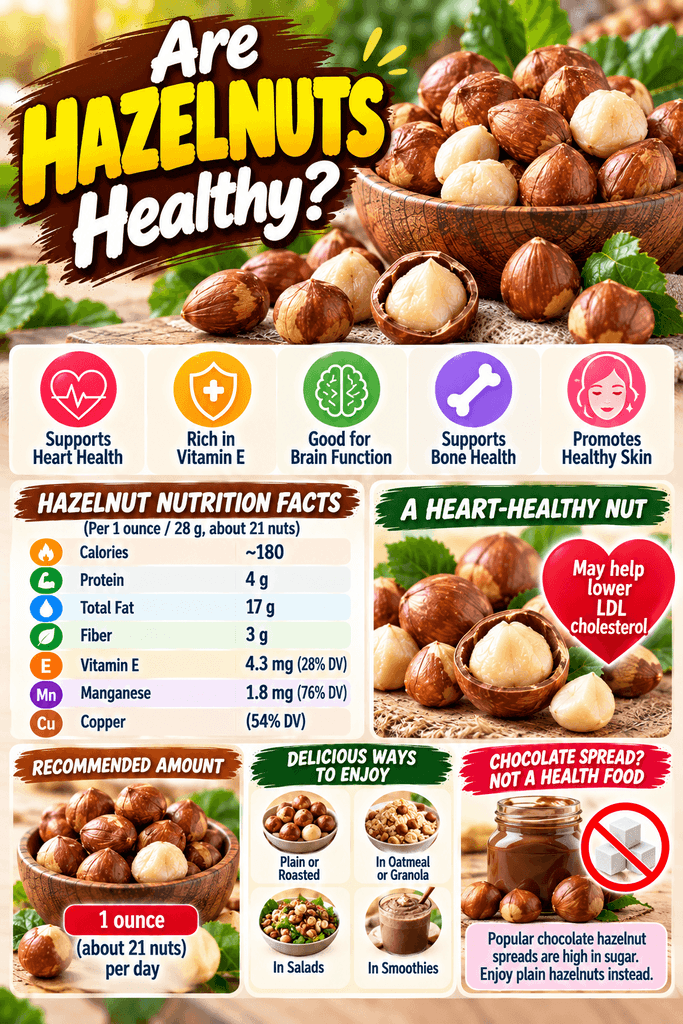
- One ounce of hazelnuts (about 21 kernels) has about 180 calories, 4 g protein, 17 g fat and 3 g fiber.
- Hazelnuts are rich in vitamin E (about 28–29% DV per ounce), manganese (about 76% DV) and copper (about 54% DV).
- A 2016 meta-analysis found that hazelnut-enriched diets lowered LDL and total cholesterol without changing body weight.
- Chocolate hazelnut spreads aren’t health food. Sugar is the first ingredient, with about 21 g in two tablespoons.
- Raw hazelnuts can cause itchy-mouth reactions in people with birch pollen allergy. Roasting often helps.
- One ounce a day, plain or dry-roasted, is a sensible portion.
What Are Hazelnuts?
Hazelnuts come from hazel trees (Corylus), and most of the world’s supply is grown in Turkey, with Italy and the U.S. Pacific Northwest (especially Oregon) also major producers. You’ll also see them called filberts: same nut, different name.
Hazelnuts have a sweet, buttery, slightly earthy flavor that deepens when roasted. They’re used whole, chopped, ground into flour, blended into butter and, most famously, mixed with chocolate in spreads, pralines and coffee flavorings. For how they compare to other nuts, see our complete guide to nuts.
Hazelnut Nutrition Facts
According to USDA FoodData Central’s record for hazelnuts (filberts), one ounce (28 g, about 21 kernels) provides:
| Nutrient (1 oz) | Amount | % Daily Value |
| Calories | ~180 | — |
| Protein | 4 g | — |
| Total fat | 17 g | 22% |
| Fiber | 3 g | ~10% |
| Vitamin E | ~4.3 mg | ~28–29% |
| Manganese | 1.8 mg | 76% |
| Copper | — | 54% |
| Magnesium | 46 mg | ~11% |
| Potassium | 193 mg | ~4% |
| Iron | 1.3 mg | ~7% |
Source: USDA FoodData Central, FDC 170581. Vitamin E per the NIH Office of Dietary Supplements, which lists 4.3 mg (29% DV) for 1 ounce of dry-roasted hazelnuts. % DV based on FDA Daily Values.
What stands out:
- Mostly monounsaturated fat, the same type of fat found in olive oil.
- Vitamin E, which makes hazelnuts one of the top nut sources, second only to almonds among common nuts.
- Manganese and copper at exceptionally high levels for such a small serving.
- Moderate fiber at about 3 g per ounce, among the higher-fiber nuts.
How Hazelnuts Compare to Other Nuts
| Nut (1 oz) | Calories | Protein | Fiber | Standout |
| Hazelnuts | ~178–180 | 4 g | 3 g | Vitamin E, manganese, copper |
| Almonds | ~164 | 6 g | 3.5 g | Vitamin E (highest), calcium |
| Walnuts | ~185 | 4 g | 2 g | Omega-3 ALA |
| Macadamias | ~200 | 2 g | 2 g | Monounsaturated fat, low carb |
| Brazil nuts | ~187–190 | 4 g | 2 g | Selenium |
Values from USDA FoodData Central.
Hazelnuts vs. almonds: Almonds have more protein and more vitamin E (about 6.8 mg vs. 4.3 mg per ounce, according to the ODS). Hazelnuts have more manganese and copper and a sweeter, richer flavor. Both are excellent; see whether almonds are healthy. For omega-3s, walnuts are the better choice; see whether walnuts are healthy.
Are Hazelnuts Healthy? The Key Benefits
1. They May Lower LDL Cholesterol
A 2016 systematic review and meta-analysis in Nutrients looked at nine studies with 425 participants who ate 29–69 g of hazelnuts a day for 4 to 12 weeks. Pooling the three randomized controlled trials, the researchers found that hazelnut-enriched diets:
- Significantly lowered LDL (“bad”) cholesterol, by about 0.15 mmol/L (roughly 6 mg/dL)
- Showed a downward trend in total cholesterol
- Didn’t change HDL cholesterol or triglycerides
- Didn’t increase body weight or BMI, even though participants ate an average of about 248 extra calories a day from hazelnuts
The authors noted the evidence is limited by the small number of controlled trials. These findings match the broader research on nuts: a meta-analysis of 61 trials in the American Journal of Clinical Nutrition found that tree nuts lower LDL cholesterol, with similar effects across nut types.
2. One of the Best Food Sources of Vitamin E
Vitamin E is a fat-soluble antioxidant that helps protect cells from damage caused by free radicals. According to the NIH Office of Dietary Supplements, the adult RDA is 15 mg a day, and one ounce of hazelnuts provides about 4.3 mg (29% DV).
Getting vitamin E from foods like hazelnuts is different from taking high-dose supplements. Food sources provide vitamin E alongside healthy fats, which help your body absorb it.
3. Rich in Manganese and Copper
- Manganese (76% DV per ounce) is involved in bone formation, metabolism and antioxidant enzymes.
- Copper (54% DV per ounce) helps your body make red blood cells, use iron, and maintain nerve and immune function.
Few foods deliver both minerals in such a small serving.
4. Heart-Healthy Fats
Most of the fat in hazelnuts is monounsaturated. Replacing saturated fat with unsaturated fat helps lower LDL cholesterol. Hazelnuts are part of a food group with strong heart evidence: a study of more than 210,000 health professionals in the Journal of the American College of Cardiology (2017) linked eating nuts five or more times a week with a 14% lower risk of cardiovascular disease. A 2025 meta-analysis of 63 cohort studies linked the highest nut intake with a 23% lower risk of early death.
5. Fiber and Fullness
At about 3 grams of fiber per ounce, hazelnuts contribute to digestive health and help you feel full. Combined with protein and fat, that makes them a satisfying snack.
6. Antioxidant Polyphenols in the Skins
Hazelnut skins (the thin brown papery layer) contain polyphenol antioxidants. Many recipes call for removing the skins after roasting, but if you don’t mind the slightly bitter taste, leaving them on keeps those compounds.
Are Hazelnuts Good for Weight Loss?
Hazelnuts can fit a weight-loss plan when portions are controlled:
- In the 2016 meta-analysis above, participants who added hazelnuts to their diets didn’t gain weight or increase BMI.
- Harvard’s Nutrition Source advises that nuts should replace other snacks rather than be added on top.
- In a five-year PREDIMED analysis (Lancet Diabetes & Endocrinology, 2016), adults who added about 30 g of mixed nuts a day (which included hazelnuts) to a Mediterranean diet gained no more weight than the control group.
Tip: Pre-portion 1-ounce servings (about 21 hazelnuts, roughly 180 calories) instead of eating from the bag.
Are Hazelnuts Keto-Friendly?
Yes, in moderate portions. Based on USDA data, about 10% of the calories in hazelnuts come from carbohydrate. One ounce has roughly 4.7 g of total carbs and 2.7 g of fiber, for about 2 g of net carbs. That’s more than macadamias or pecans, but far less than cashews. See whether macadamia nuts are healthy for the lowest-carb option.
Is Nutella Healthy? The Truth About Chocolate Hazelnut Spread
This is where many people get confused. Chocolate hazelnut spread isn’t the same as eating hazelnuts.
According to University of Illinois Extension, popular chocolate hazelnut spreads list sugar as the first ingredient, followed by oil, with hazelnuts further down the list. Two tablespoons contain roughly 21 grams of sugar, which the Extension educator compares to frosting.
For context, the 2025–2030 Dietary Guidelines for Americans suggest that no single meal should contain more than 10 grams of added sugar. Two tablespoons of chocolate hazelnut spread is about double that.
Healthier options:
- Plain hazelnut butter (just hazelnuts, maybe salt) has the nutrition without the sugar.
- Make your own chocolate hazelnut spread by blending roasted hazelnuts with unsweetened cocoa and a small amount of maple syrup.
- Use less. Illinois Extension suggests stretching the spread by mixing it with plain Greek yogurt, or using a thin layer on whole-grain toast.
- Compare labels. Nut butters vary widely. See whether peanut butter is healthy.
If you love the chocolate-hazelnut combination, pair a few plain hazelnuts with a square of dark chocolate. See whether dark chocolate is healthy.
Why Does My Mouth Itch After Eating Hazelnuts?
If raw hazelnuts make your mouth, lips or throat itch or tingle, you may have oral allergy syndrome (OAS), also called pollen-food allergy syndrome.
According to Stanford Health Care, OAS is caused by cross-reactivity between proteins in certain foods and pollens. People allergic to birch pollen may react to hazelnuts, along with foods like apples, almonds, cherries and carrots. Symptoms usually include itching, burning, tingling and sometimes swelling of the lips, mouth, tongue and throat.
Key points from Stanford Health Care:
- The proteins behind OAS are easily broken down by cooking or processing, so roasted or baked foods are often better tolerated.
- Most OAS reactions are mild, but up to 9% of people with OAS may have more severe symptoms, and up to 2% may experience anaphylaxis.
What to do: Try roasted hazelnuts instead of raw ones, and see an allergist to confirm whether you have OAS or a true tree nut allergy, which can be more serious.
Risks and Who Should Be Cautious
Tree Nut Allergy
Hazelnuts are tree nuts, among the nine major food allergens identified by the FDA. True hazelnut allergy can cause serious reactions. If you’re allergic, avoid hazelnuts and products made with them (spreads, pralines, flavored coffees, baked goods), read labels, and carry prescribed emergency medication.
Calories
At about 180 calories per ounce, hazelnuts are calorie-dense. Measure your portions.
Sweetened and Coated Versions
Chocolate-covered hazelnuts, candied hazelnuts, pralines and spreads add a lot of sugar. Treat them as desserts.
Kidney Stones
For people who form calcium oxalate kidney stones, the National Institute of Diabetes and Digestive and Kidney Diseases lists nuts and nut products among foods to limit. Ask your doctor about portions.
How Many Hazelnuts Should You Eat a Day?
For most adults, about 1 ounce (roughly 21 hazelnuts, about 180 calories) a day is a sensible portion. That’s in line with the 1-ounce servings used in most nut research. The hazelnut studies above used 29–69 g a day, roughly 1 to 2.4 ounces, but higher amounts mean more calories, so make room for them elsewhere.
Mixing hazelnuts with other nuts gives you a wider range of nutrients. If you add Brazil nuts, keep them to one or two a day; see whether Brazil nuts are healthy.
Best Ways to Eat Hazelnuts
- Roast them: Spread raw hazelnuts on a baking sheet and roast until fragrant and the skins crack. Rub them in a towel to remove most of the skins if you prefer.
- Snack on them plain: A small handful of dry-roasted, unsalted hazelnuts.
- Top breakfast: Sprinkle chopped hazelnuts over oatmeal or yogurt. See whether oatmeal is healthy.
- Add to salads: Hazelnuts pair well with greens, pears, goat cheese and roasted squash.
- Bake with hazelnut flour: Ground hazelnuts (hazelnut meal) work like almond flour in gluten-free baking. See whether almond flour is healthy.
- Make hazelnut butter: Blend roasted hazelnuts until creamy.
- Pair with coffee: A few hazelnuts with your coffee gives you the flavor without sweetened syrups. See black coffee vs. milk coffee.
Raw vs. roasted: Both are healthy. Harvard notes that plain raw or roasted nuts are good choices. Roasting deepens the flavor and may help people with oral allergy syndrome.
Buying and Storing Hazelnuts
Hazelnuts are high in unsaturated fat and can go rancid. Kansas State University Research and Extension recommends storing nuts in tightly sealed containers, with the freezer as the best option (up to one year, ideally used within six months). Refrigeration also works.
- Buy plain, unsalted hazelnuts. Whole nuts keep better than chopped or ground.
- Store hazelnut flour in the freezer, since ground nuts go rancid faster.
- Smell before eating. Bitter or paint-like odors mean they’ve gone off.
Hazelnut Myths vs. Facts
Myth: Chocolate hazelnut spread is a healthy way to eat hazelnuts.
Fact: Sugar is the first ingredient, with about 21 g in two tablespoons. Plain hazelnut butter is the healthier choice.
Myth: Hazelnuts are too fatty to be healthy.
Fact: Most of their fat is monounsaturated, and a meta-analysis found hazelnut-enriched diets lowered LDL cholesterol without weight gain.
Myth: Filberts and hazelnuts are different nuts.
Fact: They’re the same nut with two names.
Myth: An itchy mouth after hazelnuts always means a severe nut allergy.
Fact: It’s often oral allergy syndrome linked to birch pollen, which is usually mild, but see an allergist to be sure.
Myth: You must remove hazelnut skins.
Fact: The skins are edible and contain polyphenols. Removing them is a matter of taste.
Frequently Asked Questions
Are hazelnuts good for cholesterol?
Research suggests they can help. A 2016 meta-analysis found that hazelnut-enriched diets significantly lowered LDL cholesterol and showed a downward trend in total cholesterol, without changing HDL, triglycerides or body weight. The evidence comes from a small number of trials, so eat hazelnuts as part of an overall heart-healthy diet.
How many hazelnuts should you eat a day?
About one ounce, roughly 21 hazelnuts and 180 calories, is a sensible daily portion for most adults. Research studies used 29 to 69 grams a day, but larger amounts add calories, so swap hazelnuts in for less healthy snacks rather than adding them on top.
Is Nutella healthy?
Chocolate hazelnut spreads like Nutella aren’t health foods. Sugar is the first ingredient, and two tablespoons contain about 21 grams of sugar, similar to frosting. Enjoy them occasionally in small amounts, or choose plain hazelnut butter or a homemade, lower-sugar version.
Why does my mouth itch after eating hazelnuts?
It may be oral allergy syndrome, a reaction in people with birch pollen allergy to similar proteins in raw hazelnuts. Symptoms include itching or tingling of the mouth and lips. Roasting often helps, but see an allergist, since some people have true nut allergies.
Should you eat hazelnut skins?
You can. The thin brown skins are edible and contain polyphenol antioxidants, though they can taste slightly bitter. Many recipes remove them after roasting by rubbing the nuts in a towel. Whether you keep them is mostly a matter of taste.
Are hazelnuts better than almonds?
They’re different. Almonds have more protein and vitamin E per ounce, while hazelnuts provide more manganese and copper and a sweeter flavor. Both are healthy, and eating a variety of nuts gives you the widest range of nutrients.
Conclusion
So, are hazelnuts healthy? Yes, especially when you eat them plain. Hazelnuts are one of the best food sources of vitamin E, exceptionally rich in manganese and copper, and full of heart-healthy monounsaturated fat. A meta-analysis found hazelnut-enriched diets lowered LDL cholesterol without weight gain. Enjoy about an ounce a day, raw or dry-roasted, and treat chocolate hazelnut spreads as an occasional dessert, not a source of hazelnut benefits. If raw hazelnuts make your mouth itch, try them roasted and see an allergist.
Medical disclaimer: This article is for general educational purposes only and is not a substitute for professional medical advice, diagnosis or treatment. If you have a nut allergy, pollen allergy, high cholesterol or another health condition, talk with your doctor, allergist or a registered dietitian before making changes to your diet.
(3) References
- U.S. Department of Agriculture. “Nuts, hazelnuts or filberts” (FDC ID 170581). FoodData Central. https://fdc.nal.usda.gov/fdc-app.html#/food-details/170581/nutrients
- NIH Office of Dietary Supplements. “Vitamin E: Fact Sheet for Health Professionals.” https://ods.od.nih.gov/factsheets/VitaminE-HealthProfessional/
- U.S. Food and Drug Administration. “Daily Value on the Nutrition and Supplement Facts Labels.” https://www.fda.gov/food/nutrition-facts-label/daily-value-nutrition-and-supplement-facts-labels
- Perna S, Giacosa A, Bonitta G, et al. “Effects of Hazelnut Consumption on Blood Lipids and Body Weight: A Systematic Review and Bayesian Meta-Analysis.” Nutrients. 2016;8(12):747. https://www.mdpi.com/2072-6643/8/12/747 [VERIFY author order]
- Del Gobbo LC, Falk MC, Feldman R, Lewis K, Mozaffarian D. “Effects of tree nuts on blood lipids, apolipoproteins, and blood pressure.” American Journal of Clinical Nutrition. 2015. https://pubmed.ncbi.nlm.nih.gov/26561616/
- Guasch-Ferré M, Liu X, Malik VS, et al. “Nut Consumption and Risk of Cardiovascular Disease.” Journal of the American College of Cardiology. 2017. https://www.jacc.org/doi/10.1016/j.jacc.2017.09.035
- Liu M, Wang M, Fu X, et al. “Nut consumption and risk of cardiovascular disease events and all-cause mortality.” Archives of Cardiovascular Diseases. 2025. https://doi.org/10.1016/j.acvd.2025.08.010
- Estruch R, Martínez-González MA, Corella D, et al. “Effect of a high-fat Mediterranean diet on bodyweight and waist circumference.” Lancet Diabetes & Endocrinology. 2016. https://library.fabresearch.org/viewItem.php?id=10338
- Harvard T.H. Chan School of Public Health. “Nuts for the Heart.” The Nutrition Source. https://nutritionsource.hsph.harvard.edu/food-features/nuts-for-the-heart/
- Smith J. “Label Shocker: The Truth About Hazelnut Spread.” University of Illinois Extension. 2014. https://extension.illinois.edu/blogs/live-well-eat-well/2014-07-17-label-shocker-truth-about-hazelnut-spread
- Harvard T.H. Chan School of Public Health. “Dietary Guidelines for Americans 2025–2030: Progress on added sugar, protein hype, saturated fat contradictions.” 2026. https://nutritionsource.hsph.harvard.edu/2026/01/09/dietary-guidelines-for-americans-2025-2030-progress-on-added-sugar-protein-hype-saturated-fat-contradictions/
- Stanford Health Care. “Oral Allergy Syndrome.” https://stanfordhealthcare.org/content/dam/SHC/clinics/menlo-medical-clinic/docs/Allergy/Oral%20Allergy%20Syndrome.pdf
- U.S. Food and Drug Administration. “Food Allergies.” https://www.fda.gov/food/food-labeling-nutrition/food-allergies
- National Institute of Diabetes and Digestive and Kidney Diseases. “Eating, Diet, & Nutrition for Kidney Stones.” https://www.niddk.nih.gov/health-information/urologic-diseases/kidney-stones/eating-diet-nutrition
- Upham W. “Horticulture: Nut Storage.” Kansas State University Research and Extension. 2022. https://www.ksre.k-state.edu/news/stories/2022/12/horticulture-nut-storage.html