Macadamia nuts are the luxury item of the nut world: rich, buttery, a little sweet, and often the priciest bag on the shelf. They’re also the highest-fat, highest-calorie nut you can buy. So, are macadamia nuts healthy? Yes. Most of their fat is the same heart-friendly monounsaturated fat found in olive oil, and a controlled feeding study showed they can lower LDL cholesterol. They’re also one of the lowest-carb nuts, which makes them a keto favorite. The catch is calorie density, so portion size matters more with macadamias than with almost any other nut.
This guide covers macadamia nutrition, what the research shows for heart health, how they fit keto and weight-loss plans, how many to eat, and a few safety notes, including one for dog owners.
Key Takeaways
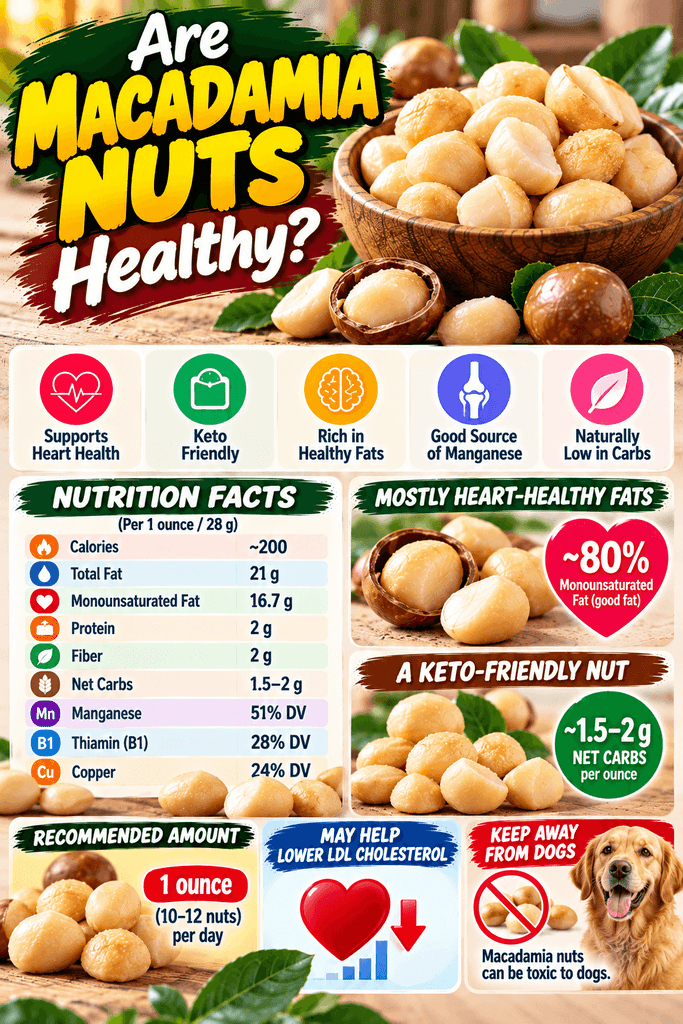
- One ounce of macadamia nuts (10–12 kernels) has about 200 calories and 21 g of fat, most of it (about 16.7 g) monounsaturated.
- In 2017, the FDA allowed a qualified health claim that 1.5 ounces a day of macadamias, as part of a diet low in saturated fat and cholesterol, may reduce the risk of coronary heart disease.
- A controlled feeding study found a macadamia-rich diet lowered LDL cholesterol by about 9% compared with a typical American diet.
- With roughly 1.5–2 g net carbs per ounce, macadamias are among the most keto-friendly nuts.
- They’re the most calorie-dense common nut, so 1 ounce a day is a sensible portion.
- Never feed macadamia nuts to dogs. The FDA lists them among the more hazardous foods for pets.
What Are Macadamia Nuts?
Macadamia nuts are the seeds of trees in the Macadamia genus, native to the rainforests of eastern Australia. Today they’re also grown widely in Hawaii, South Africa and other warm regions. Each nut is enclosed in a very hard shell, which helps explain their high price: they’re slow to grow, harvest and crack.
They have a creamy texture and mild, buttery flavor, and are often sold roasted and salted, coated in chocolate, or baked into cookies. For how they compare with other nuts, see our complete guide to nuts.
Macadamia Nut Nutrition Facts
According to USDA FoodData Central’s record for raw macadamia nuts, one ounce (28 g, about 10–12 kernels) provides:
| Nutrient (1 oz) | Amount | % Daily Value |
| Calories | ~200 | — |
| Total fat | ~21 g | 27% |
| Monounsaturated fat | ~16.7 g | — |
| Saturated fat | ~3.5 g | 18% |
| Protein | ~2 g | — |
| Fiber | ~2 g | 9% |
| Manganese | — | 51% |
| Thiamin (B1) | — | 28% |
| Copper | — | 24% |
Source: USDA FoodData Central, FDC 170178. % DV is based on FDA Daily Values.
What stands out:
- Mostly monounsaturated fat. About 80% of the fat in macadamias is monounsaturated, mostly oleic acid, the main fat in olive oil.
- The highest-calorie common nut. At about 200 calories per ounce, macadamias edge out pecans and walnuts.
- Low in protein. Macadamias have the least protein of the common nuts, about 2 g per ounce.
- Very low in carbs. About 89% of their calories come from fat and only about 7% from carbohydrate.
- Rich in manganese and thiamin. Manganese supports bone health and metabolism. Thiamin (vitamin B1) helps your body turn food into energy.
How Macadamias Compare to Other Nuts
| Nut (1 oz) | Calories | Protein | Fat | Standout |
| Macadamias | ~200 | 2 g | 21 g | Monounsaturated fat, lowest carb |
| Pecans | ~196 | 3 g | 20 g | Manganese |
| Brazil nuts | ~187–190 | 4 g | 19 g | Selenium |
| Walnuts | ~185 | 4 g | 18.5 g | Omega-3 ALA |
| Almonds | ~164 | 6 g | 14 g | Vitamin E, fiber |
| Cashews | ~157 | 5 g | 12 g | Zinc |
Values from USDA FoodData Central.
Macadamias trade protein for fat. If you want more protein per calorie, choose almonds or pistachios. If you want omega-3s, choose walnuts. Learn more in are almonds healthy, are walnuts healthy and are pecans healthy.
Are Macadamia Nuts Healthy for Your Heart?
The FDA’s Macadamia-Specific Health Claim
In July 2017, the FDA completed its review of a petition and allowed this qualified health claim:
“Supportive but not conclusive research shows that eating 1.5 ounces per day of macadamia nuts, as part of a diet low in saturated fat and cholesterol and not resulting in increased intake of saturated fat or calories may reduce the risk of coronary heart disease.”
“Qualified” means the evidence is promising but not definitive, so the claim must carry that cautious wording. Note the conditions: the benefit is tied to a diet low in saturated fat, without adding extra calories.
The Penn State Feeding Study
A controlled feeding trial led by Penn State researchers and published in the Journal of Nutrition (2008) studied adults with mildly elevated cholesterol who weren’t taking cholesterol-lowering drugs. In a crossover design, participants spent five weeks each on a heart-healthy diet including about 1.5 ounces of macadamias a day, and on a typical American diet.
According to Penn State’s report on the study, compared with the typical American diet, the macadamia diet:
- Lowered total cholesterol by about 9.4%
- Lowered LDL (“bad”) cholesterol by about 8.9%
- Also improved triglycerides
The researchers noted that the LDL reduction was greater than predicted from the nuts’ fat profile alone, suggesting other compounds in macadamias may also play a role.
The Bigger Picture: Nuts and Heart Health
Macadamias belong to a food group with strong evidence behind it:
- A meta-analysis of 61 controlled trials in the American Journal of Clinical Nutrition (2015) found that tree nuts lower total cholesterol, LDL cholesterol, apolipoprotein B and triglycerides, with effects similar across nut types.
- An analysis of more than 210,000 health professionals in the Journal of the American College of Cardiology (2017) found that eating nuts five or more times a week was associated with a 14% lower risk of cardiovascular disease.
- A 2025 meta-analysis of 63 cohort studies found that the highest nut consumers had a 19% lower risk of coronary heart disease and a 23% lower risk of early death than the lowest consumers.
Why Monounsaturated Fat Matters
Replacing saturated fat with monounsaturated fat helps lower LDL cholesterol. Macadamias are one of the richest whole-food sources of monounsaturated fat, which is why they work in a heart-healthy diet, as long as they replace less healthy foods rather than adding to them.
What About Saturated Fat?
Macadamias contain about 3.5 g of saturated fat per ounce, more than most other nuts and about 18% of the Daily Value. That’s still a small share of their total fat. Most of the fat is monounsaturated.
Practical tip: Keep macadamias to about one ounce a day, and choose them over higher-saturated-fat snacks like cheese crackers, pastries or chips. Avoid versions roasted in coconut or palm oil, and enjoy chocolate-covered macadamias as an occasional treat. If you’re watching saturated fat for cholesterol reasons, see whether butter is bad for cholesterol.
Are Macadamia Nuts Keto-Friendly?
Yes. Macadamias are among the best nuts for keto and low-carb diets.
Based on USDA data, one ounce has roughly 4 g of total carbohydrate and about 2 g of fiber, for about 1.5–2 g of net carbs. Only about 7% of their calories come from carbohydrate.
| Nut (1 oz) | Approx. net carbs |
| Macadamias | ~1.5–2 g |
| Pecans | ~1 g |
| Brazil nuts | ~1 g |
| Walnuts | ~2 g |
| Almonds | ~3 g |
| Pistachios | ~5 g |
| Cashews | ~8 g |
Approximate values calculated from USDA FoodData Central (total carbohydrate minus fiber).
Their high fat and low carb content fits the keto macronutrient pattern almost perfectly. Just remember that calories still count. For a balanced look at the diet, see whether keto is a healthy diet.
Are Macadamia Nuts Good for Weight Loss?
Macadamias are the most calorie-dense common nut, which makes people nervous. But the research on nuts and body weight is reassuring:
- In a five-year analysis of the PREDIMED trial published in Lancet Diabetes & Endocrinology (2016), adults who added about 30 g of mixed nuts a day to a Mediterranean diet gained no more weight than the control group.
- Harvard’s Nutrition Source advises that nuts should replace other snacks rather than be added on top, to avoid weight gain.
For weight loss with macadamias:
- Stick to 1 ounce (10–12 nuts), about 200 calories.
- Pre-portion them. Macadamias are easy to overeat because they’re so rich and tasty.
- Use them to replace chips, cookies or other snacks, not as an extra.
- Pair them with fruit or vegetables for volume.
For tips on portioning nut butters, see our guide to almond butter for weight loss.
Who Benefits Most From Macadamia Nuts?
- People following keto or low-carb diets, thanks to their very low net carbs.
- People looking to replace saturated-fat snacks with monounsaturated fat.
- People with mildly elevated cholesterol, as part of an overall heart-healthy diet.
- Anyone who wants a satisfying, rich snack in a small portion.
Risks and Who Should Be Cautious
Calorie Density
At about 200 calories an ounce, a large handful can easily reach 400–600 calories. Portion control is essential.
Tree Nut Allergy
Macadamias are tree nuts, which are among the nine major food allergens identified by the FDA. If you have a tree nut allergy, avoid them unless your allergist advises otherwise.
Salted, Sweetened and Coated Versions
Many macadamias are sold salted, honey-roasted, chocolate-covered or in cookies. These add sodium, sugar and calories. Choose plain raw or dry-roasted macadamias most of the time. If you love chocolate, see whether dark chocolate is healthy.
Kidney Stones
For people who form calcium oxalate kidney stones, the National Institute of Diabetes and Digestive and Kidney Diseases lists nuts and nut products among foods to limit. Ask your doctor about portions.
Never Give Macadamias to Dogs
This is a safety note every macadamia lover should know. The FDA lists macadamia nuts among the more hazardous edible items for pets. Keep macadamias, and baked goods containing them, out of your dog’s reach. If your dog eats some, contact your veterinarian or a pet poison control center right away.
How Many Macadamia Nuts Should You Eat a Day?
For most adults, about 1 ounce (10–12 nuts) a day is a sensible portion. That’s roughly 200 calories and 21 g of fat.
The FDA’s qualified health claim uses 1.5 ounces a day (about 15–18 nuts), but only as part of a diet low in saturated fat that doesn’t increase total calories. If you eat that much, cut calories elsewhere.
You don’t need to eat only macadamias. Mixing them with other nuts gives you a broader range of nutrients: walnuts for omega-3s, almonds for vitamin E and Brazil nuts for selenium. For Brazil nuts, though, stick to one or two a day; see are Brazil nuts healthy.
Best Ways to Eat Macadamia Nuts
- As a snack: A small handful of plain raw or dry-roasted macadamias.
- In salads: Chopped macadamias add buttery crunch to greens and grain salads.
- As a crust: Crushed macadamias make a flavorful, low-carb coating for fish or chicken.
- In baking: Use them in cookies and granola in small amounts. Pair with coconut for a tropical twist; see whether coconut is healthy.
- In breakfast bowls: Sprinkle chopped macadamias over yogurt, oatmeal or a smoothie bowl.
- As macadamia butter: Blend roasted macadamias into a creamy spread. Measure it with a spoon.
- Macadamia oil: Mild and high in monounsaturated fat, it works well for sautéing and dressings.
Raw vs. roasted: Both are healthy. Harvard notes that plain raw or roasted nuts are good choices, while those coated in chocolate, sugar or lots of salt are “probably not as good.”
Buying and Storing Macadamia Nuts
Because macadamias are so high in fat, they can go rancid. Kansas State University Research and Extension recommends storing nuts in tightly sealed containers, with the freezer as the best option (up to one year, ideally used within six months). Refrigeration also works.
- Buy plain, unsalted macadamias and season them yourself.
- Buy smaller bags if you won’t eat them quickly. They’re pricey, and rancid nuts are money wasted.
- Smell before eating. Bitter or paint-like odors mean they’ve gone off.
Macadamia Nut Myths vs. Facts
Myth: Macadamias are unhealthy because they’re so high in fat.
Fact: Most of their fat is monounsaturated, and a feeding study showed a macadamia-rich diet lowered LDL cholesterol.
Myth: Macadamias are the healthiest nut.
Fact: No single nut is “the healthiest.” Macadamias excel in monounsaturated fat and low carbs, but have less protein, fiber and omega-3 than some other nuts.
Myth: Macadamias will make you gain weight.
Fact: Nuts haven’t been linked to weight gain when they replace other foods, but macadamias’ calorie density makes portion control important.
Myth: Macadamias are too high in saturated fat.
Fact: They have more saturated fat than most nuts (about 3.5 g per ounce), but it’s a small share of their total fat. Most is monounsaturated.
Myth: Macadamias are safe for pets.
Fact: The FDA lists macadamia nuts among the more hazardous foods for pets. Keep them away from dogs.
Frequently Asked Questions
How many macadamia nuts should I eat a day?
About one ounce, roughly 10 to 12 nuts, is a sensible daily portion for most adults. That’s about 200 calories. The FDA’s qualified heart-health claim uses 1.5 ounces a day, but only as part of a diet low in saturated fat that doesn’t add extra calories overall.
Are macadamia nuts good for cholesterol?
They may help. In a Penn State feeding study, a diet including about 1.5 ounces of macadamias a day lowered LDL cholesterol by about 9% compared with a typical American diet. The FDA allows a qualified claim that they may reduce heart disease risk.
Are macadamia nuts keto friendly?
Yes. Macadamias are one of the most keto-friendly nuts, with roughly 1.5 to 2 grams of net carbs per ounce and about 89% of their calories from fat. Keep portions to about an ounce, because their calories add up quickly.
Are macadamia nuts fattening?
They’re the most calorie-dense common nut, at about 200 calories per ounce. Research on nuts generally shows no extra weight gain when nuts replace other foods rather than being added. Measure your portion and use macadamias in place of less healthy snacks.
Can dogs eat macadamia nuts?
No. The FDA lists macadamia nuts among the more hazardous edible items for pets. Keep macadamias and baked goods containing them away from dogs. If your dog eats some, contact your veterinarian or a pet poison control center right away.
Are raw or roasted macadamia nuts healthier?
Both are healthy choices. Plain raw and plain dry-roasted macadamias are nutritionally similar. The bigger difference comes from added salt, sugar, oils and chocolate coatings, so choose unsalted, uncoated macadamias most of the time.
Conclusion
So, are macadamia nuts healthy? Yes, in sensible portions. Macadamias are rich in heart-friendly monounsaturated fat and a good source of manganese, thiamin and copper. They’re also among the lowest-carb nuts, which makes them ideal for keto. The FDA allows a qualified claim that 1.5 ounces a day, within a diet low in saturated fat, may reduce heart disease risk, and a feeding study found a macadamia-rich diet lowered LDL cholesterol by about 9%. Their main drawback is calorie density, so stick to about 10–12 nuts a day, choose plain over coated versions, and keep them away from your dog.
Medical disclaimer: This article is for general educational purposes only and is not a substitute for professional medical advice, diagnosis or treatment. If you have a tree nut allergy, high cholesterol, kidney stones or another health condition, talk with your doctor or a registered dietitian before making changes to your diet.
(3) References
- U.S. Department of Agriculture. “Nuts, macadamia nuts, raw” (FDC ID 170178). FoodData Central. https://fdc.nal.usda.gov/fdc-app.html#/food-details/170178/nutrients
- U.S. Food and Drug Administration. “Daily Value on the Nutrition and Supplement Facts Labels.” https://www.fda.gov/food/nutrition-facts-label/daily-value-nutrition-and-supplement-facts-labels
- U.S. Food and Drug Administration. “FDA Completes Review of Qualified Health Claim Petition for Macadamia Nuts and the Risk of Coronary Heart Disease.” July 24, 2017. https://www.fda.gov/Food/NewsEvents/ConstituentUpdates/ucm568052.htm
- Griel AE, Cao Y, Bagshaw DD, Cifelli AM, Holub B, Kris-Etherton PM. “A macadamia nut-rich diet reduces total and LDL-cholesterol in mildly hypercholesterolemic men and women.” Journal of Nutrition. 2008. https://pubmed.ncbi.nlm.nih.gov/18356332/
- Penn State University. “Macadamia nuts can be included in heart-healthy diet.” 2008. https://www.psu.edu/news/research/story/macadamia-nuts-can-be-included-heart-healthy-diet
- Del Gobbo LC, Falk MC, Feldman R, Lewis K, Mozaffarian D. “Effects of tree nuts on blood lipids, apolipoproteins, and blood pressure.” American Journal of Clinical Nutrition. 2015. https://pubmed.ncbi.nlm.nih.gov/26561616/
- Guasch-Ferré M, Liu X, Malik VS, et al. “Nut Consumption and Risk of Cardiovascular Disease.” Journal of the American College of Cardiology. 2017. https://www.jacc.org/doi/10.1016/j.jacc.2017.09.035
- Liu M, Wang M, Fu X, et al. “Nut consumption and risk of cardiovascular disease events and all-cause mortality.” Archives of Cardiovascular Diseases. 2025. https://doi.org/10.1016/j.acvd.2025.08.010
- Estruch R, Martínez-González MA, Corella D, et al. “Effect of a high-fat Mediterranean diet on bodyweight and waist circumference: a prespecified secondary outcomes analysis of the PREDIMED randomised controlled trial.” Lancet Diabetes & Endocrinology. 2016. https://library.fabresearch.org/viewItem.php?id=10338
- Harvard T.H. Chan School of Public Health. “Nuts for the Heart.” The Nutrition Source. https://nutritionsource.hsph.harvard.edu/food-features/nuts-for-the-heart/
- U.S. Food and Drug Administration. “Food Allergies.” https://www.fda.gov/food/food-labeling-nutrition/food-allergies
- U.S. Food and Drug Administration. “Potentially Dangerous Items for Your Pet.” https://www.fda.gov/animal-veterinary/animal-health-literacy/potentially-dangerous-items-your-pet
- National Institute of Diabetes and Digestive and Kidney Diseases. “Eating, Diet, & Nutrition for Kidney Stones.” https://www.niddk.nih.gov/health-information/urologic-diseases/kidney-stones/eating-diet-nutrition
- Upham W. “Horticulture: Nut Storage.” Kansas State University Research and Extension. 2022. https://www.ksre.k-state.edu/news/stories/2022/12/horticulture-nut-storage.html