Turkey is the star of Thanksgiving, but it also shows up in sandwiches, burgers, and meal-prep bowls all year long. So, is turkey healthy? The short answer is yes, as long as you choose the right cuts and skip heavily processed versions.
This guide gives you a clear look at turkey nutrition based on USDA data, including white vs. dark meat, skin vs. no skin, and ground vs. deli turkey. You’ll also learn the health benefits, possible downsides, and how to make turkey part of a healthy diet every day.
Key Takeaways
- Turkey is a lean, high-protein food. Three ounces of skinless roasted breast has about 125 calories and 26 grams of protein.
- Skin matters more than color. Removing the skin cuts fat more than choosing white over dark meat.
- Dark meat has more nutrients. It’s higher in zinc and vitamin B12, with only a little more fat.
- Turkey is rich in B vitamins and selenium. It’s especially high in niacin and vitamin B6.
- Processed turkey is a different story. Deli turkey can have about nine times the sodium of roasted turkey.
- Not all ground turkey is lean. Check the label for the fat percentage.
Is Turkey Healthy? The Short Answer
Yes. Fresh, unprocessed turkey is one of the healthiest meats you can eat. The American Heart Association quotes nutrition expert Catherine Champagne, who says turkey is “a great source of protein, rich in many vitamins and minerals, and is low-fat – if you don’t eat the skin.”
MyPlate also lists skinless poultry among its lean protein choices. Turkey breast without skin is one of the leanest options on the list.
So when people ask, “is turkey healthy,” the real answer depends on which turkey you buy and how you cook it. A roasted skinless breast is very different from fried turkey or salty deli slices.
Turkey Nutrition Facts
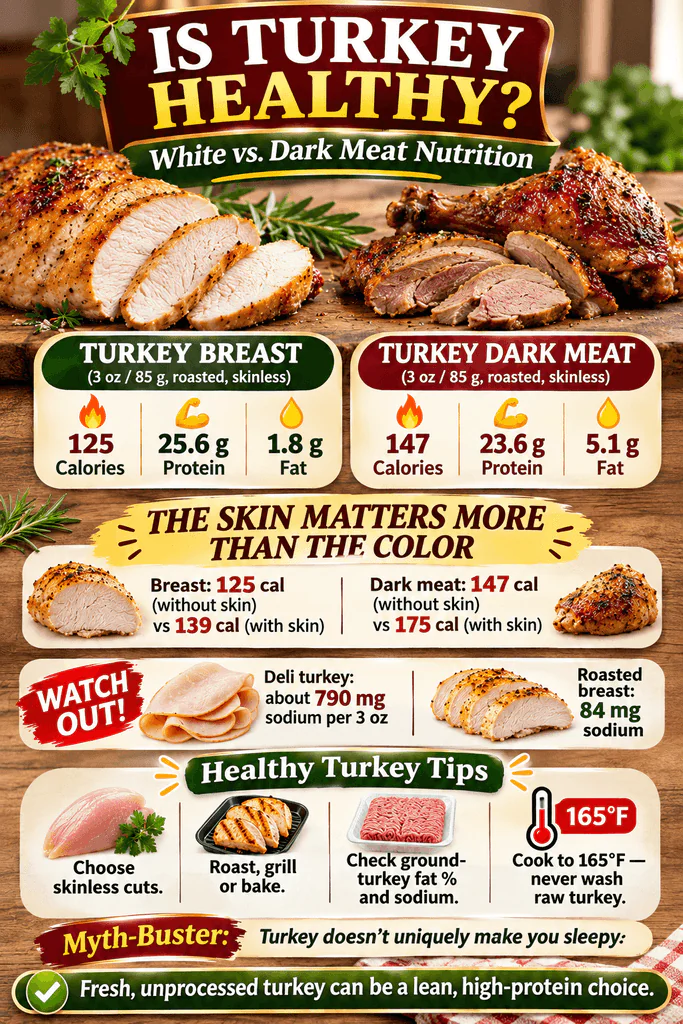
Here’s a look at the main nutrients in 3 ounces (85 grams) of roasted turkey breast and dark meat, without skin.
| Nutrient (3 oz roasted, no skin) | Turkey Breast (white meat) | Turkey Dark Meat |
| Calories | 125 | 147 |
| Protein | 25.6 g | 23.6 g |
| Total fat | 1.8 g | 5.1 g |
| Saturated fat | 0.5 g | 1.5 g |
| Cholesterol | 68 mg | 109 mg |
| Sodium | 84 mg | 88 mg |
| Niacin (B3) | 10 mg (63% DV) | — |
| Vitamin B6 | 0.7 mg (41% DV) | — |
| Vitamin B12 | 0.3 mcg (13% DV) | 1.4 mcg (58% DV) |
| Selenium | 26 mcg (47% DV) | — |
| Zinc | 1.5 mg (14% DV) | 3.0 mg (27% DV) |
| Iron | 0.6 mg | 1.2 mg |
Sources: USDA SR Legacy data for turkey breast, non-enhanced, meat only, roasted (NDB 05220) and turkey dark meat, roasted (NDB 05188). Dashes mean the value wasn’t listed in the source entry. %DV is based on FDA Daily Values.
What the Numbers Show
If you’re asking “is turkey healthy,” these numbers make a strong case. Turkey is high in protein and low in fat, especially the breast. It’s also packed with B vitamins and minerals. A single serving of breast gives you about two-thirds of your daily niacin and almost half your selenium.
Dark meat has a bit more fat and calories, but it also has more zinc, iron, and vitamin B12. Both cuts have zero carbs.
White vs. Dark Meat: Is Turkey Healthy Either Way?
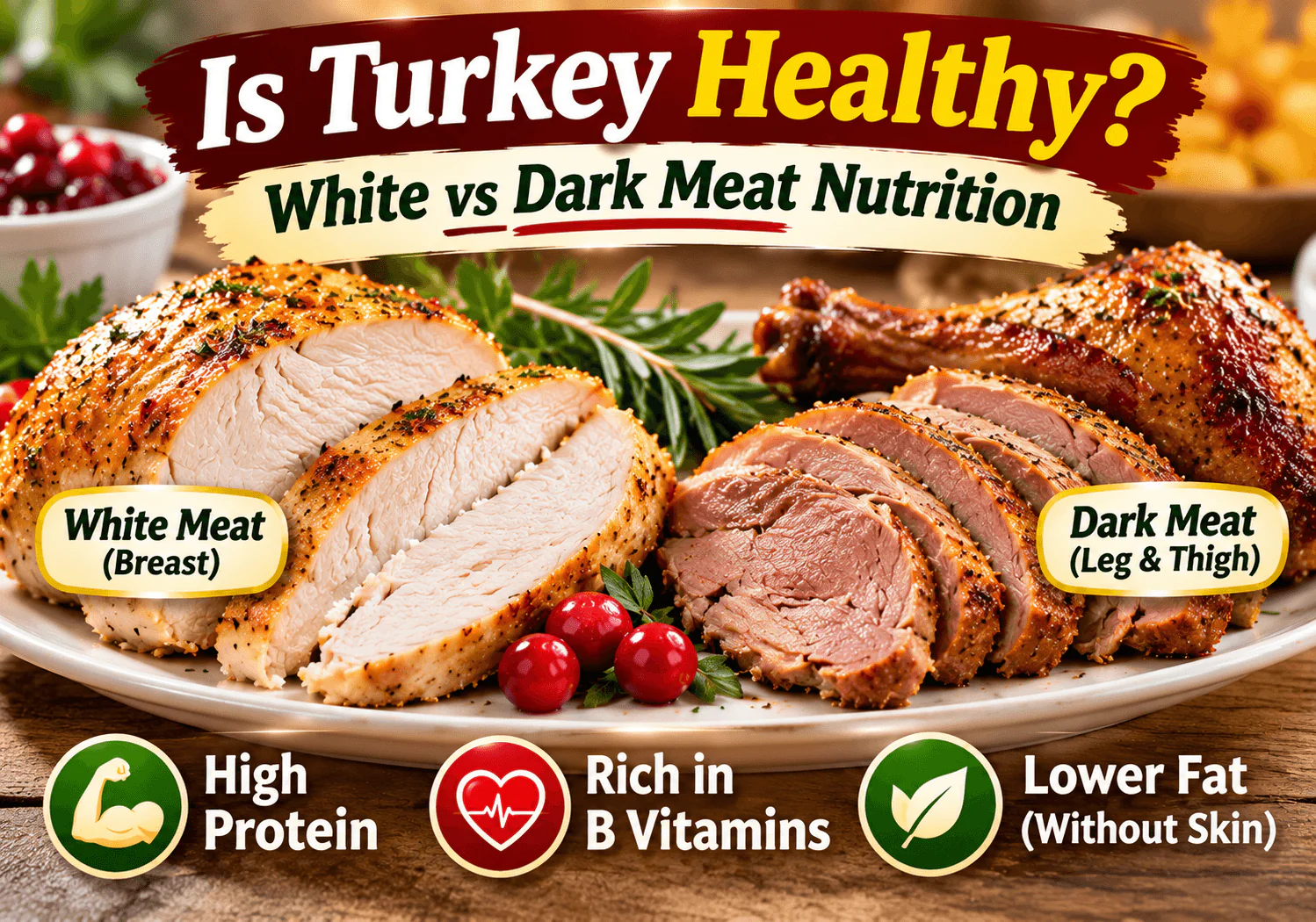
Many people avoid dark meat because they think it’s fatty. In reality, the difference is smaller than you might expect. So is turkey healthy whether you pick white or dark meat? For the most part, yes.
White Meat
Turkey breast is the leanest part of the bird. With no skin, 3 ounces has about 125 calories and 1.8 grams of fat. It’s a great pick if you’re watching calories or saturated fat.
Dark Meat
Turkey legs and thighs have about 147 calories and 5.1 grams of fat per 3 ounces without skin. That’s a little more, but dark meat brings more zinc and much more vitamin B12. It also has a richer flavor and stays juicier when cooked.
The Skin Matters More
Here’s what happens when you add the skin, based on USDA figures reported by the American Heart Association:
| Turkey Cut (3 oz, roasted) | Calories | Fat |
| Breast, no skin | 125 | 1.8 g |
| Breast, with skin | 139 | 4.5 g |
| Dark meat, no skin | 147 | 5.1 g |
| Dark meat, with skin | 175 | 8.5 g |
Champagne told the AHA that “the question of ‘white or dark?’ is not as significant as ‘skin or no skin?'” So if you love dark meat, enjoy it and simply remove the skin.
What Are the Health Benefits of Turkey?
So, is turkey healthy in ways that matter for your body? Here are the main benefits backed by nutrition data and health experts.
1. Turkey Is a Good Source of Protein
Is turkey a good source of protein? Absolutely. Three ounces of roasted breast has about 26 grams of protein, with very little fat. Protein helps build and repair muscle and keeps you feeling full.
The new Dietary Guidelines recommend 1.2 to 1.6 grams of protein per kilogram of body weight per day for adults. Turkey makes it easy to reach that goal. See our guide to eating 120 grams of protein a day.
2. Rich in B Vitamins
Turkey is loaded with niacin and vitamin B6. The NIH explains that niacin is converted into NAD, a coenzyme used by more than 400 enzymes, mainly to help your body get energy from food. Dark meat is also an excellent source of vitamin B12.
3. Packed With Minerals
The AHA notes that turkey is a good source of magnesium, phosphorus, iron, potassium, and zinc, and is high in selenium. Zinc supports immune function, wound healing, and growth, according to the NIH.
4. Low in Saturated Fat
Skinless turkey breast has only about 0.5 grams of saturated fat per 3 ounces. That makes it a heart-friendly swap for fattier meats. AHA diet guidance favors lean, unprocessed poultry over processed forms.
5. Carb-Free and Versatile
Turkey has zero carbs, so it fits low-carb, high-protein, and balanced eating plans. You can roast it, grill it, add it to salads, or use ground turkey in tacos and chili.
Is Turkey Healthy on a High-Protein or Low-Carb Diet?
Yes. Because skinless turkey is almost pure protein with very little fat and no carbs, it works well in high-protein and low-carb eating plans. Just balance your plate with vegetables, whole grains, or beans so you still get enough fiber. Turkey alone doesn’t provide fiber or vitamin C.
Is Turkey Healthier Than Chicken?
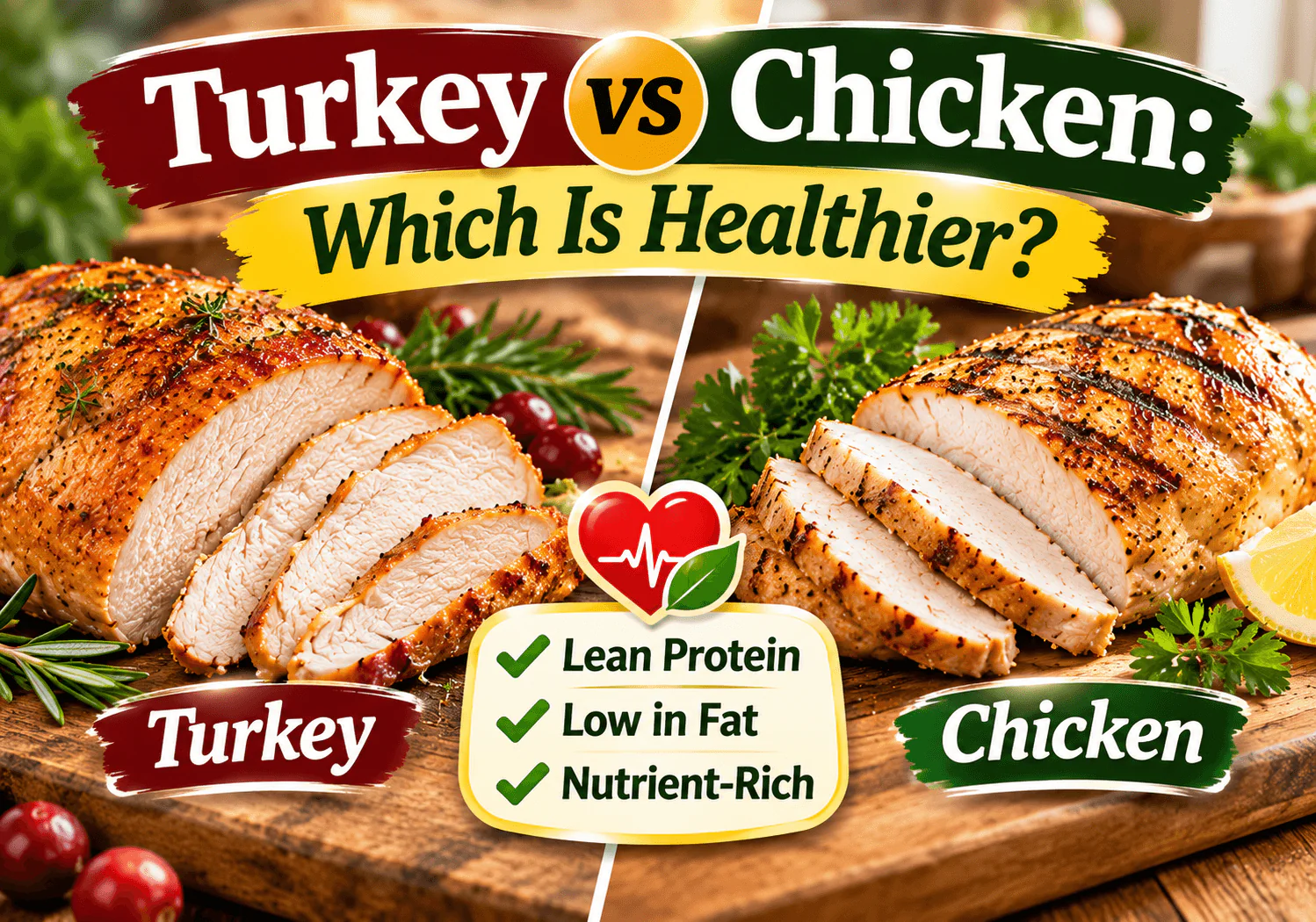
Is turkey healthy compared with chicken? The two are very close nutritionally. Turkey breast is slightly leaner than chicken breast, and turkey dark meat is leaner than chicken thighs. Chicken breast has a little more niacin.
For a full side-by-side comparison, see our guide to turkey vs chicken. You can also learn whether chicken or beef is healthier.
Are All Turkey Products Healthy?
No. This is where the “is turkey healthy” question gets complicated. Fresh roasted turkey is very different from processed turkey products.
| Turkey Product (3 oz) | Calories | Fat | Sodium |
| Roasted breast, no skin | 125 | 1.8 g | 84 mg |
| Ground turkey, 93% lean, cooked | 181 | 9.9 g | 77 mg |
| Deli turkey breast (oven roasted) | 88 | 1.4 g | About 790 mg |
Sources: USDA SR Legacy data for roasted turkey breast, ground turkey 93% lean, pan-broiled (FDC 172851), and oven-roasted turkey luncheon meat (NDB 07079), scaled to 3 oz.
Is Deli Turkey Healthy?
Deli turkey is low in fat and calories, but it’s very high in sodium. Three ounces can have nearly nine times the sodium of roasted turkey breast.
Champagne told the AHA that “all processed meat products, including turkey, contribute a significant amount of sodium.” Is turkey healthy in sandwich form? Only in moderation. Learn more about whether deli turkey is healthy.
Is Turkey Bacon or Sausage Healthy?
Is turkey healthy when it’s cured or smoked? Not as much, because turkey bacon and sausage are processed meats, too.
The World Health Organization classifies processed meat as Group 1, meaning it causes colorectal cancer. Processed meat includes meat that has been salted, cured, smoked, or otherwise processed for flavor or preservation. See whether turkey bacon is healthy and if turkey sausage is healthy.
Is Ground Turkey Healthy?
Is ground turkey healthy? It can be, but read the label.
The 93% lean version has about 9.9 grams of fat per 3 ounces cooked, much more than skinless breast. Some ground turkey includes skin and dark meat. Champagne says she chooses the lower-fat ones, which don’t have skin added, and always checks the sodium.
Is Turkey Healthy for Weight Loss?
Is turkey healthy for weight loss? Yes, it can be a great choice. Skinless turkey breast is low in calories and high in protein, which helps you feel full. A 3-ounce serving has about 125 calories and 26 grams of protein.
To make turkey work for weight loss, choose skinless breast or lean ground turkey, and cook it by roasting, grilling, or baking. Fried turkey with skin adds a lot of calories and fat, since the AHA notes that most of the frying oil is absorbed by the skin. Learn more about fried food and heart health.
Is Turkey Healthy for Cholesterol and Heart Health?
Is turkey healthy for your heart? Skinless turkey breast is a good choice for heart health because it’s low in saturated fat. The AHA’s diet guidance favors lean, unprocessed poultry over processed meats.
Turkey does contain dietary cholesterol, especially in dark meat, which has about 109 mg per 3 ounces. For most people, limiting saturated fat and sodium matters more for heart health. If you have high cholesterol, talk to your doctor about the best protein choices for you.
Is turkey healthy if you’re watching your blood pressure? Fresh turkey is, but watch the sodium in processed products. The AHA recommends no more than 2,300 mg of sodium a day, with an ideal limit of 1,500 mg for most adults. Deli turkey can use up a large share of that in one sandwich.
Is Turkey Healthy to Eat Every Day?
Is turkey healthy to eat every day? Fresh, unprocessed turkey can be part of a healthy diet every day, as long as you vary your protein sources. Eating a mix of poultry, fish, beans, nuts, eggs, and other proteins gives you a wider range of nutrients.
The bigger concern with daily turkey is processed versions. Eating deli turkey every day can add a lot of sodium. If you eat turkey sandwiches often, try roasting your own turkey breast and slicing it at home. Our homemade roasted turkey breast recipe is a lower-sodium option.
What Is a Reason Not to Eat Turkey? Risks and Side Effects
Is turkey healthy for everyone? For most people, yes, but there are a few downsides to keep in mind.
High sodium in processed turkey. Deli meat, sausages, and some packaged turkey products are very salty. Even whole turkeys can be “basted” or “enhanced” with a salt solution. See our guide to fresh vs frozen turkey to learn how to read labels.
Processed meat and cancer risk. The WHO says the evidence shows that eating processed meat causes colorectal cancer, and the risk increases with the amount eaten. Limit cured, smoked, and salted turkey products.
Food poisoning. Raw turkey can carry germs like Salmonella, just like chicken. Learn more about why chicken is healthy and how to handle poultry safely. The CDC recommends cooking turkey to 165°F and refrigerating leftovers within 2 hours. Never wash raw turkey, since that can spread germs around your kitchen.
Fried and skin-on turkey. Frying and eating the skin add calories and fat. Deep-fried turkey is much less healthy than roasted turkey.
Is Turkey Healthy for People With Health Conditions?
For most people with heart disease, diabetes, or high blood pressure, skinless roasted turkey is a smart protein choice. The main things to watch are sodium in processed and enhanced turkey, and saturated fat from the skin. If you have kidney disease, your doctor may set limits on protein, phosphorus, or potassium, so ask how much turkey fits your plan.
Does Turkey Make You Sleepy?
Many people blame turkey’s tryptophan for the Thanksgiving nap. But Harvard Health says a 3-ounce serving of turkey has about 250 mg of tryptophan, similar to chicken or beef. That’s not enough to make you sleepy on its own.
The more likely causes are digesting a big meal or drinking alcohol, according to Harvard Health. So you can enjoy turkey without worrying about a “turkey coma.”
How Much Turkey Should You Eat?
The nutrition numbers in this guide are based on a 3-ounce serving of cooked turkey, a common reference portion. Your ideal amount depends on your calorie and protein needs.
The CDC suggests filling at least half your plate with vegetables at meals, with the rest split between lean protein and starches. Turkey fits nicely in the protein section. For a complete holiday plan, see our healthy Thanksgiving menu.
Practical Tips for Eating Turkey the Healthy Way
Whether you’re new to the is turkey healthy question or already eat turkey often, these tips help.
- Remove the skin. This is the easiest way to cut fat from any cut of turkey.
- Choose fresh over processed. Roast your own turkey breast instead of buying deli slices.
- Read ground turkey labels. Look for a high lean percentage, and check whether skin is added.
- Skip “basted” or “enhanced” birds. These are injected with a salty solution.
- Roast, grill, or bake. Avoid deep-frying if you want the healthiest option.
- Use herbs instead of salt. Season with garlic, rosemary, sage, citrus, and pepper.
- Try new recipes. A lean turkey Bolognese is a tasty way to use ground turkey.
Is Turkey Healthy? Myths vs. Facts
| Myth | Fact |
| Dark meat turkey is unhealthy. | Skinless dark meat has only about 5 grams of fat per 3 ounces and more zinc and B12. |
| All turkey products are healthy. | Deli turkey can have about 790 mg of sodium per 3 ounces. |
| Ground turkey is always lean. | 93% lean ground turkey has about 9.9 grams of fat per 3 ounces cooked. |
| Turkey makes you sleepy. | Turkey’s tryptophan is similar to chicken or beef. |
| Turkey bacon is a health food. | It’s a processed meat, which the WHO classifies as Group 1. |
Frequently Asked Questions
Is turkey a good meat to eat?
Yes. Fresh, skinless turkey is one of the healthiest meats you can eat. It’s high in protein and low in fat, and it’s rich in B vitamins, selenium, and zinc. Choose roasted or grilled turkey breast or lean dark meat, and limit processed turkey like deli slices, bacon, and sausage.
Is turkey one of the healthiest meats?
Skinless turkey breast is one of the leanest meats available, with about 125 calories and 1.8 grams of fat per 3 ounces. It’s also rich in protein and B vitamins. Along with skinless chicken and fish, it’s a top choice for a healthy diet, as long as you avoid processed versions.
What are the top 3 healthiest meats?
There’s no official top three, but skinless poultry, fish, and lean cuts of meat are often recommended. Skinless turkey breast is among the leanest options, and fish like salmon adds healthy fats. MyPlate lists skinless poultry among its lean protein choices. Variety is the healthiest approach.
Is turkey healthier than chicken?
They’re very similar. Turkey breast and dark meat are slightly leaner than the same chicken cuts, while chicken breast has a little more niacin. Both are excellent sources of lean protein. How you cook and season either bird matters more than which one you choose.
What is a reason not to eat turkey?
The main concerns are processed turkey and preparation. Deli turkey, turkey bacon, and sausage are high in sodium, and the WHO links processed meat to colorectal cancer. Fried turkey with skin adds lots of fat and calories. Raw turkey can also carry germs, so cook it to 165°F.
Is it healthy to eat turkey every day?
Fresh, unprocessed turkey can be part of a healthy daily diet. Just vary your protein sources to get a wider range of nutrients. Limit deli turkey and other processed turkey products because they’re high in sodium. Roasting your own turkey breast for sandwiches is a healthier everyday option.
Conclusion: Is Turkey Healthy?
So, is turkey healthy? Yes. Fresh, skinless turkey is a lean, high-protein meat that’s rich in B vitamins, selenium, and zinc. White meat is the leanest, but dark meat without the skin is also a healthy, nutrient-rich choice.
The key is to choose wisely. Remove the skin, roast or grill instead of frying, read ground turkey labels, and limit processed turkey like deli meat, bacon, and sausage. With these simple steps, turkey can be a healthy part of your diet all year long.
Medical disclaimer: This article is for general information only and is not a substitute for professional medical advice, diagnosis, or treatment. If you have heart disease, high blood pressure, high cholesterol, kidney disease, or another health condition, talk with your doctor or a registered dietitian about the best protein choices for you.
3. References
- Merschel M. Is turkey healthy for you? Read this before you gobble any. American Heart Association News. November 23, 2021. https://www.heart.org/en/news/2021/11/23/is-turkey-healthy-for-you-read-this-before-you-gobble-any
- USDA MyPlate. Protein Foods. https://www.myplate.gov/eat-healthy/protein-foods
- USDA ARS. Turkey, breast, from whole bird, non-enhanced, meat only, roasted (SR Legacy NDB 05220). Via RecipAL: https://www.recipal.com/ingredients/10605-nutrition-facts-calories-protein-carbs-fat-turkey-breast-from-whole-bird-non-enhanced-meat-only-roasted [VERIFY: swap in the FDC link]
- USDA ARS. Turkey, from whole, dark meat, cooked, roasted (SR Legacy NDB 05188). Via RecipAL: https://www.recipal.com/ingredients/10602-nutrition-facts-calories-protein-carbs-fat-turkey-from-whole-dark-meat-cooked-roasted [VERIFY]
- USDA ARS. Turkey, ground, 93% lean, 7% fat, pan-broiled crumbles (FDC 172851). Via GetFoodFacts: https://getfoodfacts.com/food/turkey-ground-93-lean-7-fat-pan-broiled-crumbles-172851
- USDA ARS. Turkey breast, sliced, oven roasted, luncheon meat (SR Legacy NDB 07079). Via RecipAL: https://www.recipal.com/ingredients/10914-nutrition-facts-calories-protein-carbs-fat-turkey-breast-sliced-oven-roasted-luncheon-meat [VERIFY]
- Harvard T.H. Chan School of Public Health, The Nutrition Source. Dietary Guidelines for Americans 2025–2030 (summary). January 9, 2026. https://nutritionsource.hsph.harvard.edu/2026/01/09/dietary-guidelines-for-americans-2025-2030/
- NIH Office of Dietary Supplements. Niacin: Fact Sheet for Health Professionals. https://ods.od.nih.gov/factsheets/Niacin-HealthProfessional/
- NIH Office of Dietary Supplements. Zinc: Fact Sheet for Health Professionals. https://ods.od.nih.gov/factsheets/Zinc-HealthProfessional/
- World Health Organization. Cancer: Carcinogenicity of the consumption of red meat and processed meat (Q&A). https://www.who.int/news-room/questions-and-answers/item/cancer-carcinogenicity-of-the-consumption-of-red-meat-and-processed-meat
- Shmerling RH. The Turkey Coma: Fact or Fiction? Harvard Health Publishing. Updated April 24, 2026. https://www.harvardhealth.org/diet-and-nutrition/the-turkey-coma-fact-or-fiction
- Centers for Disease Control and Prevention. Preparing Your Holiday Turkey Safely. 2024. https://www.cdc.gov/food-safety/foods/holiday-turkey.html
- Centers for Disease Control and Prevention. Healthy Eating and the Holidays (Diabetes). 2024. https://www.cdc.gov/diabetes/healthy-eating/5-healthy-eating-tips-holidays.html