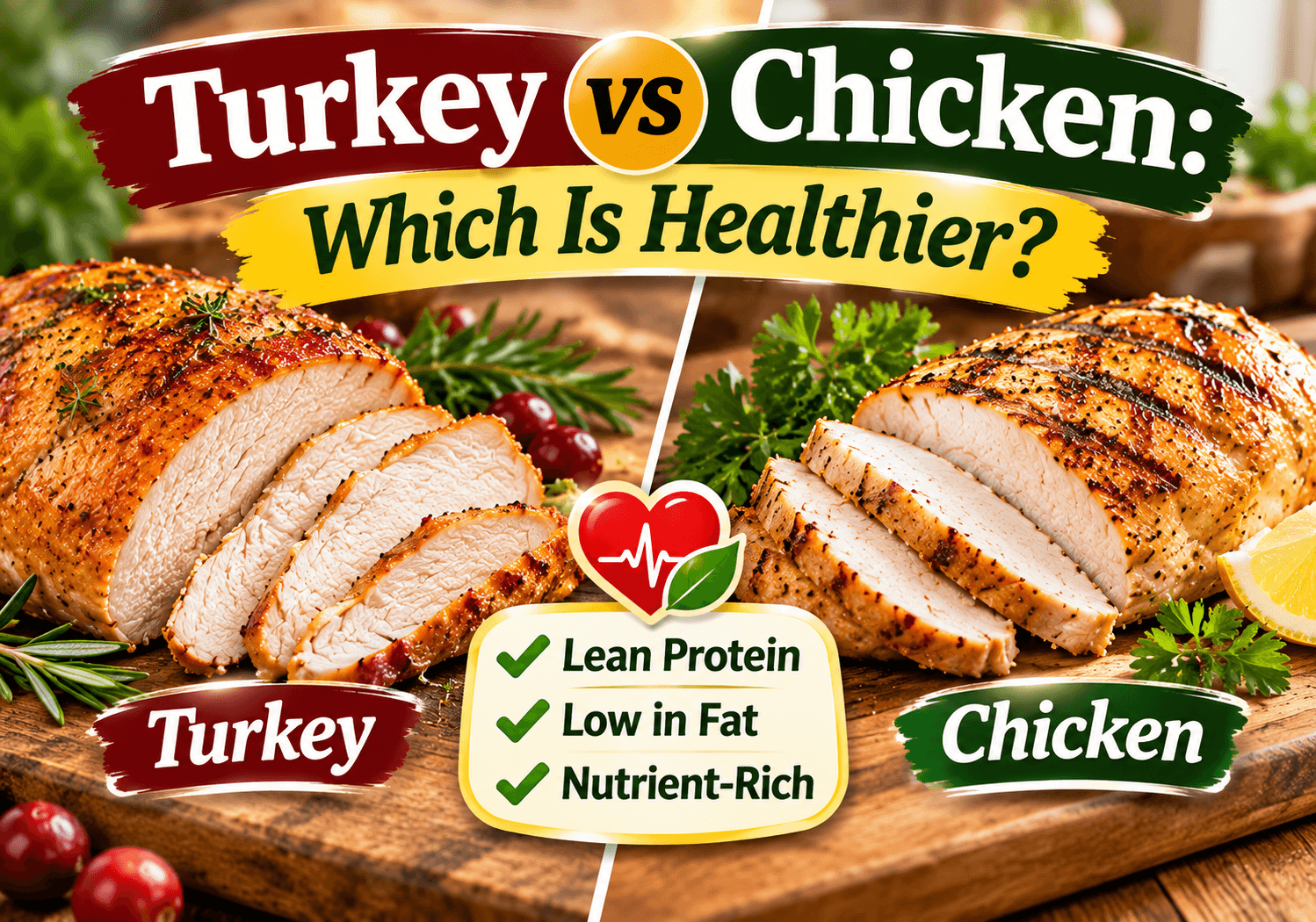
Chicken is America’s favorite everyday protein, while turkey often gets saved for holidays and sandwiches. But when you compare them side by side, which one is better for you? The turkey vs chicken debate comes down to small differences in calories, fat, and a few key vitamins and minerals.
This guide gives you a side-by-side nutrition comparison based on USDA data for both white and dark meat. You’ll also learn which bird has more protein, whether turkey really makes you sleepy, and how to choose the healthiest option for your goals.
Key Takeaways
- Protein is nearly identical. A 3-ounce serving of roasted breast has about 26 grams of protein for both chicken and turkey.
- Turkey breast is slightly leaner. It has about 125 calories and 1.8 grams of fat per 3 ounces, compared with 140 calories and 3 grams of fat for chicken breast.
- Dark meat shows the biggest gap. Turkey dark meat has less fat and fewer calories than chicken thigh, plus more zinc and vitamin B12.
- Chicken breast has more niacin. Turkey breast has a bit more vitamin B6, selenium, and zinc.
- Turkey won’t make you sleepy. It has about the same tryptophan as chicken.
- Processing matters most. Deli meats, sausages, and fried versions of either bird add sodium and fat.
Turkey vs Chicken: The Basics
Both turkey and chicken are poultry, and both are excellent sources of lean protein. MyPlate lists skinless poultry among its lean protein choices.
The biggest difference is how Americans eat them. USDA data show that people in the U.S. have about 102.7 pounds of chicken per person per year, compared with about 13 pounds of turkey. That makes chicken by far the more common everyday choice, with about eight times more eaten than turkey.
So is turkey basically the same as chicken? Nutritionally, they’re very close. But there are a few differences worth knowing, especially between the dark meat cuts.
Turkey vs Chicken Nutrition: Breast Meat
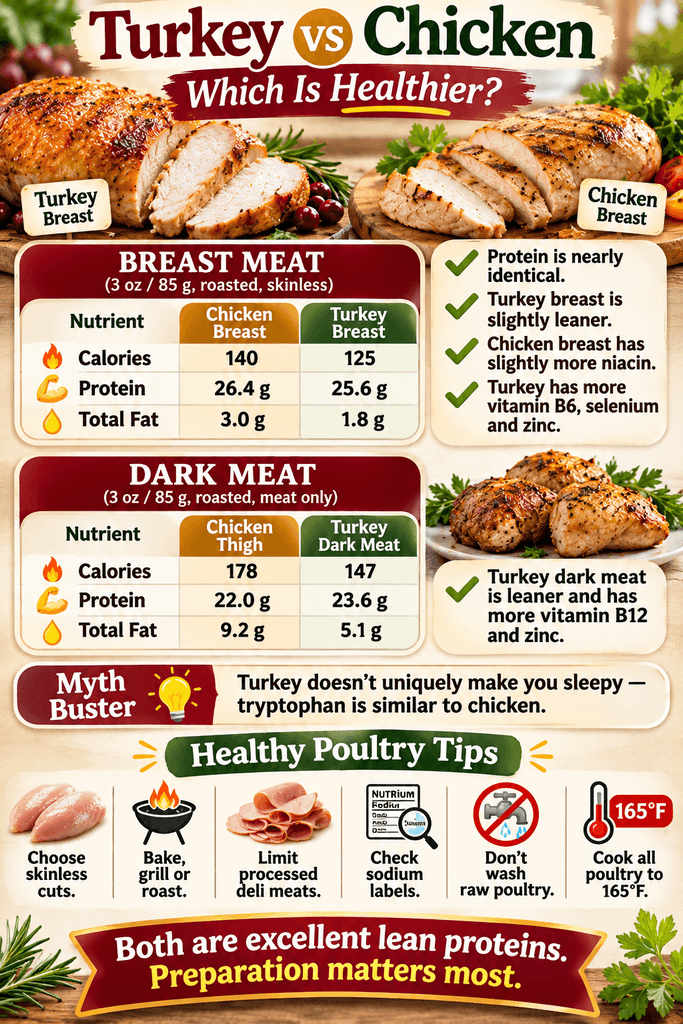
Here’s how 3 ounces (85 grams) of roasted, skinless breast meat compares, based on USDA data.
| Nutrient (3 oz roasted breast, meat only) | Chicken Breast | Turkey Breast | Winner |
| Calories | 140 | 125 | Turkey (lower) |
| Protein | 26.4 g | 25.6 g | About equal |
| Total fat | 3.0 g | 1.8 g | Turkey (lower) |
| Saturated fat | 0.9 g | 0.5 g | Turkey (lower) |
| Cholesterol | 72 mg | 68 mg | About equal |
| Sodium | 63 mg | 84 mg | Chicken (lower) |
| Niacin (B3) | 11.7 mg (73% DV) | 10 mg (63% DV) | Chicken |
| Vitamin B6 | 0.51 mg (30% DV) | 0.7 mg (41% DV) | Turkey |
| Selenium | 23.5 mcg (43% DV) | 26 mcg (47% DV) | Turkey |
| Zinc | 0.9 mg (8% DV) | 1.5 mg (14% DV) | Turkey |
| Phosphorus | 194 mg | 200 mg | About equal |
| Iron | 0.9 mg | 0.6 mg | Chicken |
Sources: USDA SR Legacy data for roasted chicken breast, meat only (1 cup = 140 g, scaled to 3 oz) and roasted turkey breast from whole bird, non-enhanced (NDB 05220). %DV is based on FDA Daily Values.
What the Numbers Show
In the turkey vs chicken breast matchup, the two are nearly tied. Turkey breast has about 15 fewer calories and about 1 gram less fat per serving. Chicken breast has a tiny bit more protein, more niacin, and less sodium.
Turkey breast offers a little more vitamin B6, selenium, and zinc. For most people, these differences are small enough that either breast is a great lean protein choice. Learn more about protein in chicken breast.
Turkey vs Chicken Nutrition: Dark Meat
Dark meat is where the turkey vs chicken differences get bigger. Here’s how 3 ounces of roasted dark meat compares.
| Nutrient (3 oz roasted dark meat) | Chicken Thigh (meat only) | Turkey Dark Meat | Winner |
| Calories | 178 | 147 | Turkey (lower) |
| Protein | 22.0 g | 23.6 g | Turkey |
| Total fat | 9.2 g | 5.1 g | Turkey (lower) |
| Saturated fat | 2.6 g | 1.5 g | Turkey (lower) |
| Cholesterol | 81 mg | 109 mg | Chicken (lower) |
| Sodium | 75 mg | 88 mg | About equal |
| Zinc | 2.2 mg (20% DV) | 3.0 mg (27% DV) | Turkey |
| Vitamin B12 | 0.26 mcg (11% DV) | 1.4 mcg (58% DV) | Turkey |
| Iron | 1.1 mg | 1.2 mg | About equal |
Sources: USDA SR Legacy data for roasted chicken thigh, meat only (1 cup = 140 g, scaled to 3 oz) and roasted turkey dark meat (NDB 05188).
What the Numbers Show
Turkey dark meat is leaner than chicken thigh. It has about 30 fewer calories, nearly half the fat, and more protein per 3 ounces. It also has much more vitamin B12 and more zinc.
Chicken thigh has less cholesterol. If you love dark meat, turkey legs and thighs are a smart, flavorful swap. See our guide to chicken thigh nutrition.
Turkey vs Chicken Protein and Macros
Does Turkey Have More Protein Than Chicken?
It depends on the cut.
- Breast meat: Chicken breast has slightly more, about 26.4 grams versus 25.6 grams per 3 ounces.
- Dark meat: Turkey has more, about 23.6 grams versus 22.0 grams for chicken thigh.
In the turkey vs chicken protein content race, the differences are small. Both are complete, high-quality proteins. The new Dietary Guidelines recommend 1.2 to 1.6 grams of protein per kilogram of body weight per day for adults, and either bird can help you get there.
If you’re tracking a high-protein goal, see our guide to eating 120 grams of protein a day.
Turkey vs Chicken Macros, Calories, and Fat
If you count macros, here’s the quick turkey vs chicken summary per 3 ounces of roasted meat:
| Cut (3 oz, meat only) | Calories | Protein | Fat | Carbs |
| Chicken breast | 140 | 26.4 g | 3.0 g | 0 g |
| Turkey breast | 125 | 25.6 g | 1.8 g | 0 g |
| Chicken thigh | 178 | 22.0 g | 9.2 g | 0 g |
| Turkey dark meat | 147 | 23.6 g | 5.1 g | 0 g |
Turkey breast is the leanest of the four, and chicken thigh has the most fat. All four are carb-free.
The skin makes a big difference too. Removing the skin is one of the easiest ways to cut fat from either bird. MyPlate measures poultry servings as cooked meat without skin.
Turkey vs Chicken: Vitamins and Minerals
Both birds are rich in B vitamins and minerals your body needs every day. Here’s how they compare in the turkey vs chicken nutrition facts.
Niacin: Chicken Wins
Chicken breast has more niacin (vitamin B3), about 73% of the Daily Value per 3 ounces. The NIH explains that niacin is converted into NAD, a coenzyme used by more than 400 enzymes in the body, mainly to turn food into energy.
Vitamin B12 and Zinc: Turkey Wins
Turkey dark meat stands out for vitamin B12, with about 58% of the Daily Value per 3 ounces. That’s about five times more than chicken thigh. Turkey also has more zinc in both breast and dark meat. The NIH notes that zinc supports immune function, wound healing, and growth.
Selenium and B6: Turkey Edges Ahead
Turkey breast has slightly more selenium and vitamin B6 than chicken breast. Both birds are good sources of these nutrients.
Turkey vs Chicken Taste and Texture
When it comes to turkey vs chicken taste comparison, chicken is mild and versatile. It takes on the flavor of whatever spices, sauces, or marinades you use.
Turkey has a richer, slightly gamier flavor, especially in the dark meat. Turkey breast is very lean, so it can dry out quickly if overcooked. Chicken breast also dries out, but chicken thighs stay juicy because of their higher fat content.
For everyday cooking, many people find chicken easier to use. Turkey works well when you want a stronger flavor, like in chili, meatballs, or a holiday roast. For a full holiday plan, see our healthy Thanksgiving menu.
Does Turkey Make You Sleepy?
This is one of the most common turkey vs chicken questions, especially around Thanksgiving. Many people blame tryptophan in turkey for the post-dinner nap.
Harvard Health says that’s a myth. A 3-ounce serving of turkey has about 250 mg of tryptophan, similar to the amount in chicken or beef. There’s not enough in a serving to have much of an effect.
So why do you feel sleepy? Harvard Health explains it’s more likely from digesting a big meal or drinking alcohol that often comes with it. In the turkey vs chicken sleep debate, it’s a tie.
Turkey vs Chicken Health Benefits
Both birds offer real health benefits when you choose lean, minimally processed cuts.
Lean protein for muscle and fullness. Both chicken and turkey breast provide about 26 grams of protein per 3 ounces with very little fat. Protein helps you stay full and supports muscle health.
B vitamins for energy. Both birds are rich in niacin and vitamin B6, which help your body turn food into energy.
Minerals for immunity. Turkey’s extra zinc and selenium support immune health. Chicken provides a bit more iron in breast meat.
Heart-friendly choices. Skinless poultry is lower in saturated fat than many cuts of red meat. Learn whether chicken or beef is healthier.
Turkey vs Chicken: Which Is Healthier?
So, which is healthier for you, chicken or turkey? For most people, they’re nearly equal. Turkey has a slight edge because both its breast and dark meat are a bit leaner, and its dark meat is richer in vitamin B12 and zinc.
Chicken is still an excellent choice. It has slightly more protein in the breast, more niacin, and less cholesterol in the thigh. It’s also easier to find, cook, and use in everyday meals.
In the turkey vs chicken debate, how you prepare the meat matters far more than which bird you pick. A grilled chicken breast is much healthier than fried turkey, and a roasted turkey breast is much healthier than fried chicken. Learn more about why chicken is healthy, and whether store-bought rotisserie chickens are healthy.
Turkey vs Chicken for Weight Loss
If you’re trying to lose weight, both birds are smart picks because they’re high in protein and low in calories. Turkey breast saves about 15 calories per 3-ounce serving compared with chicken breast. That’s a small difference, so choose the one you enjoy most.
The bigger wins come from cooking methods and portions. Grill, bake, or roast your poultry, skip the skin, and pair it with vegetables and whole grains. A crispy fried cutlet or a creamy sauce can add far more calories than the turkey vs chicken choice itself.
Who Should Choose Turkey vs Chicken?
Your best choice depends on your goals.
Turkey may be the better choice if you:
- Want the leanest possible protein, especially turkey breast.
- Love dark meat but want less fat than chicken thighs.
- Need more vitamin B12 or zinc.
- Want a richer flavor for ground meat dishes.
Chicken may be the better choice if you:
- Want a mild, versatile protein for everyday meals.
- Want slightly more protein and niacin per serving of breast meat.
- Are watching dietary cholesterol in dark meat.
- Want an option that’s easy to find and quick to cook.
Risks: Processed Meats, Sodium, and Food Safety
Whichever side of the turkey vs chicken question you choose, watch out for these issues.
Processed poultry. Deli turkey, turkey bacon, chicken nuggets, and sausages are often high in sodium and additives. The FDA’s Daily Value for sodium is less than 2,300 mg per day. Learn whether deli turkey is healthy and if turkey bacon is healthy.
Enhanced or self-basted birds. Many whole turkeys and some chicken products are injected with a salt solution. Check the label for words like “basted” or “enhanced.” See our guide to fresh vs frozen turkey.
Food safety. Raw poultry can carry germs. The CDC notes that raw chicken can be contaminated with Campylobacter, Salmonella, or Clostridium perfringens, and about 1 in 25 packages of chicken at the grocery store contains Salmonella. Always cook chicken and turkey to 165°F.
Don’t wash raw poultry. The CDC says raw chicken doesn’t need to be washed before cooking. Washing can spread germs around your kitchen.
Practical Tips for Choosing Turkey or Chicken
- Choose skinless cuts. Removing the skin cuts fat and calories from either bird.
- Pick lean ground meat. Look for ground turkey or chicken labeled with a high lean percentage, and check whether it includes skin.
- Bake, grill, or roast. These methods keep both birds lean. Frying adds a lot of fat.
- Read labels. Avoid enhanced or self-basted products if you’re watching sodium.
- Use a thermometer. Cook all poultry to 165°F for safety and to avoid dry, overcooked meat.
- Rotate your proteins. Mixing chicken, turkey, fish, beans, and other proteins gives you a wider range of nutrients. Try a lean turkey Bolognese for a change.
How Much Turkey or Chicken Should You Eat?
The nutrition numbers in this guide are based on a 3-ounce serving of cooked meat, a common reference portion. Your ideal amount depends on your calorie and protein needs, so a dietitian can help you fine-tune it.
Refrigerate leftover chicken or turkey within 2 hours, or within 1 hour if it’s above 90°F outside, according to the CDC. Learn more about how long chicken lasts in the fridge.
Ground Turkey vs Ground Chicken
Ground poultry is where the turkey vs chicken comparison gets tricky. Ground products can include dark meat and skin, so fat levels vary a lot from package to package. Always check the label for the lean-to-fat ratio and compare the Nutrition Facts panels side by side.
In general, ground breast meat is the leanest choice for either bird. Ground turkey and ground chicken both work well in burgers, tacos, meatballs, and pasta sauces.
Turkey vs Chicken: Myths vs. Facts
| Myth | Fact |
| Turkey makes you sleepy because of tryptophan. | Turkey has about the same tryptophan as chicken. Big meals and alcohol are more likely culprits. |
| Turkey has far more protein than chicken. | Breast meat is nearly identical, at about 26 grams per 3 ounces. |
| All dark meat is fatty. | Turkey dark meat has about 5 grams of fat per 3 ounces, much less than chicken thigh. |
| You should rinse raw chicken. | The CDC says raw chicken doesn’t need to be washed. |
| Deli turkey is as healthy as roasted turkey. | Processed meats are often high in sodium. Check the FDA’s sodium guidance. |
Frequently Asked Questions
Which is healthier for you, chicken or turkey?
They’re nearly equal. Turkey has a slight edge because its breast and dark meat are a bit leaner, and turkey dark meat has more vitamin B12 and zinc. Chicken breast has slightly more protein and niacin. How you cook and season the meat matters more than which bird you choose.
Does turkey have more protein than chicken?
It depends on the cut. Chicken breast has slightly more protein, about 26.4 grams versus 25.6 grams per 3 ounces of turkey breast. In dark meat, turkey has more, about 23.6 grams versus 22 grams in chicken thigh. Both are excellent, complete sources of protein.
Are chicken breast and turkey breast the same?
They’re very similar but not identical. Turkey breast has about 125 calories and 1.8 grams of fat per 3 ounces, while chicken breast has about 140 calories and 3 grams of fat. Chicken breast has more niacin, and turkey breast has more vitamin B6, selenium, and zinc.
Is turkey basically the same as chicken?
Nutritionally, they’re very close. Both are lean poultry rich in protein and B vitamins. The biggest differences are in dark meat, where turkey is leaner and richer in vitamin B12 and zinc. Turkey also has a stronger flavor, while chicken is milder and more versatile.
Why should you eat chicken instead of turkey?
Chicken is easier to find, cook, and use in everyday meals. Chicken breast has slightly more protein and niacin than turkey breast, and chicken thigh has less cholesterol than turkey dark meat. If you prefer a mild flavor, chicken is a great everyday choice.
Why is turkey not as popular as chicken?
USDA data show Americans eat about eight times more chicken than turkey each year. Chicken is smaller, cooks faster, and is sold in many convenient cuts. Turkey is often tied to holidays and deli meat. Still, ground turkey and turkey cutlets make it easy to enjoy all year.
Conclusion: Turkey vs Chicken, Which Should You Choose?
In the turkey vs chicken comparison, both are healthy, high-protein choices. Turkey is slightly leaner, especially in dark meat, and offers more vitamin B12 and zinc. Chicken breast has a bit more protein and niacin, and chicken is easier to use in everyday cooking.
The best choice is the one you’ll enjoy and cook in a healthy way. Choose skinless cuts, bake or grill instead of frying, limit processed versions, and cook all poultry to 165°F.
Medical disclaimer: This article is for general information only and is not a substitute for professional medical advice, diagnosis, or treatment. If you have heart disease, high blood pressure, kidney disease, or another health condition, talk with your doctor or a registered dietitian about the best protein choices for you.
3. References
- USDA Economic Research Service. Per capita availability of red meat and poultry projected higher in 2025 and 2026. August 21, 2025. https://ers.usda.gov/data-products/charts-of-note/113119
- USDA MyPlate. Protein Foods. https://www.myplate.gov/eat-healthy/protein-foods
- University Hospitals Health & Wellness Library. Nutrition Facts: Chicken, broilers or fryers, breast, meat only, cooked, roasted (USDA SR Legacy). https://www.uhhospitals.org/health-information/health-and-wellness-library/article/nutritionfacts-v1/chicken-broilers-or-fryers-breast-meat-only-cooked-roasted-1-cup-cho
- University Hospitals Health & Wellness Library. Nutrition Facts: Chicken, broilers or fryers, thigh, meat only, cooked, roasted (USDA SR Legacy). https://www.uhhospitals.org/health-information/health-and-wellness-library/article/nutritionfacts-v1/chicken-broilers-or-fryers-thigh-meat-only-cooked-roasted-1-cup-chop
- USDA ARS. Turkey, breast, from whole bird, non-enhanced, meat only, roasted (SR Legacy NDB 05220). Via RecipAL: https://www.recipal.com/ingredients/10605-nutrition-facts-calories-protein-carbs-fat-turkey-breast-from-whole-bird-non-enhanced-meat-only-roasted [VERIFY: swap in the FDC link]
- USDA ARS. Turkey, from whole, dark meat, cooked, roasted (SR Legacy NDB 05188). Via RecipAL: https://www.recipal.com/ingredients/10602-nutrition-facts-calories-protein-carbs-fat-turkey-from-whole-dark-meat-cooked-roasted [VERIFY: meat only?]
- Harvard T.H. Chan School of Public Health, The Nutrition Source. Dietary Guidelines for Americans 2025–2030 (summary). January 9, 2026. https://nutritionsource.hsph.harvard.edu/2026/01/09/dietary-guidelines-for-americans-2025-2030/
- NIH Office of Dietary Supplements. Niacin: Fact Sheet for Health Professionals. https://ods.od.nih.gov/factsheets/Niacin-HealthProfessional/
- NIH Office of Dietary Supplements. Zinc: Fact Sheet for Health Professionals. https://ods.od.nih.gov/factsheets/Zinc-HealthProfessional/
- Shmerling RH. The Turkey Coma: Fact or Fiction? Harvard Health Publishing. Updated April 24, 2026. https://www.harvardhealth.org/diet-and-nutrition/the-turkey-coma-fact-or-fiction
- Centers for Disease Control and Prevention. Chicken and Food Poisoning. April 29, 2024. https://www.cdc.gov/food-safety/foods/chicken.html
- U.S. Food and Drug Administration. Sodium in Your Diet. 2024. https://www.fda.gov/food/nutrition-education-resources-materials/sodium-your-diet