Every November, shoppers stand in the grocery aisle facing the same question. Should you grab a frozen bird now or wait and pick up a fresh one a day or two before the holiday? The fresh vs frozen turkey decision affects your schedule, your fridge space, and how stressful your Thanksgiving week feels.
This guide explains what “fresh” and “frozen” really mean on a turkey label, how they compare on safety, nutrition, and taste, and when to buy each one. You’ll also find a thawing chart, label tips, and answers to common last-minute questions, like what to do if your turkey is still frozen.
Key Takeaways
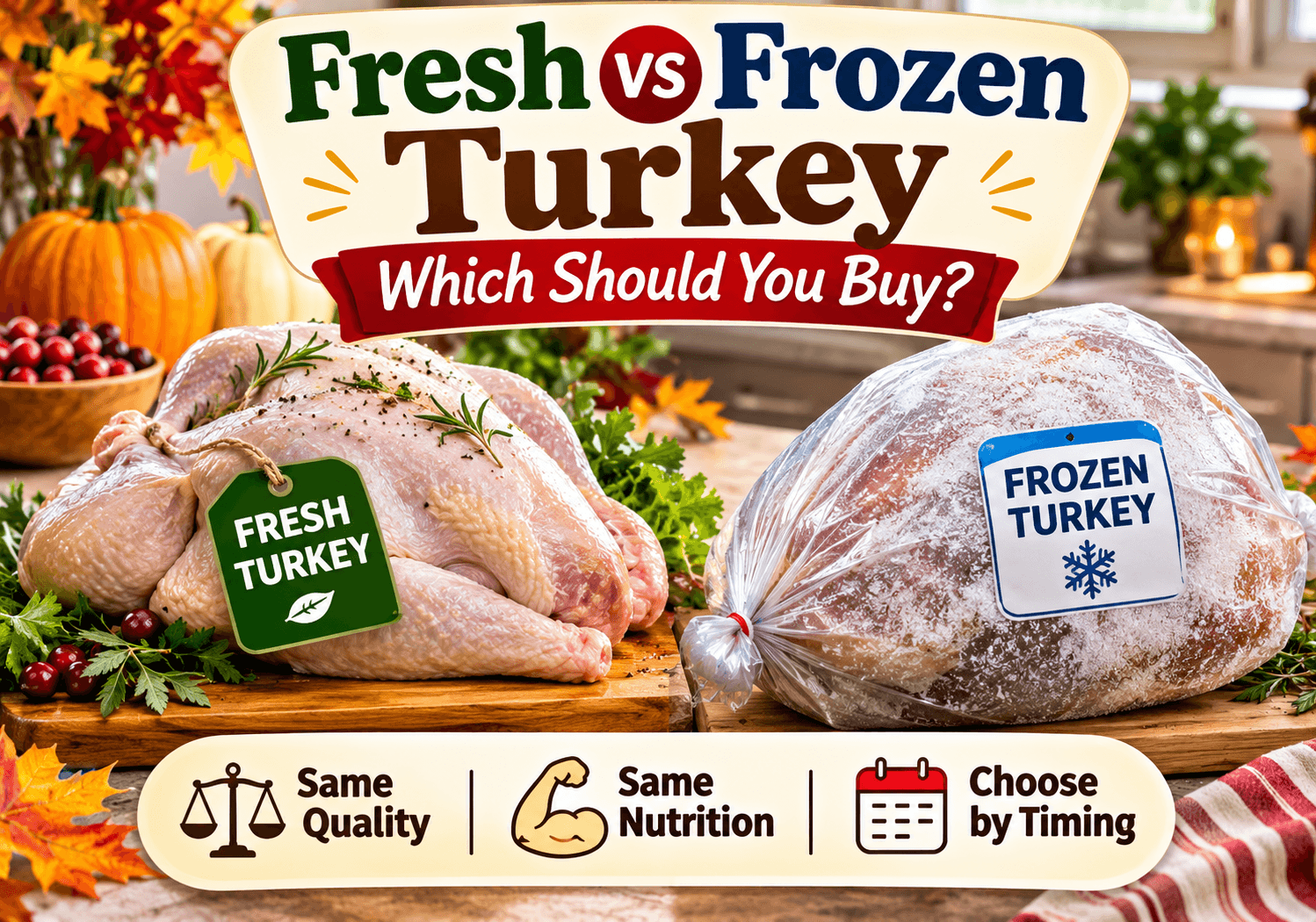
- The quality is the same. The USDA says fresh and frozen turkeys are both inspected and equal in quality, so it comes down to preference.
- “Fresh” has a legal definition. A fresh turkey has never been chilled below 26°F. A frozen turkey is kept at 0°F or below.
- Freezing doesn’t destroy nutrients. Protein, vitamins, and minerals stay the same.
- Timing is the big difference. Buy frozen if you have a week or more. Buy fresh one to two days before cooking.
- Thawing takes longer than most people think. Allow about 24 hours in the fridge for every 4 to 5 pounds.
- Watch for added sodium. “Basted” or “self-basting” birds are injected with a salty solution.
Fresh vs Frozen Turkey: What’s the Difference?
The main difference between a fresh and a frozen turkey is temperature. According to the USDA, a turkey labeled “fresh” has never been below 26°F. A frozen turkey is kept at 0°F or below.
Why 26°F? The USDA explains that below 26°F, poultry becomes firm to the touch because much of its water turns to ice. At 26°F or above, the meat still gives when you press it with your thumb, which is how most people judge freshness.
So a “fresh” turkey may still feel very cold, and it may even have ice crystals near the surface. That’s normal and doesn’t mean it was frozen. Understanding these labels is the first step in the fresh vs frozen turkey decision.
Is One Higher Quality Than the Other?
No. In the fresh vs frozen turkey comparison, the USDA states plainly that “the quality is the same.” Both are inspected by USDA’s Food Safety and Inspection Service, so the choice comes down to personal preference, budget, and timing.
Fresh vs Frozen Turkey: Nutrition Compared
Many people assume a fresh turkey is more nutritious. It isn’t, and this is one of the biggest myths in the fresh vs frozen turkey debate. The USDA states that “the freezing process itself does not destroy nutrients.” A turkey has the same protein, vitamins, and minerals whether it was frozen or not. The same idea applies to produce, which is why frozen vegetables can be healthy too.
What does make a difference is whether the turkey has been “enhanced” with a salt solution. Here’s how 3 ounces of roasted turkey breast compares, based on USDA data.
| Nutrient (3 oz roasted breast, meat only) | Not Enhanced | Enhanced (Added Solution) |
| Calories | 125 | 108 |
| Protein | 25.6 g | 22.9 g |
| Total fat | 1.8 g | 1.8 g |
| Saturated fat | 0.5 g | 0.5 g |
| Sodium | 84 mg | 202 mg |
Source: USDA SR Legacy data for turkey breast from whole bird, non-enhanced (NDB 05220) and enhanced (NDB 05718).
What the Numbers Show
The enhanced turkey breast has more than twice the sodium of plain turkey breast. Part of its weight is added water and salt, so it also has slightly less protein per bite.
The FDA’s Daily Value for sodium is less than 2,300 mg per day, and most Americans already eat more than that. Enhanced turkeys can be either fresh or frozen, so always read the label. When it comes to sodium, the fresh vs frozen turkey label matters far less than the word “basted.”
Turkey Is a Lean Protein Choice
Either way, skinless turkey breast is a lean, high-protein food. MyPlate lists skinless poultry among its lean protein choices. Three ounces of plain roasted breast gives you about 26 grams of protein, similar to the amount of protein in a chicken breast.
Learn more about why chicken is healthy, since turkey breast offers many of the same benefits. If you track protein closely, see our guide to eating 120 grams of protein a day.

Fresh vs Frozen Turkey: Taste and Texture
Does fresh turkey taste better than frozen? The fresh vs frozen turkey taste debate is popular online, but official sources don’t support a big difference. The USDA says quality is the same for both.
Some cooks feel that fresh turkey is slightly juicier. Freezing can cause some moisture loss when the bird thaws, and the USDA notes that refreezing a thawed turkey may reduce quality because of moisture lost during thawing.
In practice, cooking method matters much more than the fresh vs frozen turkey label. Overcooking dries out any bird. Use a food thermometer, take the turkey out when it reaches 165°F, and let it rest for 20 minutes before carving.
When to Buy a Fresh vs Frozen Turkey
Timing is the biggest practical difference in the fresh vs frozen turkey decision. The USDA offers a simple rule in its guide Frozen or Fresh: Which Turkey Should You Buy?:
- More than a week before your meal: Choose frozen, and leave enough time for thawing.
- Less than a week before your meal: Choose fresh.
How Soon Before Thanksgiving Should You Buy a Fresh Turkey?
Buy a fresh turkey one or two days before you plan to cook it, unless the “Best by” or “Use by” date on the package covers your cooking day. Keep it in the refrigerator, in its original wrapping, on a tray to catch any juices.
Fresh turkeys are often sold out close to the holiday, so many stores let you reserve one in advance.
When Should You Buy a Frozen Turkey?
You can buy a frozen turkey weeks or even months ahead. The USDA says turkeys can be kept frozen indefinitely, but for the best quality, cook them within one year.
The catch with a frozen turkey is thawing. If you buy frozen, plan your thawing schedule before you shop.
How Much Turkey Should You Buy?
Whichever side of the fresh vs frozen turkey question you land on, the USDA recommends allowing 1 pound of turkey per person. For pre-stuffed frozen turkeys, allow 1¼ pounds per person.
| Number of Guests | Turkey Size |
| 4–6 | 4–6 lb (or a turkey breast) |
| 8–10 | 8–10 lb |
| 12–14 | 12–14 lb |
| 16–20 | 16–20 lb |
If you want leftovers, add a few extra pounds. For smaller groups, a bone-in turkey breast is often easier than a whole bird. You can even make your own roasted turkey breast deli meat with the leftovers.
How to Thaw a Frozen Turkey Safely
Thawing is where the fresh vs frozen turkey choice really matters. A fresh turkey is ready to cook, while a frozen one needs days of planning.
The CDC warns never to thaw a turkey on the counter. It recommends three safe methods: in the refrigerator, in cold water, or in the microwave.
Refrigerator Thawing (Best Method)
Allow about 24 hours for every 4 to 5 pounds of turkey. Keep the bird in its wrapping and place it on a tray in the refrigerator. After thawing, it can stay in the fridge for one to two more days before cooking.
Cold Water Thawing (Faster)
Allow about 30 minutes per pound. Keep the turkey in a leak-proof bag, submerge it in cold tap water, and change the water every 30 minutes. Cook it right away after thawing.
Turkey Thawing Chart
| Turkey Weight | Refrigerator | Cold Water |
| 4–12 lb | 1–3 days | 2–6 hours |
| 12–16 lb | 3–4 days | 6–8 hours |
| 16–20 lb | 4–5 days | 8–10 hours |
| 20–24 lb | 5–6 days | 10–12 hours |
Source: University of Missouri Extension, based on USDA guidance.
Can You Refreeze a Thawed Turkey?
It depends on how you thawed it. The USDA says a turkey thawed in the refrigerator may be refrozen, though quality may drop a little. A turkey thawed in cold water or the microwave should be cooked right away and not refrozen.
My Turkey Is Still Frozen. What Should I Do?
Don’t panic. This is one of the most common Thanksgiving problems, and there are safe fixes.
Option 1: Switch to cold water. If you have several hours, move the turkey to a sink of cold water. A 20-pound turkey needs about 10 hours, at roughly 30 minutes per pound. Change the water every 30 minutes.
Option 2: Cook it frozen. The USDA confirms it’s safe to cook a turkey from frozen, and a partly frozen bird takes less extra time than a fully frozen one. The cooking time will take at least 50 percent longer than for a fully thawed turkey. Remove the giblet package with tongs once the bird has thawed enough, and check that it reaches 165°F.
Never thaw a turkey on the counter, in the garage, or in hot water. University of Missouri Extension lists these as unsafe thawing methods.
If you’re stuck, call the USDA Meat and Poultry Hotline at 1-888-674-6854. On Thanksgiving Day, it’s open from 8 a.m. to 2 p.m. ET.
How to Read Turkey Labels
Beyond the fresh vs frozen turkey label, the package holds other clues that affect nutrition and price. Here’s what common terms mean, according to the USDA’s labeling guide.
| Label Term | What It Means |
| Fresh | Never chilled below 26°F |
| Frozen | Kept at 0°F or below |
| Basted or self-basted | Injected or marinated with a seasoned solution, which adds sodium |
| Natural | No artificial ingredients or added color, and only minimally processed |
| No hormones added | Hormones aren’t allowed in poultry at all, so this claim must say so |
| Young turkey | Usually less than 16 weeks old |
Watch for “Basted” and “Self-Basting”
If you’re watching your sodium, skip turkeys labeled “basted” or “self-basting.” As the nutrition table above shows, enhanced turkey breast has more than twice the sodium of plain turkey. Season a plain turkey yourself with herbs, garlic, citrus, and a modest amount of salt. Wondering about salt types? Compare sea salt vs table salt.
Don’t Pay Extra for “No Hormones”
Since hormones are already banned in poultry production, every turkey in the store is hormone-free. A “no hormones added” label doesn’t make one turkey healthier than another.
Fresh vs Frozen Turkey: Pros and Cons
Here’s a quick fresh vs frozen turkey side-by-side to help you decide.
| Fresh Turkey | Frozen Turkey | |
| Quality | Same as frozen (USDA) | Same as fresh (USDA) |
| Nutrition | Same | Same |
| When to buy | 1–2 days before cooking | Weeks or months ahead |
| Thawing needed | No | Yes, often several days |
| Fridge space | 1–2 days | Up to 6 days while thawing |
| Availability | Can sell out near holidays | Widely available |
| Storage | Refrigerator only | Freezer, up to 1 year for best quality |
Who Should Choose a Fresh Turkey?
- People shopping in the last few days before the holiday.
- Cooks without enough fridge space for a multi-day thaw.
- Anyone who wants to skip the thawing step entirely.
Who Should Choose a Frozen Turkey?
- People who like to shop early or stock up when turkeys are on sale.
- Families with a big freezer and time to plan.
- Anyone who wants more flexibility with their cooking date.
Fresh vs Frozen Turkey for Small Households
If you’re cooking for two to four people, a whole bird may be more than you need. A fresh or frozen bone-in turkey breast is easier to store, thaws faster, and cooks in less time. It also gives you the leanest meat without the extra dark meat and skin.
Frozen turkey breasts and parts are handy because you can buy them well ahead and thaw them in a day or two. Fresh turkey breasts are a good last-minute option when you don’t have time to thaw a whole bird.
Food Safety Risks to Know
The fresh vs frozen turkey choice doesn’t change the key safety rules, and both need the same careful handling. Raw poultry can carry germs like Salmonella, so handle any turkey with care.
The CDC recommends these turkey safety steps:
- Don’t wash raw turkey. Washing it can spread germs around your kitchen.
- Cook to 165°F. Check the thickest part of the breast, the inner thigh, and the wing.
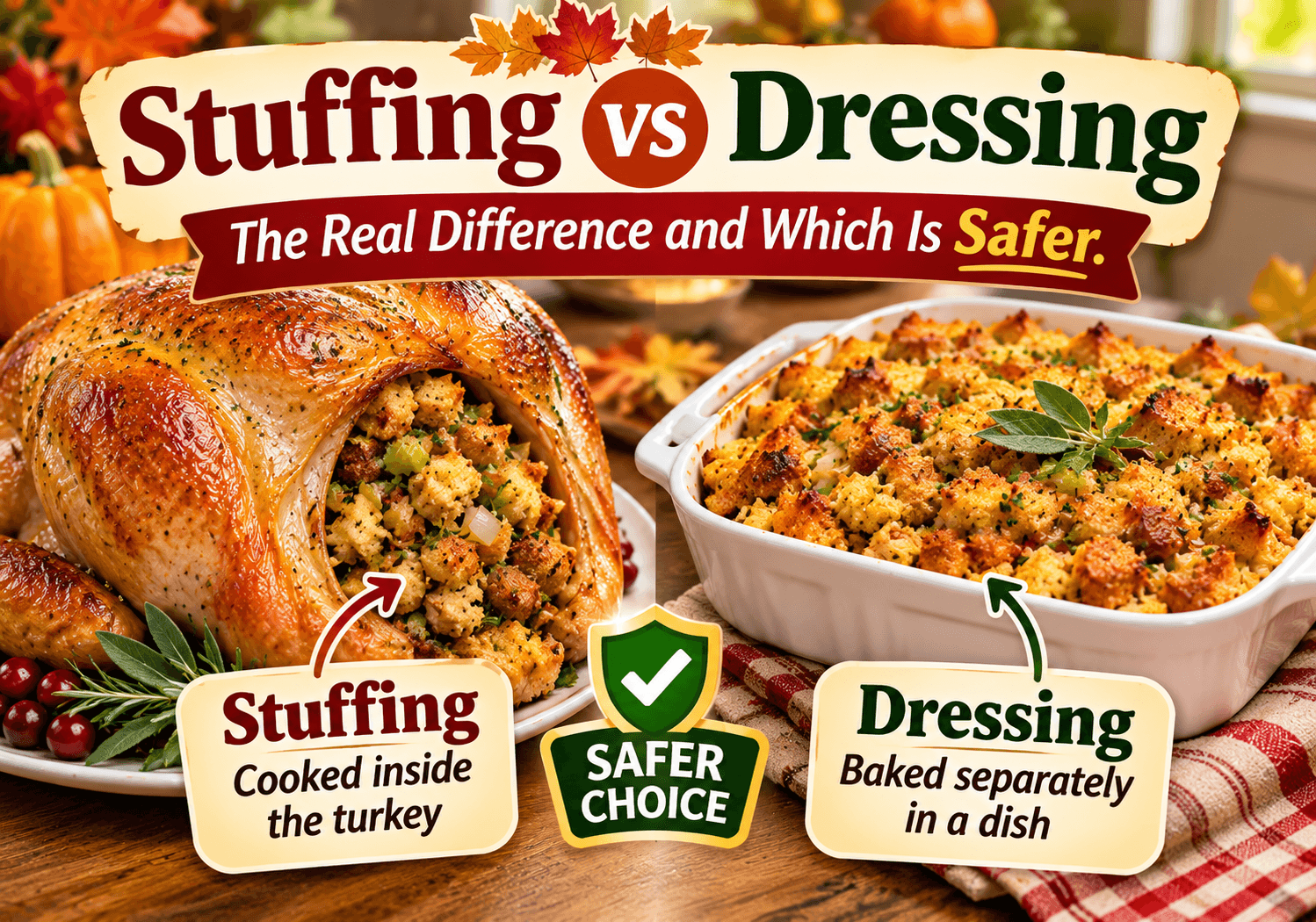
- Cook stuffing separately in a casserole dish, and make sure it reaches 165°F.
- Refrigerate leftovers within 2 hours. Use them within 3 to 4 days or freeze them.
For more on storing cooked poultry, see how long chicken lasts in the fridge. The same rules apply to turkey leftovers.
Practical Tips for Your Fresh vs Frozen Turkey
- Plan backward from your cooking day. In the fresh vs frozen turkey choice, count thawing days before buying a frozen bird.
- Reserve a fresh turkey early. Many stores take orders weeks ahead.
- Make room in the fridge. A large turkey on a tray takes up a full shelf.
- Check the giblets. Remove the neck and giblet bag before roasting a thawed bird.
- Use a food thermometer. It’s the only reliable way to know your turkey is done.
- Let it rest. The USDA suggests letting the turkey stand for 20 minutes before carving.
Fresh vs Frozen Turkey: Myths vs. Facts
| Myth | Fact |
| Fresh turkey is more nutritious than frozen. | The USDA says freezing does not destroy nutrients. |
| Fresh turkey is higher quality. | The USDA says “the quality is the same.” |
| A “fresh” turkey has never been cold. | Fresh turkeys can be chilled down to 26°F. |
| You can’t cook a frozen turkey. | You can. It just takes at least 50 percent longer. |
| “No hormones” turkeys are healthier. | Hormones are not allowed in any poultry. |
How Turkey Fits a Healthy Holiday Meal
The fresh vs frozen turkey choice is about convenience, not health. Whether you choose fresh or frozen, turkey can be the healthy centerpiece of your holiday table. Choose skinless breast meat for the leanest option, skip self-basting birds if you’re watching sodium, and fill the rest of your plate with vegetables. For a complete plan, see our healthy Thanksgiving menu.
When dessert comes around, compare pumpkin pie vs pecan pie and pumpkin vs sweet potato pie to find a lighter choice. For leftovers, try a lean turkey Bolognese or turkey sandwiches. If you buy deli turkey later in the season, check whether deli turkey is healthy.
Frequently Asked Questions
Should you buy a frozen or fresh turkey?
Both are good choices, and the USDA says the quality is the same. Buy a frozen turkey if you’re shopping more than a week ahead and have time to thaw it. Buy a fresh turkey if you’re shopping within a few days of the holiday. Your schedule and fridge space should decide.
What is the difference between fresh and frozen turkeys?
The difference is temperature. A fresh turkey has never been chilled below 26°F, while a frozen turkey is stored at 0°F or below. Both are inspected by the USDA and have the same nutrition. A fresh turkey is ready to cook, while a frozen one needs days to thaw.
How soon before Thanksgiving should you buy a fresh turkey?
Buy a fresh turkey one or two days before you plan to cook it, according to the USDA. The exception is if the package has a “Use by” or “Best by” date that covers your cooking day. Many stores let you reserve a fresh turkey in advance, so you can pick it up at the right time.
Can I keep a fresh turkey in the fridge for 4 days?
Usually not. The USDA advises buying a fresh turkey only one to two days before cooking. If the “Use by” date on the label covers your cooking day, you can follow that date. If you bought it too early, you can freeze it, though you’ll then need time to thaw it again.
My 20-pound turkey is still frozen. What should I do?
You have two safe options. Thaw it in cold water, allowing about 30 minutes per pound, or roughly 10 hours for a 20-pound bird, changing the water every 30 minutes. Or cook it from frozen, which takes at least 50 percent longer. Never thaw it on the counter.
Does a fresh turkey cook differently?
A fresh turkey and a fully thawed frozen turkey cook the same way and take about the same time. Only a turkey that’s still frozen or partly frozen takes longer. Either way, roast at 325°F, check that the thickest parts reach 165°F, and rest the bird for 20 minutes.
Conclusion: Fresh vs Frozen Turkey, Which Should You Buy?
In the fresh vs frozen turkey debate, there’s no wrong answer. The USDA says quality and nutrition are the same, so the right choice depends on your schedule. Buy frozen if you’re planning ahead and have time to thaw. Buy fresh if you’re shopping a day or two before the holiday.
Whichever you choose, read the label for added sodium, thaw safely, and cook the bird to 165°F. With a little planning, either turkey will be the star of a safe, healthy holiday meal.
Medical disclaimer: This article is for general information only and is not a substitute for professional medical advice, diagnosis, or treatment. If you have high blood pressure, heart disease, a weakened immune system, or another health condition, talk with your doctor or a registered dietitian about your holiday meal plan. For food safety questions, contact the USDA Meat and Poultry Hotline.
3. References
- USDA Food Safety and Inspection Service. The Poultry Label Says “Fresh.” https://www.fsis.usda.gov/food-safety/safe-food-handling-and-preparation/poultry/poultry-label-says-fresh
- USDA Food Safety and Inspection Service. Meat and Poultry Labeling Terms. https://www.fsis.usda.gov/food-safety/safe-food-handling-and-preparation/food-safety-basics/meat-and-poultry-labeling-terms
- USDA Food Safety and Inspection Service. Freezing and Food Safety. https://www.fsis.usda.gov/food-safety/safe-food-handling-and-preparation/food-safety-basics/freezing-and-food-safety
- USDA Food Safety and Inspection Service. Let’s Talk Turkey: A Consumer Guide to Safely Roasting a Turkey. https://www.fsis.usda.gov/es/node/3307 [VERIFY: swap in the English canonical URL]
- U.S. Department of Agriculture. Frozen or Fresh: Which Turkey Should You Buy? November 9, 2023. https://www.usda.gov/node/55345
- Centers for Disease Control and Prevention. Preparing Your Holiday Turkey Safely. 2024. https://www.cdc.gov/food-safety/foods/holiday-turkey.html
- University of Missouri Extension. How to Have a Safe Thanksgiving Dinner (N550). 2026. https://extension.missouri.edu/sites/default/files/2026-11/n00550.pdf
- University of Nebraska–Lincoln Extension. Turkey FAQs. https://food.unl.edu/article/turkey-faqs/
- USDA Agricultural Research Service. Turkey, breast, from whole bird, non-enhanced, meat only, roasted (SR Legacy NDB 05220). Via RecipAL: https://www.recipal.com/ingredients/10605-nutrition-facts-calories-protein-carbs-fat-turkey-breast-from-whole-bird-non-enhanced-meat-only-roasted [VERIFY: replace with the FDC link]
- USDA Agricultural Research Service. Turkey, breast, from whole bird, enhanced, meat only, roasted (SR Legacy NDB 05718). Via RecipAL: https://www.recipal.com/ingredients/10666-nutrition-facts-calories-protein-carbs-fat-turkey-breast-from-whole-bird-enhanced-meat-only-roasted [VERIFY: replace with the FDC link]
- U.S. Food and Drug Administration. Sodium in Your Diet. 2024. https://www.fda.gov/food/nutrition-education-resources-materials/sodium-your-diet
- USDA MyPlate. Protein Foods. https://www.myplate.gov/eat-healthy/protein-foods