Pine nuts are small, buttery and famously expensive, the star ingredient in classic basil pesto and a favorite topping for salads and roasted vegetables. They’re also the only nut with its own strange side effect: “pine mouth,” a bitter, metallic taste that can linger for days. So, are pine nuts healthy? Yes. They’re an excellent source of manganese, copper and vitamin E, and they deliver mostly unsaturated fat. Still, there are a few things worth knowing before you toast a batch: how to avoid pine mouth, why they go rancid quickly, and how they fit into a heart-healthy diet.
This guide covers pine nut nutrition, health benefits, the science behind pine mouth, allergy facts, portion sizes and the best ways to use them.
Key Takeaways
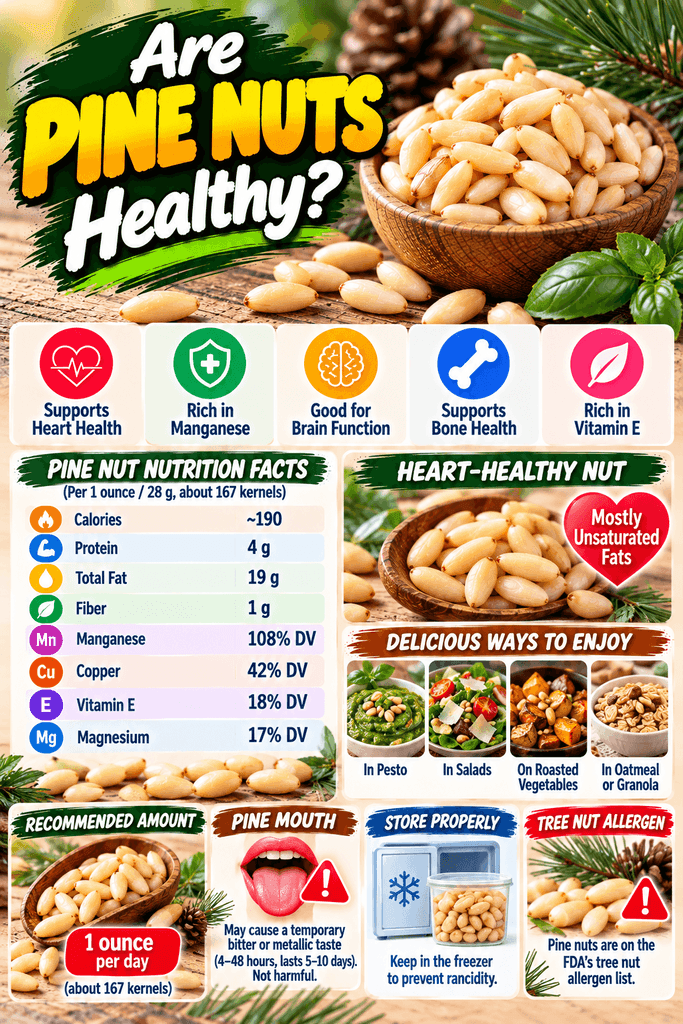
- One ounce of pine nuts (about 167 kernels) has about 190 calories, 4 g protein, 19 g fat and 1 g fiber.
- They’re an outstanding source of manganese (108% DV per ounce), plus copper (42% DV), vitamin E (18% DV) and magnesium (17% DV).
- Pine mouth is a temporary bitter or metallic taste that starts 4–48 hours after eating some pine nuts and lasts about 5–10 days. It’s unpleasant but not harmful.
- Pine nuts are on the FDA’s tree nut allergen list.
- Like other nuts, they fit a heart-healthy diet in sensible portions of about 1 ounce.
- Store them in the freezer. They go rancid faster than many nuts.
What Are Pine Nuts?
Pine nuts (also called pignoli or piñon nuts) are the edible seeds of certain pine trees. They grow inside pine cones and must be extracted by hand or machine, which is one reason they’re so expensive. Different species are harvested in Europe, Asia and North America, and the nuts vary slightly in size, shape and flavor.
Botanically they’re seeds, but for cooking, nutrition and allergen labeling they’re treated as tree nuts. For a full comparison with other nuts, see our complete guide to nuts.
Pine Nut Nutrition Facts
According to USDA FoodData Central’s record for dried pine nuts, one ounce (28 g, about 167 kernels) provides:
| Nutrient (1 oz) | Amount | % Daily Value |
| Calories | ~190 | — |
| Protein | ~4 g | — |
| Total fat | ~19 g | 24% |
| Fiber | ~1 g | ~4% |
| Manganese | 2.5 mg | 108% |
| Copper | — | 42% |
| Vitamin E | — | 18% |
| Magnesium | — | 17% |
Source: USDA FoodData Central, FDC 170591. % DV is based on FDA Daily Values.
What stands out:
- Manganese champion. One ounce supplies more than a full day’s manganese, which supports bone formation, metabolism and antioxidant enzymes.
- Copper helps make red blood cells and supports nerve and immune function.
- Vitamin E is a fat-soluble antioxidant that helps protect cells from damage.
- Magnesium supports muscle and nerve function and blood sugar control.
- Mostly fat. About 85% of the calories come from fat, mostly unsaturated, with only about 7% from carbohydrate.
- Lower in fiber than many nuts, about 1 g per ounce versus 3+ g in almonds or hazelnuts.
Pine Nuts vs. Other Nuts
| Nut (1 oz) | Calories | Protein | Fiber | Standout |
| Pine nuts | ~190 | 4 g | 1 g | Manganese (108% DV) |
| Walnuts | ~185 | 4 g | 2 g | Omega-3 ALA |
| Hazelnuts | ~180 | 4 g | 3 g | Vitamin E, manganese |
| Macadamias | ~200 | 2 g | 2 g | Monounsaturated fat |
| Pistachios | ~159 | 6 g | 3 g | Protein per calorie, lutein |
Values from USDA FoodData Central.
Pine nuts are similar in calories to walnuts and hazelnuts, with less fiber but more manganese. If you’re making pesto and want omega-3s, walnuts are a great swap; see whether walnuts are healthy. For more fiber and vitamin E, see whether hazelnuts are healthy.
Are Pine Nuts Healthy? The Main Benefits
1. Part of the Heart-Healthy Nut Family
Pine nuts share the heart-friendly profile of other nuts: mostly unsaturated fat plus minerals and vitamin E. Research on nuts as a group is strong:
- A meta-analysis of 61 controlled trials in the American Journal of Clinical Nutrition (2015) found tree nuts lower total and LDL cholesterol, with similar effects across nut types.
- An analysis of more than 210,000 adults in the Journal of the American College of Cardiology (2017) found that eating nuts five or more times a week was associated with a 14% lower risk of cardiovascular disease.
- A 2025 meta-analysis of 63 cohort studies linked the highest nut intake with a 19% lower risk of coronary heart disease and a 23% lower risk of early death.
Pine nut-specific studies are limited, so these benefits come from the broader nut evidence.
2. An Exceptional Source of Manganese
With 108% of the Daily Value per ounce, pine nuts are one of the richest food sources of manganese. Your body uses manganese for bone development, carbohydrate and fat metabolism, and the antioxidant enzyme manganese superoxide dismutase.
3. Copper, Magnesium and Vitamin E
A small serving of pine nuts also contributes meaningful amounts of copper, magnesium and vitamin E, nutrients involved in energy production, nerve function and antioxidant defense.
4. Early Research on Appetite
Pine nuts contain unique fatty acids, including pinolenic acid, that have attracted research interest. In a small randomized crossover trial published in Lipids in Health and Disease (2008), 18 overweight postmenopausal women took 3 g of Korean pine nut oil fatty acids with breakfast. Levels of CCK, a satiety hormone, rose compared with placebo (olive oil), and the researchers concluded the oil may help suppress appetite.
This was a small, short-term study using a concentrated oil, not whole pine nuts, so it doesn’t prove pine nuts help with weight loss. It’s an interesting lead, not a settled benefit.
5. A Little Goes a Long Way in Flavor
Toasted pine nuts add rich, nutty flavor to dishes in small amounts, so a tablespoon or two can make vegetables, grains and salads more satisfying. That makes healthy meals easier to enjoy.
What Is “Pine Mouth”?
“Pine mouth” (also called pine nut syndrome) is a taste disturbance some people get after eating certain pine nuts. Instead of an immediate reaction, it shows up later and makes nearly everything taste bitter or metallic.
What the Research Shows
The FDA investigated pine mouth after receiving 197 consumer complaints between July 2008 and November 2010. FDA scientists published their findings in Clinical and Translational Allergy (2011):
- Symptoms: A delayed bitter or metallic taste that came back with each meal
- Onset: 4 to 48 hours after eating pine nuts
- Duration: An average of 5 to 10 days
- Outcome: Symptoms resolved in all cases without serious health consequences
- Patterns: Most pine nuts linked to complaints were imported from Asia, particularly China (68.2%), and most were eaten raw (75.2%)
According to McGill University’s Office for Science and Society, cases were consistently linked to seeds of a Chinese species, Pinus armandii. Testing ruled out mold and pesticides as causes, and the exact compound responsible is still unknown. Reported cases dropped as importers bought fewer nuts from that species.
Is Pine Mouth Dangerous?
No. It’s unpleasant, but available evidence shows it’s temporary and harmless. It isn’t the same as a nut allergy. Some people also report mild nausea or stomach discomfort. There’s no specific treatment, and the taste goes away on its own.
How to Reduce Your Risk
- Check the country of origin and species on the package when possible.
- Buy from reputable sellers with good turnover.
- Taste one or two nuts first. If they taste bitter or off, don’t eat them.
- Store pine nuts properly to prevent rancidity (see below).
- If you get pine mouth, stop eating that batch and wait it out. If you have other symptoms, such as swelling, hives or trouble breathing, seek medical care, because those suggest an allergic reaction instead.
Are Pine Nuts Tree Nuts? Allergy Facts
Yes. In its January 2025 food allergen guidance, the FDA kept pine nut (piñon nut) on its list of tree nuts that must be declared on food labels, according to the FDA’s Questions and Answers Regarding Food Allergens (Edition 5). The same update removed coconut and several other items from the tree nut list.
Tree nuts are among the nine major food allergens identified by the FDA. If you’re allergic to tree nuts, ask your allergist whether pine nuts are safe for you. Pine nut allergy can occur on its own or alongside other nut allergies.
Hidden sources of pine nuts: pesto, some salads, Mediterranean and Middle Eastern dishes, cookies (Italian pignoli cookies) and some granolas. Always read labels and ask at restaurants.
Are Pine Nuts Good for Weight Loss?
Pine nuts are calorie-dense, at about 190 calories per ounce, but nuts in general haven’t been linked to weight gain when they replace other foods:
- In a five-year PREDIMED analysis (Lancet Diabetes & Endocrinology, 2016), adults who added about 30 g of mixed nuts a day to a Mediterranean diet gained no more weight than the control group.
- Harvard’s Nutrition Source advises using nuts to replace other snacks rather than adding them.
Tip: Use pine nuts as a flavorful topping, a tablespoon or two at a time, rather than eating them by the handful.
Are Pine Nuts Keto-Friendly?
Yes. According to USDA data, about 85% of the calories in pine nuts come from fat and only about 7% from carbohydrate. One ounce has roughly 3.7 g of carbs and 1 g of fiber, for about 2.5–3 g of net carbs. That’s more than macadamias but well within keto limits in small portions. See whether macadamia nuts are healthy for the lowest-carb option, and whether keto is a healthy diet for the bigger picture.
Pine Nuts and Pesto
Classic Genovese pesto blends basil, pine nuts, Parmesan, garlic and olive oil. It’s flavorful and made from mostly whole-food ingredients, but it’s also calorie-dense because of the oil, nuts and cheese.
Healthier pesto tips:
- Use less oil and thin the pesto with a little pasta water or lemon juice.
- Bulk it up with greens like spinach or kale.
- Measure portions: a couple of tablespoons is plenty for a serving of pasta.
Pine nut alternatives for pesto: Because pine nuts are pricey, and for anyone who has had pine mouth, other nuts work beautifully:
- Walnuts: Try this basil walnut pesto, or this kale walnut pesto.
- Pistachios: See this creamy avocado cilantro pistachio pesto, and whether pistachios are healthy.
- Vegetable-forward pesto: This broccoli walnut pesto adds a serving of vegetables.
Use pesto on pasta, grain bowls, roasted vegetables or pizza, like this potato pesto pizza.
How Many Pine Nuts Should You Eat?
For most adults, about 1 ounce (roughly 3 tablespoons, about 190 calories) a day is a sensible upper portion, consistent with the 1-ounce servings used in nut research. In practice, most people use pine nuts as a topping, 1–2 tablespoons per dish, which is a smaller portion.
How to Toast Pine Nuts
Toasting brings out pine nuts’ rich, buttery flavor:
- Skillet: Place pine nuts in a dry skillet over medium-low heat. Stir or shake often until golden and fragrant, usually just a few minutes.
- Oven: Spread them on a baking sheet and toast at a moderate temperature, stirring once, until lightly golden.
- Watch closely. Pine nuts go from golden to burnt very quickly because of their high fat content.
- Transfer them immediately to a plate so they don’t keep cooking in the hot pan.
Have your test kitchen confirm exact times for your equipment.
Risks and Who Should Be Cautious
Tree Nut Allergy
Avoid pine nuts if you’re allergic, and check labels for pesto and baked goods.
Pine Mouth
It’s temporary and harmless, but if you’ve had it before, consider buying from a different source, or switch to walnuts or pistachios in your recipes.
Calories
At about 190 calories per ounce, portions add up quickly. Measure toppings.
Kidney Stones
For people who form calcium oxalate kidney stones, the National Institute of Diabetes and Digestive and Kidney Diseases lists nuts and nut products among foods to limit. Ask your doctor about portions.
Buying and Storing Pine Nuts
Because pine nuts are high in fat and small in size, they go rancid relatively quickly. Researchers in the FDA pine mouth study found evidence of fat oxidation (rancidity) in many of the nuts tested. Kansas State University Research and Extension recommends storing nuts in tightly sealed containers, with the freezer as the best option (up to one year, ideally used within six months). Refrigeration also works.
- Buy small amounts from stores with high turnover.
- Check the origin on the label.
- Freeze pine nuts in an airtight container, and toast straight from frozen.
- Smell and taste before using. Bitter, stale or paint-like flavors mean they’ve gone off.
Pine Nut Myths vs. Facts
Myth: Pine mouth means you’re allergic to pine nuts.
Fact: Pine mouth is a temporary taste disturbance, not an allergic reaction. Allergy symptoms like hives, swelling or trouble breathing need medical care.
Myth: Pine mouth causes lasting damage.
Fact: In the FDA’s review, symptoms resolved in all cases without serious health consequences.
Myth: Pine nuts aren’t real nuts, so they’re safe for nut allergies.
Fact: The FDA lists pine nuts as tree nuts. Talk to your allergist.
Myth: Pine nuts are a weight-loss food.
Fact: A small study found pine nut oil raised a satiety hormone, but whole pine nuts haven’t been shown to cause weight loss. Portions matter.
Myth: You need pine nuts for pesto.
Fact: Walnuts, pistachios and other nuts make delicious, often cheaper pesto.
Frequently Asked Questions
What is pine mouth?
Pine mouth is a temporary bitter or metallic taste that can start 4 to 48 hours after eating certain pine nuts. An FDA study found it lasted an average of 5 to 10 days and resolved without serious health consequences. Cases were linked to nuts imported from Asia, mostly eaten raw.
How long does pine mouth last?
According to an FDA study of consumer complaints, the bitter or metallic taste lasted an average of 5 to 10 days before going away on its own. There’s no specific treatment. Stop eating the batch that caused it, and see a doctor if you have allergy symptoms.
Are pine nuts tree nuts?
Yes. The FDA’s January 2025 food allergen guidance keeps pine nuts (piñon nuts) on its list of tree nuts that must be declared on labels. If you have a tree nut allergy, ask your allergist before eating pine nuts or pesto.
Are pine nuts good for weight loss?
They can fit a weight-loss plan in small portions, usually as a topping. A small study found pine nut oil raised a satiety hormone, but that doesn’t prove whole pine nuts cause weight loss. At about 190 calories per ounce, measure your portions.
Are pine nuts keto friendly?
Yes. About 85% of their calories come from fat, and one ounce has roughly 2.5 to 3 grams of net carbs, based on USDA data. Use them in small amounts as a topping or in pesto, and count the calories in your plan.
What can I use instead of pine nuts in pesto?
Walnuts, pistachios, almonds and even sunflower seeds work well in pesto. Walnuts add omega-3 fats, and pistachios give a bright green color. These swaps are often cheaper, and they’re a good choice if you’ve had pine mouth.
Conclusion
So, are pine nuts healthy? Yes. Pine nuts are an exceptional source of manganese, with more than a full day’s worth per ounce, and they provide copper, vitamin E, magnesium and mostly unsaturated fat. They share the heart-healthy benefits linked to nuts in general. Use them in small amounts, about a tablespoon or two per dish, toast them for big flavor, and store them in the freezer. If you ever notice a lingering bitter taste, it’s likely pine mouth, which is temporary and harmless. If you have a tree nut allergy, talk with your allergist first.
Medical disclaimer: This article is for general educational purposes only and is not a substitute for professional medical advice, diagnosis or treatment. If you have a nut allergy, persistent taste changes or another health condition, talk with your doctor, allergist or a registered dietitian.
(3) References
- U.S. Department of Agriculture. “Nuts, pine nuts, dried” (FDC ID 170591). FoodData Central. https://fdc.nal.usda.gov/fdc-app.html#/food-details/170591/nutrients
- U.S. Food and Drug Administration. “Daily Value on the Nutrition and Supplement Facts Labels.” https://www.fda.gov/food/nutrition-facts-label/daily-value-nutrition-and-supplement-facts-labels
- Kwegyir-Afful EK, DeJager LS, Begley TH, Luccioli S. “Pine mouth syndrome—an emerging food hypersensitivity?” Clinical and Translational Allergy. 2011. https://pmc.ncbi.nlm.nih.gov/articles/PMC3354153/
- McGill University Office for Science and Society. “Pine mouth.” https://mcgill.ca/oss/node/8952
- U.S. Food and Drug Administration. Questions and Answers Regarding Food Allergens, Including the Food Allergen Labeling Requirements of the Federal Food, Drug, and Cosmetic Act (Edition 5): Guidance for Industry. January 2025. Hosted by the University of Nebraska–Lincoln Food Allergy Research and Resource Program. https://farrp.unl.edu/sites/unl.edu.ianr.food-science.farrp/files/media/file/FDA%20Final%20Guidance%20Edition%205%20013125.pdf
- U.S. Food and Drug Administration. “Food Allergies.” https://www.fda.gov/food/food-labeling-nutrition/food-allergies
- Hendriks HFJ, et al. “The effect of Korean pine nut oil on in vitro CCK release, on appetite sensations and on gut hormones in post-menopausal overweight women.” Lipids in Health and Disease. 2008. https://doaj.org/article/75d140ceda4a4b09b21ecdee15e7e302
- Del Gobbo LC, Falk MC, Feldman R, Lewis K, Mozaffarian D. “Effects of tree nuts on blood lipids, apolipoproteins, and blood pressure.” American Journal of Clinical Nutrition. 2015. https://pubmed.ncbi.nlm.nih.gov/26561616/
- Guasch-Ferré M, Liu X, Malik VS, et al. “Nut Consumption and Risk of Cardiovascular Disease.” Journal of the American College of Cardiology. 2017. https://www.jacc.org/doi/10.1016/j.jacc.2017.09.035
- Liu M, Wang M, Fu X, et al. “Nut consumption and risk of cardiovascular disease events and all-cause mortality.” Archives of Cardiovascular Diseases. 2025. https://doi.org/10.1016/j.acvd.2025.08.010
- Estruch R, Martínez-González MA, Corella D, et al. “Effect of a high-fat Mediterranean diet on bodyweight and waist circumference.” Lancet Diabetes & Endocrinology. 2016. https://library.fabresearch.org/viewItem.php?id=10338
- Harvard T.H. Chan School of Public Health. “Nuts for the Heart.” The Nutrition Source. https://nutritionsource.hsph.harvard.edu/food-features/nuts-for-the-heart/
- National Institute of Diabetes and Digestive and Kidney Diseases. “Eating, Diet, & Nutrition for Kidney Stones.” https://www.niddk.nih.gov/health-information/urologic-diseases/kidney-stones/eating-diet-nutrition
- Upham W. “Horticulture: Nut Storage.” Kansas State University Research and Extension. 2022. https://www.ksre.k-state.edu/news/stories/2022/12/horticulture-nut-storage.html